Author: admin

  • Conservationists slam logging of 600-year-old trees

    Conservationists slam logging of 600-year-old trees

    Updated 4 hours 50 minutes ago

    A conservation group is calling on the West Australian Government to change the criteria for classifying old growth forest after it found karri trees up to 600 years old are being wood-chipped.

    The Forest Alliance sent two karri samples – one from a stump in a clear-fell area and the other from a woodchip mill – to a laboratory in New Zealand for testing.

    Alliance spokeswoman Jess Beckerling says the results are astounding.

    “We’ve gone to the best radio carbon dating laboratory that is available and we’ve gone to the head of that school and he’s given us a 91.4 per cent probability that the sample that we sent from the woodchip mill is between 511 and 596 years old,” Ms Beckerling said.

    “These 600 year old trees – ancient trees – are trees that are our natural heritage and for them to be getting torn down predominantly for woodchips, and those woodchips are being exported to Japan and coming back to us as junk mail brochures, is shocking to everybody in Western Australia, I’m sure.”

    Environment Minister Bill Marmion has been contacted for comment.

    Topics:forestry, bunbury-6230, albany-6330, perth-6000

    First posted 5 hours 27 minutes ago

  • In California, a Grand Experiment to Rein in Climate Change

    Alert Name: CLIMATE CHANGE NEWS
    October 14, 2012 Compiled: 12:36 AM

    By FELICITY BARRINGER (NYT)

    On Jan. 1, California will become the first state in the nation to charge industries across the economy for the greenhouse gases they emit.

    By MICHAEL POLLAN (NYT)

    Is this the year that the food movement finally enters politics?

  • Waking the methane monster is madness

    Waking the methane monster is madness (2)
    Record-Searchlight (blog)
    The total amount of methane stored beneath the Arctic is calculated to be greater than the overall quantity of carbon locked up in global coal reserves so there is intense interest in the stability of these deposits as the polar region warms at a
    See all stories on this topic »
    Waking the methane monster is madness (1)
    Record-Searchlight (blog)
    I was about six or seven years old when I saw my first King Kong and Godzilla movies. I even recall one movie where the two giant killers fought each other. In the real world, people have feared monstrous killers like hurricanes, earthquakes, wildfires
    See all stories on this topic »
    Gas producers open up in joining leak study [Houston Chronicle]
    Equities.com
    Oct. 12–After months of insistence from natural gas producers that methane leaks are not a concern, nine energy companies are supporting research that may prove the opposite. The move could signal a more head-on approach from the industry to tackling
    See all stories on this topic »


    Web 1 new result for METHANE
    Doomsday Methane Bubble Rupture?: How the BP Gulf Disaster
    251 million years ago a mammoth undersea methane bubble caused massive explosions, poisoned the atmosphere and destroyed more than 96 percent of all
    www.globalresearch.ca/doomsday-methane-bubble-rupture-ho…


    This once a day Google Alert is brought to you by Google.

    Delete this alert.
    Create another alert.
    Manage your alerts.

  • Scientists uncover mystery of ball lightning

    Scientists uncover mystery of ball lightning

    Updated 8 hours 5 minutes ago

    A team of Australian scientists believe they have uncovered the cause of one of nature’s most bizarre phenomenon – ball lightning.

    Ball lightning is typically the size of a grapefruit and lasts up to 20 seconds.

    “Ball lightning has been reported by hundreds of people, for hundreds of years and it has been a mystery,” said CSIRO scientist John Lowke, lead author of a new study published in the Journal of Geophysical Research Atmospheres.

    Previous theories have suggested microwave radiation, oxidising aerosols, nuclear energy, dark matter, antimatter, and even black holes as possible causes.

    One recent theory suggests burning silicon that has been vaporised by a lightning strike.

    To unravel the mystery Mr Lowke and colleagues at the CSIRO and the Australian National University, turned their attention to reports of ball lightning forming near windows.

    “There are many observations of ball lightning appearing from a glass window either in a house (or) in the cockpit of an aircraft,” he said.

    “If it’s burning silicon, how did it come in?”

    After hitting the ground and lighting the sky, lightning strikes leave behind a trail of charged particles, or ions. In most cases, these positive and negative ions recombine in a split seconds. Any remaining ions travel down to the ground.

    Mr Lowke’s theory is that some of these ions can accumulate on the outside of non-conducting surfaces such as a window.

    “These ions pile up and produce an electrical field which penetrate the glass,” he said.

    Mr Lowke says the field gives free electrons on the inside of the window enough energy to knock off electrons from surrounding air molecules, as well as release photons, creating a glowing ball.

    Recreating it in the lab

    “This is the first paper which gives a mathematical solution explaining the birth or initiation of ball lighting,” Mr Lowke said.

    He says the next step is to use the theory to replicate ball lightning in the laboratory. That may still prove difficult, as it would require equipment capable of producing 100 million volts.

    But a ball lightning event seen by a former US Air Force pilots suggests another approach.

    While flying a C-133A cargo plane from California to Hawaii, former Lieutenant Don Smith saw two horns of Saint Elmo’s fire appear on the plane’s randome (radar cover).

    “It looked as if the airplane now had bull’s horns…they were glowing with the blue of electricity,” he said.

    “[It] was driven by ions from the aircraft radar operated at maximum power during a dense fog.”

    One aspect of ball lightning that the study did not tackle is the loud bang that can occur at the end of a display.

    “About a third of the sightings end in a bang,” Mr Lowke said.

    “[It may be that] the electric field tends to heat the gas and the whole thing takes off getting hotter and hotter and hotter and the bang is caused by the expansion of the gas.”

    But he says that is just speculation and is happy to leave that for another study.

    Topics:weird-and-wonderful, science-and-technology, physics, australia

    First posted Fri Oct 12, 2012 11:33pm AEDT

  • Thousands protest against CSG in NSW

    Thousands protest against CSG in NSW

    AAPOctober 13, 2012, 4:56 pm

    Thousands of people have protested in NSW against coal seam gas (CSG) mining.

    The two largest protests were held in Sydney and the north coast town of Murwillumbah.

    Saturday’s rallies were part of a national week of action against coal and CSG, organised by the national Lock The Gate alliance.

    They come after the NSW Minister for Resources, Chris Hartcher, offered last month to renew 22 CSG exploration licences.

    Jacinta Green of the Stop CSG Sydney group said CSG production was underway at Camden in Sydney’s southwest and a new well has been drilled next to the Nepean River.

    She said by renewing CSG licences across Sydney suburbs and in drinking water catchments, the NSW government has allowed the mining industry to endanger precious water resources.

  • Global wheat and corn stocks to fall in 2013, says US government

    Global wheat and corn stocks to fall in 2013, says US government

    US agriculture department predicts big impact on crops following severe drought in America and Australia

    Unharvested corn stands south of Council Bluffs, Iowa

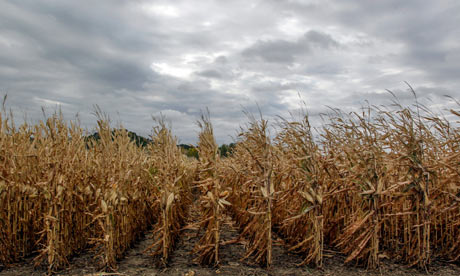
    Unharvested corn stands south of Council Bluffs, Iowa. America’s worst drought in decades is showing no sign of letting up in several key mid-west farming states. Photograph: Nati Harnik/AP

    World wheat stocks will drop by 13% next year and US and corn stocks will also be lower than expected until well into 2013, the US government predicted on Thursday, prior to farm ministers from across the globe meeting to discuss high food prices.

    It was the second time in two weeks that the US agriculture department (USDA) delivered low estimates of crop stocks to the markets. This time, the USDA said unrelenting demand would drag down US corn and soybean stocks to the lowest levels in years – 17 years for corn and eight for soybeans.

    Agriculture ministers are due to meet next week in Rome amid renewed fears of a crisis in food supplies exacerbated by the worst US drought in more than 50 years, and drought in Australia, the world’s leading wheat exporter.

    On the US markets, corn futures soared 5% on the USDA’s forecasts, hitting a three-week high. Wheat futures were up 2% near the close of the trading day in Chicago and soybeans were up 1.6%. While at high levels, corn is about 10% lower and soybeans 15% lower than the records set during the summer.

    The USDA’s estimates of the US corn and soybean crops were slightly larger than traders had expected, although the smallest in recent years. Corn is the most widely grown crop in the United States, followed by soybeans. Both are raw ingredients in processed foods, fed to livestock and converted to motor fuel. Livestock feeders say they are being ruined by high corn prices and so the US government should relax a requirement to mix corn ethanol into gasoline.

    With US corn production down for the third year in a row, usage will be tightened tremendously. Exports are forecast at 1.15bn bushels in 2012-13, the smallest in 37 years. Five years ago, the figure stood at 2.4bn bushels. Meanwhile, corn imports are forecasted to be 75m bushels, three times larger than average. The USDA also cut its estimate of the European Union corn crop by 2.6%.

    Drought will reduce Australia’s wheat crop to 23m tonnes, down 12% from a month ago, the USDA said. Harsh weather, including summer droughts and early frosts, cut an additional 3% from Russia’s wheat crop, it said.

    The USDA added that while global wheat stocks would be down 13% next year, world soybean inventories would be up, boosted by huge crops in Brazil and Argentina, which would offset the crash is US