There is no current policy to export brown coal in Victoria, because of it’s high flammability and water content.
Exergen, the company proposing the export deal, has developed new technology to make brown coal safer to transport.
There is no current policy to export brown coal in Victoria, because of it’s high flammability and water content.
Exergen, the company proposing the export deal, has developed new technology to make brown coal safer to transport.
The UK’s first “island” micro grid system is up and running at the Centre for Alternative Technology (CAT) in Wales.
It will allow the centre to use the power it generates itself instead of relying on national grid supplies and help them reduce their carbon footprint.
Centralised electricity systems like the national grid waste around 65% of energy through heat loss in power stations and transmission lines before reaching our homes.
Previously, any power generated by the centre’s wind turbines or solar panels was exported to the national grid. Now the power will be used around the Centre, with only the excess exported to the national grid.
“Even if you’ve got a wind turbine on the roof, if the grid goes down you’re in the dark like everyone else,” said Alex Randall from CAT.
“We can be on or off grid whenever we like now. At quiet times, our island grid sends any excess to the national grid and at peak times it imports any extra required,” said Randall.
• This article appeared on the Ecologist, part of the Guardian Environment Network
The find was first announced by visiting Venezuelan President Hugo Chavez in an interview with the newspaper El Pais. He divulged its existence during a walkabout in Madrid, while visiting a bookstore. Repsol chairman Antonio Brufau was with him at the time.
Chavez gave the figure on the gas volume and Elices confirmed it to the AP.
For comparison, 7 to 8 trillion cubic feet is roughly five times the natural gas that Spain consumes in a year, said another Repsol spokesman, Kristian Rix.
The gas was found in an exploration block called Rafael Urdaneta. Repsol began work there in 2006 along with the state-owned Venezuelan company PDVSA.
Rix said it is not known when the company will start pumping the gas, but in cases like these, that normally takes two to four years.
‘At the rate the certified scientific discoveries are going, Venezuela’s gas reserves will place it among the top five in the world,’ the newspaper quoted Chavez as saying.
Rix said this is Repsol’s biggest natural gas find ever.
From Our World, part of the Guardian Environment Network
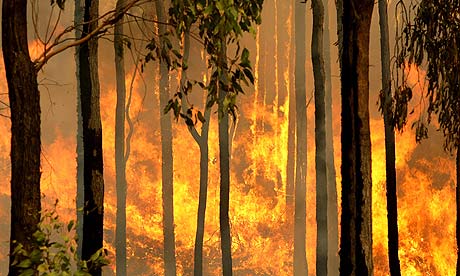
A bushfire burns in Australia in February 2009. Photograph: Torsten Blackwood/AFP/Getty Images
Fire has been used by Bininj (Aboriginal) people for managing habitats and food resources across northern Australian over millennia. The secret of fire in our traditional knowledge is that it is a thing that brings the land alive again. So we don’t necessarily see fire as bad and destructive — it can be a good thing.
Unfortunately, today fire is not being well looked after in many places in Northern Australia. However, it continues to be managed well around the outstations where people live all the time, such as at Kabulwarnamyo, where I live. To go forward, we need to encourage our children in the ways of the past. Fire must be managed and people must be living on their country (tribal land) to manage that fire.
As a Bininj man from Nangark of the Gurrguni clan, I hold much knowledge regarding my people’s traditional use of fire and have a great responsibility to ensure that this knowledge is passed down to younger generations, and more importantly, that this knowledge is still used and practised into the future to keep our country alive and healthy.
Bininj perspective on climate change
Bininj people have experienced very dramatic climate changes that have been happening since long before Balanda (white people) settled in our country. In our beliefs, our ancestors have been here from the beginning, when the earth was still soft and when some animals were like people before they became the animals we know today.
Our old people used to tell us dreamtime stories that happened a long time ago; stories about animals, birds and reptiles, and how they’ve gone through those processes of change.
When our ancestors saw changes happening, they started to adapt to the changes by looking out for solutions of how to live and survive. They were hunters and gatherers that looked for food and good places to live and enjoy a new kind of life in changed circumstance. When walking about, they would cover the whole area as part of their role as land managers — looking after our country according to our traditional land management practices.
Our people have lived through periods of great change. Knowledge of what they’ve experienced through those changes has been passed down from one generation to another.
The Great Drought
One story that is still talked about by our old people concerns a great drought. Balanda have their bible story about a great flood, but we have a story about a great drought.
When springs and rivers dried up, the first people, or Nayiyunki, were desperately walking around looking for water when they came across a paper bark tree that had a hump like a camel’s, with drinkable water in it.
So they used their stone axes to crack the humped side of the paper bark tree and out came the water to save their lives. We call the hump and the water that comes from it Djidjindok. Nayiyunki lived on that drinking water from the tree for long periods until water came back in springs and creeks.
We don’t know exactly when this happened, but we do know that Balanda (white) scientists are able to tell us that this part of Australia went through very dry periods between about 35,000 and 18,000 years ago.
Sea level rise
Another story our people talk about is how Northern Australia was attached to Papua New Guinea. It was one big land and the Nayiyunki (first people) walked around managing the whole landscape, looking for better hunting places or lakes stocked full of fish.
There are stories from Maningrida, now on the edge of the Arafura Sea that separates us from Papua New Guinea. Just off from Maningrida township is Entrance Island. It lies about 3 kms from the nearest land, at Ndjudda Point.
Our people remember when the Island was connected to the mainland. In the middle, was a big billabong — a big wetland area full of fish and geese, water chestnuts and water lilies, and other game for hunting. It was a very well known wetland place for our past generations and today people still talk about this lost wetland. When the sea level rose, all that wetland went under the seawater.
At Goulburn Island, the people there still have more stories about these times — stories about islands where people used to live that are there no longer.
Human made climate change
So we have been experiencing climate changes for long-long periods up until today’s generations. But the climate changes previously experienced were brought on by nature. They were not climate changes brought on by people, like in the situation we face today.
Nayiyunki, our first people, watched the way nature worked. They looked at how things changed at the yearly scale and named six seasonal movements for the calender — Bangerreng, Yekke, Wurrkeng, Gurrung, Gunumeleng and Gujewek.
These are the six calendar cycles of movement for our hunting and gathering purposes. People knew when the seasons changed by seeing the signs and signals in nature that marked those changes. We see changes in winds and clouds and rain; we read the changing seasons through the flowering of plants and grasses; we read the movement of birds and other animals.
These seasonal calendars have been built up over thousands of years, but now our old people and even middle-aged people like me are seeing that the seasons start to look wrong. We see that things are not really happening when they should be.
Our old people are confused. They don’t know what’s happening. These are the signals that tell us when we should be burning grass or when we can find the food we want. Scientists tell us the monsoon stopped for more than 10,000 years a long time ago. What would our world be like if we didn’t have the monsoon to give a regular annual cycle for growing, drying and burning grasses. What would tropical Australia be like if it had years of drought, like down south? It’s a scary thought.
People move around to observe signs of what things are there and what things aren’t there. If things aren’t there then people know that something is going wrong somewhere.
When changes happened before, the Nayiyunki knew the country very well through their observations. They would talk to spiritual beings and ask for their help and to show them in their dream, so that they could be ready for unexpected events.
Nayiyunki were able to deal very well with the changes in their time because these were changes made by mother nature. These were natural climatic changes that happened from the first generation. But the changes we are looking at today are not natural changes — they are caused by human behaviour. People, not nature, are responsible.
Our challenge, our contribution
Our present generation, we hear media news about global warming. Changes are happening and everybody around the world is running around madly trying to figure out a way to tackle the problems.
Though for us, the Bininj people, climate change is not new topic, since we have the stories about the changes that happened many-many years ago before our generation, we are very worried about what is affecting us today. Like sometimes we see that the wet season comes in at the wrong time.
In recent years we have experienced strong cyclones — Cyclone Monica set a new mark for violent storms and we had unexpected floods hitting our communities. Sometime we hear our old people saying these things are happening because our sacred objects are not happy with us because of disturbances to the sacred land. Dynamite and mining, big machines and roads, these are all things that worry our people.
Within Northern Australia our country has changed in a big way ever since I was born. These are the most visible symptoms that I see:
(1) the human population has tripled since I was child;
(2) our people have been losing our language and culture;
(3) feral weeds and animals are entering our community;
(4) establishment of towns and settlement;
(5) mining happening in our country; and
(6) changing weather, and more.
Feral animals and weeds are changing our natural environment. Large animals like buffaloes are damaging our landscape and weeds are already within our communities and our home-lands.
Traditional fire management has changed in a big way. Traditional practices, like travelling on foot, are not happening these days like they used to. People have changed in many ways because of the contemporary forces from outside.
We all, Balanda and Bininj, have to look at what we can do to fix the damage that is being done to the climate by greenhouse gases and so on.
Out there at Kabulwarnamyo, we are tackling climate change by bringing back and strengthening our traditional burning, the tools that we have used for thousands of years for managing our landscape.
By bringing back our way of land management and making it strong for the future, we are doing our bit to help the world deal with climate change.
• Dean Yibarbuk is Secretary of Warddeken Land Management Limited
The EPA said it had continuing concerns about toxic debris from the mine sites, and the loss of hundreds of miles of streams, which were choked off by the rubble.
“The administration pledged earlier this year to improve review of mining projects that risked harming water quality. Release of this preliminary list is the first step in a process to assure that the environmental concerns raised by the 79 permit applications are addressed and that permits issued are protective of water quality and affected ecosystems,” the EPA administrator, Lisa Jackson, said in a statement.
The decision was welcomed by some environmental organisations as a key break by the Obama administration with the policies set by George Bush.
Appalachian Voices, a local activist coalition, said in a statement:
“By recommending these permits not be approved, the EPA and the Army Corps has demonstrated their intention to fulfill a promise to provide science-based oversight which will limit the devastating environmental impacts of mountaintop removal mining.”
But environmental organisations are still pressing the Obama administration for an outright ban on mountaintop removal, which environmentalists say is the most destructive method of extracting coal.
Bush-era regulations had made it far easier for mining companies to win approval for mountaintop removal and to avoid regulatory control. The EPA, in Bush’s eight-year term, did not oppose a single permit for mountaintop removal.
Jackson, in a recent interview, admitted the agency had grown “toothless”.
The Obama administration signalled last June that it would take a tougher approach to enforcement. Earlier this week, the agency said it would halt West Virginia’s biggest mining project, spread over 2,300 acres, because of concerns over dumping debris.
The agency now has two weeks to issue its final decision on the pending permits. Projects that do meet EPA environmental standards will move ahead.
The protocol explicitly aimed at phasing out substances such as chlorofluorocarbons (CFCs) – found in products such as refrigerators, foams and hairsprays – in order to repair the thin, gassy shield that filters out the sun’s harmful ultraviolet rays. By 2010, close to 100 ozone-depleting substances, including CFCs, will have been phased out globally.
Without the decisions taken 20 years ago, atmospheric levels of ozone-depleting substances would have increased tenfold by 2050. This could have led to up to 20m additional cases of skin cancer and 130m more cases of eye cataracts, not to speak of damage to human immune systems, wildlife and agriculture.
But this is only part of the story that we celebrate on the international day for the preservation of the ozone layer (16 September). Over the past two years, it has been established that the Montreal protocol has also spared humanity a significant level of climate change, because the gases it prohibits also contribute to global warming.
Indeed, a study in 2007 calculated the climate mitigation benefits of the ozone treaty as totalling the equivalent of 135bn tonnes of C02 since 1990, or a delay in global warming of seven-12 years.
So the lessons learned from the Montreal protocol may have wider significance. Scientists now estimate that somewhere close to 50% of climate change is being caused by gases and pollutants other than C02, including nitrogen compounds, low-level ozone formed by pollution, and black carbon. Of course, a degree of scientific uncertainty remains about some of these pollutants’ precise contribution to warming. But they certainly play a significant role.
Meanwhile, many of these gases need to be curbed because of their wider environmental impact on public health, agriculture and the planet’s ecosystems, including forests.
Consider black carbon. A component of the soot emissions from diesel engines and the inefficient burning of biomass cooking stoves, it is linked to 1.6m-1.8 million premature deaths annually as a result of indoor exposure and 800,000 from outdoor exposure. Black carbon, which absorbs heat from the sun, also accounts for anywhere from 10% to 45% of the contribution to global warming, and is linked to accelerated losses of glaciers in Asia, because the soot deposits darken ice and make it more vulnerable to melting.
One study estimates 26% of black carbon emissions come from stoves for heating and cooking, with more than 40% of this amount from wood burning, roughly 20% from coal, 19% from crop residues and 10% from dung.
Some companies have developed stoves that use passive air flows, better insulation and 60% less wood to reduce black carbon emissions by around 70%. Mass introduction of such stoves could deliver multiple green-economy benefits.
While CO2 can remain in the atmosphere for centuries, other pollutants, including black carbon and ozone, remain for relatively short periods – days, weeks, months or years – so that reducing or ending emissions promises almost immediate climate benefits.
The international community’s overarching concern must be to seal a serious and significant deal at the UN climate summit in Copenhagen in December to curtail CO2 emissions and assist vulnerable countries to adapt. If the world also is to deploy all available means to combat climate change, emissions of all the substances that contribute to it must be scientifically evaluated and urgently addressed.
• Achim Steiner is UN under-secretary general and executive director of the UN Environment Program.
Copyright: Project Syndicate, 2009