Author: admin

  • Is the clean energy cashback tariff high enough to stimulate investment ?


    1. Is the clean energy cashback tariff high enough to stimulate investment?


    After months of deliberation, the UK government has announced a range of illustrative figures for feed-in tariffs. From Carbon Commentary, part of the Guardian Environment Network


    After months of deliberation, the UK government has announced a range of illustrative figures for feed-in tariffs (FITs), which it’s calling a Clean Energy Cashback scheme. FITs are fixed payments made to the owners of small generating stations for the electricity that they export to the grid. Micro-generators need high payments to justify their expensive investment in buying and installing green generation.


    The proposed levels of FIT vary by the type of technology. The principal ones covered are biomass combustion (burning wood to generate electric power), hydro, solar photovoltaics, and wind turbines. Of these, the most appealing are likely to be wind and PV. If my estimates in the following paragraphs are correct, the government’s proposal for payments to rooftop PV are too low to generate much new investment. On the other hand, the payments for rural wind are good enough to make decent returns. If the figures survive unchanged through (yet another) consultation process, we should see thousands of small wind turbines in windy British fields.


    Solar
    The proposal is for a FIT of 36.5 pence per kilowatt hour for a domestic rooftop system for installations in financial year 2010/2011. A typical UK installation is about ‘2 kilowatts peak’, a figure for the maximum output in the middle of the day in mid-summer. Such an installation will generate about 1,800 kilowatt hours (kWh) a year in a sunny location in Devon or Cornwall on a south-facing roof. No more than half this electricity would be fed into the grid, the rest would be used in the home. In this case, the revenues are approximately as follows:


    2 kilowatt peak installation in the English south-west:


    Output

    1800 kWh
    Export 900 kWh
    FIT 36.5p per kWh
    Total value 328.5
    Used in the home 900 kWh
    Saving in electricity bill 13p per kWh
    Total value 117
    Total value of installation 445.5

    The cost of such an installation today would be about £10,000, meaning a running return of about 4.5%. A PV installation is likely to last 25 years or more, so the installation pays back its cost, but with only a little to spare. In the north of England, the figures would be even less good. PV is nice, but it isn’t a money-spinner. To attract large-scale investment, the FIT might have had to be 50p or more.


    Wind is better
    A 15 kW turbine at the end of a large rural garden or on a village green would cost about £50,000 (source: Proven Turbines: £41,000 for the turbine and my estimate of £9,000 for installation and grid connection). This machine would generate perhaps 25,000 kilowatt hours on a windy and exposed site with minimal turbulence created by trees. All this would get pumped into the grid. (This is good – you get more cash from exporting the electricity than you would save by using it yourself.)


    15 kilowatt wind turbine in a good location:


    Output

    25,000 kWh
    Export 25,000 kWh
    FIT 23p per kWh
    Total value 5750
    Less: yearly maintenance cost (estimate) 750
    Total value of installation 5000

    If these estimates are correct, the return on a 15 kilowatt turbine would be 10% p.a. A machine should last twenty years or more. It isn’t a return that would excite Goldman Sachs, but it isn’t bad. Go for a wind turbine, not for the more glamorous solar panels.


  • The challenge for green energy: how to store excess electricity

    The challenge for green energy: how to store excess electricity


    For years, the stumbling block for renewable energy has been how to store electricity for days when the sun isn’t shining and the wind isn’t blowing. But new technologies suggest this goal may be within reach, writes Jon R Luoma from Yale Environment 360, part of the Guardian Environment Network


    “Why are we ignoring things we know? We know that the sun doesn’t always shine and that the wind doesn’t always blow.” So wrote former U.S. Energy Secretary James Schlesinger and Robert L. Hirsch last spring in the Washington Post, suggesting that because these key renewables produce power only intermittently, “solar and wind will probably only provide a modest percentage of future U.S. power.”


    Never mind that Schlesinger failed to disclose that he sits on the board of directors of Peabody Energy, the world’s largest private-sector coal company — a business with much to lose if a solar- and wind-powered future arrives. But at least he and his co-author got it partly right. The benefits from wind and solar are mostly intermittent — so far. But the pair somehow missed the fact that a furious search for practical, affordable electricity storage to beat that intermittence problem is well underway.


    For decades, “grid parity” has been the Holy Grail for alternative energy. The rap from critics was that technologies like wind and solar could not compete, dollar-for-dollar, with conventional electricity sources, such as coal and nuclear, without large government tax breaks or direct subsidies. But suddenly, with rapid technological advances and growing economies of manufacturing scale, wind power is now nearly at grid parity — meaning it costs roughly the same to generate electricity from wind as it does from coal. And the days when solar power attains grid parity may be only a half-decade away.


    So with grid parity now looming, finding ways to store millions of watts of excess electricity for times when the wind doesn’t blow and the sun doesn’t shine is the new Holy Grail. And there are signs that this goal — the day when large-scale energy storage becomes practical and cost-effective — might be within reach, as well. Some technologies that can store sizeable amounts of intermittent power are already deployed. Others, including at least a few with great promise, lie somewhere over the technological horizon.


    New storage approaches include improvements to existing lithium ionbatteries and schemes to store energy as huge volumes of compressed air in vast geologic vaults. Another idea is to create a network of small, energy-dense batteries in tens of millions of homes. Under such a “distributed storage” scheme, utility computers could coordinate electricity flows over a “smart grid” that continually communicates with — and adjusts the flow of power to and from — local batteries. This would even include batteries in future plug-in hybrid or all-electric vehicles.


    And one 2008 breakthrough could even fulfill chemists’ long-held dreams of producing a squeaky-clean and storable fuel by using excess electricity generated from renewable sources to cheaply produce hydrogen, which could then be used in fuel cells to power homes and cars.


    In a world run mainly on fossil fuels, finding ways to store electricity was not a pressing concern: Power plants across a regional electrical grid could simply burn more fuel when demand was high. But large-scale electricity storage promises be an energy game-changer, unshackling alternative energy from the constraints of intermittence. It would mean that if a wind or solar farm were the cheapest and cleanest way to generate power, it wouldn’t matter when the sun shone or the wind blew.
    One storage approach seems obvious: to improve battery technologies. Picture efficient, enormous batteries that can store tens of millions of
    watt-hours of juice. Today, the vast majority of new rooftop solar photovoltaic panels are connected to the grid, using it as a giant battery, pushing excess power onto the grid when solar panels provide excess power. The building then draws power from the grid when the sun doesn’t shine, with its meter spinning backward and forward with the ebb and flow of power. With relatively few solar roofs yet in play, utilities manage any ebb and flow by drawing down and ramping up generation at conventional power plants designed to balance fluctuating supply and demand.
    A more robust world of solar and wind power might be better served by some sort of giant battery — or, more likely, many of them, widely distributed. The basic concept has been proven. Since 2003, the world’s largest battery backup has been storing energy for an entire city: Fairbanks, Alaska. Isolated as it is, and not part of any regional electricity grid, the metropolitan area of about 100,000 residents needs an electricity backstop more than most: In its sub-zero winters, pipes can freeze solid in as little as two hours. Six years ago, the city installed a huge nickel-cadmium battery, the same technology used for years in laptop computers and other portable devices.


    Housed in a giant warehouse, the 1,300-metric ton battery is larger than a football field, and can crank out 40 million watts of power. Still, the Fairbanks battery provides only enough electricity for about 12,000 residents for seven minutes. That was enough to prevent 81 blackouts in the city in the battery’s first two years of operation.


    Yet effective storage of electricity from solar or wind arrays that generate power equivalent to one large coal plant implies batteries on a breathtaking scale — hundreds of units the size of the Fairbanks array.


    One possible answer? In Japan, so-called “flow” batteries have been used for years to store backup power at industrial plants. Conventional batteries store energy in chemical form.With flow batteries, charged chemicals are pumped into storage tanks, allowing still more chemical to be charged and pumped away, then pumped back into the active portion of the battery and drawn down as needed. One big advantage: Battery “size” can be expanded by simply adding more chemicals and more storage tanks. In 2003, the local utility on small King Island, off the coast of Australia, installed a large flow battery to sop up and later release excess power from a wind farm.
    As with the alternative generation technologies, cost will be key for determining which battery or other storage technologies might prevail. Aside from such typical economic concerns as raw material and maintenance costs and durability, storage technologies all face some losses in “round-trip efficiency.” Inevitably, some energy is lost as it goes into storage, and more is lost as it comes out.


    Right now, hopes are riding high on lithium ion batteries, because they have impressive round-trip efficiencies, can pack in high densities of energy, and can charge and discharge thousands of times before becoming degraded. Because of those attributes, lithium-ion battery technology has become increasingly dominant in laptop computers and cell phones. On a far larger scale, a powerful lithium ion battery pack powers the pricey all-electric Tesla Roadster, and is slated to power the plug-in hybrid Chevy Volt next year.


    On the grid, lithium ion experiments are already underway. One company, General Electric-backed A123 Systems, announced late in 2008 that it had been contracted to install a two-megawatt lithium ion storage unit at a California power plant owned by global utility giant AES.


    Still, lithium ion remains a relatively expensive technology — 10 times more expensive than lead acid batteries with equivalent capacity. Technological improvements and manufacturing scale should bring lithium costs down over time, but by the time that happens, the world could be beating a path to the door of someone who’s found a way to build an even better battery.


    Early this year, IBM revealed that it was launching a major research program into what looks like an even more promising technology — the lithium metal-air battery. Last month, a company called PolyPlus announced that it had already succeeded in developing one.


    The PolyPlus battery and the IBM technology deliver an astonishing 10 times more energy density than even today’s best lithium ion technology. That means that, pound for pound, they offer about the energy density of gasoline. The key reason they can store so much energy is that they use oxygen, drawn from the air, in place of some of the chemical reactants used along with lithium in their lithium ion cousins.
    There’s one big rub: Air isn’t just oxygen. Notably, it also contains humidity, and the lithium has a bad habit of acting like ignited gasoline when exposed to moisture, creating a real risk of fire and explosion. Chandrasekhar Narayan, manager of science and technology at IBM’s Almaden Research Center near San Jose, Calif., has suggested that it will take five to 10 years to develop an effective membrane that will let oxygen into the battery while keeping moisture out.


    Still in pie-in-sky mode, there’s “vehicle to grid” storage, or “carbitrage.” This enticing notion relies on idled storage in the batteries of the millions of plug-in hybrid or all-electric automobiles that will be in use in the future. There’s reason to believe this scheme could work. More than 90 percent of the time cars sit idled, and aside from days they’re used for long trips, most of their full energy storage capacity goes unused.


    A single idle, electric-powered car could generate as much as 10 kilowatts of power, enough to meet the average demand of 10 houses, according to Willett Kempton, director of the Center for Carbon-free Power Integration at the University of Delaware. With vehicle-to-grid technology, controlled by an array of smart meters, car owners plugged in at home or work could allow the grid to draw off unused chunks of power at times when short-term demand is high. Conversely, cars could be recharged when demand is low.


    The stored power in those electric cars, or anywhere on the grid, might not come from batteries after all. In March, Texas-based EEStor announced that it had received third-party verification of its “ultracapacitor” technology. The company claims the lightweight device, which was awarded a U.S. patent last December, can bottle up huge amounts of electricity far more quickly than any battery and can do so at lower cost.


    Like batteries, capacitors store and mete out electricity. Small conventional capacitors have been ubiquitous in electronic devices as far back as the early days of radio. But capacitors, so far, haven’t been able to store electricity for long enough to come close to competing with batteries. They have found use as devices that level out fluctuations in voltage or that briefly store power for near-instant release.


    EEStor claims that its device, which is one-quarter the weight of a similar
    lithium ion battery, can hold a large charge for days. Its patent describes a 281-pound device that would hold almost the same charge as a half-ton lithium ion battery pack installed on the Tesla Roadster. The company’s ultracapacitors have yet to prove themselves in commercial products. But industrial giant Lockheed Martin has already signed up with EEStor to use future ultra capacitors in defense applications, and Toronto-based Zenn Motors, which has also taken an ownership stake in EEStor, says it will have electric cars on the road using the technology in 2010.
    If advanced batteries or ultracapacitors aren’t the ultimate answer, maybe using excess electricity to make hydrogen that can be stored will do the trick. Hydrogen can be produced through simple electrolysis, but technical and cost hurdles have made electrolysis impractical. Today, industrial-scale hydrogen is produced using natural gas as a not-so-clean feedstock.


    But that may have begun to change last summer when MIT announced that a team lead by chemist Daniel Nocera had made a “major discovery” that employs a new kind of catalyst using cobalt and phosphate — abundant and non-toxic materials — to kick-start electrolysis.


    Outside observers say the process could be revolutionary: opening up the possibility that electricity made at any time by the sun or wind could be stored by simply splitting (and later recombining) abundant water molecules, perhaps even undrinkable sea water. The breakthrough has been hailed by scientist British scientist James Barber of Imperial College London as having “enormous implications for the future prosperity of humankind.” The website Xconomy reported in April that Nocera had quietly formed a startup company called Sun Catalytics. Efforts to reach Nocera for comment were unsuccessful.


    And there is progress being made on an entirely different front — using excess electricity to pump compressed air into caverns, salt domes, and old natural gas wells, and then releasing the air to help state-of-the-art natural gas power plants spin turbines, lowering the amount of fuel consumed by as much as 70 percent. A consortium of utilities in Iowa, Minnesota, and the Dakotas is already working with the U.S.’s Sandia National Laboratories to develop a giant, 268-megawatt compressed air system. Called the Iowa Stored Energy Park, it would store excess energy from the region’s burgeoning wind industry.


    • This article was shared by our content partner Yale Environment 360, part of the Guardian Environment Network
  • South west of England to become world centre for wave and tidal energy

    South west of England to become world centre for wave and tidal energy


    Business secretary Lord Mandelson names Cornwall as the UK’s first low carbon economic area with pioneering Wave Hub project


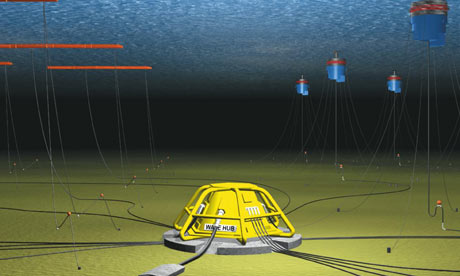
    Wave Hub

    The Wave Hub socket, part of the pioneering wave power project off the coast of Cornwall Photograph: Public Domain


    The south west of England will become a world centre for wave and tidal energy under plans published by the government today.


    Business secretary Lord Mandelson named the region as the UK’s first low carbon economic area at the launch of the low carbon industrial strategy.


    The government also announced an investment of £9.5m for the pioneering Wave Hub project, which will see a giant national grid-connected “socket” built on the seabed off the coast of Cornwall.


    The project, which will become the world’s largest wave farm, also received the official go-ahead today from the South West Regional Development Agency (RDA) and could create more than 1,800 jobs.


    Stephen Peacock, enterprise and innovation executive director of the South West RDA, said: “Being identified as the UK’s first low carbon economic area is a tremendous accolade and recognition of our commitment to develop this unprecedented economic opportunity.


    “We want to forge a new industry from the seas around our shores and today’s announcements cement our position as a global leader in wave and tidal technologies.


    “We also welcome the low carbon industrial strategy which sets out a range of opportunities to ensure that we take advantage of a global market for low carbon products and services that could be worth £4.3 trillion by 2015.”


    A further £10mm has been made available for the South West RDA to support other marine energy projects in the region.


    The European Regional Development Fund Convergence Programme also announced it would invest £20m in Wave Hub, which will be commissioned next summer.


    The first equipment orders for the project were placed this week.


    The combined government, RDA, European and private sector funding in the south west’s marine energy programme in the next two years is expected to exceed £100m.Today’s announcements form part of the government’s low carbon industrial strategy including a white paper on the low carbon transition plan as well as the UK’s renewable energy strategy, the low carbon industrial strategy and carbon reduction strategy for transport.

  • A Rising Tide for Water Power Funding?

    July 10, 2009

    A Rising Tide for Water Power Funding?


    by Justin Moresco, Contributor

    California, United States [RenewableEnergyWorld.com]

    Power generated from the movement of water has enormous potential for growth in the United States, but funding for the renewable energy source lags behind other technologies like solar and wind. Institutional investors have been hesitant to enter the market, and while the U.S. Department of Energy has increased its budget for water power, industry experts say more funding is needed, particularly for emerging technologies.


    “I think part of the lack of funding is tied to the regulatory issue…If you want to put [renewable energy] megawatts online, you see that you can put money into wind or solar with a simpler regulatory environment.”

    — Mike Bahleda, Consultant


    Consider the DOE’s budget for its water-power program, whose mission is to research, test and develop innovative technologies for generating electricity from water. The good news for the industry is that funding quadrupled this year, from about US $10 million last year to $40 million this year. But advocates of more water-power funding are quick to point out that the program was allocated no money in 2006 and 2007 and that it took a concerted lobbying effort to have it restored last year.


    But even with the funding increase this year, the budget for the DOE’s water power program still pales in comparison to other sources of renewable energy. The department has allocated $175 million this year for solar energy technologies, $55 million for wind technologies, and $169 million for fuel cell technologies.


    “Considering that just a few years ago the federal government provided no funding for hydropower R&D,” said Kristen Nelson, a spokeswoman for the trade group National Hydropower Association, “this [funding] will at least start us on the road toward meeting the Obama administrations goal of doubling renewable energy resources.”


    Part of the new budget is planned to support ocean-based power, such as technologies that harness energy from tides and waves. The department said its priority is to reduce barriers to the development and deployment of these technologies and projects, including research and development funding for components and devices and more accurate ways to assess water-power potential. Money will also go toward environmental studies and what the department calls integrated national marine renewable energy centers.


    DOE funding last year, for example, went toward a demonstration ocean wave power system developed by White River Junction, Vt.-based Concepts ETI and the expansion of national marine energy centers at Oregon State University, the University of Washington at Corvallis and Seattle and the University of Hawaii.


    The DOE’s budget this year also includes money for conventional hydropower, such as power plants attached to dams and pumped storage, where water is pumped from a lower reservoir to a higher reservoir to meet anticipated peaks in electricity demand. The DOE’s budget is supposed to fund efforts to assess the current state of U.S. hydroelectric infrastructure and identify opportunities for increased and more valuable generation, such as through efficiency and capacity gains at existing power stations. Some funding also may be used for placing power stations at existing non-powered dams and in constructed waterways.


    The Obama stimulus package, which has millions of dollars for renewable energy and other clean technology projects, wasn’t particularly kind to water-power either. It included $32 million specifically targeted for the industry to improve existing hydropower infrastructure, but not for emerging technologies, though there may be funding in broader-defined allocations, such as those to research institutes.


    Hydropower has great potential as a source of renewable energy. At 96,000 megawatts (MW) of installed capacity, almost all of which is from conventional plants, it’s also already the largest source of renewable energy in the country. A 2007 report by the Electric Power Research Institute, a nonprofit research organization, estimates that the country could increase hydropower capacity by 23,000 MW by 2025. The increase would come from ocean and conventional sources and from fresh water hydrokinetic technologies, like those that harness power from rivers.


    To achieve that build-out, however, three broad changes are needed, said Mike Bahleda, an independent consultant who was principal investigator for the institute’s report. They include more research and development funding, better economic incentives (water power is only given half as much as wind in federal production tax credits), and a streamlined regulatory environment (water projects are the only renewable source that need a federal approval). The study called for the DOE to allocate at least $37 million per year to water power, though the National Hydropower Association has called for $91 million starting in 2010 (the DOE will likely get $30 million in 2010 according to a tentative budget). 


    “I think part of the lack of funding is tied to the regulatory issue,” said Bahleda. “If you want to put [renewable energy] megawatts online, you see that you can put money into wind or solar with a simpler regulatory environment.” Another reason is widespread lack of appreciation of the potential for generating electricity from water, Bahleda said. 


    Of course the growth of any industry can’t fully depend on government support, and some would argue that industries shouldn’t depend on it at all, regardless of their potential. But venture capitalists, the traditional source of funding for emerging technologies, have largely resisted entering the water-power sector. Since 2002, U.S. water-power startups raised a total of $500,000 in 2004 and $2.6 million in 2008, according to Dow Jones VentureSource. That’s compared with $55 million in 2004 and $2.4 billion last year for solar startups.


    Some of the reasons include high capital costs and regulatory and technological risks, according to John Miller, director of the New England Marine Renewable Energy Center, a center within the University of Massachusetts that promotes the development of ocean-based renewable energy for New England. Miller said the industry isn’t lacking for ideas — he gets a call a week from someone looking to develop a new ocean power technology. And he says there at least a few dozen startups in the country focused on ocean power, almost all of which are backed by private money, from angel investors and the like.


    But the ocean power industry is relatively immature — there are no commercial plants in the United States, only a handful of pilot projects — and Miller believes that venture capital will start flowing once companies have proven their technologies. He forecasts that there will be commercial generation from wave and tidal plants within five years. Offshore wind is also considered ocean-based power, and that is further along, Miller said.


    Houston, TX-based Hydro Green Energy is one of the few U.S. water-power startups to have attracted venture capital — it alone accounted for the $2.6 million raised last year.


    The company has developed systems for generating power downstream from existing hydro plants and in the downstream portion of auxiliary or active navigational locks. One is a floating platform that suspends underwater hydrokinetic turbines at existing hydropower plants, and the other is a metallic lock gate with rows of underwater turbines. The lock gate systems could each generate between 5 and 50 MW of power.


    “We got venture funding because we had a strong business plan and intellectual property, and we had tested our technology,” said Mark Stover, vice president of corporate affairs. The company already has installed a platform system in Hastings, Minn., and it hopes to install its first lock gate for a separate project in Minnesota next year. By 2011, Stover said the company could be developing 10 to 15 projects a year.


    As forward thinking as venture capitalists often are, they’ve also been known to behave like pack animals. If Hydro Green Energy and a handful of other leading water-power startups can prove the economic viability of their businesses, venture capitalists might start jumping into the sector. Government funding might not change, but there’s nothing like the promise of profits to spur more investment in emerging industries.


    Justin Moresco has been writing about sustainability and green issues since 2005, first as a correspondent in West Africa for IRINnews. He now focuses mainly on emerging clean technology and is based in the San Francisco Bay Area. Before becoming a journalist, he was a licensed civil engineer.


    Image Gallery (1)


  • The rich can relax. We just need the poor world to cut emissions. By 125%

    The rich can relax. We just need the poor world to cut emissions. By 125%


    British and G8 climate strategy just doesn’t add up. As soon as serious curbs are needed it turns into impossible nonsense.


    Well, at least that clears up the mystery. Over the past year I’ve been fretting over an intractable contradiction. The government has promised spectacular cuts in greenhouse gas emissions. It is also pushing through new roads and runways, approving coal-burning power stations, bailing out car manufacturers and ditching regulations for low-carbon homes. How can these policies be reconciled?


    We will find out tomorrow, when it publishes a series of papers on carbon reduction. According to one person who has read the drafts, the new policies will include buying up to 50% of the reduction from abroad. If this is true, it means that the UK will not cut its greenhouse gases by 80% by 2050, as the government promised. It means it will cut them by 40%. Offsetting half our emissions (which means paying other countries to cut them on our behalf) makes a mockery of the government’s climate change programme.


    The figure might have changed between the draft and final documents, but let’s take it at face value for the moment, to see what happens when rich nations offload their obligations. What I am about to explain is the simple mathematical reason why any large-scale programme of offsets is unjust, contradictory and ultimately impossible.


    Last week the G8 summit adopted the UK’s two key targets : it proposed that developed countries should reduce their greenhouse gases by 80% by 2050 to prevent more than two degrees of global warming. This meant that it also adopted the UK’s key contradiction, as there is no connection between these two aims. An 80% cut is very unlikely to prevent two degrees of warming; in fact it’s not even the right measure, as I’ll explain later on. But let’s work out what happens if the other rich nations adopt both the UK’s targets and its draft approach to carbon offsets.


    Please bear with me on this: the point is an important one. There are some figures involved, but I’ll use only the most basic arithmetic, which anyone with a calculator can reproduce.


    The G8 didn’t explain what it meant by “developed countries”, but I’ll assume it was referring to the nations listed in Annex 1 of the Kyoto protocol: those that have promised to limit their greenhouse gases by 2012. (If it meant the OECD nations, the results are very similar.) To keep this simple and consistent, I’ll consider just the carbon emissions from burning fossil fuels, as listed by US Energy Information Administration. It doesn’t publish figures for Monaco and Lichtenstein, but we can forgive that. The 38 remaining Annex 1 countries produce 15bn tonnes of CO2, or 51% of global emissions. Were they to do as the UK proposes, cutting this total by 80% and offsetting half of it, they would have to buy reductions equal to 20% of the world’s total carbon production. This means that other countries would need to cut 42% of their emissions just to absorb our carbon offsets.


    But the G8 has also adopted another of the UK’s targets: a global cut of 50% by 2050. Fifty per cent of world production is 14.6bn tonnes. If the Annex 1 countries reduce their emissions by 80% (including offsets), they will trim global output by 12bn tonnes. The other countries must therefore find further cuts of 2.6bn tonnes. Added to the offsets they’ve sold, this means that their total obligation is 8.6bn tonnes, or 60% of their current emissions.


    So here’s the outcome. The rich nations, if they follow the UK’s presumed lead, will cut their carbon pollution by 40%. The poorer nations will cut their carbon pollution by 60%.


    If global justice means anything, the rich countries must make deeper cuts than the poor. We have the most to cut and can best afford to forgo opportunities for development. If nations like the UK cannot make deep reductions, no one can. We could, as I showed in my book Heat, reduce emissions by 90% without seriously damaging our quality of life. But this carries a political price. Business must be asked to write off sunk costs, people must be asked to make minor changes in the way they live. This country appears to be doing what it has done throughout colonial and postcolonial history: dumping its political problems overseas, rather than confronting them at home.


    Befuddled yet? I haven’t explained the half of it. As the G8 leaders know, a global cut of 50% offers only a faint to nonexistent chance of meeting their ultimate objective: preventing more than two degrees of warming. In its latest summary of climate science, published in 2007, the Intergovernmental Panel on Climate Change suggested that a high chance of preventing more than two degrees of warming requires a global cut of 85% by 2050. In drafting the climate change act, the UK government promised to keep matching the target to the science. It has already raised its cut from 60% to 80% by 2050. If it sticks to its promise it will have to raise it again.


    Global average CO2 emissions are 4.48 tonnes per person per year. Cutting the world total by 85% means reducing this to 0.67 tonnes. Average per capita output in the 38 Annex 1 countries is 10 tonnes; to hit this target they must cut their emissions by 93.3% by 2050. If the rich persist in offsetting 50% of this cut, the poorer countries would have to reduce their emissions by 7bn tonnes to absorb our offsets. To meet a global average of 0.67 tonnes, they would also need to chop their own output by a further 10.8bn tonnes. This means a total cut of 17.8bn tonnes, or 125% of their current emissions. I hope you have spotted the flaw.


    In fact, even the IPCC’s proposal has been superseded. Two recent papers in Nature show that the measure that counts is not the proportion of current emissions produced on a certain date, but the total amount of greenhouse gases we release. An 85% cut by 2050 could produce completely different outcomes. If most of the cut took place at the beginning of the period, our cumulative emissions would be quite low. If, as the US Waxman- Markey bill proposes, it takes place towards the end, they would be much higher. To deliver a high chance of preventing two degrees of warming, we would need to cut global emissions by something like 10% by the end of next year and 25% by 2012. This is a challenge no government is yet prepared to accept.


    Carbon offsetting makes sense if you are seeking a global cut of 5% between now and for ever. It is the cheapest and quickest way of achieving an insignificant reduction. But as soon as you seek substantial cuts, it becomes an unfair, impossible nonsense, the equivalent of pulling yourself off the ground by your whiskers. Yes, let us help poorer nations to reduce deforestation and clean up pollution. But let us not pretend that it lets us off the hook.


  • Most Americans don’t believe humans responsible for climate change, study finds

    Most Americans don’t believe humans responsible for climate change, study finds


    In contrast, scientists overwhelmingly believe global warming is caused by human activity


    Earth

    Planet Earth. Photograph: Blue Line Pictures/Getty Images


    Barack Obama’s sense of urgency in getting Congress and the international community to act on climate change does not appear to have rubbed off on the average American, a new study published today reveals.


    Even as the president pressed the G8 and the world’s major polluters to resist cynicism and the pressure of the economic recession to act against global warming, a majority of Americans remain unconvinced that humans are responsible for climate change, or that there is an urgent need to act.


    About 49% of Americans believe the Earth is getting warmer because of the burning of fossil fuels and other human activity, the survey by the Pew Research Centre and the American Association for the Advancement of Science said. Some 36% attributed global warming to natural changes in the atmosphere and another 10% said there was no clear evidence that the earth was indeed undergoing climate change.


    Scientists in contrast are overwhelmingly persuaded that global warming is caused by humans – some 84% blame human activity. A strong majority – some 70% – also believe it is a very serious problem. Despite that degree of consensus, some 35% of Americans continues to believe – wrongly it turns out – that climate change remains a matter of scientific controversy. Only about 47% of the public views climate change as a very serious problem, a finding that has remained stable over the years, the survey said. In other public opinion polls over the years, climate change has ranked near the bottom of the list of pressing problems.


    The Pew poll, like others in the past, also found attitudes towards climate change breaking down according to political allegiance. Some 67% of Republicans either deny the existence of climate change or attribute the phenomenon to natural causes. In contrast, 64% of Democrats believe that the earth is getting warmer because of human activity.