Author: admin

  • California fires up laser fusion machine


    The building, which has taken almost 15 years to build and commission, is due to be opened in a ceremony attended by the US energy secretary, Steven Chu, and the California governor, Arnold Schwarzenegger, who has said the facility could “revolutionise our energy future”.

    “If they’re successful, it will be a very big deal. No one has achieved a net gain in energy before,” said Derek Stork, assistant technical director at the UK United Kingdom Atomic Energy Authority (UKAEA)’s centre for fusion research in Culham, Oxfordshire.

    Inside the building, scientists will use the world’s most powerful laser to create 192 separate beams of light that will be directed at a bead of frozen hydrogen in a violent burst lasting five billionths of a second. Each fuel pellet measures just two millimetres across but costs around $40,000, because they must be perfectly spherical to ensure they collapse properly when the laser light strikes.

    The intense beams produce a powerful shockwave that crunches the fuel pellet at a million miles an hour, generating temperatures of around 100,000,000C. Under such extreme conditions, which are found only in the core of stars, the hydrogen atoms will fuse, producing helium and vast amounts of energy.

    The facility will gradually work up to full power over the next 12 months or so, but experiments are scheduled to run until around 2040.

    If the NIF succeeds, politicians will be under pressure to invest in the technology to develop a first generation of demonstration plants to feed fusion energy into electricity grids.

    Plans for a laser fusion plant have been drawn up at UKAEA in Culham. The Hiper project would use two lasers to produce power from seawater and lithium, an abundant element.

    “When this works, it will immediately change the future energy map for the world. One cubic kilometre of sea water has the fusion energy equivalent of whole world’s oil reserves,” said John Parris at the Hiper project. That would overturn concerns over energy security caused by vast amounts of the globe’s oil been locked up beneath a small number of nations.

    The NIF facility must overcome major technical hurdles before scientists can start celebrating. The laser at the heart of the facility can only fire a handful of times a day. In between each shot, the hydrogen fuel pellet needs to be replaced. Over the coming years, scientists want to see improvements that allow the facility to run continuously. That could mean firing the laser 10 times a second, at fuel pellets that are shot mid air as they are dropped into the fusion chamber.
  • Hot tub Technology

    Dr Barrett says the heaters could be switched on and off rapidly to compensate for the erratic output of wind turbines and solar panels, each heater controlled by a gadget that responds to signals sent through the electricity grid – a system used since the second world war. “Everybody is always looking for a shiny new silver-bullet solution” says Dr Barrett, “but this idea is cheap, safe, and based on technology that’s been around for decades”.

    Tea-time troubles

    Renewables are a problem for the grid, as currently configured, because supply has to match unfettered demand minute-by-minute. In Britain power consumption ranges between about 20GW and 60GW (gigawatts) depending on season and time of day. But unlike coal- and gas-fired power stations, wind turbines and solar panels are “non-dispatchable”, meaning they cannot be cranked up at a moment’s notice during half-time in the cup final if the nation is gasping for tea. This limits the proportion of renewables that can be absorbed into the grid – although the level of that ceiling is hotly debated.

    But renewables are only a problem when demand is taken as the given. If demand could be actively managed as well, a far greater proportion of renewables could be absorbed, slashing carbon emissions and raising energy security. And that’s where the immersion heaters come in.

    Dr Barrett explains that 19m domestic tanks, each fitted with a standard 3kW (kilowatt) immersion heater, would provide over 55GW of potentially flexible demand, which could be adjusted to suit the output of renewable generators. The immersion controller would ensure the water temperature stays above a set minimum – so the house would never be without a hot shower – but within a range of 45C-65C the grid would be in control. Along with hot-water storage in commercial buildings, this would provide balancing capacity greater than peak consumption today, and is a key feature of the computer model Dr Barrett has devised to investigate how Britain could best achieve a high proportion of renewable power.

    The model assumes a massive increase in wind and solar capacity; smaller amounts of wave, tidal and hydro; expanded interconnectors to France; and increased electricity storage such as the Dinorwig pumped storage facility in Wales. Existing fossil fuel stations are “mothballed” for use only as a last resort. Using a range of hourly demand forecasts and weather data, the model has shown Britain could on average generate 95% of its electricity consumption from renewables.

    In this system, hot-water storage is crucial for balancing supply and demand: when renewable generation exceeds demand, the surplus is exported to the continent, and used to recharge electrical storage and hot water tanks; when demand exceeds renewable generation, the shortfall is made up by turning off water heaters, drawing on electricity storage and imports, and firing up old fossil fuel stations.

    Dr Barrett claims the immersion heaters could be controlled using a system called ripple control, where high-frequency pulses are sent through the mains and received by a device on each water heater that turns power off and on as required. The system has been used for decades in New Zealand, where the grid company can now reduce peak demand by about 13%, and so defer expensive investments in new power stations. In Florida, where the local power company has struggled to cope with demand caused by a 50-year housing boom, 700,000 customers receive a monthly rebate for handing over control of their hot water heaters, and the utility has avoided building a 1GW power station as a result. In South Africa, ripple control is being introduced to prevent a repeat of the rolling blackouts that crippled the country last year.

    Peak practice

    Experts warn balancing the entire grid in real time is massively more complicated than occasionally reducing peak demand, and question whether ripple control could do the job. Dr Graeme Bathurst, technical director of the Manchester-based grid consultancy TNEI, says that different numbers of water heaters would need to be turned on and off every minute of the day, yet a traditional ripple-control system – which only transmits instructions, and cannot receive information from water tanks – would not know how much flexible capacity was available at any moment, nor how many heaters to control. “There is massive potential in heat storage, and this concept is eminently achievable,” says Bathurst, “but I think it will need a more intelligent system to make it work”.

    Dr Barrett argues that the aggregate heat demand of 20m households would be fairly predictable, but concedes that a modern interactive system would be better. He says it is vital the new “smart meters” the government plans to install in every home by 2020 should be capable of controlling hot-water storage. “But this isn’t rocket science,” says Dr Barrett. “It is quite clear we can go hell for leather installing renewables because we can deal with intermittency using heat storage.”

    • David Strahan is the author of The Last Oil Shock: A Survival Guide to the Imminent Extinction of Petroleum Man

  • India seeks more talks on contentious climate draft

    A top negotiator said the problems mainly related to mitigation measures such as determining the long-term global emissions goals and setting a peak year for global emissions.

    “There are differences on some of these issues, so it’s not a consensus text that is ready to be adopted in one more meeting,” the official told Reuters on Friday on condition of anonymity because he was not authorised to speak to reporters.

    Another Indian official with knowledge of the negotiations said: “There is difference of opinion and approach among the participating countries.”

    The 17 MEF members account for 80 percent of global emissions so any agreement among them would go a long way to defining a new U.N. climate treaty due to be agreed in Copenhagen in December.

    The two-page draft declaration does not set clear goals but says that developed countries, including the United States, the European Union and Japan, would “undertake robust aggregate and individual mid-term reductions in the 2020 timeframe.”

    Developing nations such as China and India say rich nations should cut emissions by “at least 40 percent” below 1990 levels by 2020 — a target developed nations say is out of reach when they are trying to stimulate recession-hit economies.

    The Indian negotiators said there was broad consensus on the need for more funding for climate change adaptation and the transfer of clean-energy technology, but there were differences of opinion on the amount and how to disburse the money.

    “More than the volume of funds it’s the delivery mechanism, the commitment that is important,” one of the negotiators said.

    (Editing by David Fogarty)

  • Growth of global carbon emissions halved in 2008, say Dutch researchers


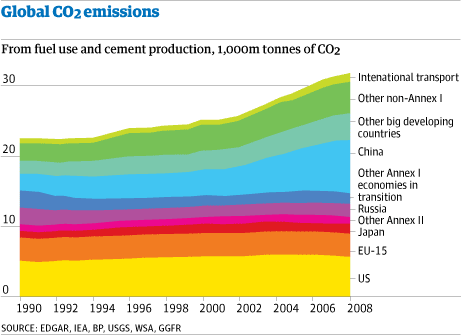
    The slowdown in emissions growth was caused primarily by a 0.6% fall in the consumption of oil – the first decline in global oil use since 1992. This trend was unevenly distributed around the world. In China oil use continued to rise, but at only 3%, down from an average of 8% since 2001. In the US, oil consumption fell by a massive 7%.

    co2

    The falling global demand reflects high prices for oil in the first half of 2008 and the economic slowdown in the second half of the year. Increasing biofuel production also helped displace a substantial volume of fossil-fuel petrol and diesel.

    Jos Olivier, the NEAA researcher responsible for the new data, acknowledged that the environmental benefits of biofuels would look “less favourable” in a broader analysis considering the impact of all greenhouses gases, rather than CO2 alone. Furthermore, the data does not take into account the CO2 released by deforestation, which accounts for almost 20% of all greenhouse gas emissions and takes place overwhelmingly in the developing world.

    Increasing renewable energy capacity and improving energy efficiency in many countries will also have contributed to the reduced rise in CO2 emissions. Olivier said: “The impact of energy and climate policy is hard to distinguish from those of fuel prices and the recession, but policies encouraging renewable electricity generation will have helped avoid around 500 million tonnes of CO2 from fossil-fuel power stations.”

    Coal consumption continued to creep up at a slower rate than in previous years, but the rise in the consumption of natural gas remained unchanged.

    It is too early to determine whether the recession will lead to global emissions flattening off entirely this year. But policymakers are likely to be particularly struck by the second revelation in the NEAA analysis.

    In 2008, the developing-world accounted for 50.3% of CO2 emissions, exceeding developed nations and international travel combined for the first time. With crucial UN climate negotiations over a successor to the Kyoto protocol now less than six months away, this new data will provide useful ammunition for those arguing for binding emissions targets for all nations.

  • Democrats confident as US climate change bill vote looms


    After weeks of attack from Republicans, the energy reform package got an important boost yesterday when its most formidable opponent in Congress – the Democratic chair of the house agricultural committee – said he would now push for its passage.


    “We think we have something here now that can work with agriculture,” Collin Peterson, who led the Democratic opposition to the bill, told a conference call yesterday. “I think we will be able to get the votes to pass this.”


    Within the White House and in Congress, the vote is seen as a historic moment, both for Obama’s political agenda and international efforts to reach a climate change treaty at Copenhagen at the end of the year.


    “This legislation is a game changer of historic proportions,” said Ed Markey, the Massachusetts Democrat who is one of the authors of the bill. “The whole world is waiting to see if Barack Obama can arrive in Copenhagen as a leader of attempts to reduce green house gas emissions.”


    The importance of the bill was underlined by the deep involvement from the White House. Obama earlier this week urged Congress to pass the bill, and aides have been closely involved in efforts to reach yesterday’s compromise. The Democratic House speaker, Nancy Pelosi, took a gamble on moving up the date for a vote on the bill to tomorrow.


    The gamble appeared to have paid off, with the Democratic leadership putting on a high-profile meeting yesterday with environmental, labour, war veterans and religious groups to talk up the bill’s prospects.


    “We are going to get this done,” said Chris van Hollen, a member of the Democratic leadership in the house of representatives. “It’s long overdue.”


    The bill, now swollen to about 1,200 pages, would bind the US to reduce the carbon emissions from burning oil and coal by 17% from 2005 levels by 2020 and more than 80% by 2050.


    It also envisages a range of measures to promote clean energy – from a development bank for new technology to new, greener building codes and targets for expanding the use of solar and wind power.


    The Democratic leadership is now hoping to pass the bill by a comfortable margin. Some environmental organisations have suggested that the bill might even win over a small number of Republicans, which would mean an important victory for Obama.


    For the most part, however, Republicans have almost uniformly opposed the bill, and say it amounts to a hidden energy tax. They have also argued that the bill would drastically raise electricity prices – a claim debunked with the release of a cost-analysis by the non-partisan Congressional Budget Office showing it would cost the average family $175 (£107) by 2020, and would save poor families about $40.


    The study – together with the compromises won by Peterson – have made the bill more palatable to Democrats from coal and oil states and from the old manufacturing areas.


    “We have been taking people out of the ‘no’ column, into the ‘undecided’ column, into the ‘yes’ column,” said Mike Doyle, a Democratic member from a former steel industry town in Pennsylvania. “The momentum is coming to ‘yes’.”


    But Peterson’s support appears to have come only after wringing a number of key concessions on the bill over several days of bargaining, overseen by the White House energy and climate advisor, Carol Browner, and other Obama administration officials.


    The most significant concession would give the US Department of Agriculture – and not the Environmental Protection Agency – control over a programme that would reward farmers for practices that reduce carbon emissions.


    Peterson also forced a four-year delay in a separate environmental regulation that would have cut the profits of corn-based ethanol, and encouraged the development of non-food biofuels instead.


    Those concessions have deepened the concerns of some environmental organisations that the bill is not aggressive enough in cutting emissions. However, Henry Waxman, who has been leading the bill through Congress, argued that the most important element of the bill had come through the hard bargaining process intact.


    “We have not given away the essentials of the bill because the essentials are the reduction of carbon emissions,” he said.

  • Australia filthiest place in the world to make aluminium

    Even putting aside all the obvious arguments that we cannot eat coal, and that food security is a paramount responsibility of government, John Kaye said that the figures about export earnings are dubious. He pointed out that while the coal industry might earn revenues equivalent to one tenth of the total national export income, a lot of that money goes straight overseas to foreign shareholders. “The money from coal that goes into the national economy is a fraction of the revenues earned by the industry as a whole,” he said.

    He also pointed out that the money spent in the production of minerals might contribute to the economy but it is not necessarily good for the nation, either economically or environmentally. He said that this is most clearly illustrated by the aluminium industry. Aluminium is manufactured by running electric currents through aluminium oxide to separate the raw metal. It has been described by scientists, politicians and industrial engineers as “bottled electricity”. An act of the NSW parliament makes it illegal for anyone to divulge the price paid by the aluminium companies for their electricity, but it is widely believed to be around three cents per kilowatt hour. Householders pay between 40 and 50 cents per kilowatt hour. Ordinary householders, then, subsidise the production of aluminium in this state.

    On top of that the State governments in Victoria, NSW and Queensland have provided massive cash payments to the multinational companies on a number of occasions. As part of the proposed Carbon Pollution Reward Scheme, the Federal government is proposing to give the aluminium companies over $600million dollars each year to compensate them for producing the 20million tonnes of carbon dioxide they pump into the atmosphere. Otherwise, the aluminium companies have threatened to move offshore.

    “We should let them go,” Dr Kaye said. He points out that the $200,000 per employee in the aluminium industry would be better spent on retraining and equipping those workers to produce renewable energy technology that we could use domestically and export. He also said that the government encourages the assumption that sending an industry like this offshore would be bad for the environment because other countries are not as tightly regulated as Australia. “It is simply not true,” he said. “NSW is the second dirtiest place in the world to make aluminium because of our reliance on coal fired electricity.” He said that China, Rumania or Brazil would be cleaner because everywhere else in the world has a better mix of renewable energy than Australia. “The only place in the world that is dirtier than NSW is Victoria,” he concluded.

    Extracted from an interview with John Kaye by Giovanni Ebono for The Generator. Watch or listen to the interview at www.thegenerator.com.au