Author: admin

  • Investors shun North Sea despite rebounding oil prices


    “Businesses have already found 2009 a turbulent, tough year and the UK offshore oil and gas industry is no more immune to these pressures than the rest of the economy,” Oil & Gas UK said in a statement.

    “There is growing concern that the rapid fall in oil prices and the freezing of capital markets will impair investment and suppress production in the North Sea, with wider implications for companies and employment across the supply chain.”

    Oil prices, despite a solid rally in recent months, languish more than 50 percent beneath record highs that were struck one year ago.

    “Even the short term, recovery in oil prices of the last two or three months is way too early to positively impact people’s decision (to invest) in the long term,” Bob Keiller, chief executive of energy industry services provider PSN, told AFP on the sidelines of the conference.

    “The volatility (of oil prices) has affected the confidence in investments,” added Keiller.

    Widely-traded Brent North Sea crude oil currently stands at about 70 dollars a barrel, more than double its level in December when the sharp global recession severely dented demand for energy.

    Prices however remain more than half their level of July 2008 when fears about supply disruptions had sent them rocketing to record highs above 147 dollars.

    According to Oil & Gas UK, expenditure on North Sea exploration was down 70 percent at the start of 2009 compared to a year earlier.

    Investment which totalled five billion pounds (5.9 billion euros, 8.1 billion dollars) in 2008 could fall to 2.5 billion pounds this year, the industry body said.

    Despite the recent rally in oil futures, the Organization of Petroleum Exporting Countries argues that the current prices is preventing investment in fresh exploration projects worldwide.

    Malcolm Webb, president of Oil & Gas UK, noted that erosion in capital expenditure for North Sea exploration had begun in 2006, when oil prices were far below current levels.

    In a sign of the bad times for the industry, the British government has postponed indefinitely the sale of North Sea exploration sites.

    “Investing in the future is not easy in the current environment,” said Bernard Looney, managing director of oil giant BP’s North Sea business.

    “Our statistical review shows that UK (oil) production has dropped 38 percent since 2000 to 2008. When I listen to people discuss what I call the seductive run up in oil price, I am worried that this is masking a much less talked about fact — gas prices.

    “They continue to fall. When you assume that 50 percent of North Sea production is gas, the average North Sea realisation today is still around 40 dollars per barrel of oil equivalent.”
  • Australia small-minded on climate change


    A paleontologist by trade, he said the white ring-tailed possum has been around for at least five million years but exposure to temperatures above 34 degrees for more than four hours results in its untimely death.

    The last of the species are located atop a few mountains in northeast Queensland.

    ‘And to see it now vanishing from its last refuge in a world heritage area tells me that our climate is changing in ways that we haven’t seen now probably for millions of years,’ Prof Flannery said.

    Forty-seven degree temperatures, winds up to 100km/h and 12 years of drought fuelled bushfires that levelled bush communities outside of Melbourne on February 7.

    Prof Flannery said climate change and such extreme events can act independently, but Black Saturday was an utter surprise.

    ‘The veracity of those fires and the veracity of the heatwaves killing off that little possum weren’t ever really on the radar for me as key near-term events,’ he told the conference.

    Warmer climate zones are expanding all over the globe, he said, and the southern, cooler zones are retracting even further south.

    He said that if carbon emissions were significantly reduced tomorrow, it would be up to 30 years before rising global temperatures would begin to ease.

    Prof Flannery hopes COP 15, the United Nations climate change conference later this year in Copenhagen, will set the stage for the next global greenhouse emissions treaty to replace the Kyoto Protocol.

    Whatever action is taken at the conference bushfires like Black Saturday may be in Australia’s future, he told the bushfires conference.

    ‘If we are successful at Copenhagen this year and if we can see the brokering of a globally-effective treaty, then what is true (is) that you might have to fight ever-more severe bushfires for the rest of your careers, it may be that your children may face a different future,’ Prof Flannery said.

    He recently attended the World Business Summit on Climate Change in Copenhagen and noted that the climate change debate in Australia takes on a very limited form.

    ‘It’s very easy in Australia to be dismayed by the nature of the climate debate and see it become very partisan and very small-minded,’ Prof Flannery said.

    ‘If I could just say that globally that isn’t the case at all.

    ‘Very major companies, companies from China, companies from the USA, big polluting companies were all represented in this meeting and came together in goodwill.

    ‘With the recognition, of course, that this is going to be hard and this is going to cost, but it’s going to have to be fair – but with the recognition that change was inevitable.’


  • Regulations fail to quiet ETS dissent


    But Malcolm Turnbull has cited the fact that the regulations are not all available as a key reason to delay a Senate vote on the laws, and chastised business leaders at a closed-door breakfast meeting this week for not attacking the government over the lack of regulatory detail.

    “The scheme itself is comprised by regulations, which have not been published … where are the business leaders … saying ‘this is madness, you cannot possibly have a parliament passing an emissions trading scheme sight unseen?” the Opposition Leader asked Business Council of Australia chief executives on Wednesday.

    The Australian Industry Greenhouse Network said yesterday the government had released just 18 out of possibly 100 or more definitions of the specific “activities” that would qualify for compensation under the scheme.

    And it said the regulations made it clear that “an industry’s fate in qualifying for emission-intensive trade-exposed status is entirely in the minister’s hands and completely outside the legislation, and therefore has no avenue for legal appeal”.

    The AIGN said the crucial definitions should be included in the legislation itself, and said there remained scores of unanswered questions about how the compensation scheme would work.

    But Greens deputy leader Christine Milne said the regulations were far too generous to industry.

    “These draft regulations confirm that the (emissions trading scheme) will be a multi-billion-dollar wealth transfer from the people to the polluters who actively stand in the way of protecting the climate,” Senator Milne said.

    The emissions trading laws will be debated in the Senate next week, but Coalition and independent senators are likely to defer a vote until August or September.

    Senator Wong said the government would continue to try to bring the legislation to a vote.

    “Well, we are pressing for a vote next week, we are pressing for the legislation to be passed, and that remains the government’s position,” she said.

    “We are very clear — this is legislation in the national interest. Mr Turnbull needs to listen to the business community, and he needs to listen to the Australian people. He needs to stop listening to those in his own partyroom who don’t want action on climate change.”

  • Climate report stresses urgent action


    “In some aspects it’s moving right near the upper range of earlier projections, this gives us a sense of urgency.

    “A good example of that is sea level rise which is moving right to the upper level of projections we’ve had around now for about 20 years. It’s a pretty fundamental parameter because it is related partly at least to how fast the oceans are warming. That’s where about 90 per cent of the extra heat is going.

    “So we have a very good indicator now that the climate … system is shifting pretty definitely and pretty rapidly.”

    Professor Steffen says time is running out to implement meaningful cuts in emissions.

    “If we want to keep temperatures below two degrees – which is an often quoted guardrail – we pretty much need to see our emissions peak within the next six to 10 years and then drop very quickly after that,” he said.

    Tipping points

    Professor Steffen says some systems like the Great Barrier Reef are reaching their tipping points.

    “Basically a tipping point means that a system is not going to respond in a nice smooth way to increased CO2 in the atmosphere or increased temperature,” he said.

    “You can see temperature rise, temperature rise, and nothing happening to a system. An example being the Indian monsoon. And then with the small additional increase in temperature, it may flip to a much drier state.

    “So basically a tipping element means you can push and push and push a system – a bit like a canoe. If you are starting to tip over in a canoe, it always comes back until you just reach that critical point and then you tip over.

    “Natural systems do this. [An example] is the Great Barrier Reef – a big natural ecosystem which is resilient to a point but once you pass that point, then it will change very quickly.”

    ‘Sense of urgency’

    Professor Steffen says the report lends a sense of urgency to the upcoming climate negotiations in Copenhagen.

    “I think I could paraphrase the Prime Minister of Denmark … who looked at this and said ‘alright, this is giving me a sense of urgency. This is giving me a sense that we have to come out of Copenhagen in December with a widely agreed road map that includes the big developing countries like China and India as well as the major players in the industrialised world like the United States’,” he said.

    “We have to get to that level of remit, we can’t wait for another round of negotiations.

    “So his bottom line message was – he took the science on board and said ‘now is the time we have got to move’.”

  • Multinationals eye up Lithium reserves beneath Bolivia’s salt flats.


    But that may be about to change. Dig down and you find brine – water saturated with salt – rich in deposits of lithium, the lightest metal.

    As the invention of the pneumatic tyre turned rubber into a precious commodity in the 19th century, the world’s tilt towards greener energy is expected to do the same for lithium in the 21st. For years, tiny amounts have been used in laptops, BlackBerrys and other devices, but now its main use is expected to be in batteries for electric cars, which campaigners, manufacturers and governments say will – or should – replace petrol and diesel vehicles.

    For Bolivia, this is good news. It is thought to possess 5.4m tonnes of lithium, half the world’s supply. “Lithium is very important for us and the world,” Bolivia’s mining and metallurgy minister, Luis Alberto Echazú, said. “We hope to extract 1,200 tonnes next year and that’s just the beginning. When we’re up and running we’ll be producing 10, 15 times that.”

    Four wells have been dug in Salar de Uyuni and a state-run pilot plant is being built near the village of Rio Grande on the fringe of the desert.

    But there is a problem. Bolivia’s socialist government has a habit of clashing with foreign multinationals in other sectors and has not clinched a deal – and, according to some, may never seal one – with the investors needed to extract significant quantities of lithium.

    Foreign companies are afraid to deal with a government that confiscates assets and rips up contracts, said Carlos Alberto López, a former energy minister and consultant with Cambridge Energy Research Associates. “Bolivia’s ­ideological face does not square with business and commercial realities. I doubt lithium’s potential will be realised in the short or medium term.” Pessimists fear a fiasco: carmakers lacking batteries to power electric vehicles and Bolivia, one of the continent’s poorest countries, losing an opportunity to develop. President Evo Morales, a former llama herder and trade union leader, has a different fear: that western multinationals will suck the wealth of Salar de Uyuni like capitalist vampires. Morales swept to power in 2005 promising to end 500 years of plunder. Lithium is a test case. “The government of Bolivia will never give away control of this natural resource,” he said. He acknowledges, however, that a foreign partner is needed.

    The government is talking to France’s Bollore Group, South Korea’s LG Group and Japan’s Sumitomo and Mitsubishi. Bollore has been asked to join the government’s scientific commission on lithium, suggesting it has the edge.

    The government said it would choose as a partner the company which will help Bolivian industry and not just ­mining. The idea is to process and add value to the lithium after it is extracted, for instance by making batteries or even fleets of electric cars in the impoverished country. The $6m (£3.6m) state-run pilot plant near Rio Grande is the first step. At the end of a dirt track dozens of workers are building barracks to house technicians and miners. Over a generator’s hum Marcelo Castro, 48, the site manager, exuded patriotic pride. “We are building every­thing from scratch. This is a historic moment. We are working for ourselves.” Rich countries would no longer plunder Bolivia’s resources. “There is a new dialectic.”

    Sceptics say that is delirium. Work at the pilot plant has proved slow, talks with multinationals remain inconclusive and there is no production timetable.

    The 2006 nationalisation of the oil and gas industry is a troubling precedent. Foreign investment evaporated, production fell and the state-owned energy company, YPFB, became mired in corruption. “The trustworthiness of the Bolivian state has come into question,” said López, “and I don’t think investors will expose themselves to being hammered on the head.”

    Time will tell. With a lithium shortage forecast for 2015, Bolivia may also have the upper hand. “We have had bad experiences in the past,” said Paulino Colque, leader of an indigenous workers’ group Uyuni. “If there are any investors that want to come, they can come – but as partners, not patrons.”


    Running on lithium


    Lithium ion batteries, first proposed in the 1970s but not commercialised until 20 years later, are the technology most likely in the short-term to make the clean electricity dream viable. Several times lighter than current rechargeable batteries (usually made from nickel compounds) and with a better performance and longer lifetime, ­Li-ion cells have already been developed for laptops and mobile phones. Now they face their biggest challenge. For cars, they will have to be more powerful, more reliable and – a big sticking point – far cheaper. Most experimental electric vehicles today use some form of Li-ion batteries and many experts agree the technology is ready for the first generation of electric vehicles. The other big hurdle is size: the batteries are still too big. Alok Jha


  • TIDAL POWER

    tidal power

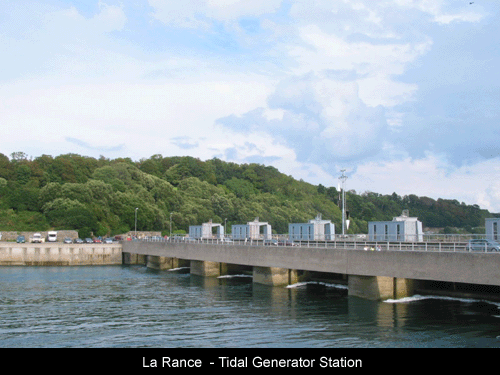
    There is little doubt that the energy potential of tides is huge. The largest power plant is the La Rance station in France which generates a whopping 240 megawatts (MW)of power. The idea of constructing a power plant on the La Rance dates to Gerard Boisnoer in 1921. The site was attractive because there is a large average range between low and high levels (8 metres, with a maximum equinoctial range of 13.5 metres).

    In spite of the high cost of the La Rance project, the plant’s costs have now been recovered, and electricity production costs are lower than for nuclear power generation. (18 Euro cents per kWh, versus 25 per kWh for nuclear). However, the barrage has caused progressive silting of the Rance ecosystem. Sand-eels and Plaice have disappeared, though Sea bass and cuttlefish have returned to the river. There are only two other plants operating worldwide, one being the 20MW Annapolis station in Nova Scotia, and a small 0.5MW plant in Russia.

    la Rance tidal

    Tidal power schemes do not produce energy 24 hours a day. A conventional design, in any mode of operation, would produce power for 6 to 12 hours in every 24 and will not produce power at other times. As the tidal cycle is based on the period of rotation of the Moon (24.8 hours) and the demand for electricity is based on the period of rotation of the earth (24 hours), the energy production cycle will not always be in phase with the demand cycle. This causes problems for the electric power transmission grid, as capacity with short starting and stopping times (such as hydropower or gas fired power plants) will have to be available to alternate power production with these power schemes.

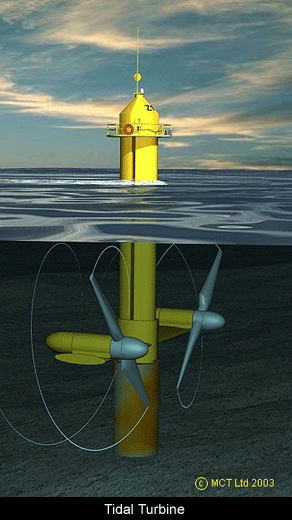
    The less intrusive plants utilising kinetic energy from current flow rather than potential energy of barrage dams would appear to be more environmentally friendly and sustainable in the long term.