Author: admin

  • WAVE POWER


    This type of power generation is not a widely employed technology, with only a few experimental sites in existence. The market potential for hydrokinetic energy is vast, ranging from small-scale distributed generation applications to large-scale power plants.
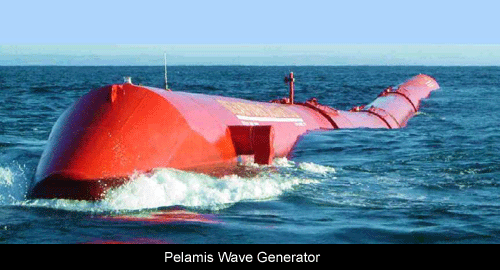
    Pelamis wave

    In general, large breakers are more powerful. Specifically, power is determined by height, speed, wavelength, and water density. The size is determined by wind speed and fetch (the distance over which the wind excites the water) and by the depth and topography of the seafloor (which can focus or disperse the energy). A given wind speed has a matching practical limit over which time or distance will not produce larger waves. This limit is called a “fully developed sea.”

    This power source could yield much more energy than tidal power. Tidal dissipation (friction, measured by the slowing of the lunar orbit) is 2.5 terawatts. The energy potential is certainly greater, and the power of the sea in this form could be exploited in many more locations. Countries with large coastlines and strong prevailing winds (notably, Ireland and the UK) could produce five percent or more of their electricity from this source of power. Excess capacity (a problem common with intermittent energy sources) could be used to produce hydrogen or smelt aluminum.


    A floating buoy, submerged system or an offshore platform placed many kilometers from land is not likely to have much visual impact. Onshore facilities and offshore platforms in shallow water could, however, change the visual landscape from one of natural scenery to industrial. These are considerations, but ultimately we need to balance the need for sustainable energy against visual impact. Which would you choose between?

    During September 2008 the Pelamis technology pictured above became the world’s first commercial sea power plant converting waves into electricity. Situated off Portugal’s coast the project is expected to expand nearly 10-fold in the coming years.

    Generating a total of 2.25 megawatts, the power is enough to supply 1,500 households the project cost is reported to be around 8.5 million Euros (US$12.55 million).

    Although the price is not currently competitive, the project was possible due to the feed-in tariff in Portugal.


  • Carbon capture plans threaten shutdown of all UK coal-fired power stations.


    A spokeswoman said that no decision had yet been made. The government could instead decide to allow coal plants still open in 2020 to operate for a limited period or to keep them in reserve to stop the lights going out.

    A spokesman for a company operating several coal plants in the UK said that even if Miliband did not carry out his threat and force existing coal plants to fit expensive CCS equipment, any further restrictions on their operation would be likely to result in their closure. It will probably prove too difficult and expensive to fit CCS to plants nearing the end of their lifespan.

    Drax is the UK’s newest and biggest coal-fired station. The Yorkshire plant, which provides about 8 per cent of Britain’s electricity, is technically able to continue to operate into the 2030s. But since it is 40 miles from the coast, transporting captured carbon for storage in the North Sea would be particularly difficult.

    Dorothy Thompson, chief executive of Drax, accepted that the plant might eventually need to fit CCS but did not say when this would be feasible or economic.

    David Porter, head of trade body the Association of Electricity Producers, said he welcomed CCS as a way of making coal plants environmentally acceptable, but said existing stations which could not fit the equipment should not be forced to close. “There are already quite enough coal-fired plants coming off the system. Security of supply should be taken seriously,” he warned.

    The Guardian has also learnt that E.ON’s controversial plans to build a new coal-fired station in Kingsnorth – the first in the UK for more than 20 years – are likely to be delayed by several years at least. It would represent a temporary victory for environmental campaigners, who staged last summer’s climate camp near the Kent site. The Kingsnorth plans could be scrapped altogether.

    E.ON has entered the new station into a government competition to build the first commercial-scale CCS demonstration project. DECC has now admitted that the decision to pick a winner has been delayed and will not take place until the autumn of 2010 at the earliest. Miliband reiterated the government’s ambition to have the winning project operational in 2014.

    E.ON is becoming increasingly concerned about the tight schedule of four years to build its first highly efficient coal plant in the UK which is also equipped with experimental CCS technology. The delay in the competition could favour Scottish Power’s entry at Longannet, which involves attaching CCS to an existing coal station.

    Miliband told the Guardian that the short space of time for E.ON to build a new plant was “one of the factors” which would influence the decision but declined to comment further.

    Paul Golby, E.ON’s chief executive, has admitted the firm would not build Kingsnorth if it did not win the competition. Under Miliband’s plans announced in April, all new coal plants must fit CCS to part of the operation. Golby said it would not be economic to do this without government subsidies and added that E.ON could build a gas plant instead.

    John Sauven, executive director of Greenpeace UK, urged the government to make all existing coal plants fit CCS: “If we fail to act, Drax will remain one of the largest sources of carbon dioxide in the world for decades,” he said. “The government’s own advisors on climate change have stated that all emissions from coal must cease by the early 2020s.

    “That’s all coal, not just new coal, so it’s vital that Ed Miliband’s new policy doesn’t ignore the inconvenient truth that we need to deal with the reality of Drax every bit as urgently as the threat of Kingsnorth.”

  • $200m wind farm planned for Shannon’s flat


    Managing director Gerry McGowan says regulatory approvals could take two years at a cost of about $2 million.

    But he says the construction of 20 turbines would only take about six months.

    Mr McGowan says the project has a lot of potential.

    “We have a belief that the New South Wales grid is conducive to more renewables being placed on it,” he said.

    “We think that whilst a lot of wind had been going into places like Tasmania and South Australia, we think New South Wales over the next few years will develop good wind sites and good wind resources.

    “We’ve got a grid that can cope with the introduction of wind power into it.”

    The company is expected to lodge the first part of a staged development application with the New South Wales Planning Department soon.

    “It’s going to be submitted in a series of applications because there are environmental issues and forestry issues, so that will take place over a couple of years,” Mr McGowan said.

    “With any wind farm you need to do a certain amount of clearing around the site. The site is fairly clear but we’ll be applying for a small amount of tree removal if we can.

    “If not, it’s not totally necessary for this particular site but it will get the output of the site up if we can remove some trees and replace them elsewhere.”

    CBD Energy – whose chairman is former deputy prime minister Mark Vaile – is also involved in wind farm projects in New Zealand and is working with Hydro Tasmania on a solar development on King Island.

  • World’s first solar aeroplane and fuel alernatives

    Even if the Solar Impulse completes a successful circumnavigation, though – it would fly day and night – there is not much chance of a solar-power aviation industry emerging any time soon, if ever.

    There seems no way for solar to power the loads required of civil aviation or to achieve the heights or speed required.

    But the aviation industry is looking at alternatives to jet fuel that are practical and sustainable, and have a smaller carbon footprint, particularly in light of emission trading schemes that seem likely to be a feature of the world economies in coming years.

    Air travel is estimated to contribute just two per cent of greenhouse gas emissions, but the industry’s high growth rate has raised concerns about future emissions. The European Union recently included aviation in the third phase of its emissions trading scheme.

    The International Air Transport Association, which represents more than 230 airlines, or almost all the commercial airlines in the world, has set a target of using 10 per cent alternative fuels by 2017.

    Although several options to reduce emissions are available, including synthetics known as Fischer-Tropsch fuels and first-generation biofuels, the industry is favouring so-called second and third-generation biofuels because they have the required high energy content, do not freeze at cold temperatures produce fewer carbon emissions and do not compete with food crops.

    During the past 12 months, there have been at least four flights by leading airlines that have tested biofuels.

    Virgin Atlantic flew a Boeing 747-400 with one engine operating on a 20 per cent mix of babassu oil – derived from the nut of a native Brazilian tree – and coconut oil. Air New Zealand flew a similar plane in December with one engine operating on a 50 per cent mix of biofuel from jatropha.

    Continental Airlines flew a Boeing 737-800 in January with one engine using a 50 per cent mix of algae and jatropha, while Japan Airlines in January also flew a Boeing 747-300 with a 50 per cent biofuel mix containing jatropha, camelina (an energy crop grown in rotation with wheat and other cereal crops) and algae.

    IATA and the airlines are still digesting the results, but the initial response is promising.

    Honeywell, which provided the process technology to convert the second-generation, renewable feedstocks to green jet fuel, says the demonstration flights will have a tremendous influence on how the aviation community thinks about biofuels.

    Honeywell subsidiary UOP’s renewable energy and chemicals unit general manager Jennifer Holmgren says the tests demonstrate that its technology produces “on-spec” green jet fuel from sustainable feedstocks.

    She says commercial-scale production and usage of these biofuels in the aviation industry could be a reality in a few years, and having a substantial effect on aviation jet fuel supply within three to five years.

    However, according to those providing the potential feedstocks, market accessibility and economic benefits still need to be addressed, as it is not yet clear that there is enough raw material to supply the entire aviation industry.

    Read more at The Australian.

  • Coast residents warned to brace for climate change


    “The frequency of flooding events is going to increase significantly,” he said.

    “The average for Australia is that if we have a sea level rise of only half a metre, which is very conservative for this century, you’re going to see flooding events increasing by a factor of something like 300.

    “This means that if you’ve got a flooding event that happens every year at the moment, it’s going to be happening every day by the end of the century.

    “I say it’s a risk-based thing, it gives you the probability of a flooding event during the life of the asset.

    “It includes both the uncertainty of when the next storm’s going to come and also the uncertainty of the projections of sea level rise into the future.”

  • New catalyst boosts hydrogen as transport fuel


    Umit Ozkan, a professor of chemical and biomolecular engineering at Ohio State University, has led a team of scientists to develop a catalyst that can make hydrogen from ethanol without the need for high temperatures or expensive materials such as platinum or rhodium. The work could circumvent some of the storage and transportation problems.

    “Instead of making hydrogen from biofuel at a centralised facility and transporting it to gas stations, we could use our catalyst inside reactors that are actually located at the gas stations. So we wouldn’t have to transport or store the hydrogen – we could store the biofuel, and make hydrogen on the spot.” The research was presented on Wednesday at the American Chemical Society‘s annual meeting in Philadelphia.

    Catalysts that can make hydrogen from biofuels already exist but usually need rare, expensive ingredients. “Precious metals have high catalytic activity and, in most cases, high stability, but they’re also very expensive,” said Ozkan.

    She said that her goal from the outset was to develop a cheaper catalyst, one that was based on readily-available metals. The resulting catalyst is made from calcium, cobalt and small grains of cerium oxide, a common ingredient in ceramics. According to the researchers, it an produce hydrogen with 90% efficiency at around 350C – a low temperature by industrial standards. “Rhodium is used most often for this kind of catalyst, and it costs around $9,000 (£4,800) an ounce,” said Ozkan. “Our catalyst costs around $9 a kilogram.”

    She added that operating at lower temperatures would also bring energy savings. “And if the catalyst is highly active and can achieve high hydrogen yields, we don’t need as much of it. That will bring down the size of the reactor, and its cost”.

    The production of hydrogen from ethanol produces waste gases such as carbon dioxide and methane – the former can be trapped and stored while the latter can be burned to supply some of the energy needed for the conversion process itself. Though the team’s current research focused on ethanol, the researchers believe it could be adapted to other liquid biofuels.

    Ozkan said that a preliminary economic analysis of her technique showed that the price of hydrogen could approach that of petroleum. “As gasoline prices continue to rise, hydrogen produced from renewable sources such as bio-liquids will be more and more competitive. Also, the possibility of using hydrogen in fuel cells will provide much higher efficiency than internal combustion engines can. So the actual cost, in dollars per mile, may already be lower.”

    Friends of the Earth‘s biofuels campaigner Kenneth Richter warned that hydrogen was only as clean a source of power as the energy used to produce it. “Rather than being a clean alternative to fossil fuels, biofuels are actually increasing carbon dioxide emissions. Hydrogen-fuelled cars are still a long way off – the immediate priority for cutting emissions is smarter cars that burn less fuel.”