Author: admin

  • Reveal carbon risks, oil firms told


    Reveal carbon risks, oil firms told

    Oil giants involved in the exploitation of tar sand fields face calls this week to disclose future carbon liabilities. Co-operative Financial Services (CFS) and environmental charity WWF-UK are launching a campaign for a legal requirement for companies including Shell and BP to include this information in financial reporting.

    The Co-op says tar sands activities threaten to create a new class of toxic investment that could push the financial system into deeper crisis, while WWF wants the UK to take the lead and make London the centre of green finance. Nearly £40bn of UK pension assets is invested in British-based oil and gas companies. Co-op and WWF say investors need disclosure so they can factor financial and environmental risks into their decision-making. Disclosure of the financial risks associated with tar sands should be a key part of a new transparent system.

    The Co-operative Bank is already funding a legal challenge against oil companies by the Beaver Lake Cree nation in Canada’s Alberta province. Chief Al Lameman claims caribou, elk, moose and other animals are being harmed and plants used in traditional medicine are threatened.

    Paul Monaghan of CFS said: “The Co-op focused on the issue of unconventional oil in last year’s Observer Good Companies Guide and highlighted the risks and need for improved transparency on environmental performance. Legislation encouraging better disclosure on carbon would be a good start.”

  • US admits responsibility for emissions to bring big polluters together

    US admits responsibility for emissions to bring big polluters together

    Hillary Clinton offers admission to ease obstacles towards reaching agreement at climate change summit in Copenhagen


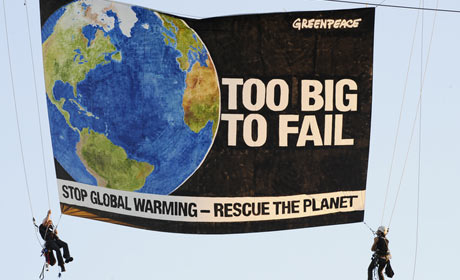
    Greenpeace activists display a banner from a crane near the State Department in Washington

    Greenpeace activists display a banner from a construction crane near the State Department in Washington Photograph: Tazz/Tazz/Greenpeace

    The Obama administration issued a mea culpa today on America’s role in causing climate change, in a move to get the major economies working together on a global warming treaty.

    The admission by Hillary Clinton at a two-day meeting of the world’s biggest polluters was intended to ease some of the obstacles towards a deal at UN talks in Copenhagen in December. She placed the gathering of officials from 17 countries, the European Union and the United Nations on a par with the G20 meeting on the economic crisis earlier this month.

    As the secretary of state opened the meeting, the Greenpeace US executive director, Phil Radford, was arrested in his first day in the job. He and six other climbers unfurled a banner from a construction crane near the state department with a message for the environment ministers: “Stop Global Warming. Rescue the Planet.” Radford called for the industrialised world to commit to deeper cuts in emissions and provide assistance to developing countries.

    Clinton addressed the complaints of developing countries such as India and China that America and the EU, by demanding binding emissions cuts, want to saddle them with the burden of climate change; they argue they did not cause the problem and must prioritise growth. She said the US recognised industrialised countries bore a responsibility: “Some countries like mine are responsible for past emissions.” She wanted China and India to grow their economies: “We want people to have a higher standard of living.”

    Obama had broken with eight years of denial under George Bush, Clinton said. “The United States is fully engaged and ready to lead and determined to make up for lost time both at home and abroad … the US is no longer absent without leave.”

    She saw climate change as the gravest problem facing the international community: “The facts on the ground are outstripping the worst case scenario models.”

    Diplomats see the gathering of Australia, Brazil, Canada, China, the European commission, France, Germany, India, Indonesia, Italy, Japan, Korea, Mexico, Russia, South Africa, Britain, the United States, Denmark and the UN as an important ­station on the road to Copenhagen.

    The two-day meeting – one of three such before December – is not expected to produce definitive agreements. But diplomats hope to get a clearer idea of how countries are prepared to act. There is also hope of establishing negotiations on financial aid and technological assistance to developing countries which will bear the brunt of global warming.

    In almost 100 days in office, Obama has worked to persuade the world he wants to play a leadership role on climate change. Clinton emphasised that progress, noting directives by Obama, and US rulings designating CO2 as a pollutant.

  • The truth about climate change

    The truth about climate change

    Vested interests have tried to spread misinformation about global warming, but scientific evidence shows urgent action is needed 

    Many people ask how sure we are about the science of climate change. The most definitive examination of the scientific evidence is to be found in the work of the Intergovernmental Panel on Climate Change (IPCC) and its last major report published in 2007. I had the privilege of being chairman or co-chairman of the panel’s scientific assessments from 1988 to 2002.

    Many hundreds of scientists from different countries were involved as contributors and reviewers for these reports, which are probably the most comprehensive and thorough international assessments on any scientific subject ever carried out. In June 1995, just before the G8 summit in Scotland, the academies of science of the world’s 11 largest economies (the G8 plus India, China, and Brazil) issued a statement endorsing the IPCC’s conclusions and urging world governments to take urgent action to address climate change. The world’s top scientists could not have spoken more strongly.

    Unfortunately, strong vested interests have spent millions of dollars on spreading misinformation about climate change. First, they tried to deny the existence of any scientific evidence for global warming. More recently, they have largely accepted the fact of anthropogenic (man-made) climate change but argue that its impacts will not be great, that we can “wait and see,” and that in any case we can always fix the problem if it turns out to be substantial.

    The scientific evidence does not support such arguments. Urgent action is needed both to adapt to the climate change that is inevitable and to reduce emissions of greenhouse gases, especially CO2, to prevent further damage as far as possible.

    At the Earth summit in Rio de Janeiro in 1992, the world’s nations signed up to the Framework Convention on Climate Change (FCCC), the objective of which is “to stabilise the concentration of greenhouse gases in the atmosphere at a level that does not cause dangerous interference with the climate system … that allows ecosystems to adapt naturally to climate change, that ensures food production is not threatened, and that enables economic development to proceed in a sustainable manner.” Such stabilisation would also eventually stop further climate change.

    It is now recognised that widespread damage due, for instance, to sea level rise and more frequent and intense heat waves, floods and droughts, will occur even for small increases of global average temperature. Therefore it is necessary that very strong efforts be made to hold the average global temperature rise below 2C relative to its preindustrial level.

    If we are to have a good chance of achieving that target, the concentration of CO2 must not be allowed to exceed 450 parts per million (it is now nearly 390 ppm). This implies that before 2050 global emissions of CO2 must be reduced to below 50% of the 1990 level (they are currently 15% above that level), and that average emissions in developed countries must be reduced by at least 80% of the 1990 level. The UK has already committed itself to a binding target to reduce emissions by that amount, and President Barack Obama has expressed intention that the United States should also set that target.

    One clear requirement is that tropical deforestation, which is responsible for 20% of greenhouse gas emissions, be halted within the next decade or two. Regarding emissions from the burning of fossil fuels, the International Energy Agency (IEA) in its Energy Technology Perspectives has set out in detail the technologies and actions that are needed in different countries and sectors to meet these targets.

    For the short term, the IEA points out that very strong and determined action will be necessary to ensure that global CO2 emissions stop rising (the current increase is more than 3% per year), reach a peak by about 2015, and then decline steadily toward the 2050 target. The IEA also points out that the targets can be achieved without unacceptable economic damage. In fact, the IEA lists many benefits that will be realised if its recommendations are followed.

    What is required now is recognition that anthropogenic climate change will severely affect our children, grandchildren, the world’s ecosystems, and the world’s poorer communities, and that the severity of the impact can be substantially alleviated by taking action now.

    John Theodore Houghton, a former professor of atmospheric physics at Oxford University, and founder of the Hadley Centre for Climate Prediction and Research, was the co-chair of the IPCC’s scientific assessment working group and lead editor of its first three reports

    Copyright: Project Syndicate, 2009.

  • National broadband network to cut power bills, says Conroy

    National broadband network to cut power bills, says Conroy


    April 28, 2009

    Article from:  Australian Associated Press

    THE national broadband network could significantly reduce Australia’s carbon footprint and cut consumers’ power bills, Communications Minister Stephen Conroy says.

    Consumers connected to “smart grids” via the $43 billion network will pay less for electricity through a more efficient use of power, also reducing the need for more power generators, he says.

    “Australia has set ambitious targets to reduce carbon emissions by 2020 and this will require an economy-wide response,” Senator Conroy said during an address at the National Press Club in Canberra.

    “The fact is broadband is a green technology. In fact, it is an enabler of efficiencies that could drive major reductions in carbon emissions.”

    He said energy providers were already planning to use broadband to improve the way they monitor and manage power distribution. The national broadband network would help energy companies balance the peaks and troughs of daily usage.

    “Smart grids connected by broadband raise the potential to not only monitor energy use but to allow remote adjustment of lights or temperature,” Senator Conroy said.

    “For households this means opportunities for reduced power consumption and costs. This in turn allows them to sell the recovered power on the market, reducing the need for new power generators.”

    Estimates in the United States had put the cost savings for consumers connected to smart grid networks at between five per cent and 25 per cent. Other research pointed to further savings for Australia stemming from the national broadband network.

    “In fact, (climate change analysis company) Climate Risk has estimated that local energy and travel savings alone could be worth up to $6.6 billion annually.”

    The Opposition remains critical of the broadband plan, with communications spokesman Nick Minchin scoffing at Senator Conroy’s claims about the network’s contribution to the climate change fight.

    “According to Senator Conroy there is no need for an ETS (emissions trading scheme) because the NBN is going to slash our emissions on its own,” Senator Minchin said.

    “Senator Conroy is claiming this all singing, all dancing NBN is also going to save the planet.” 

  • Arctic CO2 levels growing at an “unprecedented rate’ say scientists

    Arctic CO2 levels growing at an ‘unprecedented rate’, say scientists

    Figures from a measuring station in northern Norway show that CO2 levels are increasing by 2-3 parts per million every year


    The concentration of carbon dioxide in the atmosphere has reached a record high, according to the latest figures released by an internationally regarded measuring station in the Arctic.


    The measurements suggest that the main greenhouse gas is continuing to increase in the atmosphere at an alarming rate despite the downturn in dip in the rate of increase of the global economy.


    Levels of the gas at the Zeppelin research station on Svalbard, northern Norway, last week peaked at over 397 parts per million (ppm), an increase of more than 2.5ppm on 2008. They have since begun to reduce and today stand at 393.7ppm. Prior to the industrial revolution, CO2 levels were around 280ppm.


    CO2 levels recorded in Svalbard tend to be higher than the global average, but scientists said the CO2 level they had measured was unprecedented even for that location. “These are the highest figures collected in 50m years,” said Johan Strom, professor of atmospheric physics at the government-funded Norwegian Polar Institute, which collected the data.

    “It is not the level of CO2 that is the problem, because the earth will adapt. What is very worrying is the speed of change. Levels [here] are now increasing 2-3ppm a year.


    “The rate of increase is much faster than only 10-20 years ago. You can almost see the changes taking place. Never before have CO2 levels increased so fast,” he said.


    The global annual mean growth rate for 2007 was 2.14ppm – the fourth year in the past six to see an annual rise greater than 2ppm. From 1970 to 2000, the concentration rose by about 1.5ppm each year, but since 2000 it has risen to an average 2.1ppm.


    “There can be week-to-week or day-to-day variability,” said Thomas Conway, research chemist at US National Oceanic and Atmospheric Administration’s (NOAA) Earth Systems research lab in Boulder, Colorado. But he said a 2.5ppm annual increase was “on the high end”.


    “This is part of an overall pattern of CO2 increasing in the atmosphere. Unless the burning of fossil fuels decreases, then the CO2 will not decrease. And if the rate of fossil fuel burning increases, so will the rate of CO2 increases,” he added.


    “These are quite large numbers. It sounds like this is an Arctic phenomenon,” said Dr Vicky Pope, head of climate change advice at the Met Office Hadley Centre in Exeter. “It fits with the general increase in emissions. You would expect the concentrations of CO2 to grow.”


    Last week, NOAA released preliminary figures for its annual greenhouse gas index, which incorporates data from 60 sites around the world – including Zeppelin. Total global CO2 concentration topped 386ppm. In 2008 the global average increased by 2.1ppm, slightly less than the 2.2ppm increase in 2007. NOAA’s primary CO2 measurement station is Mauna Loa Observatory in Hawaii.


    CO2 levels are typically higher in the Arctic than the global average because there is more landmass and human activity in the northern hemisphere. As a result, human emissions from factories and transport tend to lead to higher CO2 levels here.


    The figures will concern policy-makers ahead of global talks on a successor to the Kyoto Protocol in December. Climate scientists advise that the world must prevent CO2 levels from rising higher than around 450ppm CO2 equivalent (a measure of global warming potential that incorporates other gasses such as methane and is higher than the measured CO2 levels) to avoid a 2C increase on preindustrial global average temperature.


    The Zeppelin research station is situated on a mountain top approximately 1100km from the North Pole. The closest town, Ny Alesund, is the northernmost human settlement in the world, mainly inhabited by research scientists. Although the research station is far from major sources of human pollution, atmospheric circulation brings air from Europe and North America into the Arctic region.


    “There is less human influence here and most of the pollution comes straight here at this time of the year. From now on levels will reduce until the end of August when they will pick back up,” said Strom.


    “It is clearly the effect of human activity. Even if we stopped emitting now, we would have to live with this … we will have to live with it for thousands of years, but that does not mean we should do nothing.”

    The figures come as Al Gore hosts a conference in Tromso, northern Norway, on melting arctic ice. Last week he told the US senate committee on energy and commerce that the arctic is now melting at an “unprecedented” rate.

    “The most recent 11 summers have all experienced melting greater than the average 35 year time series,” he said.


    He is expected to warn ministers in polar regions that the arctic ice cap may totally disappear in as little as five years if nothing is done to curb greenhouse emissions.


    Earlier this month, US scientists reported that annually forming sea in the Arctic region covered roughly the same area as in previous years, but had significantly thinned.
  • Study says Warming Poses Peril to Asia

    Study Says Warming Poses Peril to Asia


    Published: April 26, 2009

    With diminished rice harvests, seawater seeping into aquifers and islands vanishing into rising oceans, Southeast Asia will be among the regions worst affected by global warming, according to a report scheduled for release on Monday by the Asian Development Bank.

    The rise in sea levels may force the sprawling archipelago of Indonesia to redraw its sea boundaries, the report said.

    All these changes will occur progressively over the next century, the bank estimated, giving countries time to improve their flood control systems, upgrade their irrigation networks and take measures to prevent forest fires, which the report predicts will become more common.

    “Our modeling shows that sea levels will rise up to 70 centimeters,” or about 28 inches, said Juzhong Zhuang, an economist at the bank and one of the authors of the report. “That will force the relocation of many millions of people.”

    Brackish water seeping into the water table in Jakarta, Indonesia, and the rice paddies of the Mekong Delta in Vietnam is already a growing problem, the report says.

    Some of the 92 outermost small islands that serve as a baseline for the claims of coastal waters by Indonesia could disappear, according to the report.

    The margin of error of such complex projections so far into the future remains a nagging question but the report’s conclusions are nonetheless sobering for Southeast Asian nations, which have a combined population of more than 563 million.

    The report focuses on Indonesia, the Philippines, Thailand, Singapore and Vietnam.

    A projected one foot rise in sea levels in the Philippines by 2045 would flood about 5,000 acres, affecting 500,000 people, the report says. Under another sequence of events, sea levels could rise 39 inches by 2080, affecting 2.5 million people in the Manila Bay area.

    The authors of the report urged governments to build infrastructure adapted to climate change, arguing that the current economic crisis was not incompatible with combating and adapting to global warming.

    “The investment in climate change adaptation can serve as an effective fiscal stimulus,” said Tae Yong Jung, another author of the report.

    Southeast Asia is particularly vulnerable to global warming because of the number of people who live near coastlines and the high rate of poverty. About 19 percent of those in Southeast Asian, some 93 million people, live on less than $1.25 a day and are more vulnerable to the projected increase in typhoons, drought and floods.

    The region also has a high percentage of agricultural workers, more than 40 percent of the population, who would face a decline in the production of rubber, rice, corn and other crops because of extreme weather, the report said.

    The number of fish in the oceans is also likely to decline because of changes in currents caused by a warmer atmosphere.

    In cities like Manila, Bangkok and Jakarta, which are already stiflingly hot for several months of the year, average temperatures in 2100 could be nine degrees hotter, the report says, using data from the Intergovernmental Panel on Climate Change.

    “If that’s the case, the cities will be like an oven,” Mr. Zhuang said.