Author: admin

  • Miliband’s coal decision is cvnical and meaningless


    Miliband’s coal decision is cynical and meaningless

    If coal plants go ahead on the condition that their emissions will one day be abated through carbon capture and storage technology, then emissions are a certainty

    It’s simple: there should be no new coal burning without 100% carbon capture and storage (CCS) to bury carbon dioxide emissions underground where they cannot influence the climate.

    This is a very different matter from Ed Miliband’s proposal in the House of Commons today that energy companies must “demonstrate CCS on a substantial proportion of any new coal-fired power station.” The figures he has just proposed (400MW of gross capacity) suggest that only around one-quarter to one-fifth of total emissions from a new plant will be captured.

    These partly abated coal plants, in other words, would still be much worse than unabated gas plants.

    Miliband went on to insist that “when the technology is proven [we will make a] commitment that CCS will be fitted on the entire plant.”

    So the big “if” about CCS has magically been turned into a “when”.

    If Miliband is sure that full-scale CCS is viable, two questions arise:

    1. Why has he just announced four demonstration projects to test whether it is viable or not?

    2. Why not go ahead with full CCS right now?

    Of course, there is no “when”. As Alastair Darling told the House of Commons in May 2007:

    “It is true to say that the technology to capture, transport and store the carbon exists, but it has not actually been joined up on a commercial basis yet … these things might never become available.”

    It might work. It might not. As anyone seeking to develop and commercialise a new technology knows, it is likely to be beset by a host of unforeseeable difficulties, which will almost certainly delay it and possibly derail it.

    As Miliband says:

    “I have had representations that from day one there should be 100% CCS on new coal, but I believe that this does not appreciate the need that still exists to demonstrate the technology before full-scale commercial deployment is possible.”

    So here’s the difficulty for the government. It will approve a new generation of coal-burning power stations, starting with Kingsnorth in Kent, on the basis that they will one day reduce their emissions by means of a technology that has not yet been demonstrated. What happens if the CCS demonstrations show that it doesn’t work on the scale Miliband envisages, or not, at least, when he predicts? The only means the government will then have of cutting emissions from the coal-burning plants it approves today is to shut them down, wholly or partially. Two factors mean that this is likely to be politically impossible:

    1. The government has to decide now what our future energy mix will be. All large-scale electricity generation – whether from fossil fuel, nuclear or renewables – takes years to plan, develop and bring onstream. If, say, the government decides that in 2020 one-fifth of our power will come from coal, and then discovers in 2020 that coal emissions cannot be abated by CCS, it will not be able to shut those power stations down without massive consequences for electricity supply. The choice will be a stark one: either it will have to abandon its carbon targets or it will have to subject the country to electricity rationing and rolling black-outs. It’s not hard to guess which way it would jump.

    2. Both Labour and the Conservatives have long colluded with the power generation industry. The Guardian’s new revelations about this relationship are just the latest in a long line. The power sector is a formidable industrial lobby group, which no government appears prepared to confront.

    Miliband can make extravagant promises today about retrofitting 100% CCS to all new coal-burning power stations by 2020 and preventing them from operating without it. But he probably won’t be in office then, and almost certainly won’t be in his current role. Perhaps, as a private citizen, he intends to march into the Kingsnorth power plant and demand that it shuts down, but he can expect to be bludgeoned by the police if he does, just like the rest of us.

    The government’s announcement, in other words, is cynical and meaningless. It cannot enforce the decision it has just made, and it knows that no one else will. If coal plants go ahead on the condition that their emissions will one day be abated through CCS, the emissions will be a certainty. The abatement will not.

    monbiot.com

  • Mangroves ‘protect coastal villages during cyclones’


    Mangroves ‘protect coastal villages during cyclones’

    Mangroves cut coastal deaths during cyclones — but their effectiveness during tsunamis is inconclusive, says a new study. From SciDev, part of the Guardian Environment Networ

    Mangrove swamp

    Debate is growing on using mangrove forests as a protective shield against cyclones

    Mangrove forests, common along tropical coasts, can provide a protective shield against destructive cyclones and reduce deaths, a study has found.

    The finding follows a report published earlier this year (January) which said that mangroves were not effective against tsunamis (see Mangroves do not protect against tsunamis). It adds to a growing debate on using mangroves as bioshields in coastal areas.

    The new study, conducted by scientists at the University of Delhi, India, and Duke University in the United States, analysed the 1999 ‘super cyclone’ that ravaged Orissa state in eastern India, killing an estimated 10,000 people.

    The scientists found that coastal villages in Orissa with the widest mangrove belts suffered fewer deaths, compared to those with narrower or no mangroves.

    Their statistical models suggest that without mangroves, villages within ten kilometres of the coast would have suffered an average of 1.72 additional deaths.

    “Statistical evidence of this life-saving effect is robust” and remains “highly significant” even after taking into account other environmental and socioeconomic factors, the report says.

    The January study, however, found that ‘bioshields’ have negligible effects against tsunamis. Others have argued that promoting green coastal belts as a buffer against tsunamis is diverting valuable funds from effective protection measures such as developing early warning systems.

    Saudamini Das, an associate professor at the University of Delhi and a co-author of the new study points out that while the new study does not address whether mangroves protect tsunami-hit areas it does clear all doubts about their effects against cyclones.

    Das told SciDev.Net that there are key differences in the height and energy of the waves in tsunami and cyclone situations. Cyclones cause sea waters to rise and form a wall of water called a ‘storm surge’ up to eight metres high. The waves are driven by cyclone winds and their energy is concentrated near the water surface. “Mangroves can reduce the wind energy and [wave] velocity in this case,” she says.

    By contrast, tsunami wave heights can reach up to 20 metres and their effects on mangroves are not clear as there is no similar study covering a large sample size and taking into account other environmental and socioeconomic factors, she says.

    Das also says the maximum speed of tsunami waves mangroves can withstand is yet to be studied.

    • This article was shared by our content partner SciDev, part of the Guardian Environment Network

  • Budget 2009: Darling promises 34% emissions cuts with world’s first binding carbon budgets


    Budget 2009: Darling promises 34% emissions cuts with world’s first binding carbon budgets

    Environmentalists warn that emissions targets are out of date


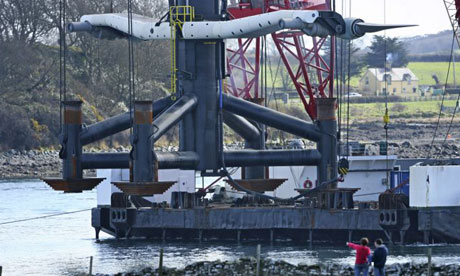
    SeaGen - the world's first and largest commercial scale tidal stream energy generator - was laid down in Strangford Lough, Northern Ireland

    There was widespread criticism that the rest of the budget did not include enough money for renewable energy such as tidal power. Photograph: Peter Muhy/Getty/AFP

    If they can actually do it, the government’s pledge to cut global warming emissions by one third in just over a decade should transform the way the UK economy works.

    However, critics warned that the cuts would still not be enough to avoid dangerous climate change, and warned that other spending pledges were not nearly enough to meet the target.

    Darling has now promised to cut greenhouse gases by 34% by 2020 through so-called carbon budgets, which fix binding limits on greenhouse gas emissions over five-year periods. The 34% target is in line with the advice of the government’s independent watchdog, the Committee on Climate Change. “This represents a step change in the UK ambition on climate change,” said the budget report.

    The budget report said the government “aims” to do this without purchasing controversial carbon credits from cuts made in other countries, but said these “offsets” could be a “fallback option”. It also said the target cut would be higher if there was “satisfactory” global agreement on cutting emissions, but stopped short of committing to the higher 42% cut recommended by the CCC in those circumstances.

    “These budgets give industry the certainty needed to develop and use low carbon technology – cutting emissions, creating new businesses and jobs,” said the chancellor.

    Nobody expected the government to reject the emissions targets put forward by its watchdog, which are designed to help reach a promised reduction of 80% by the middle of this century.

    However, the formal announcement makes the UK the first country in the world to set legally binding targets.

    Environmental campaigners and business groups commended the government on committing itself to firm targets. However, there were immediate warnings that not enough was being done.

    Friends of the Earth, the charity which led a mass public campaign for the Climate Change Act which created the targets, said the 34% cut was no longer enough.

    “Setting the first ever carbon budgets is a ground-breaking step – but the government has ignored the latest advice from leading climate scientists and set targets that are completely inadequate,” said Andy Atkins, the organisation’s executive director. “A 42% cut by 2020 is the minimum required if we are to play our part in avoiding dangerous climate change.”

    There was also widespread criticism that the rest of the budget did not include enough money for renewable energy like wind and tidal power, and energy efficiency for homes and other buildings. The budget also promised up to four “demonstration” projects for carbon capture and storage for coal and gas power plants, and £60m of new spending on research and development of the unproven technology, but critics said these partial capture schemes were not enough if the government goes ahead with plans for up to eight new coal plants.

    James Cameron, vice-chairman of Climate Change Capital, a low-carbon investment fund with more than US$1.5bn (£1bn) under management, said: “The idea of a carbon budget is to be applauded and must become a permanent feature of how we direct our economy. But the reality is that creating a low carbon economy requires more than high-level commitment. The scale of investment required is huge, and thus far the commitments to stimulate the economy and reduce emissions have been small gestures, albeit in the right direction. They have identified the correct areas to be targeting with strategic intervention but the orders of magnitude are much too small.”

    The budget report said a full strategy on how the targets will be met is due this summer, but that the “latest government modelling” showed it was on course to meet the 2020 and two interim targets.

    “The strategy will strengthen the long-term policy framework, taking into account recent consultations on heat and energy saving, renewable energy and zero carbon homes,” added the report.

  • Biogas reaches critical mass in Europe

    From Renewable Energy News

    The yard is piled high with stacks of wood. A local company collects it from the surrounding forests and brings it to the 2-MW gassification biomass power plant at Gussing in Burgenland in Austria.

    Biomass supplies Gussing with not only all of its own energy needs, but also allows it to feed surplus energy into the national grid – using only about a quarter of the amount of wood that regrows each year in the local forests.

    “We wouldn’t be able to use all the new wood there is out there,” said Christian Keglovits from the European Center for Renewable Energy in Gussing.

    About 47 percent of the land in Austria is covered in forest, and it is by tapping its rich timber resources that the country now plans to ramp up the proportion of renewables in its energy mix to meet an ambitious European Union goal, which was set in 2008.

    All the European Union countries are required to increase their use of renewable energies by an average of about 11 percent to boost the EU’s share of renewables in the energy mix from about 8.5% today to 20% by 2020.

    They’ve also been asked to increase energy efficiency by 20 percent compared to a business-as-usual scenario.

    In line with this, Austria has been given a national target of generating 34 percent of its energy from renewable sources by 2020, up from the 23.3 percent today.

    To meet the EU targets by 2020, Austria’s final energy consumption should be 1,406 PJ. Of that, about one-fifth, or around 280 PJ, is expected to come from biomass by 2020. In fact, biomass will be supplying more than half of the 519 PJ set to be generated by renewables in Austria, jumping ahead of the traditional hydropower resource.

    “If you look at all the countries in the top of the EU table when it comes to producing renewable energy, they all make use of bioenergy. Austria, Sweden, Latvia and Finland all have abundant forests. Bioenergy around the globe has a huge potential,” Kasimir Nemestothy, Austrian Chamber of Agriculture, told RenewableEnergyWorld.com.

    Nemestothy recently helped author a policy paper for the magazine Science (March 13th) arguing that America could apply some of the lessons from Austria’s biomass industry to tap its own gigantic bioenergy resources.

    Austria’s biomass sector has indeed been growing fast and furious out of the spotlight. In 2005, biomass contributed 176 PJ to Austria’s final energy consumption compared to 131 PJ in 2000.

    “Biomass could contribute much more than 280 PJ to Austria’s final energy consumption,” said Gregor Grill from Austria’s Biomass Association, a biomass industry umbrella organization.

    Sweden recently floated a plan to increase the country’s share of renewables to 50 percent by 2020, largely by using its biomass resources.

    The key to using bioenergy successfully is efficiency, says Grill. First, there has to be logistical and organizational efficiency when it comes to collecting wood, waste and straw and getting it to the biomass plant.

    Second, there has to be technological efficiency in converting the wood or straw or waste to energy. To improve the logistics of collecting wood economically, Austria is promoting a decentralized network of small-scale biomass plants rather than large-scale ones.

    “The key to bioenergy efficiency is integration and multipurpose use so we can get heat and electricity at the same time,” said Grill.

    Austria already has 120 combined heat and power (CHP) plants producing 320 MW of electricity. Grill said some of these CHP plants have a conversion rate of 60 to 70 percent.

    More than just a reliable resource, biomass is also flexible.

  • Wind drives back economic gloom

    From the American Wind Energy Association

    Washington, D.C. (April 13) –  Wind energy leaders in several categories maintained their #1 positions even as other leaders emerged in new categories, while 24 states saw new wind turbine and component manufacturing facilities opened, expanded or announced in 2008, according to the annual wind energy industry rankings report released today by the American Wind Energy Association (AWEA).

    The new listings, based on 2008 year-end numbers, show Texas leading in wind capacity and largest wind farms installed, Minnesota and Iowa both generating over 7% of their electricity from wind, and Indiana as the state with the fastest growth in wind on a percentage basis.

    In company rankings, NextEra Energy Resources (formerly FPL Energy) continues to lead in wind farm ownership; GE Energy remained the wind turbine maker with the largest amount of new capacity installed, and Xcel Energy again leads investor-owned utilities in wind power.  Wind power’s recent growth has also accelerated investment in manufacturing: wind turbine and turbine component manufacturers announced, added or expanded more than 55 facilities in 2008 alone, spanning 24 states from Alabama to Wisconsin.  

    “The wind energy industry today generates not only clean energy for our economy, but also hope and opportunity for American workers and businesses,” said AWEA CEO Denise Bode.  “Whether it is building or maintaining a wind project, or producing wind turbine components, you’ll find people employed in wind power in nearly all 50 states today,” Bode said.

    “But we cannot rest on past achievements. We need the right policies in place for our industry to maintain its momentum. A national Renewable Electricity Standard, requiring utilities to generate 25 percent of their electricity from renewable energy sources by 2025, is vital to provide the long-term, U.S.-wide commitment businesses need to invest tens of billions of dollars in clean energy installations and manufacturing facilities, and create hundreds of thousands of American jobs,” Bode said.

    Highlights from AWEA’s new report include:

    • Iowa, with 2,791 MW installed, surpassed California (2,517 MW) for the No. 2 position in wind power generating capacity.
    • The top five states in terms of capacity installed are: 
      • Texas, with 7,118 MW
      • Iowa, with 2,791 MW
      • California, with 2,517 MW
      • Minnesota , with 1,754 MW
      • Washington, with 1,447 MW
    • Oregon moved into the 1,000-MW club, which now counts seven states, including Texas, Iowa, California, Minnesota, Washington and Colorado.
    • Indiana ranked as the state with the fastest growth rate, expanding installations from zero to 131 MW, followed by Michigan (48%), Utah (21%), New Hampshire (17%) and Wisconsin (6%).
    • Two states – Minnesota and Iowa – now get over 7% of their electricity needs from wind.  Minnesota ranks first in this list (7.48%), followed closely by Iowa (7.1%).  The rest of the top five are Colorado, North Dakota, and New Mexico.
    • Ten new manufacturing facilities came online, 17 were expanded, and 30 were announced in 2008, according to AWEA estimates.  These investments and announcements span 24 states: Arkansas, Colorado, Iowa, Michigan, Nebraska, New York, Tennessee, Wisconsin, South Carolina, North Carolina, North Dakota, Oklahoma, Illinois, Alabama, Ohio, Indiana, Montana, Texas, Minnesota, Idaho, South Dakota, Pennsylvania, Oregon, and Massachusetts.
    • Approximately 85,000 people are employed in the wind industry today—a 70% increase from 50,000 a year ago—and hold jobs in areas as varied as turbine component manufacturing, construction and installation of wind turbines, wind turbine operations and maintenance, legal and marketing services, and more.
    • NextEra Energy Resources remains atop the list of project owners, with 6,290 MW of wind power assets, roughly 25% of the total installed in the U.S.  The three companies that make up the next 25% are Iberdrola Renewables, MidAmerican Energy (including PacifiCorp), and Horizon-Energia de Portugal.
    • GE Energy turbines accounted for 43% of all new capacity installed in the U.S. in 2008.  The rest of the top five include Vestas, which accounted for 13%, Siemens and Suzlon at 9% each, and Gamesa at 7%.  Several new companies–Acciona, REPower, Fuhrlander, DeWind and AWE–entered the U.S. market in 2008.
    • The wind power generating fleet of over 25,300 MW in place as of December 31,2008 will generate an estimated 73 billion kWh in 2009, enough to serve the equivalent of close to 7 million average U.S. homes.  

     
    The full annual rankings report is available on the AWEA Web site at www.awea.org/publications/reports/AWEA-Annual-Wind-Report-2009.pdf; the new annual Outlook brochure is available at http://www.awea.org/pubs/documents/Outlook_2009.pdf; and a state-by-state listing of existing and proposed wind energy projects is available at http://www.awea.org/projects.

  • World’s major rivers under threat

    From the UK Guardian

    Some of the mightiest rivers on the planet, including the Ganges, the Niger, and the Yellow river in China, are drying up because of climate change, a study of global waterways warned yesterday.

    The study by the National Center for Atmospheric Research in Colorado found that global warming has had a far more damaging impact on rivers than had been realised and that, overwhelmingly, those rivers in highly populated areas were the most severely affected. That could threaten food and water supply to millions of people living in some of the world’s poorest regions, the study warned.

    “In the subtropics this [decrease] is devastating, but the continent affected most is Africa,” said NCAR’s Kevin Trenberth. “The prospects generally are for rainfalls, when they do occur, to be heavier and with greater risk of flooding and with longer dry spells in between, so water management becomes much more difficult.”

    The scientists examined recorded data and computer models of flow in 925 rivers, constituting about 73% of the world’s supply of running water, from 1948-2004. It found that climate change had had an impact on about a third of the major rivers. More than twice as many rivers experienced diminished flow as a result of climate change than those that saw a rise in water levels.

    In addition, those rivers that did see a rise were in sparsely populated, high latitude areas near the Arctic Ocean where there is rapid melting of ice and snow.

    The authors said their study brought new clarity to an understanding of the long-term effects of climate change on waterways. “I think our study settles the question regarding long-term trends in global streamflow,” said Aiguo Dai, the lead author of the report.

    The greatest danger was posed to those dependent on the Niger in West Africa, the Ganges in South Asia and the Yellow river in China. The Colorado river in the US was also experiencing a drop in water levels.

    Other big rivers in Asia, such as the Brahmaputra in India and the Yangtze in China, remained stable or registered an increase in flow. But the scientists said they too could begin shrinking because of the gradual disappearance of the Himalayan glaciers.

    The only rivers that could gain strength from climate change were those that flow north of the 50th parallel. “Global warming raises temperature and precipitation there and it may not be a bad thing,” said Dai. “However, these are sparsely populated regions.”

    The study found that climate change, which had disrupted rain patterns and evaporation, had a far greater and more damaging effect on the world’s rivers than other human-made factors such as dams, and diverting water for irrigation. “For many of world’s large rivers the effects of the human activities on yearly streamflow are likely small compared with that of climate variations during 1948-2004,” the study said.

    It also had a knock-on effect because the rivers empty into the world’s oceans. As the rivers shrink, oceans were growing saltier. During the lifespan of the study, fresh water discharge into the Pacific ocean fell by about 6% – or roughly the annual volume of the Misssissippi.