Author: admin

  • US power company to tap solar energy in space


    US power company to tap solar energy in space

    Orbiting solar farms will be commercially viable within next seven years, says group

    solar farm

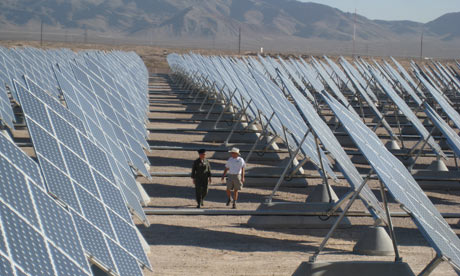
    Ground-based solar installations require huge tracts of land, and cannot produce a constant supply of electricity. Photograph: OLIVIA HAMPTON/AFP/Getty Images

    A leading American power company is hoping to turn science fiction into reality by supporting a project to set up solar panels in outer space and beam the electricity generated back to Earth.

    Pacific Gas and Electric Company, which serves San Francisco and northern California, has agreed to buy electricity from a startup company claiming to have found a way to unlock the potential power supply in space.

    The firm, Solaren Corp, says it will launch solar panels into orbit and then convert the power generated into radio-frequency transmissions, which will be beamed back down into a depot in Fresno, California. The energy would then be converted into electricity and fed into the regular power grid, PG&E said.

    Although spacecraft and satellites routinely use solar panels, the project marks the first serious attempt to take advantage of the powerful and near-constant supply of sunshine in space.

    Nasa and the Pentagon have been studying the idea of orbiting solar farms since the 1960s, and a number of private researchers have been looking at ways to tap into space-based solar energy.

    But Solaren Corp, founded by a former spacecraft engineer, says it has developed a technology that would make it commercially viable within the next seven years to transmit electricity generated in space to a terrestrial power grid.

    PG&E announced this week that it had agreed to buy 200 megawatts of electricity from Solaren starting in 2016. The deal has yet to be approved by California state government regulators and PG&E has not put any money into Solaren, but the promise alone has turned the notion of space based solar power from fantasy to reality.

    “There is a very serious possibility they can make this work,” said PG&E’s spokesman Jonathan Marshall.


    Unlike on earth, with its cycle of nights and days and where there can be clouds, sunshine in space is practically constant – aside from a few days around the spring and autumn equinoxes. That means the space-based solar panels could potentially produce a steady supply of electricity.

    The sunlight hitting solar panels 200 miles in space would be 10 times as powerful as the light filtering down to Earth through the atmosphere. The satellite would then convert the energy into radio waves and beam them down to a receiving station on Earth. Spirnak did not give details of how this would work but said the technology was based on that now used by communications satellites, describing it as “very mature”. He added that power losses via the radio-wave route are lower than transmission cables used on Earth. Another advantage of the plan is that it does not require large amounts of real estate. Ground-based solar installations require huge tracts of land.

    Solaren has released relatively few details about the project. But Solaren’s CEO, Gary Spirnak, said the company, a group of about 10 former satellite and aerospace engineers, was confident in the technology and timing behind the venture.

    He argued that the science behind the orbiting solar farms was little different to that of communications satellites. “This is the exact same thing that satellites do every day. The basic technology is there,” said Spirnak. “The bottom line is that this is not really a technology issue.”

    Daniel Kammen, a professor in energy and resources at the University of California, Berkeley, agreed: the most daunting challenge to Spirnak is cost.

    “The ground rules are looking kind of promising. Whether we can do it at scale, whether we can do it affordably, whether it is too much of a technological leap or not, those are all factors,” Kammen said. “It is doable. Whether it is doable at a reasonable cost, we just don’t know.”

    Spirnak argues that a confluence of recent events now make the project more commercially viable. The cost of rocket launches – though still prohibitive – has been dropping because of the commercialisation of space, making it cheaper to send up and service solar panels.


    Spirnak will face a difficult task raising funds for his project though, especially in this time of global economic recession. He said he was seeking in the low billions of dollars in investment – much higher than the usual $100m (£67m) to $200m costs for projects in renewable energy.
  • Climate change threatens Ganges, Niger and other mighty rivers

                                                                                    Neville Gillmore

    Climate change threatens Ganges, Niger and other mighty rivers

    water levels map

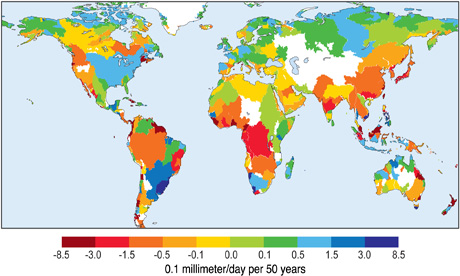
    This map shows the change in run-off inferred from streamflow records worldwide between 1948 and 2004, with bluish colors indicating more streamflow and reddish colors less. Graphic: Journal of Climate, modified by UCAR

    Some of the mightiest rivers on the planet, including the Ganges, the Niger, and the Yellow river in China, are drying up because of climate change, a study of global waterways warned yesterday.

    The study by the National Center for Atmospheric Research in Colorado found that global warming has had a far more damaging impact on rivers than had been realised and that, overwhelmingly, those rivers in highly populated areas were the most severely affected. That could threaten food and water supply to millions of people living in some of the world’s poorest regions, the study warned.

    “In the subtropics this [decrease] is devastating, but the continent affected most is Africa,” said NCAR’s Kevin Trenberth. “The prospects generally are for rainfalls, when they do occur, to be heavier and with greater risk of flooding and with longer dry spells in between, so water management becomes much more difficult.”

    The scientists examined recorded data and computer models of flow in 925 rivers, constituting about 73% of the world’s supply of running water, from 1948-2004. It found that climate change had had an impact on about a third of the major rivers. More than twice as many rivers experienced diminished flow as a result of climate change than those that saw a rise in water levels.

    In addition, those rivers that did see a rise were in sparsely populated, high latitude areas near the Arctic Ocean where there is rapid melting of ice and snow.

    The authors said their study brought new clarity to an understanding of the long-term effects of climate change on waterways. “I think our study settles the question regarding long-term trends in global streamflow,” said Aiguo Dai, the lead author of the report.

    The greatest danger was posed to those dependent on the Niger in West Africa, the Ganges in South Asia and the Yellow river in China. The Colorado river in the US was also experiencing a drop in water levels.

    Other big rivers in Asia, such as the Brahmaputra in India and the Yangtze in China, remained stable or registered an increase in flow. But the scientists said they too could begin shrinking because of the gradual disappearance of the Himalayan glaciers.

    The only rivers that could gain strength from climate change were those that flow north of the 50th parallel. “Global warming raises temperature and precipitation there and it may not be a bad thing,” said Dai. “However, these are sparsely populated regions.”

    The study found that climate change, which had disrupted rain patterns and evaporation, had a far greater and more damaging effect on the world’s rivers than other human-made factors such as dams, and diverting water for irrigation. “For many of world’s large rivers the effects of the human activities on yearly streamflow are likely small compared with that of climate variations during 1948-2004,” the study said.

    It also had a knock-on effect because the rivers empty into the world’s oceans. As the rivers shrink, oceans were growing saltier. During the lifespan of the study, fresh water discharge into the Pacific ocean fell by about 6% – or roughly the annual volume of the Misssissippi.

  • ACF urges Senators :fix CPRS, then pass it


    ACF urges Senators: fix CPRS, then pass it.         Neville Gillmore

    Date: 22-Apr-2009

    The climate change problem is too urgent and Australia has too much to lose for the Parliament not too fix the flaws in the Carbon Pollution Reduction Scheme (CPRS), the Australian Conservation Foundation told a Senate inquiry in Melbourne today.

    ACF executive director Don Henry told the Senate Select Committee on Climate Policy tens of thousands of lives, hundreds of thousands of jobs and some of Australia’s most beautiful places were at risk if Australia responded weakly to climate change.

    “This year’s heatwave and bushfires are a foretaste of a much worse future if we don’t act now,” Mr Henry said.

    “More than 50,000 jobs in the tourism and recreation sectors are dependent on a healthy and attractive Great Barrier Reef and thousands more jobs that depend on the ski fields, the Daintree Rainforest and Kakadu are similarly at risk.

    “A weak Australian and global response to climate change will condemn these Australian icons and many of the jobs that depend on them.  On the other hand, Australian leadership on climate change can generate more than half a million jobs and help achieve strong global action to avoid dangerous climate change.”

    Mr Henry said it was in Australia’s national interest that an agreement to substantially cut greenhouse pollution was reached at the global negotiations in Copenhagen in December.

    “We call on the Parliament to set strong Australian targets, not the existing weak targets, to cut emissions.  We call for the CPRS be fixed and passed this year.  In its current form it carries a high risk of entrenching Australia in a laggard position on climate change.” 

    Mr Henry said for the emissions trading scheme to be effective it must have a strong 2020 target to reduce emissions and strong measures to boost renewable energy and energy efficiency.

    “This Parliament has the unique chance to promote strong action on climate change at precisely the time it is needed. As a nation we have the opportunity to play a key role in averting the worst of climate change and promoting strong jobs growth in the clean economy of the future. I urge all Parliamentarians to grasp this historic opportunity now.”

    Find the full text of Don Henry’s opening statement here »

  • Atmospheric CO2 and Methane Still Building


     April 21, 2009, 12:27 pm

    Atmospheric CO2 and Methane Still Building      Neville Gillmore

    co2 on the riseNOAA The graph shows recent monthly mean carbon dioxide measured at the Mauna Loa Observatory, Hawaii (recent months are preliminary data).

    The National Oceanic and Atmospheric Administration is reporting that the concentrations of carbon dioxide and methane, the two most important greenhouse gases released through human activities, rose in 2008.

    The agency’s preliminary summary of greenhouse gas trends consolidates data from 60 monitoring stations around the world. A variety of factors shapes how much of these two gases remains in the atmosphere after they are emitted, which is one reason the global economic recession hasn’t become evident in the data yet, N.O.A.A. researchers said.

    The concentration of carbon dioxide has reached 386 parts per million in the air. The pre-industrial peak in concentrations was 280 parts per million (UPDATE: for at least the preceding 650,000 years or so). Some scientists, notably  James Hansen of NASA, say that a long-term target for the atmospheric concentration of the gas should be 350 parts per million. In this century, given continuing growth in the use of fossil fuels, many climate scientists see the concentration exceeding 450 parts per million or even 550 parts per million before stabilizing and — someday, perhaps — declining.

    Methane levels rose in 2008 for the second consecutive year after a 10-year plateau. As the agency put it, “Atmospheric concentrations increased by 4.4 molecules for every billion molecules of air, bringing the total global concentration up to 1788 parts per billion.” Methane persists only a few years in the air, but is about 25 times more efficient than carbon dioxide at trapping heat.

    In a printed statement, Pieter Tans of the agency’s Earth System Research Laboratory in Boulder, Colo., said the only way to stop growth in the atmospheric concentration of the gases is to reduce emissions enough that natural processes can keep pace. “Think of the atmosphere and oceans taking in greenhouse gases as  a bathtub filling with more water than the drain can empty, and the drain is very slow,” Dr. Tans said.

  • Plight of the Penguins


    Plight of the penguins            Neville Gillmore

    Already threatened by global warming, harvesting krill to supply omega-3 oil means danger for Antarctica’s penguins.

    Fifty years ago, delegates from 12 nations – including the United States, Norway and Japan – gathered in Washington DC to discuss how to protect Antarctica, the only continent without a native human population. The result was a treaty system that ensures Antarctica will continue to be used exclusively for peaceful purposes and not become an object of international discord.

    Yet as nations gather again to celebrate the Antarctic treaty system’s 50th anniversary this spring, new scientific research indicates that many species of penguins, some of the Antarctic’s most iconic residents, are in deep trouble.

    While the plight of the polar bear may be better known, emperor penguins are also going to be hit hard by the effects of global warming. Made famous by the documentary March of the Penguins, these flightless birds use the Antarctic’s sea ice as a breeding ground and base for feeding on krill, fish and squid. But projected changes in Antarctic sea ice due to global warming will dramatically change the environment for these penguins and countless other species.

    Indeed, a 2008 study by a number of leading penguin experts warned that “50% of Emperor colonies … and 75% of Adelie colonies … that currently exist at latitudes north of 70 degrees S are in jeopardy of marked decline or disappearance, largely because of severe decreases in pack-ice coverage.”

    Making matters worse, these penguins increasingly must compete with man for their principal food: a small, yet invaluable shrimp-like animal known as Antarctic krill. Measuring only five to six centimetres in size, krill comprise the largest biomass in the Southern Ocean. These tiny creatures, rich in the omega-3 oils used in health supplements, are seen by some corporations as a potential source of big profits.

    The Norwegian-based firm Aker Biomarine, one of the globe’s leading krill fishing companies, recently applied to have its Antarctic krill fishery certified by the Marine Stewardship Council (MSC). The council attempts to provide market-based tools to promote sustainably caught fish. To accomplish this, the MSC works with fisheries, seafood companies, scientists, conservation groups and the public to promote the best “environmental choice” in seafood. Yet while the council’s mission is important, certifying the krill fishery would stymie further efforts to more effectively conserve and manage Antarctic resources.

    Certifying a fishery like Antarctic krill is far more complex than it may seem. Although overall catches appear relatively low as compared to total krill abundance, uncertainties exist about the local impact of fishing operations since they often overlap with the feeding areas of krill predators.

    When it comes to krill and other forage species, MSC’s standards fall far short of achieving its goal of sustainability. In certifying a fishery, the council considers the sustainability of fish stocks – seeking to minimize environmental impacts and maximize effective management. The problem is that it measures mortality rates as though the animals were in an aquarium without predators. In reality, krill are part of a living system where there are many pressures apart from fishing. Yet, the MSC’s process to assess potential krill certification does not take adequate account of the role that krill serve in anchoring the Antarctic food chain.

    Furthermore, according to a recently published study by the National Science Foundation’s Long Term Ecological Research Programme, “Over the past 50 years, winter temperatures on the [Antarctic] Peninsula have risen five times faster than the global average.” Krill are sensitive to warmer waters and thus less abundant there. Nonetheless, climate change and the complexity of ecosystem interactions are not adequately accounted for in the current management process.

    Governments, acting jointly through administrative bodies of the Antarctic treaty system (such as the Commission for the Conservation of Antarctic Marine Living Resources) need to impose precautionary fishery management measures sufficient to ensure that enough krill are left to meet the needs of penguins and other predators. In the meantime, however, the MSC can do the right thing by agreeing not to certify the Antarctic krill fishery until the international community can enact proper protective measures.

    As the world prepares to celebrate 50 years of cooperation on Antarctic research and resources management, we shouldn’t stand idly by as the combination of careless fishing practices and unchecked global warming emissions speed the emperor penguins’ march to extinction.

  • Hundreds of millions will be hurt by climate change


    Hundreds of millions will be hurt by climate change, Oxfam warns.

    April 21, 2009       Neville Gillmore

    Article from:  Agence France-Presse

    HUNDREDS of millions of people will become victims of climate change-related disasters over the next six years, Oxfam said today, urging governments to change the way they respond to such events.

    The British-based aid and development charity estimated the number of people affected by climatic disasters would rise by 54 per cent to 375 million people a year on average by 2015, based on data on similar disasters since 1980.

    In a new report, it warned that humanitarian aid spending and the way it was allocated was far from prepared to meet the challenge.

    “The response is often fickle – too little, too late and not good enough,” said Oxfam chief executive Barbara Stocking.

    “The system can barely cope with the current levels of disasters and could be overwhelmed by a substantial increase in numbers of people affected. There must be a fundamental reform of the system.”

    The report, “The Right to Survive”, says governments can take action to mitigate the effect of climatic disasters, citing investment by Bangladesh in cyclone protection measures which has reduced the death toll from storms.

    “While there has been a steady increase in climate-related events, it is poverty and political indifference that make a storm a disaster,” Stocking said.

    Oxfam is also launching a new campaign urging rich countries to cut their greenhouse gas emissions by at least 40 per cent on 1990 levels by 2020 to tackle the source of global warming.

    Oxfam analysed data from the Centre for Research on the Epidemiology of Disasters at Louvain University in Belgium, which covered more than 6,500 climate-related disasters since 1980 and the numbers of people affected.

    It defines people “affected” by a disaster as those suffering physical injury or illness, those made homeless or who required immediate assistance.