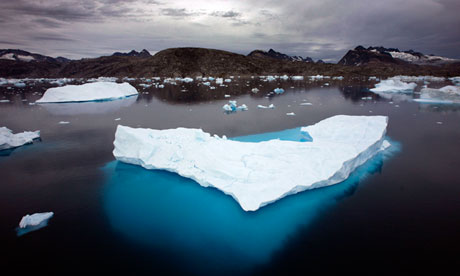
Prof Peter Wadhams calls for “urgent” consideration of new ideas to reduce global temperatures. Photograph: John Mcconnico/AP
One of the world’s leading ice experts has predicted the final collapse of Arcticsea ice in summer months within four years.
In what he calls a “global disaster” now unfolding in northern latitudes as the sea area that freezes and melts each year shrinks to its lowest extent ever recorded, Prof Peter Wadhams of Cambridge University calls for “urgent” consideration of new ideas to reduce global temperatures.
In an email to the Guardian he says: “Climate change is no longer something we can aim to do something about in a few decades’ time, and that we must not only urgently reduce CO2 emissions but must urgently examine other ways of slowing global warming, such as the various geo-engineering ideas that have been put forward.”
These include reflecting the sun’s rays back into space, making clouds whiter and seeding the ocean with minerals to absorb more CO2.
Wadhams has spent many years collecting ice thickness data from submarines passing below the arctic ocean. He predicted the imminent break-up of sea ice in summer months in 2007, when the previous lowest extent of 4.17 million square kilometres was set. This year, it has unexpectedly plunged a further 500,000 sq km to less than 3.5m sq km. “I have been predicting [the collapse of sea ice in summer months] for many years. The main cause is simply global warming: as the climate has warmed there has been less ice growth during the winter and more ice melt during the summer.
“At first this didn’t [get] noticed; the summer ice limits slowly shrank back, at a rate which suggested that the ice would last another 50 years or so. But in the end the summer melt overtook the winter growth such that the entire ice sheet melts or breaks up during the summer months.
“This collapse, I predicted would occur in 2015-16 at which time the summer Arctic (August to September) would become ice-free. The final collapse towards that state is now happening and will probably be complete by those dates”.
Wadhams says the implications are “terrible”. “The positives are increased possibility of Arctic transport, increased access to Arctic offshore oil and gas resources. The main negative is an acceleration of global warming.”
“As the sea ice retreats in summer the ocean warms up (to 7C in 2011) and this warms the seabed too. The continental shelves of the Arctic are composed of offshore permafrost, frozen sediment left over from the last ice age. As the water warms the permafrost melts and releases huge quantities of trapped methane, a very powerful greenhouse gas so this will give a big boost to global warming.”
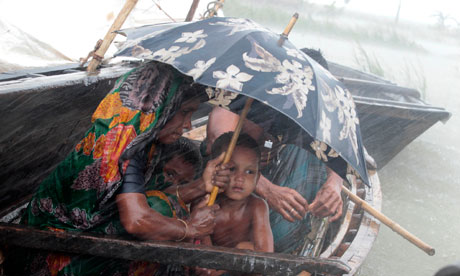
A woman sits in a boat with her children during heavy rains at a flooded village in Kurigram July 2012. Photograph: Andrew Biraj/REUTERS
In the wake of the continuing negotiations on climate change in Bangkok last week, businesses need to take action to improve the outcomes for future generations.
Number seven of the Children’s Rights and Business Principles launched by Unicef earlier this year is related to the environment. This has global relevance for all businesses, since all business activities impact directly or indirectly on the world that our children will inherit.
On a recent trip to Bangladesh, I found that climate-related disasters such as flooding were already having an effect on children’s lives. The country is making efforts to build multi-purpose cyclone shelters, which are also being used as schools. Yet these cyclone shelters, while necessary, may not be sufficient to protect the children in Bangladesh if the world is heading for global warming of more than 3°C.
The effects of climate change have a disproportionate impact on children as well as other vulnerable groups. Children and women are 14 times more likely to be killed in a disaster. Save the Children has found that half of all those affected in an emergency are children, and that an increase in climate-related disasters would mean millions would die or be forced to flee from their homes.
Climate change particularly affects agriculture and contributes to rising food prices. Unfortunately, children are particularly vulnerable to this, since malnutrition is already the underlying contributing factor in about one third of all child deaths. The global food crisis of 2008 had a huge impact on child and infant mortality.
Ecological debt
Like financial debt, ecological debt places a burden on children and future generations. This links to the debate over the recent financial crisis. There have been calls for businesses and investors to consider the triple bottom line of social, environmental, and economic sustainability – and to reward long-term value creation over the fast buck.
At the recent Rio+20 Conference, countries reiterated their commitment to protect the climate “for the benefit of present and future generations of humankind”. Should companies also consider this principle of intergenerational equity?
This principle would mean markets and businesses supply the needs of today, without disregarding the needs of tomorrow. Damaging ecosystems and making species extinct leaves an unwelcome legacy. There is the unsettling possibility that this generation might leave the Earth in a worse state than they found it. The recent study in Nature showed humanity may already be overstepping various planetary boundaries, including on biodiversity, nitrogen and climate change. Scientists have also warned that remaining deposits of several irreplaceable and finite mineral resources are being fast depleted.
Sourcing and supply chains
These business-as-usual trends will not just have external impacts, but systemic impacts that harm us all. Recognising the rights of children means companies should consider sourcing from renewable materials, as well as ensuring materials can be re-used, to preserve vital natural resources. Companies with global supply chains may also consider the impact of global operations on vulnerable communities.
For example, Fairtrade coffee companies have been working with their producers down the supply chain to help them become more resilient. The Fairtrade Foundation highlights that rising temperatures would be a disaster for the coffee industry. Reducing the vulnerability of children is low-cost, like ensuring a water supply, and can help develop skills across communities over a long time period.
In the UN climate talks in Bangkok earlier this month, the governments of high-emitting countries continued to avoid tackling the issue, often citing financial or competitiveness concerns. Yet in an interconnected world, all businesses will be affected by the emerging challenges for water, food and energy under climate change – of which the 2008 crisis may be a precursor.
The challenges for businesses are similar to those for governments and individuals: the tendency to focus on short-term rather than long-term concerns. The recession may have made this more difficult. However, with energy and input prices rising, there are clearly opportunities for businesses that move towards green growth. Innovative circular business models will reduce risks in a world where inputs are constrained.
Previously, corporate considerations of impacts on children were mainly limited to concerns about child labour or health. As the world begins to be hit by climate change, water and resource scarcity, as well as financial crisis, business leaders are in the pivotal position to make decisions that consider wider sustainability and respect the rights of children.
In the end, relying on growth that degrades basic resources will not only lead to catastrophe for our children but it is not a sustainable business model either.
Helena Wright is a doctoral researcher at Imperial College London and has attended the UN talks on climate change.
Majority support … 63 per cent of all voters would prefer Malcolm Turnbull as the Coalition leader. Photo: Andrew Meares
MALCOLM TURNBULL has stretched his lead over Tony Abbott as the preferred Liberal leader and for the first time has majority support among Coalition voters.
The latest Herald/Nielsen poll shows 63 per cent of all voters prefer Mr Turnbull as the Coalition leader, compared with 30 per cent for Mr Abbott.
Since the question was asked three months ago, Mr Turnbull’s support has risen 2 percentage points and support for Mr Abbott has fallen by 4 points.
A breakdown shows that in the past three months, support for Mr Turnbull among Coalition voters has risen 4 points to 53 per cent while Mr Abbott has fallen 5 points to 45 er cent, giving Mr Turnbull an eight-point lead.
Advertisement
Among Labor voters, Mr Turnbull remains very popular, with 73 per cent support compared with 19 per cent for Mr Abbott.
The poll of 1400 voters was taken from Thursday night to Saturday night and followed a rugged week for Mr Abbott in which he was subject to claims he physically intimidated a female political rival 35 years ago.
Also during the polling period, Mr Turnbull made a controversial but popular speech in which he lamented the current state of political discourse and the standards of parliamentary question time.
The poll showed Mr Turnbull more popular than Mr Abbott in all states and in both the city and the country. He was twice as popular than Mr Abbott among both male and female voters.
Mr Abbott deposed Mr Turnbull as the Opposition Leader in December 2009. Liberals say the party would never return to Mr Turnbull because he is unpopular among many colleagues, especially the right-wingers.
Only if Labor became competitive in the polls would there be pressure on Mr Abbott’s leadership. The poll shows that while Labor is clawing back slowly under Julia Gillard, an Abbott-led Coalition would win comfortably if an election were held today.
One scenario that could prompt a return to Mr Turnbull would be for Labor to replace Ms Gillard with Kevin Rudd, who, the poll shows, would lift Labor’s primary vote by 10 points and give it an election-winning lead.
Labor’s recovery under Ms Gillard appears to be occurring predominantly in Queensland and NSW, states in which Coalition governments have recently announced harsh budget cuts, including big job losses and cuts to front-line services in health and education.
The poll shows that in the past three weeks, federal Labor’s primary vote in NSW has risen 5 points to 35 per cent, the Liberals have stayed steady at 45 per cent and the Greens fell 5 points to 9 per cent.
In Queensland, where support for the new Premier, Campbell Newman, has declined, federal Labor’s primary vote has risen 4 points to 30 per cent in three weeks. The Coalition’s has fallen 5 points to 48 per cent.
The Coalition’s two-party-preferred vote lead over Labor in Queensland has fallen from 63-37 to 58-42.
Ms Gillard targeted Mr Newman’s ”brutal” budget cuts yesterday in a speech to the Queensland state ALP conference, her first public appearance since her father died last weekend. The government is seeking to portray what Mr Newman is doing as a small version of what Mr Abbott would do if he became prime minister.
”Newman’s budget razor is Abbott’s curtain raiser,” she said.
Labor was crushed in the Queensland state election in March. Ms Gillard told the party’s survivors there that they ”will be on the front line in the fight to come in 2013”, when the federal election is due.
”You are the sentries who can tell Australians what’s at risk, what would be coming,” she said. ”You’ve seen it. Tell your story, make sure they know.
”Every working Australian must know in 2013 what happened in Queensland in 2012.
”The fight is on, it’s the fight of our lives, let’s get out there and win it.”
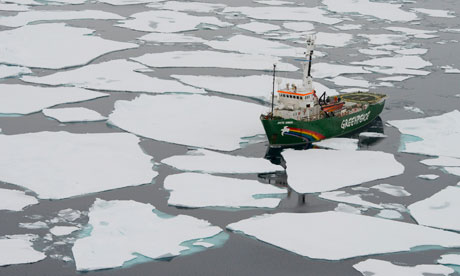
The Arctic Sunrise ship from the air during an expedition to the Arctic to document the lowest sea ice level on record. Photograph: Daniel Beltra/Greenpeace
Where is the ice? We are now at 83.20N which is very close to the north pole yet still there is no continuous ice cover (head here for more on my journey through the Arctic). We are mostly among small, thin, one- and two-year-old floes, with very little of the older, harder and more resilient “multiyear”, or permanent ice that you would expect in these latitudes.
Our ice pilot, Arne Sorensen, went up in the helicopter and found little change even as far north as 83.50 – just 350 miles from the pole. Just finding an ice floe big enough to moor the 50 metre-long Arctic Sunrise for the scientists aboard to conduct their experiments has proven harder than expected – something that many think is almost unheard of at this latitude.
The obvious inference is that the ice has retreated far further this year than before and we will need to check previous years’ satellite data to confirm this. But there may actually be far less ice in the Arctic than the satellite figures suggest.
In winter when the sea surface is frozen up here, scientists can be pretty sure how much ice there is. But in the summer months when the ice is melting and there’s much more water around, the satellite can become confused.
It can think that melt water sitting on the ice floes is open water; it may not be able to tell the size of the floes or the distance between them; it can have problems “seeing” the ice because of clouds and fog.
In short, the melting effect makes it much harder to quantify the amount of ice there is and the satellite tends to see more ice than there actually is. That’s why monitoring groups such as NSIDC or the university of Bremen try to compensate with weather filters or by calculating the ice extent over a number of days rather than on individual ones.
We know, here on the ship, how misleading the satellite data can be.
Here, possibly only 50% of the sea is covered in ice. Yet the data is telling the scientists that there is continuous ice cover at this latitude.
That’s why Julienne Stroeve, ice expert from NSIDC the folk expected to flag the record minimum ice extent record in a few days’ time – has been filming the ice conditions every few hours.
When she returns, she hopes to match her real-time observations of the ice conditions with the satellite data. She speculates that the low fog conditions we have experienced could be making it seem there is more ice than there actually is.
Either way, the situation is deadly serious. Both satellites and human observation suggests that the ice is now so thin over much of the arctic that it doesn’t matter how much it freezes in winter, because it will melt in the summer. That would mean ice-free summers in the arctic coming far sooner than the models have predicted.
Strangely, what we are beginning to see is just what the old Arctic explorers and visionaries such as Elisha Kane, Isaac Hayes, Captain W E Parry and Sir John Barrow hoped to find. It was widely believed from the 16th century that there was a tepid lake at the north pole, and that another continent lay beyond the ice. The problem facing explorers then was to get beyond the icepack which barred the route. It was this prospect of Arcadian lands that spurred these adventurers.
Today, the prospect of an ice-free Arctic and easy access to the other side of the world has become the dream of oil, mining and shipping companies. The profits they see inn in the ice free sea are similar to those seen by the British from a clear passage over the top of the world to China and the east.


 Email
Email