A federal coalition will finish the long-awaited upgrade of the Pacific Highway by stripping two billion dollars from a Sydney commuter rail project, a move backed by the NSW government but slammed by federal Labor and the Greens.
In a pitch to regional voters, including those in the former NSW Nationals seats now held by independents Rob Oakeshott and Tony Windsor, Nationals leader warren truss says Labor’s pledge to complete the Pacific works by 2016 is just another broken promise.
Mr Truss says a coalition government will deliver a four-lane highway from Sydney to Brisbane by ending a stand-off between cash-strapped NSW and the federal government.
But Federal Infrastructure and Transport Minister Anthony Albanese says the coalition’s plan means the Pacific Highway upgrade won’t be completed this decade.
And Greens transport spokeswoman Lee Rhiannon says expanding Sydney’s rail network should not be sacrificed to make the Pacific Highway safer and it shows the axe will fall on public transport under an Abbott government.
BLACKTOWN CITY COUNCIL has fallen to the Liberal Party in a knife-edge result that has embarrassed the Labor leader John Robertson, the state MP for the area.
The fall of Blacktown is another in a string of working-class areas in outer Sydney that swung away from Labor to the Liberals at last Saturday’s elections.
They include Liverpool, Auburn, Bankstown, Campbelltown and Parramatta.
In Blacktown, the swing was 10 per cent but it was the victory of independent Russ Dickens over Labor-endorsed independent Kathie Collins that will take the council out of Labor hands for the first time since 1989.
Advertisement
The NSW Electoral Commission confirmed the result on Friday, with Dr Dickens, a former mayor, prevailing by 868 votes.
Former Liberal councillor Nick Tyrrell said the area had rejected Labor. ”This has got to be an embarrassment for Robbo. In his own backyard, people are still throwing rocks at the ALP,” he said.
The new Liberal mayor is likely to be Jess Diaz, a migration lawyer whose son Jayme narrowly lost the seat of Greenway at the last federal election.
Labor Party assistant general secretary Jamie Clements said that there was no shame in the result for Mr Robertson, whose area overlays wards four and five, where the Labor vote held up. Those wards cover suburbs such as Blacktown, Doonside, Shalvey, Mount Druitt and St Marys.
”There has been significant demographic changes in Riverstone and Toongabbie and that’s where the vote was softer. It was only for the quality of the candidate in Nathan Rees that we hung on to Toongabbie at the state election,” he said.
Meanwhile, Nathaniel Smith, the son of the NSW Attorney-General, Greg Smith, has started his political career, with his election to Kogarah City Council. Mr Smith, a registered lobbyist, is expected to seek preselection to get into state Parliament.
”I’ve seen from my father how much work is involved in being a good politician and I am in no rush,” he told The Sun-Herald.
Despite the O’Farrell government’s laws that forced several MPs to relinquish council seats, there remains a strong link between local government and Macquarie Street.
Both electorate staff of the Mulgoa MP Tanya Davies were elected. Mark Holmes was elected in Blacktown and Patrick Conolly, the son of the Riverstone MP Kevin Conolly, at Hawkesbury council.
Steven Issa, son of the Granville MP Tony Issa, will replace him on Parramatta City Council.
Katherine O’Regan, the chief of staff for the Environment Minister, Robyn Parker, was elected as a Liberal on Woollahra council and will quit her role with the minister as per orders from the Premier, Barry O’Farrell.
Bernard Bratusa, media adviser to the Sports Minister, Graham Annesley, was waiting to learn whether he had been elected to Penrith City Council.
We can’t ignore it. It doesn’t matter how good our policies are if the message isn’t getting through to the electorate, he said. What is our strategy to fix the situation?
Hayes has a relatively safe seat, Fowler, with a margin of 8.7 per cent. But his seat includes part of Liverpool and the swings against Labor in the council elections, if replicated federally, could wipe him out. Labor did improve its vote in inner west areas, where the Greens lost a good deal of support, but in the outer west it was a bleak picture.
As the ABC’s psephologist, Antony Green, summarised: ”There were consistent swings of 5 per cent to 10 per cent from Labor to Liberal in Blacktown, Bankstown, Parramatta and Campbelltown.”
The results, Green said, revealed that Labor had not yet recovered from the drubbing it took at the state election 18 months ago.
”More worrying for Labor is that these results may also reflect attitudes to the Gillard government,” he said.
”For all the talk of federal Labor’s poor polling in Queensland and Western Australia, it is NSW where the real damage to Labor could be done at next year’s federal election.
”Labor still can’t recover its base in western Sydney, even at grassroots elections. It is a serious warning of how bad next year’s federal election defeat could be for Labor.”
So there was a good deal of caucus interest in Swan’s answer. The survival instinct focuses the mind.
The Deputy Prime Minister and Treasurer replied that the result was ”patchy”, with some good results and some not so good. He said that, at the same time, there were signs of a revival in the Labor vote in Queensland after the election of the Liberal National Party of Campbell Newman and with the anticlimax of the carbon tax.
Labor now had some more clear air to get out its message on jobs, education reform and health, Swan said.
It was designed to be reassuring but it didn’t amount to a strategy and it didn’t satisfy the MPs fearing that they could lose their seats.
A second backbencher from western Sydney, John Murphy, spoke up. Murphy is especially vulnerable. He holds his seat of Reid by a margin of 2.6 per cent.
He agreed with Swan that the ALP performance had been ”patchy” and cited two contrasting local experiences. The Labor mayor of Canada Bay council, Angelo Tsirekas, managed to win a 10 per cent swing in his favour.
But in Auburn, where Labor had long held an unassailable dominance, the party had been outpolled by the Liberals by a margin of two to one.
If that’s not an alarm, Murphy said, I don’t know what is. We’ve got to take notice and get into these communities, he urged. Canada Bay and Auburn fall within Murphy’s federal electoral boundaries.
Swan offered a reassurance that things would turn around but again offered no strategy. A third MP, Stephen Jones, echoed the concerns of Hayes and Murphy.
It was a moment of ironic tang for some in the room. Some caucus members remembered hearing Julia Gillard justify her coup against Kevin Rudd by saying that she was not so much troubled by the Rudd government’s difficulties but by the fact that he seemed to have no plan to get out of difficulty.
But as the week developed, something of an opportunity arrived for the Gillard government. It came from the Liberal Party. Not the kerfuffle over whether Tony Abbott did – or did not – intimidate a rival in student politics 35 years ago.
It was the staccato series of announcements from the Liberal state governments of plans to slash health and education services.
This provided the government with one opportunity after another to lambaste the Liberal premiers for their savage cuts and to warn that an Abbott government would do the same, only bigger. ”It’s a gift from heaven,” one Labor MP crowed.
By the middle of the week, Kevin Rudd helpfully appeared on TV live from Beijing to help the government frame its attack on the Liberals. The Liberal premiers were the entree, Rudd said, and Abbott was to be the main course.
Rudd supporters said his interview on 7.30 was a reminder of how effective he could be as a campaigner; Gillard supporters gnashed their teeth and accused Rudd of taking advantage of the Prime Minister’s bereavement to destabilise her government.
These two themes – a sense of creeping desperation among some in the caucus and the subterranean competitive tension between Gillard and Rudd – help make sense of the most remarkable political development of the week.
Last week, the government decided to allow the fishing supertrawler, formerly the Margiris but now known as the Abel Tasman, to catch its approved quota under strict conditions. But this week the government reversed its position and changed the law with the specific aim of stopping the ship from operating in Australian waters.
This was an extraordinarily erratic piece of work by any standard. The Environment Minister, Tony Burke, moved changes to the law specifically to ban such a vessel, aiming at one vessel in particular but only for one year.
The amendment to the Environment Protection and Biodiversity Conservation Act that the government successfully got through the House gives the Environment Minister an unfettered new power to ban commercial fishing if ”there is uncertainty about the environmental, social or economic impacts of the fishing activity”. And it’s enough for the uncertainty to exist only in the mind of the minister.
That’s sufficiently sweeping that the minister can stop anything at any time.
A number of ministers in the Gillard cabinet are privately appalled by the decision. They include the Minister for Agriculture and Fisheries, Joe Ludwig, who argued in the cabinet against arbitrary decisions and in defence of due process and the established scientific evaluation methods, and the Communications Minister, Stephen Conroy, who argued against whimsical bans on economic activity and in favour of commonsense – much as the entire government did last week in its decision on the sale of Cubbie Station to a Chinese-Australian consortium.
But surely the ban on the supertrawler was a prudent environmental decision to prevent overfishing?
Not at all. The quota to catch 18,000 tonnes of fish off Tasmania remains intact. It will just be fished by other vessels now, smaller ones. Not one fish’s life has been saved by the decision.
OK, but the ban will prevent the monster ship’s vast nets from killing dolphins and turtles as ”bycatch”, won’t it? Not at all. The supertrawler’s nets are the same size as the ones already in use on smaller vessels, as my Herald colleague Lenore Taylor has documented this week.
So why is it called a supertrawler? Because of the size of its capacity to process and refrigerate and store its catch, not because of the the size of its nets.
In fact, the strict conditions that Burke had already imposed on the Abel Tasman probably would have made it safer than the standard vessels in protecting dolphins and other bycatch. The conditions he laid down last week included the stipulation that two fisheries officials must be on board whenever it is fishing to monitor the catch and that it must position cameras in its nets to guard against collateral damage to species other than fish.
So what was it all about? It was a populist reversal by a government under attack from environmental campaigners at GetUp! and Greenpeace. And a panicked response to what the Coalition’s Greg Hunt has called ”the Ruddism that has infected the government”.
That is, policymaking by a government in fear of a Rudd leadership campaign. When a Labor backbencher, Melissa Parke, said she would move a private members’ bill to stop the trawler, she was soon supported by Kevin Rudd.
Fearing a backbench revolt led by Rudd, the Gillard cabinet reversed its own policy and made a populist decision that was unscientific and economically irrational. And despite superficial assumptions, it offers no improvement of environmental protection.
The Coalition called it ”government by GetUp!”. But, in truth, it is a government ruled by its own weakness. It is fearful of its electoral standing and fearful of a potential leadership challenge.
It has made a series of announcements of multibillion-dollar new promises that it cannot afford and now makes a populist, arbitrary and counterproductive policy decision that has some of its most senior members in despair. ”What we see is the collapse of the intellectual capacity of this government,” one cabinet minister lamented privately at the supertrawler decision.
The Gillard government says it is a year from an election, yet it is so busy campaigning that it is getting very sloppy at governing. The Labor caucus craves a strategy but it is getting a campaign and not a very rational one.
Vanishing Arctic ice is the planet’s white flag of surrender
The planet’s last great global ice melt left a benign and balmy climate in which civilisation was cradled: the new great melting heralds a grave threat to civilisation
A webcam at the north pole shows ice cap melting on 22 August 2012. Photograph: University of Washington/ North Pole Environmental Observatory/NOAA
Our planet is waving the white flag of surrender. But as the polar flag becomes ever more tattered, with holes scorched by hotter ocean waters, humanity pumps ever more globe-warming gases into the air.
The story of the Arctic ice cap is the story of modern environmentalism. In 1968, as satellites began to document the vast ice field blanketing the north pole, the iconic Earthrise image was beamed back to the ground. It revealed a planet of awesome beauty, deep blue oceans, verdant continents and crowned with at least 8m square kilometres of gleaming ice. The image kickstarted the global green movement.
In 2007, a new record was set for the minimum summer sea ice cover in the Arctic had halved. This furious flag waving attracted attention. That year, the world’s scientists declared the end of any doubt that our addiction to burning fossil fuels was changing the face of the planet. Al Gore expounded his inconvenient truth and the world seemed set to act.
Today, that 2007 record is smashed and the shredded white flag is now flickering rathering than flashing. But the danger is greater than even, even if the alarm signal is frayed.
The last great global ice melt the planet witnessed came 10,000 years ago at the end of a deep ice age. As glaciers retreated, a benign and balmy climate emerged in which the human race has flourished. Our entire civilisation is built on the warm soils left as the ice sheets melted.
Will this be the first great tipping point to tumble the world into a new and hostile climate regime, as the cooling, reflective ice vanishes? Will the new, warm Arctic radically alter the temperate weather enjoyed by Europeans, for whom global warming has seemed a distant concern?
We seem to be prepared to take that chance. The shrinking ice has not opened new leads for decisive global action to tackle climate change. Instead, in a vicious irony, the new channels are being exploited for oil and gas exploration, unearthing more of the very fuels driving the warming.
Decades from now, will today’s record sea ice low be seen as the moment when our Earthly paradise gave up the ghost and entered a hellish new era? I sincerely hope not, but with this global distress signal failing to attract attention, I fear the worst.
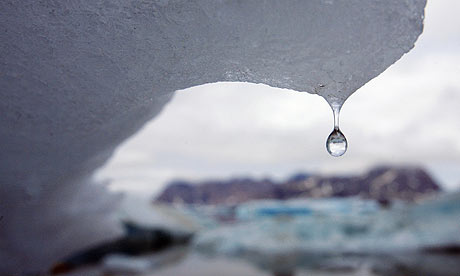
Satellite images show that the rapid summer melt has reduced the area of Arctic sea ice to less than 3.5 million square kilometres this week. Photograph: John Mcconnico/AP
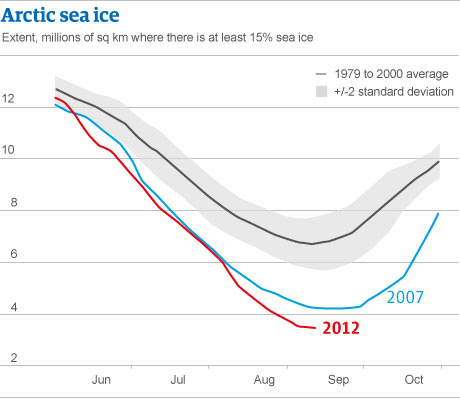
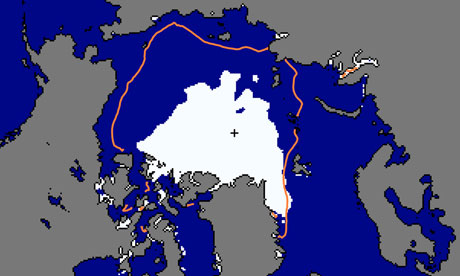
Sea ice in the Arctic has shrunk to its smallest extent ever recorded, smashing the previous record minimum and prompting warnings of accelerated climate change.
Satellite images show that the rapid summer melt has reduced the area of frozen sea to less than 3.5 million square kilometres this week – less than half the area typically occupied four decades ago.
Arctic sea ice cover has been shrinking since the 1970s when it averaged around 8m sq km a year, but such a dramatic collapse in ice cover in one year is highly unusual.
The record, which is based on a five-day average, is expected to be officially declared in the next few days by the National Snow and Ice Data Centre in Colorado. The NSIDC’s data shows the sea ice extent is bumping along the bottom, with a new low of 3.421m sq km on Tuesday, which rose very slightly to 3.429m sq km on Wednesday and 3.45m sq km on Thursday.
Scientists predicted on Friday that the Arctic Ocean could be ice-free in summer months within 20 years, leading to possibly major climate impacts. “I am surprised. This is an indication that the Arctic sea ice cover is fundamentally changing. The trends all show less ice and thinner ice,” said Julienne Stroeve, a research scientist with the NSIDC.
The shrinking of the ice cap was interpreted by environment groups as a signal of long-term global warming caused by man-made greenhouse gas emissions. A study published in July in the journal Environmental Research Letters, that compared model projections with observations, estimated that the radical decline in Arctic sea ice has been between 70-95% due to human activities.
“We are on the edge of one of the most significant moments in environmental history as sea ice heads towards a new record low. The loss of sea ice will be devastating, raising global temperatures that will impact on our ability to grow food and causing extreme weather around the world,” said John Sauven, director of Greenpeace UK.
Sea ice experts on Friday said they were surprised by the collapse because weather conditions were not especially conducive to a major melt this year. The ice is now believed to be much thinner than it used to be and easier to melt.
Arctic sea ice follows an annual cycle of melting through the warm summer months and refreezing in the winter. The sea ice plays a critical role in regulating climate, acting as a giant mirror that reflects much of the Sun’s energy, helping to cool the Earth.
David Nussbaum, chief executive of WWF-UK, said: “The disappearance of Arctic ice is the most visible warning sign of the need to tackle climate change and ensure we have a world fit to pass on to the next generation. The sheer scale of ice loss is shocking and unprecedented. This alarm call from the Arctic needs to reverberate across Whitehall and boardrooms. We can all take action to cut carbon emissions and move towards a 100% renewable economy.”
Ed Davey, the UK climate and energy secretary, said: “These findings highlight the urgency for the international community to act. We understand that Arctic sea-ice decline has accelerated over recent years as global warming continues to increase Arctic temperatures at a faster rate than the global average.
“This Government is working hard to tackle climate change and we are working closely with our international partners not to exceed 2 degrees above pre industrial levels. I am calling for the EU to increase its emission target from 20% to 30% and will be taking an active lead at the UNFCCC Climate change talks in Doha later this year, where I will push for further progress towards a new global deal on climate change and for more mitigation action now. The fact is that we cannot afford to wait”.
Canadian scientists said this week that the record melt this year could lead to a cold winter in the UK and Europe, as the heat in the Arctic water will be released into the atmosphere this autumn, potentially affecting the all-important jet stream. While the science is still developing in this area, the Met Office said in May that the reduction in Arctic sea ice was contributing in part to the colder, drier winters the UK has been experiencing in recent years.
Arctic sea ice extent on 12 September 2012, in white, compared with the 1979-2000 median, marked with a red line. Photograph: NSIDC
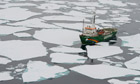
• John Vidal was hosted aboard a Greenpeace research vessel. The NGO did not have control over editorial copy


 Advertisement

 Email
Email