Author: admin

  • Warning to Israel: a lesson from history

    In many ways, Israel is similar to the medieval Crusader states in the Holy Land. It has a different religion and different institutions from all of its neighbours. It looks west for its military and economic support and if it were not for that support would be unlikely to survive for long.

    Just as with those states, Israel is secure for as long as it can rely on its western lifeline. In the short term there is little danger of this being cut (the crusader states lasted about 200 years too). The US will probably be the dominant global power for the rest of my lifetime but it won’t be for ever. Think how one would have written about the long term future of the British Empire a hundred years ago. So, in the long term and in Israel’s own interests, it needs to come to an accomodation with its neighbours.

    by Comment No. 478925
    Posted March 16 11:15
    on comment is free  in response to Josh Freedman Berthoud’s (phew!) article Identity on parade:
    `In entering the Eurovision song contest, Israel is making a strong assertion about how it wishes to be viewed by the rest of the world.’


  • World Bank threatens Congo’s rainforest

    World Bank plans to increase timber production in Congo threaten the environment and ignore the rights of forest dwellers.
    By Jean-Roger Kaseki, March 19, 2007 9:00 AM,

    In 2004, more than 100 environment, development, and human rights groups in the Democratic Republic of Congo called on the World Bank to stop plans that would carve up the world’s second-largest rainforest into industrial logging concessions.

    Photo by Michael K. NicholsInternal World Bank documents obtained by the Rainforest Foundation revealed that the bank intended to create a favourable climate for industrial logging in the Congo, and envisioned a 60-fold increase in the country’s timber production.
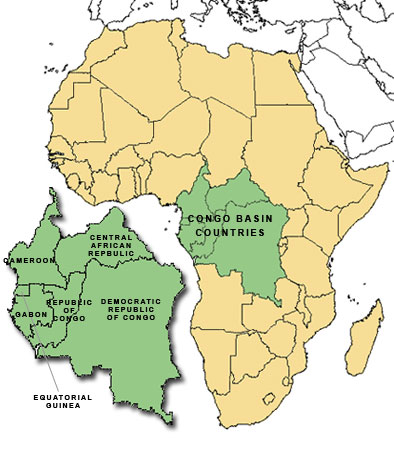
    Plans for the development of the forests would have major repercussions on the rights and livelihoods of millions of Congolese citizens, with serious and irreversible impacts on the forest environment.

    Map of the countries of Congo basinCovering around 1.3 million square kilometres, the rainforests of the Democratic Republic of Congo are the largest in the world after Amazonia, and have so far largely been spared extensive destruction. An estimated 35 million people live in and around these forests, including Bantu farmers, and Twa and Mbuti hunter-gatherer Pygmies.

    Full story on comment is free

    The Congo is the Earth’s second largest river by volume and has the world’s second largest rainforest (18% of the planet’s remaining tropical rainforest). The Congo Basin represents 70% of the African continent’s plant cover and makes up a large portion of Africa’s biodiversity with over 600 tree species and 10 000 animal species. Six nations – Cameroon, the Central African Republic, the Republic of Congo, the Democratic Republic of Congo, Equatorial Guinea and Gabon – share the 1.5 million square mile Congo basin.

    The Congo is one of the world’s most threatened ecosystems. Commercial logging, clearing for subsistence agriculture, and widespread civil strife has devastated forests, displaced forest dwellers, and resulted in the expansion of the “bushmeat” trade. Since the 1980s, Africa has had the highest deforestation rates of any region on the globe.

    Source: rainforests.mongabay.com/congo

  • Seeney accuses Qld gov of stealing water for profit

    Reference: Queensland Parliament, Record of proceedings, First Session of the Fifty-second Parliament, Thursday, 8 March 2007, p.795. The document is available at http://www.parliament.qld.gov.au/hansard

    Erisk Net, 14/3/2007

  • Tas gov fast tracks Gunns’ $2b pup mill

    Tasmania’s politicians would determine the fate of a $2 billion pulp mill, prompting claims the state was descending into “cronyism and corruption". Premier Paul Lennon announced cabinet backing for a fast-track assessment of Gunns Ltd’s project, outside the planning system, reported The Australian (16/03/2007, p.2).

    State fast tracks assessment after the Gunns shock: The fast track was agreed at emergency meetings of cabinet and the Labor caucus after Gunns on Wednesday withdrew the project from the independent planning process.

    No public debate: The new process – which sources said would involve assessment by expert consultants – would be put to a recalled state parliament this week. Sources said the assessment could be as short as two months, and no longer than five, with no input from the public.

    Parliament to have final say: Parliament would also have the final say on whether the biggest development proposal in the state’s history could be built on the Tamar River, near Bell Bay, in northern Tasmania.

    The blame game: Gunns claimed that delays before the Resource Planning and Development Commission, and its inability to come to a verdict before November, had forced its hand. However, the man appointed only last month to head the RPDC assessment, former judge Christopher Wright, has blamed Gunns for "all or most" of the delays.

    The Australian, 16/3/2007, p. 2

  • Water fills Lake Eyre

    South Australia’s Lake Eyre continues to fill with water from prolonged heavy rains in the north of the country.  Inital water from rains this season evaporated or were absorbed into the soil before reaching Lake Eyre, which is the lowest point on the continent.

    Lake Eyre


    A lone yacht takes a rare opportunity to sail in Lake Eyre. Photo: David Mariuz

    Source: theage.com.au