Author: admin

  • New Study Shows How Fast Ice Sheets Can Change

    New Study Shows How Fast Ice Sheets Can Change
    Climate Central
    How high and how fast sea level will rise is a crucial question for the coming century, and it all depends on how fast the giant ice sheets atop Greenland and Antarctica melt back and slide into the ocean as the planet warms. To try and figure out how
    See all stories on this topic »

    Web 3 new results for SEA LEVEL RISE
    Sea level change not so easy to measure | Newcastle Herald
    In 2011 another researcher looked specifically at the sea level rise in NSW over the 20th The question that needs to be asked is: why is sea level rise now
    www.theherald.com.au/…/sea-level-change-not-so-easy-to-me…
    Sea level restrictions rolled back | Bay Post
    The NSW Government has announced significant changes to the way the NSW coast will be managed, dropping the existing state-wide sea level rise planning
    www.batemansbaypost.com.au/…/sea-level-restrictions-rolled-…
    Sea levels re-think – ‘onerous’ – St George & Sutherland Shire Leader
    Special Minister for State Chris Hartcher announced on the weekend the government would drop ”onerous” statewide sea level rise planning benchmarks for
    www.theleader.com.au/…/sea-levels-re-think-onerous-benchm…
  • Big dry spell coming for Australia

    EL NINO????

    Big dry spell coming for Australia

    2
    Amber Colquhoun and Jenna Watt

    Big dry on the way … Amber Colquhoun and Jenna Watt enjoy the water at Bondi. Picture: Adam Taylor Source: The Daily Telegraph

    AUSTRALIA faces a big dry spell after our wettest two years on record, it was claimed today.

    A dramatic shift in ocean temperatures through the Pacific and Indian oceans is about to cause the dramatic shift in our weather, according to Tom Saunders, Senior Meteorologist at The Weather Channel.

    Australia is now rapidly drying out, he said this morning.

    “In July weather patterns started to shift, evident only a month later when the nation recorded its fifth driest August in 113 years of records,” Mr Saunders said.

    “The nation’s dry August was not just random variability, it was due to changes in water temperatures across the Pacific and Indian oceans.

    “A positive Indian Ocean Dipole (IOD) has now firmly developed off Australia’s west coast. A positive IOD refers to a pattern of colder waters off the west coast of Indonesia and warmer waters off the east coast of Africa. This reduces the amount of evaporation and moisture carried from the tropical oceans into the atmosphere over Australia, and this reduction in moisture eventually reduces rainfall through the country,” says Saunders.

    The effects of the abnormal ocean temperatures are already being felt.

    “Coolangatta has recorded its longest dry spell on record with 48 consecutive days without rain. Alice Springs is less than a week away from recording its longest dry spell on record while Brisbane has recorded only 0.2mm of rain over the past 54 days,” Mr Saunders said

    “When you combine the positive IOD with an emerging El Niño we are very confident rain will be below average over most of the country through the remainder of 2012, particularly through south-eastern states.”

    “Even though we are expecting below average rain there will still be short periods of relief. In the short term the dry spell for some parts of Australia including south-east Queensland will break, with a spell of storms and showers likely next week.’’

    Yesterday saw the first rain in Sydney for more than three weeks. Despite warnings of a big dry Sydney is forecast to see showers for most of next week after a mostly sunny weekend.

  • Benefits of thorium as alternative nuclear fuel are ‘overstated’

    Benefits of thorium as alternative nuclear fuel are ‘overstated’

    A report on thorium’s potential says the UK should continue to research the technology but downplays proponents’ claims

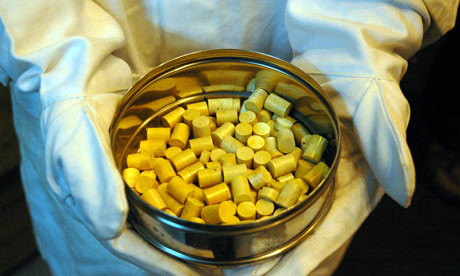
    India nuclear plans: Thorium pellets at the Bhabha Atomic Research Centre (BARC) in Mumbai

    Thorium, which has been hailed as an alternative nuclear fuel. Photograph: Pallava Bagla/Corbis

    The benefits of an alternative nuclear fuel that could offer a safer and more abundant alternative to the uranium that powers conventional reactors have been “overstated”, according a new government report on the potential of thorium.

    The report says the UK should continue to be engaged with the technology but downplays claims by thorium proponents who say that the radioactive chemical element makes it impossible to build a bomb from nuclear waste, leaves less hazardous waste than uranium reactors, and that it runs more efficiently.

    “Thorium has theoretical advantages regarding sustainability, reducing radiotoxicity and reducing proliferation risk,” states the report, prepared for the Department of Energy and Climate Change by the National Nuclear Laboratory (NNL). “While there is some justification for these benefits, they are often overstated.”

    Some of NNL’s hesitance comes from UK utility companies’ unwillingness to invest the money in research and development necessary to draw out thorium’s advantages.

    “Nevertheless, it is important to recognise that worldwide there remains interest in thorium fuel cycles and this is not likely to diminish in the near future,” the report concludes. “It may therefore be judicious for the UK to maintain a low level of engagement in thorium fuel cycle research and development by involvement in international collaborative research activities.”

    The report notes that thorium’s advantages would be most noticeable in reactor types other than the conventional solid fuel, water-cooled reactors used in almost all of the world’s commercial nuclear electricity stations today.

    In particular, a design known as a very high temperature reactor is “especially well suited to thorium fuels,” NNL states. The old UK Atomic Energy Authority built and operated an experimental thorium-fueled high temperature at Winfrith in the 1960s and 70s. The reactor, nicknamed Dragon, is partially decommissioned.

    Several thorium initiatives are under way outside the UK. In the US, Flibe Energy is developing a thorium reactor based on designs developed in the 1960s by the US Department of Energy’s Oak Ridge National Laboratory in Tennessee.

    China is also developing different types of thorium reactors, and India is expected to start construction in four or five years of one that uses solid thorium fuel.

    Thorium is an abundant, mildly radioactive element that occurs naturally around the world. The largest reserves exist in Australia, the US, Turkey, India, Brazil and Venezuela, according to the World Nuclear Association.

  • War is what America knows how to do best.

    War is what America knows how to do best.

    the United States is alone on the planet, not just in its ability, but in its willingness to use military force in drug wars, religious wars, political wars, conflicts of almost any sort, constantly and on a global scale. No other group of powers collectively even comes close. It also stands alone as a purveyor of major weapons systems and so as a generator of war. It is, in a sense, a massive machine for the promotion of war on a global scale.

    We have, in other words, what increasingly looks like a monopoly on war. There have, of course, been warrior societies in the past that committed themselves to a mobilized life of war-making above all else. What’s unique about the United States is that it isn’t a warrior society. Quite the opposite.

    Washington may be mobilized for permanent war. Special operations forces may be operating in up to 120 countries. Drone bases may be proliferating across the planet. We may be building up forces in the Persian Gulf and “pivoting” to Asia. Warrior corporations and rent-a-gun mercenary outfits have mobilized on the country’s disparate battlefronts to profit from the increasingly privatized twenty-first-century American version of war. The American people, however, are demobilized and detached from the wars, interventions, operations, and other military activities done in their name. As a result, 200 Marines in Guatemala, almost 78% of global weapons sales, drones flying surveillance from Australia — no one here notices; no one here cares.

    War: it’s what we do the most and attend to the least. It’s a nasty combination.

    For the full and most interesting text click here.

  • Dear Climate Institute News Subscriber,

    On Fri, Sep 14, 2012 at 1:50 AM, Climate Institute <info@climate.org> wrote:

    Dear Climate Institute News Subscriber, 

    The latest issue of Climate Alert is now online at: http://www.climate.org/publications/climate-alert.html. This special issue examines climate change in the Arctic and potential mitigation strategies for short-lived climate forcers. The pdf version is also attached. 

    In other news, Climate Institute recently created a blog about innovative solutions for climate change and other environmental problems. You can access the Smart Solutions blog here: http://climate.org/smart-solutions/.

    We appreciate your continued interest in Climate Institute activities. If you would like to support Climate Institute’s efforts, you may donate here: http://www.climate.org/about/donate.html.


    Climate Institute
    900 17th St NW, Suite 700
    Washington DC 20006
    (202) 552-4723

  • Open-cut mine threat to Gardens of Stone

    Open-cut mine threat to Gardens of Stone

    0
    Macarthur Coal's Coppabella coal mine

    Conservationists fear open-cut mining will destroy one of the state’s most stunning landscapes at Ben Bullen State Forest. Source: Supplied

    A MASSIVE open-cut coal mine which would raze almost 1000ha of state forest has outraged conservationists, raised major health concerns, split the local community and sparked claims of increased power bills if it is not approved.

    Coalpac wants to expand its mining operations at Cullen Bullen on the western shoulders of the Blue Mountains near Lithgow to include open-cut coal mining in the Ben Bullen State Forest bordering the famed Gardens of Stone National Park.

    Conservationists fear open-cut mining will destroy one of the state’s most stunning landscapes and create health issues from dust, blast emissions and noise pollution from the proposed 24-hour-a-day operation.

    Public hearings into development consent for Coalpac’s proposal are to begin next week.

    “This sort of hillside open-cut coal mining below scenic cliff lines is unprecedented,” Colong Foundation for Wilderness director Keith Muir said.

    Coalpac CEO Dr Ian Follington warned power prices could rise and the company faced a bleak future if the proposal was not approved.