Author: admin

  • Green news roundup: Climate minister, badger cull and Arctic sea ice

    Green news roundup: Climate minister, badger cull and Arctic sea ice

    The week’s top environment news stories and green events

    If you’re not already receiving this roundup, sign up here to get the briefing delivered to your inbox

    Climate change minister Greg Barker

    Environment news

    Questions over climate change minister’s links to his adviser
    World’s 100 most endangered species listed
    Asian frogs becoming extinct before they can be identified, biologists warn
    Activists plan to disrupt autumn badger cull after court appeal fails
    Rising number of top firms believe climate change is threat to business
    Climate activists target Shell with ice protest over Arctic drilling
    Climate change will extend hay fever season by six weeks, report warns

    On the blogs

    John Vidal in the arctic : Greenpeace MY Arctic Sunrise ship expedition to the Arctic

    Tracking polar bears across the Arctic ice
    Wind energy could surpass global power demand – with huge hurdles
    Cycling in China: not for the faint-hearted
    George Monbiot: The great riches of our seas have been depleted and forgotten

    Multimedia

    week in wildlife : sun shines through mist behind trees, Elkton, Oregon

    The week in wildlife – in pictures
    The Cold Edge – Polar Photography by Dave Walsh – in pictures
    Brian May responds to badger cull defeat – video
    100 most endangered species: priceless or worthless? – in pictures
    Nowhereisland leaves its final port of call – big picture
    British wildlife photography awards 2012 – in pictures

    Features

    Javan rhinoceros in Ujung Kulon National Park, Java, Indonesia

    Javan rhino clings to survival in last forest stronghold
    Dolphin murals spark marine awareness campaign in Philippines
    Yangtze finless porpoise: China’s national treasure disappearing fast

    Green jobs

    Architectural Conservation & Development Officer jobs, St Helena government, South Pacific, £40k pa taxable
    Community Project Officer, Groundwork London, £21,000
    Research Officer – Water Policy Programme, Overseas Development Institute, London, £26,004 to £36,486 per annum

    … And finally

    Terry Nutkins: what are your fondest memories?
    For Shiona Tregaskis, the legacy of Terry Nutkins – who died of leukaemia aged 66 on Thursday – was to inspire her to smuggle her pet rat into school

    • SKY_Sustainable_Business_NY_101012
    • Button_Int_Dev_Achievement_Award_Voting_071012
    • Button_Guardian_Subscription_Bundles_DAILY


    You are receiving this email because you are a Green Light subscriber.

    Click here if you do not wish to receive Green Light emails from the Guardian News and Media.
    Click here to find out about other Email Services from the Guardian.

    Guardian News & Media Limited – a member of Guardian Media Group PLC. Registered Office: Kings Place, 90 York Way, London, N1 9GU. Registered in England No. 908396

  • Gosford Council changes tide mapping

    Gosford Council changes tide mapping

    GOSFORD Council is set to change the way sea level rise mapping is displayed on its website – and the Coastal Residents Group is celebrating.

    The group had been agitating for changes to the mapping, which they said was highly confusing.

    “This is a big step and we are pleased reference to a one-in-a-100-year flood scenario is to be removed from sea level rise maps,” Coastal Residents Group secretary Pat Aiken said. “There will no longer be potential for that information to be misunderstood.

    “It also takes away any opportunity for insurance companies to take advantage of misinformation in setting premiums.”

    Mr Aiken said there was still work to be done and he looked forward to a period of community consultation on the new mapping.

    “The king tide information could still be open to misinterpretation,” he said.

    “We need more information on these tides, so that people understand what impact that could have on their properties.”

    ADDED BENEFIT

    “It also takes away any opportunity for insurance companies to take advantage of misinformation in setting premiums,” Mr Aiken said.

  • Hansen still argues 5m 21st C sea level rise possible

    With all the bilge that the NSW Govt. and Councils are spruiking, this
    is the more likely scenario. They are not listening. Sandbagging will not
    block this rise out. They are living in a fools paradise.
    I am glad that in Leura we are about 1000 metres above sea level.

    Would they bother to read Hansen’s report moreover understand it?

    Hansen still argues 5m 21st C sea level rise possible

    by Stuart Staniford

    This is interesting – here is the latest paper from James Hansen and coauthor Miki Sato Paleoclimate Implications for Human-Made Climate Change. If you are up to reading climate science papers it’s highly recommended (I’m a little slow in getting to it – the press release was Dec 8th 2011 but I just got to reading it yesterday and today).
    A little background is in order – one of the serious scientific debates in the climate science community over the last decade has been the implications of the unexpectedly large acceleration of glacier discharge in Greenland and Antarctica and in particular a discovery by Zwally et al in 2002 that surface melt water can get down the base of a glacier and lubricate its motion. Prior to the early 2000s it was assumed that ice sheets would decay mainly by melting on the surface and climate models all assumed that they would decay only very slowly in a warmer world – it was a surprise to realize that the most important breakdown mode was actually basal lubrication and sliding down into the ocean.
    Hansen in particular became the leading spokesman for the view that the ice sheets on Greenland and parts of Antarctica would prove quite unstable under Anthropocene conditions and might break down in a rapid non-linear manner and cause very large levels of twenty-first century sea level rise. See for example this essay from 2005 in which he says:

    Consider the situation during past ice sheet disintegrations. In melt-water pulse 1A, about 14,000 years ago, sea level rose about 20 m in approximately 400 years (Kienast et al., 2003). That is an average of 1 m of sea level rise every 20 years. The nature of glacier disintegration required for delivery of that much water from the ice sheets to the ocean would be spectacular (5 cm of sea level, the mean annual change, is about 15,000 cubic kilometers of water). “Explosively” would be an apt description, if future ice sheet disintegration were to occur at a substantial fraction of the melt-water pulse 1A rate.
    Are we on a slippery slope now? Can human-made global warming cause ice sheet melting measured in meters of sea level rise, not centimeters, and can this occur in centuries, not millennia? Can the very inertia of the ice sheets, which protects us from rapid sea level change now, become our bete noire as portions of the ice sheet begin to accelerate, making it practically impossible to avoid disaster for coastal regions?

    This kind of nigh-apocalyptic rhetoric from a very senior and respected climate scientist provoked a flurry of papers in response seeking to analyze the situation. Most of these suggested various reasons why 21st century sea level rise, while likely worse than previously projected (for example in the 3rd IPCC report in 2001), would not be as bad as the worst fears of Hansen. Hansen and Sato’s own description of this new literature seems fair to me:

    Rahmstorf (2007) made an important contribution to the sea level discussion by pointing
    out that even a linear relation between global temperature and the rate of sea level rise, calibrated with 20th century data, implies a 21st sea level rise of about a meter, given expected global warming for BAU greenhouse gas emissions. Vermeer and Rahmstorf (2009) extended Rahmstorf’s semi-empirical approach by adding a rapid response term, projecting sea level rise by 2100 of 0.75-1.9 m for the full range of IPCC climate scenarios. Grinsted et al. (2010) fit a 4-parameter linear response equation to temperature and sea level data for the past 2000 years, projecting a sea level rise of 0.9-1.3 m by 2100 for a middle IPCC scenario (A1B). These projections are typically a factor of 3-4 larger than the IPCC (2007) estimates, and thus they altered perceptions about the potential magnitude of human-caused sea level change.
    Alley (2010) reviewed projections of sea level rise by 2100, showing several clustered around 1 m and one outlier at 5 m, all of these approximated as linear in his graph. The 5 m estimate is what Hansen (2007) suggested was possible under IPCC’s BAU climate forcing. Such a graph is comforting – not only does the 5-meter sea level rise disagree with all other projections, but its half-meter sea level rise this decade is clearly preposterous.
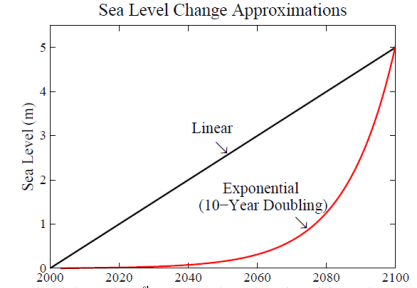
    However, the fundamental issue is linearity versus non-linearity. Hansen (2005, 2007) argues that amplifying feedbacks make ice sheet disintegration necessarily highly non-linear, and that IPCC’s BAU forcing is so huge that it is difficult to see how ice shelves would survive. As warming increases, the number of ice streams contributing to mass loss will increase, contributing to a nonlinear response that should be approximated better by an exponential than by a linear fit. Hansen (2007) suggested that a 10-year doubling time was plausible, and pointed out that such a doubling time, from a 1 mm per year ice sheet contribution to sea level in the decade 2005-2015, would lead to a cumulative 5 m sea level rise by 2095.
    Nonlinear ice sheet disintegration can be slowed by negative feedbacks. Pfeffer et al.
    (2008) argue that kinematic constraints make sea level rise of more than 2 m this century
    physically untenable, and they contend that such a magnitude could occur only if all variables quickly accelerate to extremely high limits. They conclude that more plausible but still accelerated conditions could lead to sea level rise of 80 cm by 2100

    I had been following this debate and reading the papers in question and had been somewhat reassured that 21st century sea level rise would be not too problematic for civilization at large (though it clearly would be very painful for coastal property owners and jurisdictions).
    (Before we go on it’s worth emphasizing the important aside – hardly any climate scientists doubt that huge quantities of the Greenland and Antarctic ice sheets would eventually melt and cause tens of meters of sea level rise as a result of human climate modifications – the debate is solely about how much of the consequences of our actions we will experience in the 21st century).
    However, Hansen is not reassured by these new papers and is doubling down:

    The kinematic constraint may have relevance to the Greenland ice sheet, although the assumptions of Pfeffer at al. (2008) are questionable even for Greenland. They assume that ice streams this century will disgorge ice no faster than the fastest rate observed in recent decades. That assumption is dubious, given the huge climate change that will occur under BAU scenarios, which have a positive (warming) climate forcing that is increasing at a rate dwarfing any known natural forcing. BAU scenarios lead to CO2 levels higher than any since 32 My ago, when Antarctica glaciated. By mid-century most of Greenland would be experiencing summer melting in a longer melt season. Also some Greenland ice stream outlets are in valleys with bedrock below sea level. As the terminus of an ice stream retreats inland, glacier sidewalls can collapse, creating a wider pathway for disgorging ice.
    The main flaw with the kinematic constraint concept is the geology of Antarctica, where large portions of the ice sheet are buttressed by ice shelves that are unlikely to survive BAU climate scenarios. West Antarctica’s Pine Island Glacier (PIG) illustrates nonlinear processes already coming into play. The floating ice shelf at PIG’s terminus has been thinning in the past two decades as the ocean around Antarctica warms (Shepherd et al., 2004; Jenkins et al., 2010). Thus the grounding line of the glacier has moved inland by 30 km into deeper water, allowing potentially unstable ice sheet retreat. PIG’s rate of mass loss has accelerated almost continuously for the past decade (Wingham et al., 2009) and may account for about half of the mass loss of the West Antarctic ice sheet, which is of the order of 100 km^3 per year (Sasgen et al., 2010).
    PIG and neighboring glaciers in the Amundsen Sea sector of West Antarctica, which are also accelerating, contain enough ice to contribute 1-2 m to sea level. Most of the West Antarctic ice sheet, with at least 5 m of sea level, and about a third of the East Antarctic ice sheet, with another 15-20 m of sea level, are grounded below sea level. This more vulnerable ice may have been the source of the 25 ± 10 m sea level rise of the Pliocene (Dowsett et al., 1990, 1994). If human-made global warming reaches Pliocene levels this century, as expected under BAU scenarios, these greater volumes of ice will surely begin to contribute to sea level change. Indeed, satellite gravity and radar interferometry data reveal that the Totten Glacier of East Antarctica, which fronts a large ice mass grounded below sea level, is already beginning to lose mass (Rignot et al., 2008).

    However, probably their main point is that the data we have on the Antarctic/Greenland meltdown is relatively short and is consistent with the idea that it’s doubling with a relatively short (decade or less) timescale and if you extrapolate that out over the 21st century you get to very large values of sea level rise (a point I made in a blog post back in 2006). This leads them to include this figure (which I take to be a conceptual sketch rather than an exact forecast):

    The picture that emerges is a relatively slow manageable sea level rise in the first part of the century followed by increasingly catastrophic levels of change in the latter part of the century as the rapid breakdown of the ice sheets overwhelms everything else.
    I take Hansen’s opinions very seriously. It’s certainly true that there isn’t enough data to rule out this scenario yet (though another decade of data should help a lot). Obviously at this point he hasn’t succeeded in persuading most of his colleagues, but neither have they persuaded him. Only more data is likely to resolve the situation.

    Original article available here

  • Anti-super trawler bill passes

    Anti-super trawler bill passes

    AAPSeptember 13, 2012, 5:36 pm

    A controversial super trawler will be banned from fishing in Australian waters for at least two years after federal government legislation passed the lower house.

    The bill will prevent the 142m Abel Tasman, formerly known as the Margiris, from fishing for its 18,000 tonne quota in seas stretching from southern Queensland to Western Australia.

    The Environment Protection and Biodiversity Conversation Amendment (Declared Fishing Activities) Bill 2012 was passed with the support of key independent MPs Craig Thomson, Andrew Wilkie and – at the 11th hour – independent MP Rob Oakeshott.

    Environment Minister Tony Burke moved several amendments to appease crossbench and coalition concerns about the reach of the bill.

    Existing fishing operations and recreational fishing won’t be caught up in the new laws, which will only cover environmental concerns, not social and economic ones.

    At the request of independent MP Rob Oakeshott, new bans cannot be made after 12 months from the bill taking effect, giving time for a promised review of fisheries management to take place.

    All the amendments were voted in the affirmative

    AAPSeptember 13, 2012, 5:36 pm

    A controversial super trawler will be banned from fishing in Australian waters for at least two years after federal government legislation passed the lower house.

    The bill will prevent the 142m Abel Tasman, formerly known as the Margiris, from fishing for its 18,000 tonne quota in seas stretching from southern Queensland to Western Australia.

    The Environment Protection and Biodiversity Conversation Amendment (Declared Fishing Activities) Bill 2012 was passed with the support of key independent MPs Craig Thomson, Andrew Wilkie and – at the 11th hour – independent MP Rob Oakeshott.

    Environment Minister Tony Burke moved several amendments to appease crossbench and coalition concerns about the reach of the bill.

    Existing fishing operations and recreational fishing won’t be caught up in the new laws, which will only cover environmental concerns, not social and economic ones.

    At the request of independent MP Rob Oakeshott, new bans cannot be made after 12 months from the bill taking effect, giving time for a promised review of fisheries management to take place.

    All the amendments were voted in the affirmative.

  • Support GET-UP . Avaaz 350 org and Greenpeace

    Dear readers

    Due to loss of voters support, it is unlikely that
    the Greens will be able, after the next Federal Election,
    to provide the political clout necessary to fight the
    issues being highlighted on the GENERATOR.

    I suggest to readers that they subscribe to groups
    on the front line such as GET-UP , AVAAZ, 350 org
    and Greenpeace. Get-Up and Avaaz have millions of
    members and subscribers, and can very quickly organise
    Petitions, protests, rallies etc. These groups will be vital
    in future campaigns.

    I am a former Greens Member and resigned over actions
    taken over the BDS/Palestine-Israel sanctions proposal.
    This has caused many problems in the NSW Greens, and
    has resulted in factional disputes, which is affecting their
    voter base.

    I will continue to post important items on the Generator,
    but we need the continued support of these very powerful
    action groups, if we are to effectively fight the issues
    that are emerging.

    So Support and contribute. It is emerging as our only
    course available.

    PEOPLE POWER PUTS FEAR INTO THE HEARTS AND MINDS OF POLITICIANS.

    Neville Gillmore.

  • 4 days to stop a corporate Death Star

    4 days to stop a corporate Death Star

    Inbox
    x

    Iain Keith – Avaaz.org
    12:45 PM (33 minutes ago)

    to me

    Dear friends,

    We have four days to stop a top-secret global corporate power grab that attacks everything from a free Internet to environmental protections. This agreement is being negotiated right now by bureaucrats backed by corporate lobbyists. Click below to crash their secret meeting with our global call to kill the TPP deal:

    Details are leaking of a top-secret, global corporate power grab of breathtaking scope — attacking everything from a free Internet to health and environmental regulations, and we have just 4 days to stop it.

    Big business has a new plan to fatten their pockets: a giant global pact, with an international tribunal to enforce it, that is kept top secret for years (even from our lawmakers!) and then brought down like a Death Star on our democracies. Big Tobacco, Big Oil, Big Pharma, Walmart and almost 600 other corporate lobbyists are all in on the draft — including limits on smoking laws, affordable medicines and free speech on the Net.

    The latest round of negotiations ends in just 4 days — but outcries in each of our countries could shake the confidence of negotiators and scuttle the talks forever. Let’s get to a million against the global corporate takeover. Sign below and forward widely. Avaaz will project our petition counter on the walls of the conference so negotiators can see the opposition to their plan exploding in real time:

    http://www.avaaz.org/en/stop_the_corporate_death_star/?bhPqncb&v=17866

    The deal, called the Trans-Pacific Partnership (TPP), is written to protect investors from government regulation, even if that regulation is passed in the public interest. Leaked versions suggest the TPP would undermine protections for air and water safety and reintroduce measures from the US Internet freedom attack as well as steamrolling efforts to produce generic affordable medicines. Worse still, lawmakers who fail to conform to the TPP’s rules face sanctions in an international tribunal — a place where corporations can sue us for deals previous governments signed in secret!

    Negotiators say this is just a trade agreement, written to facilitate investment and profit for all. But the leaked draft imposes so many limits on citizen protections, it’s clear this “trade” agreement is skewed to put corporate profit above people’s needs — that’s not surprising since it’s been drafted in secret with almost 600 corporate lobbyists.

    But there is hope: Australia is bucking against the international tribunal system, and New Zealand is objecting to the takeover of its medicine-pricing protections that keep drugs affordable. Massive public opposition, casting doubt over each country’s ability to sell TPP at home, could derail the talks for good. Sign the petition now, and forward widely — the delegates and lobbyists are watching the wave of opposition grow in real time:

    http://www.avaaz.org/en/stop_the_corporate_death_star/?bhPqncb&v=17866

    US candidate for Senate, Elizabeth Warren in a recent speech said: “Corporations are not people. People have hearts, they have kids, they get jobs, they get sick, they cry, they dance. They live, they love, and they die. And that matters, because we don’t run this country for corporations, we run it for people.” Let’s reach one million to stop the corporate takeover of our governments.

    With hope,

    Iain, Pedro, Laura, Ari, Emma, Lisa, Luca, Ricken and the whole Avaaz team

    PS – Avaaz has launched Community Petitions, an exciting new platform where it’s quick and easy to create a campaign on any issue you care strongly about. Start your own by clicking here: http://www.avaaz.org/en/petition/start_a_petition/?do.ps.tpp

    MORE INFORMATION

    The Nation: “NAFTA on Steroids”
    http://www.thenation.com/article/168627/nafta-steroids

    The Guardian: “The Pacific free trade deal that’s anything but free”
    http://www.guardian.co.uk/commentisfree/2012/aug/27/pacific-free-trade-deal

    Huffington Post: “Leak Cracks Open Trans-Pacific Partnership Scandal”
    http://www.huffingtonpost.com/ian-fletcher/leak-cracks-open-transpac_b_1594675.html

    Reuters: “Lawmakers press for open Trans-Pacific trade talks”
    http://www.reuters.com/article/2012/06/27/us-usa-congress-trade-idUSBRE85Q1MK20120627

    TechDirt: “Hollywood Gets To Party With TPP Negotiators; Public Interest Groups Get Thrown Out Of Hotel”
    http://www.techdirt.com/articles/20120131/23161417605/hollywood-gets-to-party-with-tpp-negotiators-public-interest-groups-get-thrown-out-hotel.shtml

    Electronic Frontier Foundation: “Background and analysis of the Trans-Pacific Partnership Agreement”
    https://www.eff.org/issues/tpp

    ——————————

    ——

    Support the Avaaz Community!
    We’re entirely funded by donations and receive no money from governments or corporations. Our dedicated team ensures even the smallest contributions go a long way.


    Avaaz.org is a 15-million-person global campaign network
    that works to ensure that the views and values of the world’s people shape global decision-making. (“Avaaz” means “voice” or “song” in many languages.) Avaaz members live in every nation of the world; our team is spread across 19 countries on 6 continents and operates in 14 languages. Learn about some of Avaaz’s biggest campaigns here, or follow us on Facebook or Twitter.

    You are getting this message because you signed “Save our dying planet!” on 2011-12-08 using the email address nevilleg729@gmail.com.
    To ensure that Avaaz messages reach your inbox, please add avaaz@avaaz.org to your address book. To change your email address, language settings, or other personal information, https://secure.avaaz.org/act/index.php?r=profile&user=6be3e9aa63582c9b1397464fcc49baa9&lang=en, or simply go here to unsubscribe.