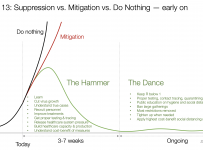
If you are actually interested in the public policy surrounding the decisions around the Corona virus, this article is thoroughly researched and incredibly informative.
Target lockdowns and be effective
As always the devil is in the detail.
The primary consideration is what is different about Singapore and South Korea compared to Italy and Spain? https://lnkd.in/gtfiCf4
Alarm bells rang in the Cage when a derailment occurred on the Melbourne Sydney track on February 24th 2020 due to “mud holes” on the track. The Rail Tram and Bus Union reported in 2011 that the practice of replacing sleepers without lifting the track, known as sideways replacement, was causing mudholes that could lead to derailment. As a result, then transport minister, Anthony Albanese initiated a study by the Australian Transport Safety Bureau that decided in 2013 the train line was only safe if trains were slowed down and appropriate warnings given.
Last month’s derailment was caused when a train driver travelled at 100kmh through a section of track designated to be safe at speeds of 10kmh apparently unaware of the warning.
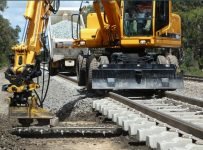
The sleepers are inserted without raising the tracks
The 2013 ATSB report concluded:
“the ATSB is satisfied that the necessary steps have been
taken to address any issues that might otherwise compromise the safety of rail
operations … at the expense of operational efficiencies through increased train
running times.”
Industry observers at the time, predicted disaster but, as the official report stopped short of recommending that anything be done about it, everyone, including the national news services packed up and went home until the deaths this week.
The facts are that the Australian Rail Track Company put out a request for tender in 2007 to upgrade the Melbourne to Sydney rail line. The problem was that the old wooden sleepers allowed the guage of the tracks to wander. New concrete sleepers wouild ensure the tracks ran straight and true. That tender was awarded to a consortium using Harry Bilt’s Platypus technology capable of replacing the sleepers without ripping up the rails. According to the ATSB in 2013, the decision to use this controversial technology was that there was not enough money available to do the job properly.
“It is also likely that the cost
associated with addressing the ballast, drainage or formation issues would have
precluded completely re-sleepering the Melbourne to Sydney line with the
funding available and therefore some residual safety risk associated with poor
track gauge would have remained if this path had been chosen.”
The dangers of sideways sleeper replacement have long been a topic for discussion on railway discussion boards such as railpage.com.au, unions such as the Victorian Rail, Tram and Bus Union (RBTU) and international forums. The looseness of the ballast put under the sleeper when it is inserted between the rail and the ground allows water to collect and mud-holes to form. The result is known as “fouled ballast.” These concerns were raised on Radio National when the Australian Transport Safety Board reported in 2013.
The gaps under the rails collect water, leading to mud-holes
The ATSB report suggested both short term and long term risk management processes would need to be employed to avoid a major incident. It spent some time outlining speed restrictions and additional monitoring of track failure as the short term measures but was deliberately vague about the methods of avoiding the risks in the long term.
“Longer term strategies ARTC
implemented … are unlikely to correct the more deep-seated formation problems. …
It is possible that water will continue to weaken the structure in some
locations, with a corresponding requirement for an increased regime of track
maintenance and the application of new or further speed restrictions.”
The final conclusion, that as long as we run the trains very slowly, we should be able to avoid deaths, is hardly a strategy for creating a safe, high speed rail network. Unfotunately, the problems of fouled ballast are not the only failure to maintain the national rail network during decades of cost-cutting. Analysis of the Wallan derailment also reveals issues with signals and possibly internal processes.
The question now is whether the unfortunate deaths of innocent workers and injury to passengers will inject enough steel into future inquiries to ensure that the national rail network is at least made safe and, ideally, brought up to something resembling international standards. 10km per hour is not an acceptable speed for the major passenger link between Australia’s two largest capital cities.
One of the items he put to air was an interview he had earlier recorded with Dick Smith. “… we know that we cannot continue to grow on a finite planet, but capitalism depends on growth, so it might all go bust. We might not be here to see the future, I’m sure some cockroach will be here and ready to start evolving again, but I am optimistic. I am a capitalist and I hope that some wonderful genius will come along and save us from ourselves.”
Dick Smith campaigned against endless growth
Yes Dick reflects the dilemma we face as a civilisation. Interestingly, he knows more than most of us about the challenges of ending growth. He ran Australian Geographic as a xero-growth company for eight years. Listen to the last three minutes of the interview to hear him discuss that.
Your order has been processed and will be delivered by Australia Post StarTrack service. You will receive postage information once it is packed and delivered to the system.
Two contrasting views of our relationship with nature emerged at last night’s Circular Economy Meetup at the Precinct in Brisbane’s Fortitude Valley.
Founder of GreenKPI, Johanna Kloot, painted a picture of the
circular economy as recognising that all our resources come from the land, “everything
you have eaten, worn or used today is a product of the environment. The economy
is simply the conduit that carried that resource to you.”
Professor Speight chatting after the Circular Economy meetup
Professor of Microbial Technology at QUT, Rob Speight, outlined
the production of synthetic leathers, meats and fibres using genetically
engineered microbes as a means we might employ to take the pressure off agriculture
and reduce its enormous contribution to global warming and the ensuing climate
chaos.
He described a synthetic hamburger that bleeds, ensuring a
genuine taste experience thanks to genetically modified yeast that can produce
heme, the haemoglobin component that gives blood, and therefore meat, its
unique quality that plant based patties do not provide.
Professor Speight conducts research into dissolving natural
fibres so that we might recover the valuable plastics in mixed fibre clothing.
95% of the world’s textiles involve a mixture of cotton an polyester (wool
polyester blends make up around 1%) but it cannot easily be recycled using
existing technologies because the cotton and polyester fibres are intricately
woven together. Using digestive enzymes the team at QUT can remove the natural
fibres allowing the polyester to be recovered for remanufacture.
He began his research journey investigating the problem of
removing dags from cattle before slaughter. He said that feedlot cattle carry around
40kilograms of manure, dirt and urine caked into their hair which has set like
concrete and requires up to ten hours of high pressure washing to remove before
the animal can be cleanly slaughtered. The QUT research into digestive enzymes
allows the cow to be shampooed so that the dags can be removed much more quickly.
“We don’t want the solution to be too strong, no-one wants a bald cow,” he quipped.
Some members of the audience wondered if simply
transitioning from red meat or, at least from red-meat produced in feedlots, might
not be an easier solution, preferring Johanna Kloot’s approach of learning to
live in harmony with nature.
Professor Speight noted that red meat earns around 20% of
the Queensland economy putting it in a similar category to coal, and
environmental disaster on which we rely for our comfortable lifestyles.
Great Notions asked both speakers to consider a future in
which synthetic production of food, fibres and other materials allowed us to restore
some of the biodiversity and reverse the damage done by the industrial harming
of animals and land. “Might we save the environment by replacing agriculture
with a test tube?”
Johanna Kloot responded with the observation that living in
harmony with nature has been the sustainable practice of the oldest living
civilisation that has existing on the Australian continent for thousands of
generations. “The solution is in harmony and respect, rather than control.”
Professor Speight observed that we need to temper the
temptation to synthesise everything for two reasons. First, “nature provides
unique and complex experiences, such as steak, that we cannot and should not
even try to replicate” whereas a hamburger uses meat that has been minced
beyond recognition and is more environmentally and economically sound to
synthesise. Secondly, he noted that “we do not understand genes well enough to
actually synthesise complex lifeforms. It is very arrogant of humans to think
that we can engineer life. We can engineer yeast and algae to create useful fuels
and simple materials but the only life form we have completely mapped is a
virus with about twenty genes. We really know very little.”
Host Yasmin Grigaliunas observed a number of times
throughout the discussion, “hashtag itscomplicated. Once again, we see that
this is a very complex topic and there are no simple solutions.”