Speculation is perfectly all right, but if you stay there you’ve only founded a superstition. If you test it, you’ve started a science
Hal Clement
Twenty Photos: My Seven Months Living at Standing Rock
These images show some of the defining moments of the past seven months — some that made it to mainstream media coverage and others unseen until now. Among the ever-growing lessons this place has taught me is what it means to simultaneously build and tear down. The life we have built here has taught many how to live a large-scale sustainable, decolonized, anticapitalist lifestyle that until now academics, sociologists, theoreticians, and greenies alike have only been able to hypothesize.
Global warming didn’t really get started in a big way until the 1950s. Today, the warming rate is seven times greater than it was in the 1950s and the carbon emission rate is four times greater than in the ’50s. That same sulfur pollution that caused all the acid rain in the ’60s and ’70s is a global cooling pollutant that hides warming. With grossly increasing smog in Asia since about the turn of the century, the results have been that 30 percent of warming that should have occurred has been masked or covered up by global cooling sulfate smog.
As the year comes to a close, there’s a few memories that really stand out. “I’ll remember the winning moments of the campaign to stop the privatisation of ASIC, and succeeding in saving funding for renewables. I’ll remember being among the crowds of people rallying for justice for refugees and people seeking safety.”
During the Reagan presidency, the US embarked on a surge in military spending which inevitably induced the Soviet Union to respond likewise. Both countries incurred massive financial problems owing to the accelerated arms race. In the case of the Soviet Union, the unsustainable arms expenditures led to the collapse of its economy, and consequently its political system dissolved in 1991. At all costs, Russia must avoid an arms race that would shatter its economy and eventually its national sovereignty. That is exactly what American adversaries want.
Recent press headlines about Syrian peace talks and a possible ceasefire reflect naivete and false hopes that come from thinking the world is the way we wish it to be and not the way it really is. Russian President Vladimir Putin’s geopolitical gambit in Syria is poorly understood and generally underestimated
Former UK Ambassador to Syria Debunks Aleppo Propaganda
Assad is not going to be removed by force of arms or at the negotiating table. What Britain should do now is three things: we should stop supporting a failed and divided opposition; we should start to try to help the people of Syria by lifting sanctions; and we should be working with the Russians on an overdue political settlement.
Israel has been angered by the vote and has retaliated by announcing that it would cut funding to several UN institutions and countries who voted in favor of the resolution which proposes that Israel cease its settlement building in occupied Palestinian lands, stating that the settlements have “no legal validity and constitute a flagrant violation under international law.”
UN vote exposes the true face of Israel’s settlement policy
The UN Security Council’s passage of Resolution 2334, which condemns the settlements and calls for an immediate halt to their expansion, is merely the latest — and possibly most reverberant — incident to unmask the fiction of Israel’s commitment to a viable two-state solution.
Kerry: ‘Israel Can Either Be Jewish or Democratic — It Cannot Be Both’
Today, there are a similar number of Jews and Palestinians living between the Jordan River and the Mediterranean Sea. They have a choice. They can choose to live together in one state or they can separate into two states. But here is a fundamental reality. If the choice is one state, Israel can either be Jewish or democratic. It cannot be both. And it won’t ever really be at peace.
The strategy of the West of dumping its hazardous agricultural technologies and seeds on Greece and every other country that did not industrialize its countryside is threatening millennia of agrarian wisdom and practice,
The ruinous consequences of seventy years of nuclearisation are now patently manifest. The Hanford facility in the US, Sellafield in the UK and the Mayak Industrial Complex in the former USSR have all served as “sacrifice zones” where plutonium pits were manufactured for deployment in nuclear warheads during the Cold War era. They are now vast nuclear wastelands with unthinkable quantities of radioactive wastes stored in ageing containers and leaking landfill sites. Less visibly, countless abandoned uranium mines throughout the world continue to release radioactivity into the air, soil, local waterways and groundwater.
Nine nations — the United States, Russia, United Kingdom, France, China, India, Pakistan, Israel and North Korea — possess approximately 16,300 nuclear weapons.
Turkey Blasts the US for Supporting Terrorists in Syria
There is now “confirmed evidence, with pictures, photos and videos” of US complicity in and support of terrorist groups in Syria, including the Islamic State group
Huge stockpiles of weaponry and ammunition, many with NATO markings, were discovered in East Aleppo when the Al-Nusra militants, a local branch of Al Qaida, were pushed out of the city by Syrian forces.
If you remove the top 25 cash holders, you’ll find that for most of Corporate America, cash on hand is declining even as these companies rack up more and more debt at historic rates. The bottom 99% of corporate borrowers have just $900 billion in cash on hand to back up $6 trillion in debt. “This resulted in a cash-to-debt ratio of 12%—the lowest recorded over the past decade
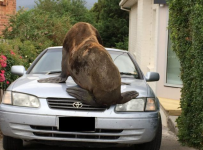
Australian fur seal weighing 200kg wanders down Tasmanian street, squashes car
“It did this spectacular manoeuvre where it slid down the back of the first car and jumped onto bonnet of the second car and scrambled over the top of that.”

The final week of 2016 is an apt time to reflect on the role of religion. Fundamentalists fan the flames of religious hate from Aleppo to Ipswich. Borders snap shut, refugees languish in ghettos and First Nations people from West Papua and Western Australia to just West of the Mississippi at Standing Rock are tortured to death by police upholding Christian values.
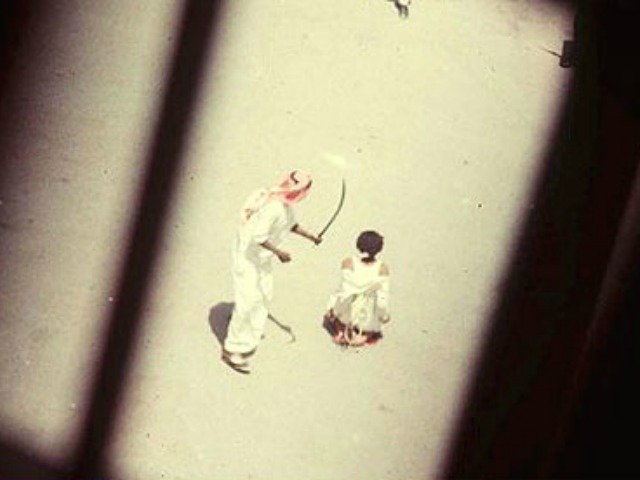
In Chop Chop Square each and every Friday the Saudi family execute and flog dissenters to uphold the untenable claim that their Jewish forebears are direct descendants of Mohammed. Yet we pray in Parliament and swear on the bible in court. We give tax free dollars to criminal institutions so they might rape our children and force battered women to reconcile with their perpetrators in those self-same Christian values.
Our elected representatives banish reason in the name of faith, deny science and belittle grace. Nature red in tooth and claw, the market rules the human race, a race of lemmings herded by armies bearing icons and brands. Religion joined by commerce both harnessed by a State that no longer even pretends to represent us but simply take.
Religion justifies that right to take, to exploit, to dominate. We wipe out life to live. We reduce the biosphere to microscopic animals and machines, industrial harming of the few living things we eat, the planet a machine to feed the megacity a few remnants of nature a Disneyland for the mega rich.
But it need not be so.
All life takes, consumes, organizes, builds. Else there would be entropy. That is the law of thermodynamics. Each ant nest a treasury of stolen organic matter dragged home by neutered workers. Bee hives the same except they fly by with their baskets of pollen, sucked nectar. How ants must wail and nash their nippers as the bees buzz past.
The gift of consciousness is wasted on post hoc rationalization, justifying our greed, our fear and anger. We must harness it to create wondrous beauty, we must apprehend the Universe with awe, the Earth with respect, each other with kindness. We must stop racing to the cliff and learn to look after each other, one by one and then in communities and then we can begin again.
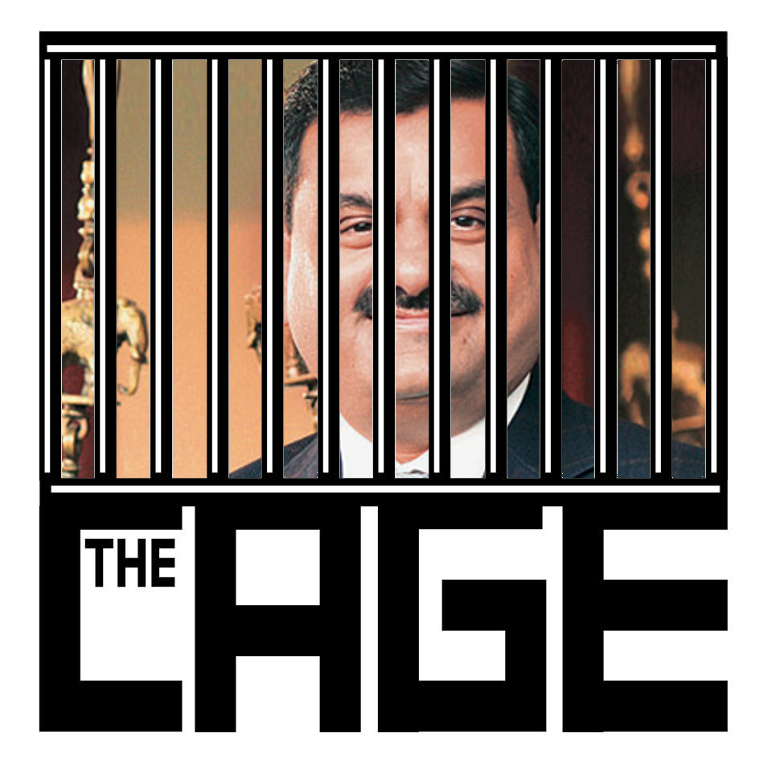
Merry Christmas, from the Cross, in the Cage on the Zeds. My name is Geoff Ebbs.
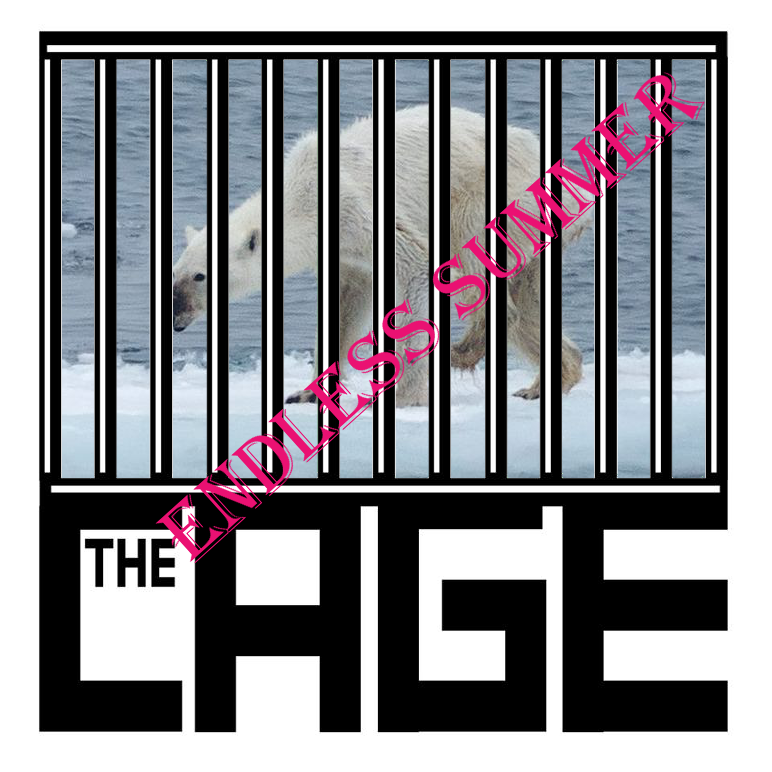
You are in the Cage unscripted. Australia is on holiday. The Summer that Will Not End in our lifetimes has begun. It is hot. It is very hot. And the Endless Summer has just begun.
As we huddle in the air conditioning, or wallow in the kid’s wading pool draping wet towels over ourselves to survive the heat we also come to terms with the passing of the social democratic state. The social safety net built with the blood of the unionists, the suffragettes and environmentalists is being dismantled before our eyes.
While we will report and comment on its demise, The focus of The Cage is not to lament its passing but to find ways to build a new people power movement a movement built on community, a movement that operates independently to undermine the controls placed on us in the Cage, a movement that loosens those restrictions and builds a robust, hopeful, loving society that will outlast the death throes of capitalism.
We are here to agitate, educate and organize. We are here to build the post-apocalyptic society into which we bring the new-borns, the to-be-borns and each other. Not a cheery vision perhaps, but at real one, one of courage, one of robust abundance, one based on love, solidarity and the power within. We uncompromisingly refuse to enslave ourselves for the masters of the Cage, even as we use the infrastructure of the Cage to survive.
This project is not secret. There are few secrets in this era of total surveillance. Every phone call you make, every text message you send, every social media post you make is collected, collated and analysed. Our task is not to overthrow the emerging network of networks in which we are simply nodes, it is to engage, evolve and redesign it for a better future.
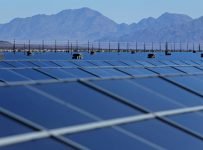
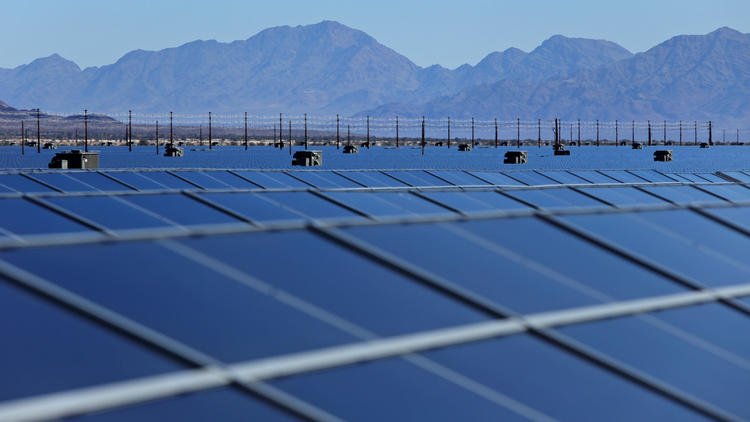
The Desert Sunshine Solar Farm produces 550MW of power from 900 hectares of solar panels
News that the City government of LA is totally powered by renewables follows rapidly declining costs of solar electricity and advances in community owned generation models. A conference held earlier this month identified major opportunities for community based power generators using renewable energy. Reporting on the conference in South Wind, energy writer Peter Boyer wrote that hybrid energy systems at community level will resolve the disparity between antiquated centralized systems and distributed systems based on rooftop solar and local wind. The conference was held on Flinders Island in Bass Strait near Tasmania and focused on the systems that Boyer points to as a model for the future.
Recent ABC reports that India is stepping away from coal fail to understand the nuanced report by the Central Electricity Agency (CEA) that predicts falling demand for new coal power. Their report indicates that the government has overestimated general economic growth and individual demand for electricity. Despite this, the government intends to proceed with its Ultra Mega Power Plants projects to rapidly expand India’s coal fired electricity and general electricity consumption. The Paris-based International Energy Agency predicts that India will double coal consumption in the next five years, despite a global slowdown led by China, which consumes half the world’s coal.
Indicating a significant shift in the Indian power sector, the Central Electricity Authority (CEA) has, in its National Electricity Plan (2017-2022), said the country does not need any more coal-based capacity addition till 2022. CEA said India would add massive renewable-based capacity.
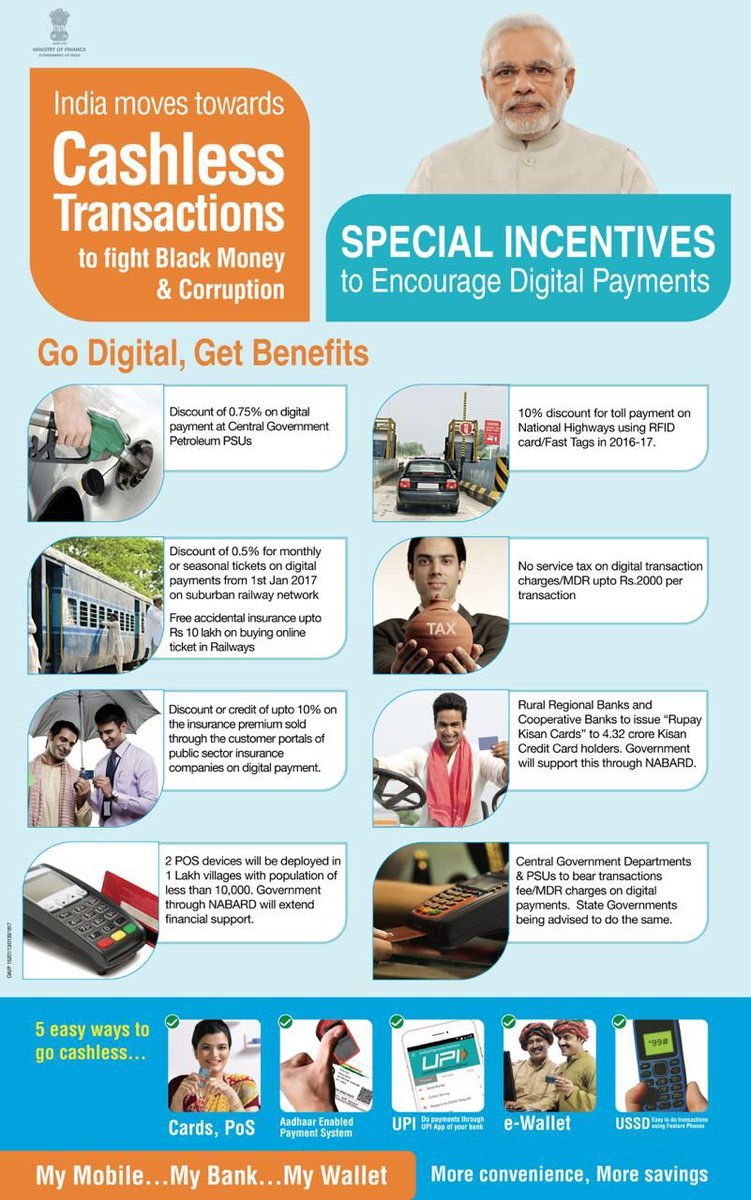
Prime Minister Morodi’s justification for a Cashless India
India’s rapid move to a cashless society was part of Prime Minister Morodi’s campaign against corruption and tax avoidance but the consequences of the sudden cancellation of all 500 and 1,000 rupee bills has led to an economic crisis and widespread accusations that it is an attack on the poor. With uneven access to digital and financial services the enforced move to a digital economy is leaving hundreds of millions of people behind. 17% of Indians own a smart phone and only 11% have a credit or debit card. Hundreds of thousands of people have marched in the streets, locking down banks and government offices.
Chakravorti, who co-authored a report titled “The Cost of Cash in India,” found that, “most Indians lack the means to use cashless alternatives irrespective of their desire to do so.”
“The digital infrastructure in India is so horrendously poor,” Chakravorti says. “The majority of people don’t have access to smartphones. Large numbers of them cannot read or write. Mobile connections are extremely poor. Even the people in the city, for them connections are terrible.”
A New Delhi shop keeper has lost 80% of his business due to the crisis
Chakrovorti says policy-makers pushing a cashless society are “essentially putting the cart before the horse. The country needs to invest in its digital infrastructure before it pushes people to digital payments.”
The point of this new act being that no longer will it be necessary to offer payment to employees in cash. It will be possible to pay via cheque, or electronic transfer into a bank account. The aim is, of course, all rather tied in with the demonetisation campaign and the move toward a cashless society. If wages are being paid in a manner easy to check then the tax system can be expected to benefit. And given that vast swathes of India’s economy are entirely informal it’s obviously in the government’s interest for this to happen.
In a further push to cashless economy, the Central cabinet has approved the ordinance for paying wages via electronic means — which means that the government has given its nod for cashless salary. Accordingly, the government approved to amend Section 6 of the Payment Of Wages Act.
It was a move that could have brought India’s economy to a shuddering halt. Indeed, the seemingly endless queues outside banks, and the difficulty of spending cash at shops and stalls may have seemed like it did. But the decision to demonetise the 500 and 1,000 rupee notes was just one in a series of moves that will push India towards a digital economy.