Paul Judd – reunited with his money … thanks to super Suzy
Beware online services offering to find lost super, says local man, Paul Judd.
“I got an email offering to find lost super, pressed the button and ‘BOOM’ my super disappeared,” he told Westender.
Of course, the super was there somewhere, it just took a bit of a journey to find it, and along the way Paul discovered some of the pitfalls that can occur when you roll your super over.
“I was lucky that I bumped into Suzy. Yellow Brick Road went out of their way to get everything in place before they touched a cent.”
Independent research carried out for Yellow Brick Road indicates that people living within two kilometres of West End have one quarter of a billion dollars in lost super. Yellow Brick Road is running a campaign to help people find and consolidate that superannuation, carefully.
“It is often young people who are most affected,” said Ms Butterworth. She said because they are not carefully managing their superannuation, they do not notice when employees open new funds for them and they end up with multiple superfunds all with small amounts of money and all costing them annual fees.
“It is not until they start to calculate how much they will need when they retire, that they give it any thought.”
Paul Judd is one example of a local in exactly that position.
At 40, Paul is beginning to calculate the amount he can save over the years that he will enjoy working.
“I want to retire before seventy,” he said.
His mistake, though, was to respond to an email that offered to consolidate his superannuation money, automatically.
Ms Butterworth helped Paul find his super, sort out the insurance and invest more aggressively than the average managed fund, that matched his appetite for risk, to yield a higher return and give him a better lifestyle in his retirement.
“You have to choose between spending less now, spending less later, or working longer,” she said. As we age, the options begin to narrow, so the key is to start early.
“If Paul had come to me ten years ago, he would be in a completely different position,” said Ms Butterworth.
Google street view showing the building as residents have come to know and love it
Confusion reigns as different departments of the Brisbane City Council coordinate their response to community concerns over the disappearance of the tree outside Suncorp at 108 Boundary St West End.
The tree appears to have been removed by Council because of traffic concerns and that there is no intention of replanting another tree to replace it.
The Google Street View shows the Sun Corp building before the storms damaged the two trees on the corner earlier this year. The before and after shots taken by Tony Robertson show the change to the landscape over the weekend.
Readers reported responses ranging from secret contractors in the dead of night, to council officers claiming that police had called for the removal of the trees. Council’s media department is working to obtain an official response for Westender.
We can already report that the police deny making any complaint about the tree, that photographs of the tree being removed during the day indicate there was no secrecy involved and the tree assessment form provided by Council indicates that it was undertaken using standard council procedures.
West End Community Association (WECA) is spearheading a campaign to have the trees replaced and has prepared drawings to alleviate any concerns regarding traffic safety.
We have specifically asked Council to respond to questions regarding community consultation and streetscape design for Boundary St and will report them as soon as they are available.
The Bentley Blockade on April 14, 2014. Photo by David Lowe
The critical battle between protectors of the land and miners at Bentley in NSW has been won, by the protestors.
I sat down to write an early morning story exhorting all good humans (you) to come to the aid of the nation’s land and water at the Bentley Blockade next Monday. As the computer warmed up, news filtered through that the mining company’s license has been revoked by the NSW government.
You are off the hook. I no longer have to exhort you to choose between the comfort of your daily life and a cold, uncomfortable, non-violent battle three hours drive away.
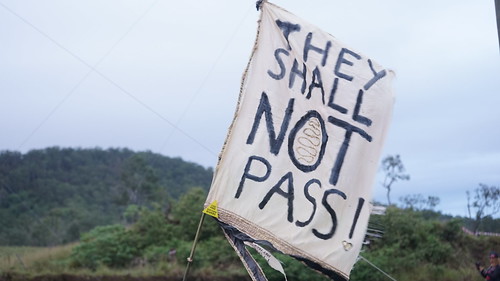
The NSW government had organised hundreds of riot police, mounted units and the dog squad to face down thousands of farmers and environmentalists on a property in a small town in Northern NSW. The protesters have locked onto structures built at all access points to a farm that had sold mining rights to Metgasco.
Bentley is only one battle in the war between the short term view of the economy built around mining and the long term view built around land, water and renewable energy but it is close to the coast, close to Brisbane and is a test case for a relatively new NSW Government determined to emulate Queensland and declare itself open for business to coal.
At stake
The gas company was planning an exploration well to determine the viability of extracting gas from the limestone in form of extraction slightly different to the coal seam gas more familiar to Queenslanders but just as invasive to the artesian basis and surface activity such as farming.
The concern of the farmers is that miners are being given priority over water and land on which our food supply depends. In the words of the quickly-dumped NSW Premier Nathan Rees in June 2009, “Coal is more important to the people of NSW than food.” His logic was that we can make more money by selling coal than by selling food and so can then use that money to buy all the food we want. When challenged he failed to recognise any problem with that logic.
The concern of the environmentalists is that the focus on resource extraction, particularly the extraction of fossil fuels, takes us further down the dead end of building an unsustainable consumer economy that irrevocably damages the ecosystems that support us, including the water and land that the farmers want to protect.
Flags over Bentley blockade at Easter 2014
The battle lines
The four thousand engaged locals who have been staffing the camp and supporting the “Simmos” locked onto the structures that deny the miners access to the property are supported by over 85% of the surrounding communities of Richmond Valley, Lismore, Ballina and Tweed Heads.
The local papers, shire councils, Greens party and groups like Lock the Gate, have consistently raised questions as to why the State Government is using taxpayer funded police and other resources to back mining companies in the face of such strong public opposition. The opponents include local plicemen, school principals and the famous Knitting Nannas.
The mining companies and representatives of NSW government departments responsible for mining and resources have begun recently to engage in the debate in detail, asserting that the wheels of industry and the gas stoves of Melbourne and Sydney will sputter to a cold, barren halt without alternative sources of gas.
It is true, the search for alternative forms of gas began around the mid nineties as Santos revealed that its Cooper Basin gas field that supplies NSW with its natural gas would run out by 2020. Instead of seeing this as an opportunity to activate and promote renewable sources of energy and build the long term future, governments backed the advocates of fossil fuel to follow the US down the track of exploring non-conventional gas and oil extraction.
While the public engagement in the details of the debate is new, it was not enough to convince an already engaged and alert public that they should sacrifice water and land for a secure energy future based on fossil fuels.
Monday’s plans
Plans for convoys of supporters from as far away as Brisbane made it evident that the hundreds of riot police already on their way to the towns of Lismore and Casino would face a very public battle that they would be unlikely to win and that would go all the way to a fully-fledged battle with well prepared, unarmed, non-violent demonstrators who have declared their preparedness to die if necessary.
At the same time, the investigations of the Independent Commission Against Commission have revealed that many decisions in favour of mining projects have been made by public officials seriously compromised by their acceptance of bribes from mining companies.
Retreat
A relevant sign at the Invasion Day rally in Brisbane
In the end, it appears to have been easier for the government to back out gracefully than fight its own citizens on behalf of a company that may have corruptly gained its support.
This victory for the tribe means I don’t need to challenge you as to whether you are willing to travel for three hours to go and support a small band of protestors on the front line. You should remain alert, however, as this is simply one battle in a global war.
At stake is the fundamental direction of society. Do we maintain the status quo and preserve our consumerist dream of 1.7 cars per family in an air-conditioned garage with a well stocked freezer or do we accept that we need to reduce our footprint to build a better future?
As the slogan goes, “On which side do you stand? The dirty dollar, or the pristine land?”
A divided West End Traders Association (WETA) last night designed a two pronged strategy to manage graffiti. On one hand the strategy will embrace and promote street art on the other it will vigorously police the defacement of commissioned art and no paint zones that property owners want to keep pristine.
The strategy was developed following a presentation by Brisbane City Council Graffiti Liaison Officer. Wilhelm Offen and a heated discussion between members with radically different views.
Council spends millions each year in an incredibly complex battle with graffiti artists, often out of the public eye, in deserted buildings or public institutions that are not visited by the public. At least three full time staff form a Taskforce Against Graffiti (TAG) that coordinates the efforts of police, Brisbane City Council and private agencies.
Graffiti Liaison Officer Offen described an international network of artists that go on “tagging holidays” where they collectively deface a city, literally giving the police the finger via CCTV cameras set up to catch them red-handed. He described these people as organised criminals, selling drugs and engaged in high level crime such as bank robbery and money laundering.
Members of WETA challenged a number of these assertions, pointing out that without a distinction between street artists defending their right to public expression and ordinary vandals, any policy is bound to fail in the confusion. It was also noted that drug dealers and bank robbers rarely go out of their way to identify themselves to police.
One of West End’s more popular graffiti icons. The pet spider appeared in a range of graffiti
Some business owners described the vandalism to their property, especially the use of rooftops as temporary drug dens complete with mattresses, drug paraphernalia and the subsequent rubbish. Graffiti Liaison Officer Offen said that rooftop tagging presented special challenges to TAG as it is hard to catch the perpetrators, expensive for business owners to respond and, because the graffiti is on private property, impossible for council to buff out the graffiti.
Graffiti Liaison Officer Offen suggested that businesses commission local graffiti artists to use the wall space accessible from their rooftop as advertising space. He has prepared a guide to navigating council rules around advertising, street art and public taste so that businesses are not guilty of the same crimes as the illegal street artists.
This highlighted the absurdity of the Council’s existing zero tolerance approach and formed the basis for one component of the new strategy.
To manage street art and encourage the positive aspects of a public visual culture, WETA will work with businesses and Graffiti Liaison Officer Offen to commission artworks in designated areas. These will initially be on private property and in prominent spaces.
A similar approach will be developed for vacant property that is earmarked for demolition or redevelopment, working with existing and new owners to provide canvasses for street artists and community groups developing and using visual art in public space as part of their expression.
The third arm of the pro-street art strategy will be to provide a series of billboards for public announcements and advertisements. West End Community Association will be approached to manage these spaces and ensure that they are kept up to date and within acceptable guidelines.
Not all business owners support this pro-art strategy. Graffiti Liaison Officer Offen also gave his professional opinion that such strategies have been shown not to work. He accepted, though, that it is better to have community engagement in an experimental strategy than to simply leave Council and police fighting a losing battle with taggers. WETA confirmed that it work within existing bylaws and would not pressure Graffiti Liaison Officer Offen to go outside the professional guidelines of his job.
The other arm of the strategy will be that used elsewhere across Brisbane. TAG will work with local businesses to respond as rapidly as possible to undesirable graffiti, using CCTV footage to identify perpetrators, and buffing over graffiti and removing posters as soon as possible.
Business owners are responsible for dealing with the defacement of their property, council can only deal with paint on public areas such as footpaths, street furniture and council buildings.
A remarkable aspect of the discussion was intensity and volume of the activity that goes on out of the public eye.
Graffiti Liaison Officer Offen described hundred of graffit artists painting thousands of square metres of publicly owned property within weeks of it being vacated.
The amount of rooftop activity going on in our community was an eye opener for many WETA members, including this reporter.
Public complaints by high profile people about commissioned artworks in public spaces presents a large waste of public resources as evidence is collected and documents prepared for formal responses and legal defences about issues which are outside council jurisdiction.
A number of examples of commissioned art being painted over by Council were raised. In every case a complex story of misinformation and hidden agendas emerged.
The nuanced response developed at this meeting is specifically designed to ensure the maximum engagement of the business and residential community and minimise the problems that emerge when lines and intent of communication are not clear. WETA is to be commended for finding a path through this potential minefield. It may be experimental but, should it work, it could form a blue print for other communities facing the same challenge.
Community journalist Jan Bowman, quoted Westender’s coverate on Radio 612 and there was significant discussion on the Westender facebook page.
While most of the activity and comment concerned the government’s blanket opposition to graffiti, its infamous painting over of some of Brisbane’s largest street art and the lack of space and support for street artists, some local businesses supported the government’s view that unauthorised graffiti is damage to property.
Paul Hey of Montague Developments wrote:
Less loved graffiti on a property in Montague Rd
I regard myself as being reasonably broad minded when it comes to art and also graffiti.
I don’t think any society can say it should be encouraged randomly without it being intensively managed.
As land owners we get a lot of totally shit graffiti happy to show you some photos, this is a big cost to clean it up and repaint when it is done.
I am more than happy to encourage good graffiti in appropriate locations with consent from owners, but that probably takes the fun out of it for the authors of the graffiti, I think many do it because it is illegal and a crime.
There is a big difference between acceptable Street Art as you call it and out right vandalism awful scribble (and sometimes there is a fine line between the two, who is the arbiter?)
His comments were in part inspired by the list of questions that Westender provided to a number of outlets. (We have yet to receive any response other than Paul’s).
Those questions were:
Q. Crime stoppers make a link between community safety to the presence of graffiti, can you please provide the research that they base this claim on?
Q. What type of crimes are linked to graffiti?
Q. How exactly does graffiti make neighbourhoods unsafe?
Q. Isnt it true that the only reason graffiti is listed as a crime is because its an offence against property? Or are they claiming that humans are hurt in the practice of graffiti, like physical assault or sexual assault?
Q. Can Crimestoppers list the street-art projects that they have supported in the last five (5) years?
Q. How many specialist art curators does Crimestoppers employ for the purposes of distinguishing street-art from graffiti?
Q. In the minds fo Crimestoppers what distinguishes political comment or artistic expression from graffiti?
Paul notes:
Unless I read them wrong, your questions you seem to be suggesting graffiti is desirable.
I don’t think the image above fits into the “Street Art” tag or maybe I am out of touch.
are you suggesting that dealing of peoples walls and business premises is ok and should be encouraged?
This issue is a constant problem for property owners and the idea of encouraging it is an interesting (but maybe troublesome) concept.
Westender is keen to work with readers to find the resolution to these very different starting points.
If we take the concensus approach and identify the common ground as a sensible starting point then we would all agree that there are some forms of street art that need to be celebrated and maintained and there are forms of graffiti that are undesirable and cost property owners money to remove. That leaves the questions about who decides and what disincentives should be used.
If we treat this as an application of dialectic, one point of view might be that the outer walls of private property are public space. Now that is a controversial argument. It was brought to a head in England when a property owner carefully preserved and sold a Banksy street art piece called ‘Slave Labour’ for $US700,000 before demolishing a property. This raised questions over the copyright inherent in illegal, public street art.
Bassid Kone is themasterful centre of this dynamic musical experience
The theatre space at Queensland Multicultural Centre, BEMAC, took off last night as the Kone Express left the station with two thirds of the audience on the dance floor, glowing and grinning in sheer delight at the exuberance of the performance.
Bassidi Kone is a young man from Mali, who travels the world but manages to maintain an Australian outfit that play as the Kone Express whenever he is in town. Right now they are touring the country to take this infectious musical hybrid into the regions in a combination of workshops and performances.
Kone Express is a fusion of Western and African music with a beautiful tension between the structured rhythm of a drums, bass, guitar, keyboards and horns combo and the jembe, Balaphon and variety of drums from the three Africans on stage.
The fusion goes all the way through the performance. The trombone player, Tom Williams, doubles as an MC introducing the key players while the lead singer, Shabba Ashun, takes on the role of inspiring the audience to dance clap and generally engage with the music on as many levels as possible. Some of his dance moves have to be seen to be believed, and his ability to single-handedly fill in a quiet spot in the proceedings is second to none.
This double handed approach is especially evident in the percussion and melody.
At its best, the square cornered room laid down by the whitefella music was stretched, complemented and transformed by the melodies and percussions of Bassidi Kone and his compatriots. In these moments the audience was uplifted and transported onto an agile cloud of music. At times the two threads almost seemed to wander into a different space only to be brought back into alignment for a chorus or a big finish.
This reviewer was thoroughly engaged on the dance floor, using the framework beat to guide the legs while the more freeform rhythms of the drums and the melodies of Kone’s Balaphon (an enormous marimba) gave expression to the arms and head.
That’s how I like to think it looked anyway.
Don’t rely on the fact that I had a great time and feel good about, check out Kone Express on YouTube and form your own opinion. Even better, watch out for the dates in June and July and get yourself along for a night on the tiles. Just make sure you have your dancing shoes on and are really ready to bust your best moves. You will get plenty of opportunity.