|
Web Clip
inthemix – News: Emerging artists, here’s your chance to win studio time and international gigs – 1 day ago
|
Breaking the Silence – monbiot.com

|
||||||||||||||
|
Web Clip
inthemix – News: Emerging artists, here’s your chance to win studio time and international gigs – 1 day ago
|
Breaking the Silence – monbiot.com
|
||||||||||||||
|
Inbox
|
x |
|
10:54 AM (28 minutes ago)
 |
|||
|
||||
|
Recycling Tip
Unneeded printouts can be cut and stapled to make notepads.
|
Moments ago

Neville, This is a sweet victory for everyone who has helped fight Tony Abbott’s $100,000 degrees – but it is not over yet. The Liberals have made it clear that they want to push through plans to deregulate university fees, rip funding out of our universities and saddle students with a debt sentence. Thank you for every dollar donated, petition signed and Facebook graphic shared. Your efforts have made it clear that Australians just don’t want these changes. But we have to keep fighting until they drop the policy for good. Australia cannot afford to put a university degree out of reach for millions of our young people. I want you to know that Labor will keep fighting until that happens and I know that you’ll keep fighting with me. Thanks for standing with me on this, Bill |
|||||||||||
<A
HREF=”https://media1.ancestry.com/click?spacedesc=15041806_12649166_728x90_15041799_15041806&ML_NIF=Y”
TARGET=”_blank”>
<IMG
SRC=”https://media1.ancestry.com/image?spacedesc=15041806_12649166_728x90_15041799_15041806&random=&ML_NIF=Y”
WIDTH=728 HEIGHT=90 ALT=”Click Here” BORDER=0>
</A>
</NOSCRIPT>

This week, thousands of diplomats from across the globe are gathered in Lima, Peru, to start hashing out a new agreement to address global warming. The hope is that they’ll have a final deal in place by the end of 2015.
It’s a daunting task. Scientists warn that the world is currently on pace to heat up around 4°C (7.2°F) or more by the end of the century. That much extra heat could have disastrous consequences: the eventual loss of Greenland’s ice sheet, steep sea-level rise, crop failures, mass extinctions, and so on.
Even if we zeroed out fossil-fuel emissions, the world would still be hotter in 2100
The clearest way to avoid that fate is to reduce global greenhouse-gas emissions in the coming decades. But even if the world managed to zero out fossil-fuel emissions this century — an exceedingly ambitious goal — we may still be on pace for 2°C (3.6°F) or more of warming by 2100. That’s not quite as drastic, but it would still mean some amount of sea-level rise, widespread flooding, increased drought, and so on. Poorer countries, in particular, could struggle to adapt.
So the point of the UN talks is for countries to figure out how best to navigate this increasingly difficult situation: How much should global emissions be cut? What actions should individual countries take? How much aid should wealthier nations offer to poorer nations to adapt to whatever level of warming we do get? These questions won’t all get answered definitively by 2015, but the hope is for an agreement that at least gets things started.
In the past, these talks have often been gridlocked by deep disagreements over how to divvy up these tasks. Poorer countries have argued that the US, Europe, and other rich nations are to blame for most of the man-made carbon-dioxide currently in the atmosphere, so they should bear the burden for both cutting emissions and providing aid to poorer countries. Richer countries, for their part, argue that you also have to look at future emissions to tackle the problem — so fast-growing nations like China and India need to do more.
In November, the US and China had a mini-breakthrough of sorts on this impasse when both countries pledged to curb their emissions between now and 2030. That’s led to some optimism about these upcoming talks. But that deal wasn’t enough, on its own, to decisively alter the trajectory of global emissions and avoid 4°C or more of warming. A lot more is still needed for that.
So below are 7 key charts from the Global Carbon Project that give a sense for what’s at stake in these talks — and why it’s so difficult to come to a deal:

Let’s start with the big picture on climate change. The black line above shows the current growth of annual carbon-dioxide emissions worldwide. The colored lines show various future pathways and what they’d mean for global warming.
We’re currently on pace for somewhere between 5.8°F and 9.7°F of warming
The world’s nations have all agreed that it would be “dangerous” to allow global average temperatures to rise more than 2°C (or 3.6°F) above pre-industrial levels. (See here for why.) But to have a decent chance of staying below 2°C, global emissions would likely have to follow the blue or yellow trajectories — peaking in the very near future and declining sharply by century’s end.
Instead, emissions keep rising. And if emissions continue on their present course, scientists estimate, we can expect somewhere between 3.2°C and 5.4°C of warming by the end of the century (that’s between 5.8°F and 9.7°F). Various reports have warned that this would entail dramatic and irreversible changes, like destabilizing Greenland’s ice sheet or large-scale extinctions. The World Bank, for one, thinks this much warming could be impossible for many countries to adapt to.
Recently, countries like the United States, Europe, and China have all made various pledges to reduce their emissions in the future. But even if you take all those pledges seriously, analysts at the Climate Action Tracker have found that we’re still on pace for between 3°C and 4.6°C of warming by century’s end. That’s not much better. (The range is largely due to uncertainty over exactly how the climate would respond to so much carbon — but scientists are quite confident that it would get a lot hotter.)

Here’s another way to look at the climate issue. If we want to avoid more than 2°C of global warming, scientists estimate, then humans can only put about 3,200 gigatons of carbon dioxide into the atmosphere. (This gives us a two-thirds chance of staying below the limit.)
We’re about two-thirds of the way through our carbon budget
Since the Industrial Revolution, we’ve loaded roughly 2,000 gigatons of carbon dioxide into the atmosphere. So we only have about 1,200 gigatons left. And at current growth rates, we’ll blow through that in about two or three decades.
That’s our “carbon budget.” Meeting the 2°C goal would, in theory, entail divvying up the remaining 1,200 gigatons among various countries. Country A gets to emit this much carbon. Country B gets to emit this much carbon. And so on. But that’s incredibly hard to do. For one, setting these sorts of top-down goals hasn’t had much success to date. And, as we’ll see below, allocating responsibility isn’t easy.
By the way, there’s a good argument that the 2°C limit has become impossible, and that something like 3°C (or 5.4°F) is a more realistic goal. If that were the case, the carbon budget would be a bit bigger (we’d have around 2,000 to 2,500 gigatons left), but we’d still be on pace to blow through it within several decades.

Now comes the blame game. The chart above shows cumulative emissions from fossil fuels and cement over time. For any given year, it more or less shows who is responsible for what fraction of the carbon-dioxide in the atmosphere.
The US and Europe have had their fossil fuel party, now India and China want theirs
As you can see, the United States and Europe are responsible for 49 percent of all carbon emissions from fossil fuels and cement that have been emitted since 1870. They’ve long enjoyed the growth benefits from using fossil fuels — and now other countries want theirs. This chart also explains why many people put the blame for current global warming squarely on the United States and Europe and are asking for aid to adapt.
But the US and Europe, by contrast, argue that the situation is now shifting rapidly. If you only look since 1990, China has been responsible for 20 percent of the cumulative emissions in the atmosphere — more than Europe (14 percent) and on par with the United States (20 percent). That’s why wealthier nations often point instead to charts like the one below:

The previous climate treaty — the Kyoto Protocol of 1997 — divided the world into two sections: wealthy nations (“Annex B”) and developing countries (“non-Annex B”). The former were supposed to cut their emissions. The latter were allowed a free pass so that they could keep growing.
Emissions from wealthy nations are declining
As the chart above shows, that more or less happened. Annual emissions from Europe, the United States, and other wealthy “Annex B” countries are declining, albeit slowly. But emissions from developing countries have exploded.
Today, developing countries produce 58 percent of the world’s annual carbon-dioxide emissions. China alone is responsible for 27 percent. This is why negotiators from wealthy countries often insist that China and other poorer countries need to commit to reductions in any new treaty. China, for its part, has recently pledged to have its emissions peak by around 2030 (although it won’t say at what level). It remains to be seen if other developing countries follow suit.

Here’s another chart on the same theme. China’s overall emissions are currently higher than those of the US or Europe. But Chinese negotiators have long argued that that’s only fair — after all, China has 1.3 billion people, so of course it’s emissions will be higher.
But now China is crossing a different threshold. It’s per capita emissions are actually higher than those in Europe. (They are still far below America’s, although America’s have been dropping sharply.)
By the way, that chart above also shows why India is so reluctant to heed calls to reduce its emissions — especially when its per-capita emissions are still so low and 300 million people still have no access to electricity.

Here’s another tricky issue. Emissions can also be “outsourced” abroad. Say, for instance, a US factory moves to China and produces goods that are then shipped back to the United States. America’s emissions decrease. China’s emissions increase. But who’s responsible for that carbon, really?
This isn’t a trivial issue. The Global Carbon Budget 2014 report notes that virtually all of the reductions in emissions made by wealthy countries like the US and Europe since 1990 have been offset by “outsourced” emissions to places like China. These emissions transfers are now growing at a rate of 11 percent per year.

So now, if we want to stay below the 2°C limit (or 2.5°C or 3°C), negotiators have to take all of the factors above and come up with some way to divvy up the remaining carbon budget.
As this chart from the Global Carbon Project shows, there are lots of ways to do this. Negotiators could agree to let everyone maintain their current share of emissions (an “inertia”). The United States emits 18 percent of the world’s emissions today and gets 18 percent of the remaining carbon budget. But that’s not terribly fair, since India would get penalized for being poor — it would miss out on the growth benefits of burning fossil fuels.
Alternatively, you could take an “equity” approach. India is a big and poor country in dire need of more growth. So it should be allowed to take up a bigger share of the carbon budget. The United States and Europe get a much smaller share, by contrast — they need to enact draconian emissions cuts. The problem is that it’s not clear whether this is even technically feasible.
A third approach, described here, is a “blended” approach that tries to compromise on all these different issues. A recent paper in Nature Climate Change argued that this was the best way to stay below the carbon budget. Whether national governments agree with that, of course, is another story.
More realistically, the world’s nations will set their own individual goals based on what they each think makes the most sense for themselves. Most analysts think this is the most likely outcome of the current UN talks — each nation sets voluntary goals for themselves and the new treaty sets up some sort of monitoring and verification mechanism.
Now, whether all those voluntary pledges add up to staying within the carbon budget and below 2°C is much less clear. Which brings us all the way back to chart #1 up top…
Past UN climate talks have failed. Will this one be any different?
How to stop global warming, in 7 steps.
An in-depth look at the 2°C climate goal — and what happens if it’s no longer feasible
Here’s what the world would look like if we took global warming seriously
|
Web Clip
|
Our day in the sun

Dear NEVILLE —
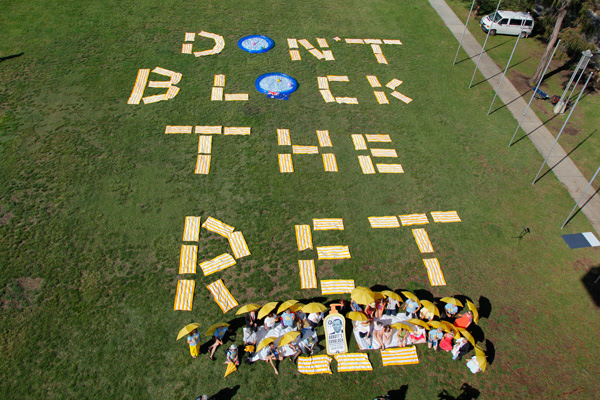
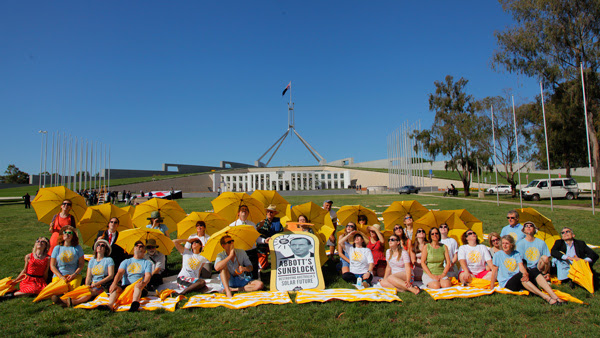
I’m writing this from Parliament House in Canberra, in a break between meetings with MPs, because I have to tell you about the huge day we had yesterday. Yesterday, on the first day of summer and the start of the last parliamentary sitting week of the year, we made our voices – and the voices of all of you who are standing up for solar – heard here in Canberra. Our day started on the lawn in front of Parliament House with a giant beach-towel sign spelling out a message that couldn’t be missed:
We want our government to protect the Renewable Energy Target and to save Australia’s solar future, not destroy it.
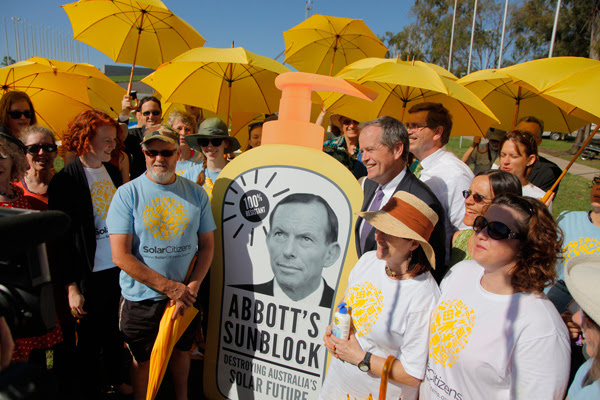
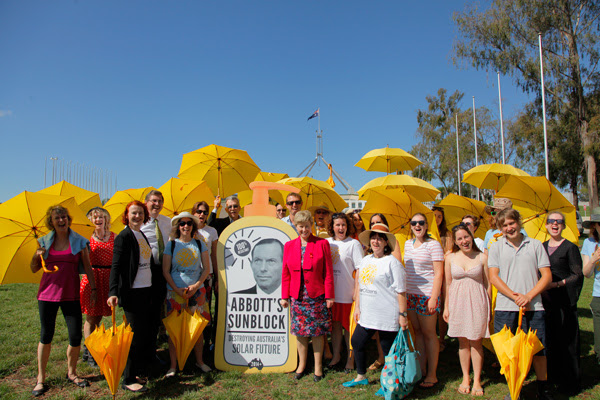
We were joined on the lawn by Leader of the Opposition Bill Shorten, and Leader of the Greens Christine Milne, who both emphasised the importance of the work Solar Citizens does. They had a chance to meet the amazing volunteers who had travelled from all over Australia to be at Parliament to tell their stories of uncertainty in the industry and support for solar, directly to federal politicians. Mr Shorten told us:
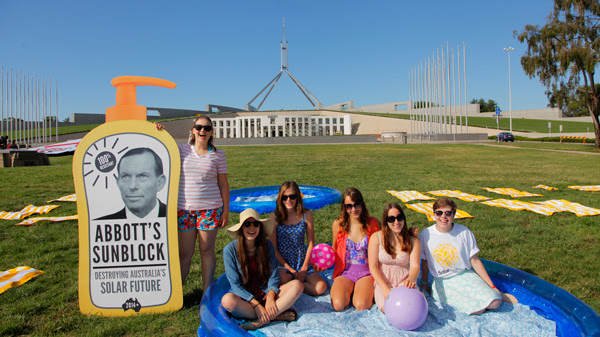
There was also a crowd of media with us on the lawn yesterday and we were on ABC24. Perhaps it was our giant bottle of ‘Abbott’s Sunblock’, our passionate chanting of ‘vision not regret, protect the RET!’ or the fact that new polling shows that 85% of Aussies want more rooftop solar and 76% want to increase the Target, not scale it back.*
But after a morning in the sun, our day wasn’t over. As soon as the last beach towel had been folded and put away, we headed inside Parliament House to begin our full day of scheduled meetings with MPs from both major parties. For several of our volunteers, it was their first meeting time with a politician but they were there to tell their story and they knew they had Solar Citizens from all over the country behind them, so a few nerves weren’t going to get in the way. Our country’s decision-makers heard from our team of 24 Solar Citizens, including solar workers like Rhonda and Tom, whose jobs are at risk from the uncertainty in the industry, and solar owners like Peter, a retiree who wants every Australian to be able to go solar like he did. 
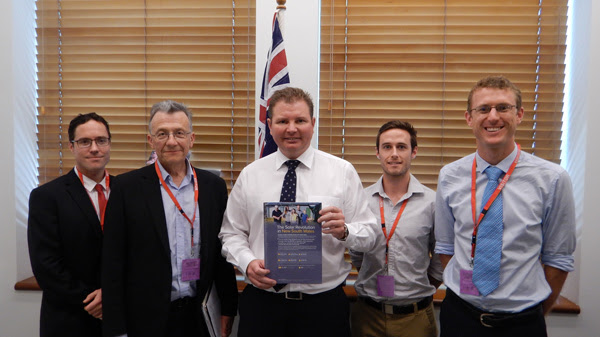
Meeting with Russell Matheson, Member for Macarthur.
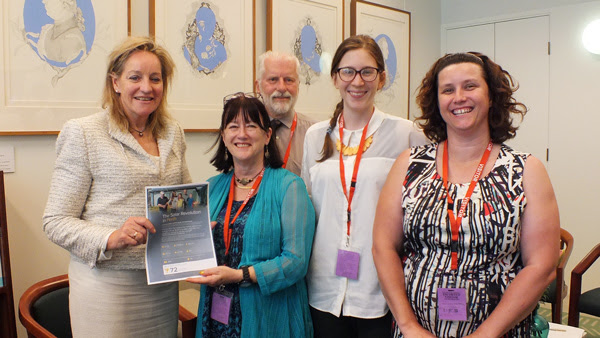
Meeting with Alannah MacTiernan, Member for Perth. Meeting with Melissa Price, Member for Durack.
Meeting with Craig Laundy, Member for Reid. We even booked in a last minute meeting with Bob Katter after a Solar Citizen got chatting to him in the Parliament House cafe. He wanted to hear more about why protecting the Renewable Energy Target is so important, and so do most MPs. Our teams reported plenty of enthusiasm for solar power among MPs, though many needed to be reminded of important facts about the popularity of the Target. Several had to be pressed on the need for the Government to re-commit to the full 41,000 gigawatt hour, which is so crucial to see solar and renewables grow. We know that sitting down with our elected representatives, like we did yesterday, is the best way to deliver a powerful and direct message to grow solar and protect the Target. Over one hundred of you have met with your MP already in recent months via our Time to Shine campaign. If you haven’t yet taken this step, will you help us magnify our efforts and book in a meeting with your local MP? You don’t even have to go all the way to Canberra like we did yesterday. It is exciting to be here in the halls of Parliament getting our solar message through, especially knowing that we have all of you behind us. Thanks for everything you’ve been doing to stand up for solar and the Target. In solar-darity! Claire PS. You can see more shining photos from our huge day of solar advocacy yesterday on our Facebook page here. Please share with your friends and encourage them to join our movement to protect Australia’s solar future. Solar Citizens |
|||||||||||
all
Comment is free
Nuclear power keeps the corporates in charge. No wonder it’s conservatives’ preferred solution to climate change
Tim Hollo
Tony Abbott says he has ‘no theological objection’ to nuclear power. That’s fair – only blind faith could justify his belief in a power source that’s so costly and risky
abbott bishop
‘Nuclear power’s great attraction is that it would maintain the corporate grip on energy infrastructure.’ Photograph: AAP
Tuesday 2 December 2014 10.51 AEST
Share on Facebook
Share on Twitter
Share via Email
Share on LinkedIn
Share on Google+
Shares
48
Comments
41
“I have no theological objection” to nuclear power, Tony Abbott said on 1 December, responding to Julie Bishop’s relaunch of the right’s preferred “solution” to global warming this week.
Abbott’s choice of words is fascinating. On the face of it he’s suggesting that opposing nuclear power is a faith-based, rather than rational, view. But it is the right’s consistent promotion of a technology that has been shown repeatedly to be too slow, too costly and too risky (see, for instance, here and here) that is underpinned by several right wing articles of faith. It’s worth unpacking this credo, because it reveals what’s really going on when nuclear power is raised.
The first tenet is a truly theological one, based on a one-eyed reading of the Bible:
“And God said unto them, Be fruitful, and multiply, and replenish the earth, and subdue it: and have dominion over the fish of the sea, and over the fowl of the air, and over every living thing that moveth upon the earth.”
The US Christian right has long promoted this line from Genesis 1:28 as a Biblical critique of environmentalism. God is telling them, they believe, that we humans are entitled to do whatever we like with the Earth and its resources. There is, of course, a very different Biblical view. Thea Ormerod of the Australian religious response to climate change, among others, talks of the concept of “stewardship”, and the responsibility to look after God’s creation.
But the “dominion mandate” dovetails so neatly with the modern industrial idea that humanity is separate from and dominant over nature that it has become a powerful aspect of the western materialist creation story.
Nuclear power fits perfectly within a world view that sees splitting the atom as the apogee of human dominance over nature. Given its enormous and persistent waste problem, nuclear power is only acceptable if you believe that it is our right to pollute as we please.
Advertisement
Abbott has explicitly referred to the dominion mandate, most notably in a speech about forestry early this year. Clearly, this theology influences his views on nuclear power.
The second tenet is not canonical, unless you believe Jesus was making an ironic statement when he threw the money-lenders out of the temple. But the increasingly blind faith Abbott and his ilk invest in corporate capitalism has developed a distinctly theological aura.
While it is reasonable to reject climate science, and acceptable to deny declining reef health, it is heresy to question whether handing ever more power to corporate interests will benefit the rest of us.
The privatisation of profit and socialisation of risk inherent in nuclear power only makes economic sense if you believe in the divine right of corporations. With multi-billion dollar cost blowouts in construction and decommissioning, the refusal of private insurance companies to cover risk, and a waste stream that will need to be managed for many times longer than our civilisation has so far existed, it’s basically a complex wealth transfer from citizens to corporations.
Nuclear power’s great attraction for those who subscribe to this particular faith is that it would maintain the corporate grip on energy infrastructure at a time when diversified and distributed renewable energy systems threaten to democratise energy supply.
Energy regulators the world over are facing increasingly panicked demands from beleaguered fossil fuel companies to staunch the loss of market share as more and more people realise that solar power makes sense. In parts of the USA, there are even proposals to make going off the grid illegal. In this context, nuclear power is a godsend.
The final tenet is the central one of conservative faith – that change is difficult, dangerous and unnecessary. This, as Naomi Klein’s latest book, This Changes Everything, points out is what makes climate change so threatening for the right. The clear message of accelerating global warming caused by the fuels that have allowed industrial consumerist capitalism to develop is that we have to change direction.
If you want to deal with climate change – but your world view won’t let you contemplate changing the way we use energy, the way we consume, the way our society is structured – nuclear power provides a neat solution. It suggests that we can tackle climate change without really changing anything.
A pity it’s not true. Not even the International Energy Agency believes it. But then neither, frankly, do many of its advocates.
Spruiking nuclear power, for many on the right, is not about actually promoting its use. It’s far more important as a weapon in the culture war, promoting an idea which buttresses their three key articles of faith: that “man” has dominion over nature; that corporate might makes right; and that change must be avoided.
Opposition to nuclear power is, I would emphasise, a rational position. The evidence is stacked against it. A suite of renewable energy options can be rolled out faster and cheaper and more safely, and they can supply our energy needs – so long as we also change our profligate lifestyles.
But it is also an ethical position, based on a particular world-view; a view that we humans need to stop living as if there is no tomorrow, or there will be no tomorrow; a view that we can and should live as though all of us on this planet, human and non-human, now and in the future, matter.
Support for nuclear power is based on a world-view, but it doesn’t have the benefit of also being backed by rational arguments. It is simply a fantasy of the right, a convenient prop they occasionally produce to pretend we can address climate change while changing nothing, and a weapon in their culture war.