|
Web Clip
|
Better Dead Than Different – monbiot.com

|
||||||||||||||
|
Web Clip
|
Better Dead Than Different – monbiot.com
|
||||||||||||||
|
Web Clip
CNN.com Recently Published/Updated – Jesse Ventura: Military doesn’t ‘fight for our freedom’ – 1 hour ago
|
BREAKING: They’ve been exposed

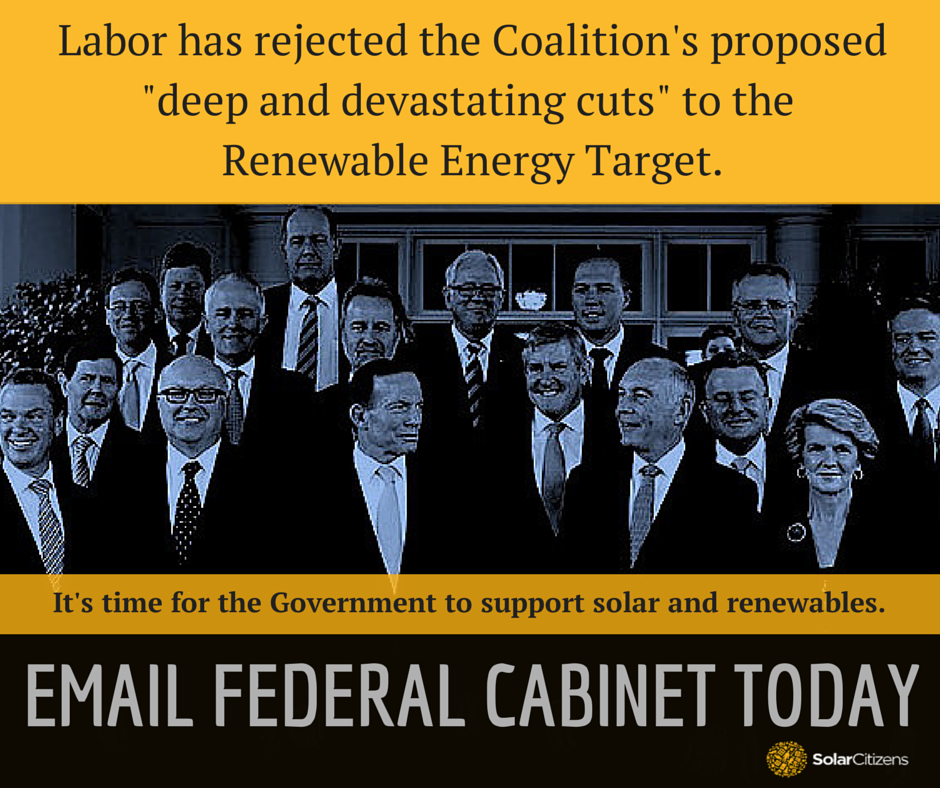
NEVILLE — This is big. Labor has called out the government’s heinous attempts to destroy solar and walked away from Renewable Energy Target negotiations, saying it could not accept the government’s proposed “deep and devastating cut to the sector”*. This development has lifted the curtain on the government’s true intentions for solar and renewable energy. By failing to come to an agreement with Labor to restore bipartisan support for the Target’s future, the government has exposed the fact it wants to keep pushing on with its attempt to put renewables at grave risk.
Labor’s Environment spokesman Mark Butler’s statement today says he “raised serious concerns about restrictions on the rooftop solar industry”** in negotiations. On top of this, we’ve been hearing persistent talk that the government wants to drastically reduce the small-scale part of the scheme that covers rooftop solar. This is in stark contrast to Ian Macfarlane’s public statements last month that household solar was in the clear.*** The Coalition broke its election promise as soon as they walked through Parliament’s door as the new Government, setting up the bogus Warburton review that has undermined the renewable energy industry and sent billions in investment offshore. The Target will bring power prices down for everyone, create more than 15,000 solar jobs and make it easier for people to go solar. But the big power companies are fighting tooth and nail to protect their huge profits and we all know who they expect to pay – every Australian power user. But together we won’t let them get away with it. The Federal Cabinet is meeting soon and the people sitting around the large table can resolve to back the Target and restore confidence in Australia’s most innovative new industry. Ask your politicians whose interests they’re backing – yours or those of the big power companies? Send your personal message to Cabinet right now and show them that you’ll support politicians that support lower power prices and create more Aussie jobs. Claire, National Director PS: A year is a long time in politics, but we need to remember how this began. The Coalition promised to support the Renewable Energy Target, but soon after the 2013 election it announced an unnecessary review that undermined the industry and cost billions in investment. Even the Warburton review found the Target will bring down power prices for Australians by 2020. So stop reading this email and write to Federal Cabinet using our easy online tool – tell the Government to get back in touch so Australia can get on with the job growing solar and renewables . Solar Citizens |
|||||||||||

22°C
Min 8°

Posted
More than half a billion tonnes of coal is mined in Australia each year from national reserves that are the fourth largest in the world, behind the United States, Russia and China.
Coal exports have added, on average, $44 billion to the national annual income over the past five years, with Australia predicted to be one of the biggest beneficiaries on increasing global trade in coal. Prime Minister Tony Abbott says coal is “good for humanity” and that he is confident about the future of the industry.
But the latest ‘synthesis report‘ from the United Nations Intergovernmental Panel on Climate Change, released in November, warns that without, among other things, reducing the carbon intensity of electricity generation, global warming is on track to exceed current temperatures by 4 degrees Celsius by 2100.
Environment Minister Greg Hunt says the Government’s “direct action” plan will underpin research into clean coal technology, which will “significantly” reduce emissions from current coal-fired power generators.
“What we have to focus on is reducing emissions and the best thing that we can do is to actually clean up existing power stations. What we’re proposing right now is to work with power stations. We have the research of the CSIRO which is talking about a 30 to 50 per cent reduction in emissions from brown coal power stations through their direct injection combustion engine research,” he told ABC radio on November 3.
Mr Hunt told the ABC’s Four Corners in July that: “The technology which is emerging now and which I think will be available over the next three to five years cleans up very significantly – not perfectly, but very significantly, by up to 30 to 50 per cent the emissions from current generation.”
Can clean coal technology halve emissions from current power generators within five years?
In October 2012, the federal Parliamentary Library summarised the options for reducing emissions in power generation. It stated: “Designation of a technology as a ‘clean coal’ technology does not imply that it reduces emissions to zero or near zero. For this reason, the term has been criticised as being misleading; it might be more appropriate to refer to ‘cleaner coal’.”
Australia has about 25 coal-fired power stations in operation which burn black and brown coal. According to the Climate Council, 65 per cent of Australia’s coal-fired power stations will be over 40 years old by 2030.
All but four of Australia’s power stations are what are known as older, “subcritical” plants, which waste 65 per cent, or more, of the coal they burn.
Four “supercritical” plants were built in Australia in the late 1990s to replace old plants from the 1970s and emit less greenhouse gases than the subcritical plants.
According to the International Energy Agency (IEA), state-of-the-art, ultra-supercritical (USC) plants can run at up to 46 per cent efficiency. On World Coal Association estimates, those efficiency gains mean a USC plant could emit up to 40 per cent less than a regular, existing power station. Advanced-USC plants, which are even more efficient, are being developed overseas.
The association’s website estimates that for every one percentage point gain in efficiency, there is a 2 to 3 per cent reduction in the amount of greenhouse gasses produced. So, a USC plant running at 46 per cent efficiency would produce 22 to 33 per cent lower emissions than an existing plant running at 35 per cent efficiency.
University of Queensland Energy Initiative director Chris Greig says it is reasonable to suggest that any new high-efficiency, low-emissions technology would produce 30 per cent to 50 per cent lower emissions than the current subcritical plants. “But 50 per cent would be a stretch. It would be comparing the best replacement technology with the worst existing plant,” he told Fact Check.
But Australia is unlikely to implement either the USC or Advanced-USC technology because the cost of retrofitting existing plants is prohibitively expensive, almost equal to building an entirely new plant, according to Professor Greig, and Bloomberg New Energy Finance (BNEF) head of Australia Kobad Bhavnagri.
This means the supercritical or ultra-supercritical technology will likely only be used if a new plant is built, and according to an August report from the National Electricity Market Operator, for the first time in history, Australia will not need any more coal or gas power capacity to maintain adequate supply over the next decade.
BNEF also says in its Asia Pacific 2030 Market Outlook report, released in June, that new coal generation projects “are unlikely in Australia, as lenders are reluctant to contribute finance citing significant reputational risk”.
With USC technology too expensive to retrofit, CSIRO researchers are investigating cheaper, more effective technologies to reduce emissions created from burning coal. Those technologies include carbon capture and storage, and intense gasification technologies. But Mr Hunt says it is direct injection carbon engine (DICE) technology which will clean up Australia’s coal industry.
The CSIRO’s head of the Advanced Carbon Power division, and principal scientist working on DICE, Louis Wibberley, says that it would be “absolutely possible” for DICE to cut emissions by 30 per cent, or up to 50 per cent respectively, when compared to old black and brown coal generators, if the technology could be developed to a commercial roll-out stage.
“But we are struggling to get the funding from the coal industry,” he told Fact Check.
Dr Wibberley says DICE technology, which is essentially a diesel engine about the same size as those used on ships, uses a liquid slurry of water and brown or black coal (and bio-char if available) to create energy.
He says the technology to create the right type of liquid is at commercial stage, but the first fully-sized engine to power a commercial plant won’t be available until 2020, as a best-case scenario.
He says while Australia has one laboratory small-scale prototype engine, the Japanese should be ready to test a 1,000 kilowatt single cylinder engine some time over the next 18 months, which would be big enough to power about 1,000 homes.
He notes that a 12,000 to 30,000 kilowatt prototype demonstration engine could be possible overseas by 2018.
German company MAN Diesel & Turbo estimates it can manufacture an engine within three to five years.
Dr Wibberley says Australia is about a year behind that schedule for implementation, because of funding and administrative issues which have delayed development of the technology.
The benefit of DICE technology over other clean coal systems is that individual engine units can be inserted into existing power plants, and could produce between 5,000 and 7,000 kilowatts each.
Dr Wibberley says the expectation is that existing coal generators could be systematically decommissioned and replaced with DICE units in a planned, staged rollout, which could be cheaper and easier than retrofitting plants with other technologies.
A commercial DICE power plant is expected to cost about $1.4 million per 1,000 kilowatts to build, and could also assist in the uptake of carbon capture and storage, “delivering a 30 to 40 per cent cost advantage (in terms of $/t CO2 abated) compared to conventional coal and gas power generation technology,” Dr Wibberley said in a paper presented to the International Energy Agency in May.
“The cost to commercialisation…would be comparatively low (say $75 million) and far less than most other cleaner coal technologies,” it said.
The CSIRO says that unlike traditional generators, DICE technology:
Mr Bhavnagri says that putting aside DICE technology, which is still in an early research phase, Mr Hunt’s statements about clean coal technologies making a significant impact on reducing global warming “aren’t supported by the evidence and lack substance”.
He says BNEF doesn’t focus on clean coal anymore, “which is indicative of the fact it doesn’t really have that much of a future”.
BNEF expects that emissions from Australia’s power generation sector will remain high for at least 15 years, despite more renewable energy technology coming on line. Its Market Outlook report states that power sector emissions in Australia are only expected to fall by 6 per cent between 2013 and 2030.
The report says coal will persist as an energy source, and with the incumbent coal fleet likely to be long-lived and remain cheap to operate, output – and emissions – will stay high.
“To decarbonise the power sector in the absence of cost-effective sequestration technologies, policy measures will be needed that raise the short-run cost of coal and force larger amounts of retirements [of subcritical generators],” it said.
While Mr Hunt did not specifically mention DICE during his Four Corners interview, the Environment Minister subsequently confirmed publicly that his statement about reducing emissions by up to 50 per cent was based on the CSIRO’s technology.
That technology remains in a development phase and is not realistically expected to be commercially operative and rolled out within three to five years. Funding issues and lack of widespread industry support have put development of DICE technology in Australia behind the rest of the world by about a year.
No other clean coal technology sufficient to cut emissions from current generators by up to 50 per cent is economically viable at industrial scale in Australia, or expected to become viable within the next five years.
Whatever the technological developments, forecast demand for coal-fired electricity in Australia is not expected to make implementation of the new clean coal technologies economically viable domestically.
Mr Hunt’s statement is highly ambitious.
22°C
Min 8°
Posted
More than half a billion tonnes of coal is mined in Australia each year from national reserves that are the fourth largest in the world, behind the United States, Russia and China.
Coal exports have added, on average, $44 billion to the national annual income over the past five years, with Australia predicted to be one of the biggest beneficiaries on increasing global trade in coal. Prime Minister Tony Abbott says coal is “good for humanity” and that he is confident about the future of the industry.
But the latest ‘synthesis report‘ from the United Nations Intergovernmental Panel on Climate Change, released in November, warns that without, among other things, reducing the carbon intensity of electricity generation, global warming is on track to exceed current temperatures by 4 degrees Celsius by 2100.
Environment Minister Greg Hunt says the Government’s “direct action” plan will underpin research into clean coal technology, which will “significantly” reduce emissions from current coal-fired power generators.
“What we have to focus on is reducing emissions and the best thing that we can do is to actually clean up existing power stations. What we’re proposing right now is to work with power stations. We have the research of the CSIRO which is talking about a 30 to 50 per cent reduction in emissions from brown coal power stations through their direct injection combustion engine research,” he told ABC radio on November 3.
Mr Hunt told the ABC’s Four Corners in July that: “The technology which is emerging now and which I think will be available over the next three to five years cleans up very significantly – not perfectly, but very significantly, by up to 30 to 50 per cent the emissions from current generation.”
Can clean coal technology halve emissions from current power generators within five years?
In October 2012, the federal Parliamentary Library summarised the options for reducing emissions in power generation. It stated: “Designation of a technology as a ‘clean coal’ technology does not imply that it reduces emissions to zero or near zero. For this reason, the term has been criticised as being misleading; it might be more appropriate to refer to ‘cleaner coal’.”
Australia has about 25 coal-fired power stations in operation which burn black and brown coal. According to the Climate Council, 65 per cent of Australia’s coal-fired power stations will be over 40 years old by 2030.
All but four of Australia’s power stations are what are known as older, “subcritical” plants, which waste 65 per cent, or more, of the coal they burn.
Four “supercritical” plants were built in Australia in the late 1990s to replace old plants from the 1970s and emit less greenhouse gases than the subcritical plants.
According to the International Energy Agency (IEA), state-of-the-art, ultra-supercritical (USC) plants can run at up to 46 per cent efficiency. On World Coal Association estimates, those efficiency gains mean a USC plant could emit up to 40 per cent less than a regular, existing power station. Advanced-USC plants, which are even more efficient, are being developed overseas.
The association’s website estimates that for every one percentage point gain in efficiency, there is a 2 to 3 per cent reduction in the amount of greenhouse gasses produced. So, a USC plant running at 46 per cent efficiency would produce 22 to 33 per cent lower emissions than an existing plant running at 35 per cent efficiency.
University of Queensland Energy Initiative director Chris Greig says it is reasonable to suggest that any new high-efficiency, low-emissions technology would produce 30 per cent to 50 per cent lower emissions than the current subcritical plants. “But 50 per cent would be a stretch. It would be comparing the best replacement technology with the worst existing plant,” he told Fact Check.
But Australia is unlikely to implement either the USC or Advanced-USC technology because the cost of retrofitting existing plants is prohibitively expensive, almost equal to building an entirely new plant, according to Professor Greig, and Bloomberg New Energy Finance (BNEF) head of Australia Kobad Bhavnagri.
This means the supercritical or ultra-supercritical technology will likely only be used if a new plant is built, and according to an August report from the National Electricity Market Operator, for the first time in history, Australia will not need any more coal or gas power capacity to maintain adequate supply over the next decade.
BNEF also says in its Asia Pacific 2030 Market Outlook report, released in June, that new coal generation projects “are unlikely in Australia, as lenders are reluctant to contribute finance citing significant reputational risk”.
With USC technology too expensive to retrofit, CSIRO researchers are investigating cheaper, more effective technologies to reduce emissions created from burning coal. Those technologies include carbon capture and storage, and intense gasification technologies. But Mr Hunt says it is direct injection carbon engine (DICE) technology which will clean up Australia’s coal industry.
The CSIRO’s head of the Advanced Carbon Power division, and principal scientist working on DICE, Louis Wibberley, says that it would be “absolutely possible” for DICE to cut emissions by 30 per cent, or up to 50 per cent respectively, when compared to old black and brown coal generators, if the technology could be developed to a commercial roll-out stage.
“But we are struggling to get the funding from the coal industry,” he told Fact Check.
Dr Wibberley says DICE technology, which is essentially a diesel engine about the same size as those used on ships, uses a liquid slurry of water and brown or black coal (and bio-char if available) to create energy.
He says the technology to create the right type of liquid is at commercial stage, but the first fully-sized engine to power a commercial plant won’t be available until 2020, as a best-case scenario.
He says while Australia has one laboratory small-scale prototype engine, the Japanese should be ready to test a 1,000 kilowatt single cylinder engine some time over the next 18 months, which would be big enough to power about 1,000 homes.
He notes that a 12,000 to 30,000 kilowatt prototype demonstration engine could be possible overseas by 2018.
German company MAN Diesel & Turbo estimates it can manufacture an engine within three to five years.
Dr Wibberley says Australia is about a year behind that schedule for implementation, because of funding and administrative issues which have delayed development of the technology.
The benefit of DICE technology over other clean coal systems is that individual engine units can be inserted into existing power plants, and could produce between 5,000 and 7,000 kilowatts each.
Dr Wibberley says the expectation is that existing coal generators could be systematically decommissioned and replaced with DICE units in a planned, staged rollout, which could be cheaper and easier than retrofitting plants with other technologies.
A commercial DICE power plant is expected to cost about $1.4 million per 1,000 kilowatts to build, and could also assist in the uptake of carbon capture and storage, “delivering a 30 to 40 per cent cost advantage (in terms of $/t CO2 abated) compared to conventional coal and gas power generation technology,” Dr Wibberley said in a paper presented to the International Energy Agency in May.
“The cost to commercialisation…would be comparatively low (say $75 million) and far less than most other cleaner coal technologies,” it said.
The CSIRO says that unlike traditional generators, DICE technology:
Mr Bhavnagri says that putting aside DICE technology, which is still in an early research phase, Mr Hunt’s statements about clean coal technologies making a significant impact on reducing global warming “aren’t supported by the evidence and lack substance”.
He says BNEF doesn’t focus on clean coal anymore, “which is indicative of the fact it doesn’t really have that much of a future”.
BNEF expects that emissions from Australia’s power generation sector will remain high for at least 15 years, despite more renewable energy technology coming on line. Its Market Outlook report states that power sector emissions in Australia are only expected to fall by 6 per cent between 2013 and 2030.
The report says coal will persist as an energy source, and with the incumbent coal fleet likely to be long-lived and remain cheap to operate, output – and emissions – will stay high.
“To decarbonise the power sector in the absence of cost-effective sequestration technologies, policy measures will be needed that raise the short-run cost of coal and force larger amounts of retirements [of subcritical generators],” it said.
While Mr Hunt did not specifically mention DICE during his Four Corners interview, the Environment Minister subsequently confirmed publicly that his statement about reducing emissions by up to 50 per cent was based on the CSIRO’s technology.
That technology remains in a development phase and is not realistically expected to be commercially operative and rolled out within three to five years. Funding issues and lack of widespread industry support have put development of DICE technology in Australia behind the rest of the world by about a year.
No other clean coal technology sufficient to cut emissions from current generators by up to 50 per cent is economically viable at industrial scale in Australia, or expected to become viable within the next five years.
Whatever the technological developments, forecast demand for coal-fired electricity in Australia is not expected to make implementation of the new clean coal technologies economically viable domestically.
Mr Hunt’s statement is highly ambitious.
CleanTechnica is the #1 cleantech-focused
website in the world. Subscribe today!
CleanTechnica logo
The World Moves Post-2020 While Australia Remains Fixated On 2020
Share on Google+Share on RedditShare on StumbleUponTweet about this on TwitterShare on LinkedInShare on FacebookPin on PinterestDigg thisShare on TumblrBuffer this pageEmail this to someone
November 11th, 2014 by Joshua S Hill
That I am at loggerheads with the environmental and energy-related policies of the Australian Government is of no surprise to anyone who has spent much time here at CleanTechnica. CC1As an Australian working for a US-based, international-focused website, the ability to comment on Australia’s current politics from an international perspective is incredibly helpful, while simultaneously depressing.
As the image to the side shows, the World Bank currently finds 39 countries as implementing a carbon tax of some sort or another.
Australia would have made that number 40, except Prime Minister Tony Abbott successfully scrapped the country’s carbon tax, making us the first country to have implemented a carbon tax only to then remove it.
Two reports released here in Australia on Monday further pinpoint just how devastating the country’s recent energy and environmental policies have been. Furthermore, they show how backward Australian politics is, fixating so obsessively on 2020 goals while the rest of the world begins to focus on a post-2020 world.
“By just focusing on 2020 emission and renewable energy goals, the recent political debate has ignored growing scientific, investment, and international realities,” said Erwin Jackson, Deputy CEO of The Climate Institute. “This short-term focus is simply a high risk approach to the significant challenges of decarbonising our economy and helping avoid dangerous impacts for Australia.
“Australian politics is fixated on 2020 but the world is now increasingly looking beyond 2020.”
Moving Beyond 2020
“Much of the recent climate policy debate in Australia has been framed around our 2020 emissions reduction and renewable energy goals,” wrote the authors of a Climate Institute report published Monday, which aims to tackle Australia’s role in a post-2020 international climate.
“While these goals remain a credibility test of Australia’s climate action, they are insufficient for stable economic policy, and are being overtaken by international policy developments and investment realities.”
The new report concluded that scientific, investment, and international realities are repositioning the focus on post-2020 total decarbonisation targets. As a result, Australia must hit a net 2025 emissions reduction target of 40% below 2000 levels as well as begin work on decarbonisation the economy by 2040.
An indicative international process to set targets in the post-2020 framework.
CC3
The conclusions are not crazy either, considering that Australia joined over 190 countries to work collectively to avoid 2ºC of warming above pre-industrial levels. In hand with Australia’s decision to join other countries in focusing on post-2020 goals in Warsaw last year, The Climate Institute find that the country’s post-2020 targets should include the following:
A short-term commitment to reduce net emissions by 40 per cent on 2000 levels by 2025
A medium-term emission pathway of 65-75 per cent reductions on 2000 levels by 2035
A long-term goal to decarbonise the economy by between 2040 and 2050
“For any policy to remain stable and effective it needs to be relevant not just for the next five years, but for the next 50 years,” said Jackson. “Failure to deliver a proper plan risks institutionalising investment uncertainty, and a much more rapid – and therefore more disruptive – decarbonisation at a later date.”
Furthermore, according to Jackson, “it also completely avoids the physical, investment, and international realities of climate change and evolving action to address it.”
Investment Realities
The realities of investment in this day and age is that, regardless of your own personal opinions on issues like climate change and energy efficiency, investing in clean energy and similar is a necessity. However, according to a second report released Monday, this time by Tim Flannery, Gerry Hueston, and Andrew Stock of the Australian Climate Council, Australian investment in renewable energy throughout 2014 has dropped a whopping 70% compared with 2013.
Annual large-scale renewable energy investment in Australia
CC2
Unsurprisingly, the authors have subsequently moved Australia, a crucial major climate change player, from “leader to laggard.”
The report made four key findings, which highlight Australia’s failing involvement in the world in which we currently live:
China and the US have firmly moved from laggards to global leaders on climate change.
In the last five years most countries around the world have accelerated action on climate change as the consequences have become more and more clear.
Australia, a crucial player in global climate action, moves from leader to laggard.
Global action must accelerate to protect Australia and the world from the consequences of a changing climate, sea level rise and more frequent and intense extreme weather.
That Australia is falling leagues behind international allies and trading partners is no surprise to many who are watching from the outside in. However, for many Australians, it would arguably be a great surprise to find that we are so far behind the pack. The political realities dictate that the “truth” is whatever is heard loudest — and sadly, the actual truth is not always the same as the political “truth”.
As Australia moves into a long period of state and national elections, one hopes that the truth is heard above the “truth”.
Keep up to date with all the hottest cleantech news by subscribing to our (free) cleantech newsletter, or keep an eye on sector-specific news by getting our (also free) solar energy newsletter, electric vehicle newsletter, or wind energy newsletter.
The G20 pledged to phase out ‘inefficient’ fossil fuel subsidies in 2009, yet new research finds that governments are are spending $88 billion every year supporting exploration – more than double what the oil and gas companies are investing.
How much is each G20 government spending on fossil fuel exploration?
Read more in our individual country studies for Argentina, Australia, Brazil, Canada, China, France, Germany, India, Indonesia, Italy, Japan, Republic of Korea, Mexico, Russia, Saudi Arabia, South Africa, Turkey, the United Kingdom and the United States.