AdFlight Centre Online – flightcentre.com.au – We’ll Beat Any Web Airfare Quote Or You Fly Free. Enquire Today.
|
climate code red

|
||||||||||||||
|
AdFlight Centre Online – flightcentre.com.au – We’ll Beat Any Web Airfare Quote Or You Fly Free. Enquire Today.
|
climate code red
|
||||||||||||||
1 of 1
| Ad850% + Investment Returns – the-best-investments-today.com – Invest In Alternative Investments. Huge Profits. Free Top-Pick Guide! |
The John James Newsletter 24
Why is this message in Spam? It contains content that’s typically used in spam messages. Learn more The John James Newsletter 24 2 November 2014. CO2 and mass extinctions of species – Andrew Glikson Some nine mass extinctions due to rapidly escalating levels of CO2 are recorded over the past 580 million years. As our anthropogenic global emissions of CO2 are rising at a rate for which no precedence is known from the geological record another wave of extinctions is unfolding. http://theconversation.com/another-link-between-co2-and-mass-extinctions-of-species-12906 The Day Israel Attacked America Al Jazeera investigates the deadly Israeli attack on a US naval vessel.In 1967. At the height of the Arab-Israeli Six-Day War the Israeli Air Force launched an unprovoked attack on the USS Liberty, a spy ship that was monitoring the conflict from the safety of international waters in the Mediterranean. Was it a cover for Israel’s imminent attack to capture the Golan Heights from Syria? Why did the US not object? Why was aid to Israel trebled in the next year? Victorian town aims to be 100% renewable by 2022. Yackandandah and surrounding villages already have a penetration rate of rooftop solar of 28.7 per cent, with 201 of the 700 dwelling buildings hosting a total of 600kW of solar. The Indigo Shire has the highest solar penetration of any council in the state. http://reneweconomy.com.au/2014/victoria-town-aims-100-renewables-2022 Politics and aid (1) Israel allowed only 75 trucks full of reconstruction material to enter the strip in mid-October to rebuild shelters for the estimated 110,000 Palestinians left homeless by Israel’s massive assault http://www.maannews.net/eng/ViewDetails.aspx?ID=736421 Politics and aid (2) Russian convoy delivers the fourth Russian humanitarian aid convoy to Ukraine. The previous three convoys have delivered 6,000 tons of food products, including cereals and canned food, as well as medicines, electricity generators, warm clothes and bottled drinking water. http://en.itar-tass.com/world/757574 Ecological farming on the Maldives How to use our own wastes for the preservation of the planet. https://www.youtube.com/watch?v=W1J59rPnXeQ&feature=youtu.be Hungary suspends internet tax plan after mass protests Around 100,000 Hungarians attended a rally protesting against the centre-right government’s plan. Pentagon spending hits five-year high The rate at which the United States economy grew last quarter from a surge in military spending that went up 16 percent. This is a five-year high not seen since the US was involved in wars in both Afghanistan and Iraq. Significantly, it has helped the economy overcome below-expectation consumer spending. http://rt.com/usa/200911-gdp-defense-spending-surge/
Minnesota’s highways are poised to become renewable energy generators The state is soliciting proposals for solar developers to lease unused land along highways with up to 1-megawatt solar panel arrays built on public right-of-way around the state. |
|||||||||
RTCC Respond Magazine 2014
Most read
Latest
Recommended
IPCC report is “roadmap” to Paris climate deal – Pachauri
IPCC report is “roadmap” to Paris climate deal – Pachauri
27 October
Why you should bother to read the IPCC synthesis report
Why you should bother to read the IPCC synthesis report
29 October
Ikea launches solar panels in the Netherlands
Ikea launches solar panels in the Netherlands
27 October
US and UK call on UN science panel to stress climate risks
US and UK call on UN science panel to stress climate risks
26 October
Antarctic sea ice reaches record high, as Arctic hits 2014 minimum
Antarctic sea ice reaches record high, as Arctic hits 2014 minimum
22 September
Inconclusive Bonn climate talks leave a heavy Lima workload
Inconclusive Bonn climate talks leave a heavy Lima workload
24 October
Climate change could create more Boko Haram extremists – study
Climate change could create more Boko Haram extremists – study
29 October
Poland “won” EU 2030 deal – does the climate lose?
Poland “won” EU 2030 deal – does the climate lose?
29 October
Naomi Klein: New York showed glimpse of climate justice movement
Naomi Klein: New York showed glimpse of climate justice movement
27 October
Ambitious or weak? Reaction to the EU’s 2030 climate package
Ambitious or weak? Reaction to the EU’s 2030 climate package
24 October
China, India set pace in global clean energy growth
China, India set pace in global clean energy growth
28 October
Fracking may release cancer-causing air pollution – study
Fracking may release cancer-causing air pollution – study
30 October
IPCC will abolish doubt in climate politics – Danish minister
IPCC will abolish doubt in climate politics – Danish minister
30 October
Climate marathon: IPCC nears finish line for seminal report
Climate marathon: IPCC nears finish line for seminal report
29 October
EU set to overachieve 2020 carbon emissions goal
EU set to overachieve 2020 carbon emissions goal
28 October
Climate marathon: IPCC nears finish line for seminal report
Last updated on 29 October 2014, 4:39 pm
Scientists will need to sift through over 200 comments, ranging from grammatical errors to strategic concerns
IPCC chair Rajendra Pachauri and IPCC WG-1 Co-Chair Thomas Stocker confer in Copenhagen (Photo by IISD/ENB)
IPCC chair Rajendra Pachauri and IPCC WG-1 Co-Chair Thomas Stocker confer in Copenhagen (Photo by IISD/ENB)
By Ed King
An exquisite form of torture is taking place this week in Copenhagen.
Over 500 delegates from 120 countries are working through a complex 100-page document that outlines the latest scientific understanding on climate change.
Officials are checking each page, line by line, and discussing whether the findings make sense.
Changes must be approved by consensus between government representatives and participating scientists. This is where politics and science collide.
The result of these endeavours will be the Intergovernmental Panel on Climate Change Synthesis Report, the final part of a mammoth six-year project.
It is likely to be one of the most carefully analysed documents this year and could determine economic and energy planning for next 20 years.
A final draft seen by RTCC says there is “unequivocal” evidence of change around the world, with potentially “irreversible” impacts if greenhouse emissions continue to rise.
But with three days of debate to go, the draft may yet change. A deluge of government reviews seen by RTCC offers a sense of priorities in capitals around the world.
Below is a taste of the variety of views from 181 pages of comments, which the IPCC is expected to address before Sunday. The comments have been copied directly, typos and all.
They reveal fears the dangers of climate change are not clear enough, that politicians will find the report too hard to read and a reassuring consensus that grammar is still important.
General feedback
The text has improved much from the earlier draft. However, the SPM still falls short of an actual synthesis and it does not provide a very good integration of the assessments of the three IPCC Working Groups. Rather, it still gives the impression of largely a copy-paste composite. [Government of Sweden]
The authors should take extra care to avoid complex and long sentences. In particular run-on sentences should be avoided. Preferably, long sentences should be broken up into shorter ones. [Government of Sweden]
This document should be prepared so as to be effective for the people who will only read the gray boxes. This report is a story, of what happens if we don’t act, and what can happen if we do… it should be an effective story. [Government of United States of America]
Clarity
This number tells very little. Is 0.1 much or little? [Government of Finland]
Does “unequivocal” mean “virtually certain”? If appropriate, defined uncertainty terminology should be used. [Government of United States of America]
SPM 1.3 This sentence is too generic and sounds obvious. Needs to be more explicit [Government of India]
What is the logical connection between the two sentences? [European Union] Headline 2.1
THE WHOLE SECTION IS MISLEADING. [WGIII 1.3, 5.3] [Government of Bolivia]
“unprecedented in at least 800,000 years”: Really? How certain? [Government of United States of America] Headline 1.2 SPM
This would be good to write out in terms of what the information means, in less scientific language. [Government of Sweden]
How long is “ever”? [Government of United States of America]
Does “clear” mean “virtually certain”? [Government of United States of America]
How is “unequivocal” defined? Is it “virtually certain”? [Government of United States of America]
What is meant by “consequential impacts”? [Government of United States of America]
What does “fractions of the global population” mean? Suggest considering whether there is a more clear way to state this. [Government of Canada]
Misestimate is not a real word. Underestimate or mistake would be more accurate in this context. [Government of Ireland] SPM 3.1
UK demands
[SPM 3.4] This is a key section with information very relevant to policy makers. Clear information on:
• The expected global temperature in 2100 without additional mitigation
• What emissions need to do to have a likely chance of reaching 2C and how this compared to current
• The scale of the challenge
• The risks of delay and the likely co-benefits
Should be provided and not hidden in supporting text and diagrams. The section is currently quite long and would better be split into two sections; the first on where we need to be to reach 2C and the second on where we currently are. The headline statements below could then reflect this new split [Government of United Kingdom of Great Britain & Northern Ireland]
SPM 4.5
One of the important co-benefits of climate change mitigation action, e.g. on emissions from the transport sector, is improved air quality. I would suggest making this explicit: “Co-benefits arise when investments in adaptation or mitigation can be managed to yield increased welfare from improved economic growth, public health, air quality or infrastructure.” [Government of United Kingdom of Great Britain & Northern Ireland]
Saudi concerns
Change ‘past 15 years’ to ‘past 17 years (1998-2014) [Government of Saudi Arabia] (RE warming pause)
Add from WGI SPM). It is very likely that the annual mean Antarctic sea ice extent increased at a rate in the range of 1.2 to 1.8% per decade (range of 0.13 to 0.20 million km2 per decade) between 1979 and 2012 [Government of Saudi Arabia]
There is low confidence in the scientific understanding of the small observed increase in Antarctic sea ice extent due to the incomplete and competing scientific explanations for the causes of change and low confidence in estimates of natural internal variability in that region. From WG1 SPM page 19 [Government of Saudi Arabia]
This figure is for the period 1951 to 2010. Warming was lower during the more recent period 1998 – 2010. This should be clearly indicated in this graph. [Government of Saudi Arabia]
Imponderables
“Plants cannot move”: this may seem odd unless there is a qualifier such as “naturally” or “by themselves”? Please check whether such an addition would be appropriate. [Government of Belgium] PM 2.3
SPM 2.3
We suggest the phrase “climate change is expected to lead to … greater likelihood of death …” needs to be reworded to more clearly explain what is meant. Everybody dies somtime, ie the unqualified likelhood of death is always 1.0. Perhaps what is meant is “climate change is expected to lead to … greater likelihood of EARLY death …? [Government of New Zealand]
Duplication
Editorial correction: The phrase “take account of” should occur only once in this sentence. [Government of New Zealand]
“take account of” is twice [Government of Finland]
“take account of” is repeated [Government of Italy]
Eliminate one of the two “take account of”. [Government of Switzerland]
typo: delete “take account of” as it is written twice. [Government of Ireland]
Referring to “of take account”: to delete. [European Union]
Delete repetition “take account of”. [Government of Russian Federation]
Editorial: delete “take account of” because these words have been repeated. [Government of Austria]
“take account of” is dublicated, one of them should be removed. [Government of Turkey]
Presentation
I have zoomed 150% in the pdf and have a huge monitor. The figure has a low resolution which makes it hard to read on paper. The sea level has rised so there is an erosion impact on western Europe soft coast which is not shown [Government of Denmark]
Table SPM.2: Please reconsider the use of colours in this table. [Government of Norway]
Read more on: IPCC
– See more at: http://www.rtcc.org/2014/10/29/climate-marathon-ipcc-nears-finish-line-for-seminal-report/#sthash.Z1X3nZRI.dpuf
|
AdMaster of Public Health – tua.edu.au/Scholarships – Up to 30% Scholarships Available For 2015 Enrolment. Enquire Today!
|
Which budget measures will make it through the Senate?

Dear NEVILLE,
A whole budget agenda stalled — how’d that happen? After a frantic fortnight of action by GetUp members, the Abbott Government remains unable to muster the numbers in the Senate to make headway on their key budget priorities. Legislation on university deregulation, Medicare, Newstart and Family Tax Benefits is effectively stuck in parliamentary limbo. But sudden, surprise deals with the crossbench (like last week on the Government’s ‘Direct Action’ climate plan) show the absolute necessity of keeping up the pressure — especially with just one voting session left this year. To get fired up for the last big push, take a few minutes to check out where key budget measures stand, what we’ve done together to stop them, and the threats that remain.
A key Senate report released Tuesday bore the mark of 2,801 GetUp submissions and dozens of members making their presence felt at public Senate hearings. The Government’s own senators called on Education Minister Christopher Pyne to rethink his much-despised plan to charge students interest on HECS debt. But despite noting considerable community concern about the impact on student fees, the report stopped short of ditching deregulation altogether. So with the legislation slated for debate, GetUp members drove in 6,843 emails and calls to the Senate crossbench. The outcome? This week, Clive Palmer reiterated PUP’s promise to vote against deregulation, telling ABC radio he considers himself the “last sentry to the gate to ensure [students] have a good future“.1 With intel that Senators Muir and Wang are the weakest links on this issue, we’re looking at ways for GetUp members to speak with them directly in the lead up to the November sitting period. In addition, our new TV ad funded by over 2,300 GetUp members will start airing this Monday to key demographics, including Senator Muir’s Victoria and Senator Wang’s WA. If you’re yet to sign the petition to keep our universities affordable, add your name now: https://www.getup.org.au/higher-education.
700,000 Australian families under threat of losing $3,000 per year? Undecided politicians? A critical vote scheduled just days away? It was a moment built for the magic that GetUp members bring to politics. The Abbott Government was trying to ram legislation through the Senate this week that would cut off family tax benefits for low- and middle-income families when their youngest turns 6. 10,304 GetUp members leapt into action, calling and writing their crossbench senator to highlight the impacts of this hidden budget nasty. Denied the crossbench votes they needed, the Abbott government (you guessed it) put off the vote. But with GetUp members reporting back that 6 of the 8 crossbench senators are undecided, we’ve got a big lift ahead to keep Australian families safe from this unfair new tax burden. If you’re yet to contact your senator to let them know that the job of a parent doesn’t stop at 6, you can do so here: https://www.getup.org.au/family-tax.
We’re close. The finish line is in sight, the final sprint before us. In September, the Abbott Government exposed the weakness of their hand on social safety net cuts by splitting up the legislation based on what they could agree on with the ALP. That ‘struggling’ bit includes the drastic changes to Newstart — including a 6 month waiting period for young jobseekers — that GetUp members have been fighting tooth and nail. But we’re not counting our chickens before they hatch. As we head to the end of the year, GetUp members will continue to lift up the promises of the Palmer United Party, and hold them to their word to defend young jobseekers. If you haven’t already, add your name to the petition protect young job seekers: https://www.getup.org.au/newstart.
The GP copayment, publically discredited and politically toxic, has no current path through the Senate — but continues to lurk in the shadows of the Coalition party room. In fact, suggestions emerged this week that the Abbott Government could try to sidestep the Senate and force the GP fee through as regulation.2 What’s more, the Government’s furthered plans to Americanise our health system by opening up its new ‘Private Health Networks’ to be run by private insurance companies.3 That could mean insurance companies telling your GP what and who they can and can’t treat. We’re talking to peak health bodies right now about what this could mean and what can be done. Watch this space! SO, WHAT’S NEXT? As the budget continues to expose the Abbott Government as unfair and out of touch, GetUp members have been keeping energised and vigilant against sneaky horsetrading, and watching the crossbench’s every move. We’ve just one month left to drive our campaigns home and bolster the budget blockade before Parliament breaks for the year. But despite months of success by GetUp members holding pollies to account on this budget, this week’s surprise agreement on the Government’s climate package proved that lightening strike deals with the Senate crossbench can happen at any moment. Heading off bad deals before they happen means having the resources always on hand, which is made possible by the regular donations of GetUp’s core members.
References |
|||||||||||

Australian ecologist Corey Bradshaw and environmental scientist Barry Brook of the Environment Institute of The University of Adelaide, Australia have modeled projected population growths for the world.
Prompted by concerns wildlife, human-made climate change and human overcrowding, both scientists worked together on models of population growth to see if this could be changed. They set up nine models. Currently, it is thought that there are 7.2 billion people alive today and that is expected to rise to 10.9 billion in the year 2100.
Three of the models approached the issue using non-catastrophic methods. The first is that of female empowerment and wide spread use of contraception and the other two were both ‘forced’ one-child policies. While the first policy may be desirable, the latter two raise awkward ethical questions.

The other six models were catastrophic envisioning mass destruction of people by the effects of climate change, conflicts, and pandemic disease. One of these was the World War III scenario, which would have reduced population by 5% and used fatality figures of both combatants and civilians in both World Wars and also included the fatalities from 1919’s Spanish Flu pandemic, which killed more people than the previous four years of combat. One scenario drastically reduced the population to just over a billion people. Presumably, a nuclear war scenario was not used, but food shortages caused by human-made climate change were. The food shortages reduced the population by increasing childhood mortality.
In the end the scientists found that only the most extreme measures (draconian one child policy implemented immediately, irresistible pandemic, global conflict and the like) stopped the projected growth in population, let alone reversed it. It appears that, like the weather, population growth is a brute fact that cannot be easily avoided and humanity will have to prepare for its effects and alleviate those.
The Guardian home
News
World
Sport
Comment
Culture
Business
Environment
Science
Travel
Technology
Life & style
Data
TV
Video
Environment
Climate Consensus – the 97%
Climate consensus blog badge
Previous
Blog home
New research reveals what’s causing sea level to rise
Sea level rise is half due to melting ice and half due to ocean warming, including 13% from the deepest oceans, a new paper has found
Share 91
inShare1
Email
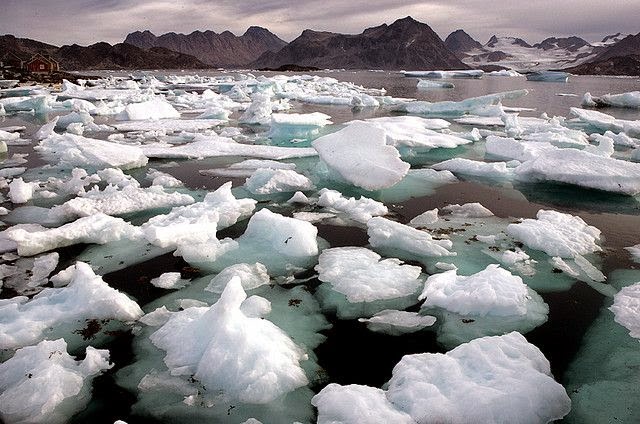
A fjord behind the town of Ilulissat in Greenland. Melting land ice accounts for about half the current rate of sea level rise, according to the latest research. Photograph: Reuters. A fjord behind the town of Ilulissat in Greenland. Melting land ice accounts for about half the current rate of sea level rise, according to the latest research. Photograph: Reuters.
There have been a number of studies recently on ocean warming and sea-level rise. Collectively, they are helping scientists unite around an emerging understanding of climate change and its impact on the Earth.
Most recently, a study by scientists Sarah Purkey, Gregory Johnson, and Don Chambers was published. This team was responsible for a 2010 paper that was groundbreaking in that it quantified very deep (abyssal) sea warming. This latest paper is, in some respects, a continuation of that work.
The researchers recognised that changes to sea levels are mainly caused by thermal expansion of ocean waters as they heat, changes to the saltiness of water, and an increase in ocean waters as ice melts and flows into the sea. The total annual sea level rise is about 3mm per year – the question is, how much of that is from expansion and how much is from melting?
Greg Johnson Greg Johnson
The researchers used a few tools to answer this question. One tool was ocean bottom pressure measurements. If you can measure changes to ocean pressure, you can deduce how much water is in the ocean. Another tool is through an inventory approach. This inventory method quantifies how much glaciers retreat, polar ice melts, and changes to water storage on land. The paper reports that both methods agree with each other. They conclude that increased water in the oceans is causing between 1.5–1.8 mm per year of sea level rise, depending, in part, on which years are under consideration.
The authors don’t just consider the ocean as a whole. They break the ocean regions into seven different sections because the change to ocean levels is not uniform. In some regions, waters are rising quickly, in others, the rise is much slower or zero. One reason for regional variability is that the Earth’s gravity is changing.
For instance, there is so much ice in Greenland and Antarctica that is melting and flowing into the ocean, the mass of these two regions is being reduced; therefore, the pull of gravity toward Greenland and Antarctica is changing. As a result, we expect water levels near Greenland and Antarctica may actually fall as those ice sheets melt.
But, ocean levels elsewhere, particularly UScoastlines, will rise more than average because of this same effect. I have a paper in press with Ted Scambos on this very topic that should be published in a few weeks.
Another reason sea level rise isn’t uniform is that there are local changes to heat and salt which can increase or decrease water density in certain regions, causing local changes to sea level. A third reason is that changes to wind patterns can slosh water around, causing it to build up in one area, fall in another.
In each of the seven ocean regions, the researchers collected temperature and salt measurements at carefully distributed sections. These measurements allowed them to calculate how much of the ocean rise is due to heat/salt effects. They compared the expected sea level rise to actual satellite measurements. The difference between expansion sea level rise and actual sea level rise is the contribution by melt water which flowed into the ocean. This method they call the residual measurement.
Then, they collected measurements from special satellites (GRACE) which measure local fluctuations in ocean mass. They compared the GRACE results with the residual measurement. It turns out they were in near perfect agreement; 1.5 mm per year of sea level rise is from added mass to the oceans. The rest is from expansion. Not only did the two methods agree, but they agreed region by region. They showed, for instance, that the South Atlantic and the South Indian/Atlantic Oceans are rising very rapidly. The North Pacific, South Pacific, and Indian Oceans are rising modestly. The southern Pacific is falling modestly and the North Atlantic is basically constant.
Next, they calculated the relative sea level rise for waters from the surface down to different depths (300, 1,000, 2,000, 3,000, 4,000, and 6,000 m) to determine which layers make the largest contributions to sea level rise. The authors report that the deeper we go into the ocean, the less heating has occurred (this is expected and well known). Interestingly, they find that every water layer, even the deepest waters, have contributed some to sea level rise. They also report that the sea level rise contribution from the layers 300-2,000 meters is much more than previously reported.
Dr Johnson summarised their results,
We find a small but measurable contribution from deep-sea warming to the global sea level budget (and hence global energy budget) from 1996–2006. The ocean warming is estimated directly from highly accurate, full-depth, oceanographic temperature data. The magnitude of the deep warming contribution to sea level below 2,000 m is about 13% of the total contribution of the mass trend below 2,000 m for that same time period.
I asked how this paper agrees or disagrees with a recent paper that reportedly showed the deepest ocean waters are not heating. He replied that the two studies actually agree with each other. They both show that the deepest ocean waters are likely contributing only a small fraction to the overall ocean energy/water rise. On the other hand, the uncertainty is largely because the deepest waters just don’t have a history of sufficient measurements to close the uncertainty range. He also stressed the importance of a proposed fleet of deep-water measuring devices (Deep Argo).
It is sometimes said that “global warming” is really “ocean warming”. Given the importance the oceans have on our past and future climate, you can be sure scientists around the world are working to better understand how much heat is going into the oceans, where the heat is going, and what will happen in the future. The recent publications are helping us close the uncertainty range and improve our knowledge. This is what progress looks like.