Author: Neville

  • Their fight is our fight too

    Adphoto booth hire sydneywww.wackysnaps.com.au – Unlimited Instant Photo, Free Props Weddings, Functions, Parties

    Their fight is our fight too

    Inbox
    x

    350.org Australia via list.350.org 

    12:08 PM (44 minutes ago)

    to me

    Dear friend,

    Last week, thirty Pacific Islanders did something truly brilliant. Together, brothers and sisters from across the Islands joined over 500 Australians to block ten coal ships at the world’s largest coal port in Newcastle.

    Click here to re-live this incredible day.

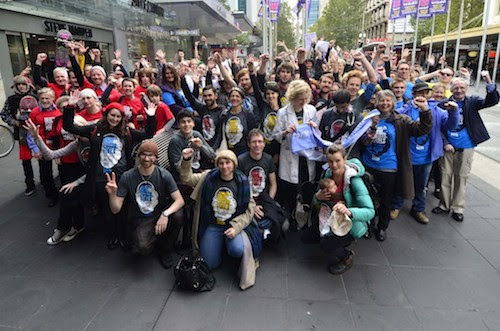
    And this week, Australia responded. In cities around the country, we stood together to show that the fight for the Pacific Islands is our fight too.  Australians will not let our island neighbours drown – we will stand up to the fossil fuel industry whose activities are destroying their and our homes, their and our communities.

    Click here to pitch-in and help us sustain the fight!

    Over the past four days, Australians everywhere have taken the frontline of the fight against climate change to the heart of the fossil fuel industry and their backers.

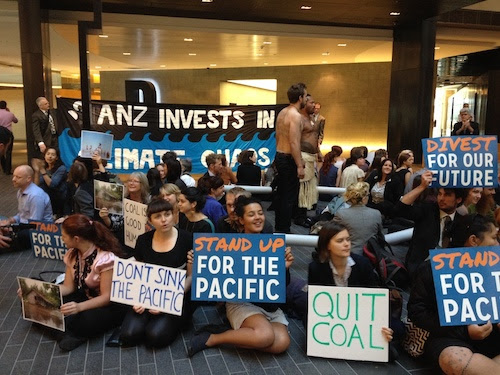
    From Melbournians peacefully sitting-in at ANZ – the largest lender to coal and gas projects in Australia…

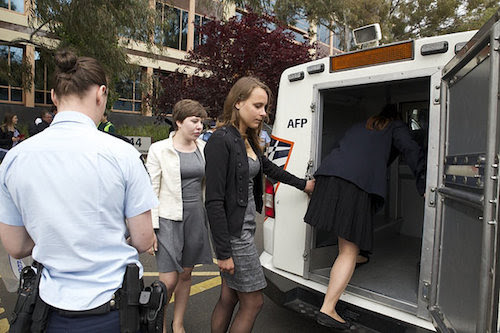
    …to Canberrans getting arrested for peacefully occupying the Minerals Council of Australia, whose lobbying locks us into an unsafe future…

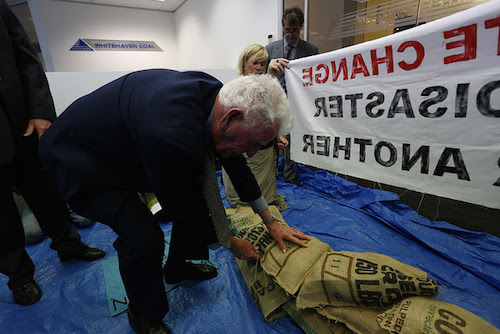
    …and 92-year olds sitting in at the offices of Whitehaven Coal who, right now, is developing Australia’s largest greenfields coal mine at the Leard State Forest.

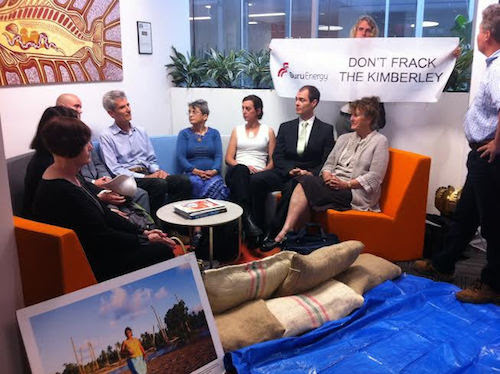
    From Perth residents occupying the offices of oil and gas company Buru Energy, who plans to frack the land of traditional owners in the stunning Kimberly…

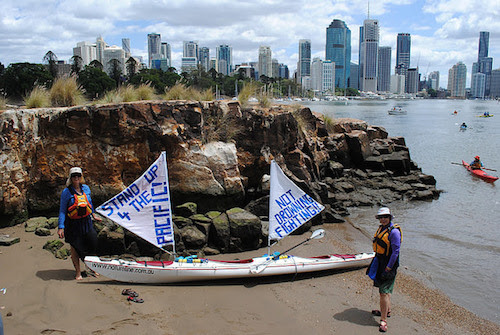
    …and flotillas on the Brisbane river…


    …to thousands of Australians moving hundreds of millions of their savings out of Australian Banks financing fossil fuel expansion.


    And this is just the start. To truly win this fight, the action that we’ve taken this past week has to grow in scale and pace. The coming months and years will test us in ways that we can’t imagine.

    Click here to support 350.org Australia and 350.org Pacific to continue to grow this movement and fight this fight.

    Because we are the first generation to feel the impact of climate change and the last to be able to do anything about it. So let’s do something about it – together, peacefully, hand-in-hand.

    Yours in solidarity,

    Blair, Charlie, Josh, Simon and Aaron for the whole 350 team

    PS See all the images from the Warriors’ actions here:


    350.org is building a global climate movement.

    Become a sustaining donor to keep this movement strong and gr

  • WATER MATTERS Mailing List

    1 of 7


    AdStudy Region Developmentune.edu.au/Economic-Development – Study Econ & Reg Development online anywhere, anytime with UNE. Oct 27!

    [Watermatters] Water Matters Issue 34 October 2014 [SEC=UNCLASSIFIED]

    Inbox x

    Water Matters Distribution List <watermatters@ris.environment.gov.au>

    11:40 AM (8 minutes ago)
    to watermatters

    Dear subscribers


    Please find the link to the Water Matters e-newsletter below. This issue contains stories about renewed funding for the GABSI program, the Commonwealth Environmental Water Holder’s selection of six local engagement officers, a new web tool allowing users to map Australia’s groundwater resources and the 100th anniversary of the River Murray waters agreement.


    http://www.environment.gov.au/water/publications/water-matters


    Water Matters provides subscribers with information about the Australian Government’s water reform initiatives.


    If you wish to unsubscribe from Water Matters, please follow this link:

    http://www.environment.gov.au/apps/web-forms/subscribe/watermatters.html

     
    _______________________________________________
    WaterMatters mailing list
    WaterMatters@bode.ris.environment.gov.au
    http://www.environment.gov.au/mailman/listinfo/watermatters

  • SOLAR CITIZENS SAVE THE RET

    3 of 6
    AdDon’t buy CBA, BHP, WOWwww.moneymorning.com.au – Forget blue-chip stocks. Here’s where the big gains are in 2014

    Hoodwinked?

    Inbox
    x

    Claire, Solar Citizens

    10:54 AM (31 minutes ago)

    to me

    Dear NEVILLE,

    They’re not being straight with us and they are still out to destroy solar and renewables.

    Two weeks ago Cabinet rejected the dodgy Warburton review of the Renewable Energy Target. But yesterday the Federal government walked into negotiations with almost exactly the same position as the Warburton review, and that is the destruction of the Target.

    The government is bent on pursuing the so-called “real 20%”, which would mean Australia’s renewable energy production would be cut almost in half by 2020.

    The vested interests are lining up for exemptions and the big power companies reckon they will clinch their glittering prize – a weakened Target that will mean bigger profits for them and higher power prices for all of us.

    So far Labor says it will not accept such an attack on the policy, saying it is “completely unacceptable”. But without a bipartisan agreement on the Target, there is no certainty for solar in Australia and the jobs, growth and investment it creates.

    The future of solar and renewable energy in this country hangs on a precipice, but you can help.

    Make a quick phone call today to the MPs who are in Parliament this week, negotiating the future of the Target. Tell your politician that you won’t be taken for a ride when they are talking about Australia’s solar and renewables future.

    Tell them that we want the Target kept in full, with no cuts.

    • Ian Macfarlane, Industry Minister – (02) 6277 7070
    • Greg Hunt, Environment Minister – (02) 6277 7920
    • Joe Hockey, Treasurer – (02) 6277 7340
    • Mark Butler, Shadow Environment, Climate Change and Water Minister – (02) 6277 4089
    • Gary Gray, Shadow Resources Minister – (02) 6277 4913
    • Chris Bowen, Shadow Treasurer – (02) 6277 4822

    Yesterday Industry Minister and government negotiator Ian Macfarlane said there would be “no change to the household photovoltaic scheme”. It’s encouraging talk that shows we’re making progress and being heard in the halls of Parliament – our campaign is working. All of your letters, emails, Facebook messages, MP meetings and rallies have left the government with no doubt that we love our solar.

    But the government seems to think it can talk up protecting household solar so it can clinch wholesale cuts to the Target, which would mean less jobs, growth and investment in Australia and higher power prices for everyone by 2020. Even modelling commissioned by the Warburton Review found that the Target will lower power prices in the long term.

    A promise from the government on this is hollow unless they can come to a bipartisan agreement; and remember we had bipartisanship until the government started waging its year-long campaign to try and decimate renewables.

    Right now we need to keep up the pressure on the government and the opposition to make sure there are no cuts to the Target so that solar’s future is protected.

    Call these key MPs today at their Parliament House offices and tell them that you and millions of Australians want solar and the Renewable Energy Target protected in full.

    • Ian Macfarlane, Industry Minister – (02) 6277 7070
    • Greg Hunt, Environment Minister – (02) 6277 7920
    • Joe Hockey, Treasurer – (02) 6277 7340
    • Mark Butler, Shadow Environment, Climate Change and Water Minister – (02) 6277 4089
    • Gary Gray, Shadow Resources Minister – (02) 6277 4913
    • Chris Bowen, Shadow Treasurer – (02) 6277 4822

    Australians want the Renewable Energy Target and solar protected – make sure our representatives know that, in no uncertain terms. Make a quick call today to the key negotiating MPs and tell them that the Target must be kept, in full.

    Yours for a strong solar future,

    Claire, National Director

    P.S. When Tasmanian Solar Citizens met with cross bench Palmer United Party senator Jacqui Lambie last month she told us that she loves and supports solar. It’s a position she repeated yesterday when she was interviewed on Sky News. Every conversation you can have with a politician calling on them to protect the Renewable Energy Target gets through and has an impact. Make your call today to tell MPs at the negotiating table to protect solar and the Target in full – the future of Australian renewables is in our hands.

    Solar Citizens
    http://www.solarcitizens.org.au/

    -=-=-

    Solar Citizens is an independent community-based organisation bringing together millions of solar owners and supporters to protect and grow solar in Australia. You can also keep up with Solar Citizens on Twitter or like us on Facebook.

Blog

Worst case scenarios of sea level rise, and why scientists and policymakers consider them

  • 21 Oct 2014, 17:52
  • Robert McSweeney
 Thames Barrier | Shutterstock

Sea levels could rise by a maximum of 190 centimetres by the end of the century, according to a new study, which examines a worst case scenario for sea level rise.

In reality, the amount of sea level rise we get is likely to be less than that. But scientists and policymakers examine such ‘worst case’ scenarios to safeguard against climate risks.

Upper limit

With 10 per cent of the world’s population living less than 10 metres above sea level, the threat of  coastal flooding is significant. The Intergovernmental Panel on Climate Change (IPCC) expects sea level rise to cause a ‘ significant increase‘ in sea levels extremes and the risk of coastal flooding.

The new study, published in  Environmental Research Letters, considers the assessment of 13 ice sheet experts. They conclude that the contribution from ice sheets is likely to be greater than projected by the IPCC. The paper suggests that sea levels could rise by as much as 190 cm this century.

Projections of sea level rise are typically constructed by working out the contribution to sea level rise from different  factors. The biggest contribution is from water expanding as it warms, followed by melting glaciers, then melting ice sheets on Greenland and Antarctica.

The crucial question for sea level rise this century is how much ice will be lost from the ice sheets, the authors argue. But it remains one of the largest uncertainties. In its Fifth Assessment Report (AR5), the IPCC  says there isn’t sufficient evidence for them to give probabilities of large-scale losses of ice sheets.

The new study uses expert judgement to consider areas of ice sheet loss that are often not included in the sea level  models that the IPCC bases its assessment on. They then combine these judgements with the methods used in AR5 to produce their upper-limit figure of 190 cm.

‘Likely’ range

It’s likely that sea level rise will be lower than that. In AR5, the IPCC projects sea level rise of between 26 and 82 cm by 2100. These projections are presented as a ‘likely’ range, meaning there is a 66 per cent likelihood that sea level rise will fall within this range.

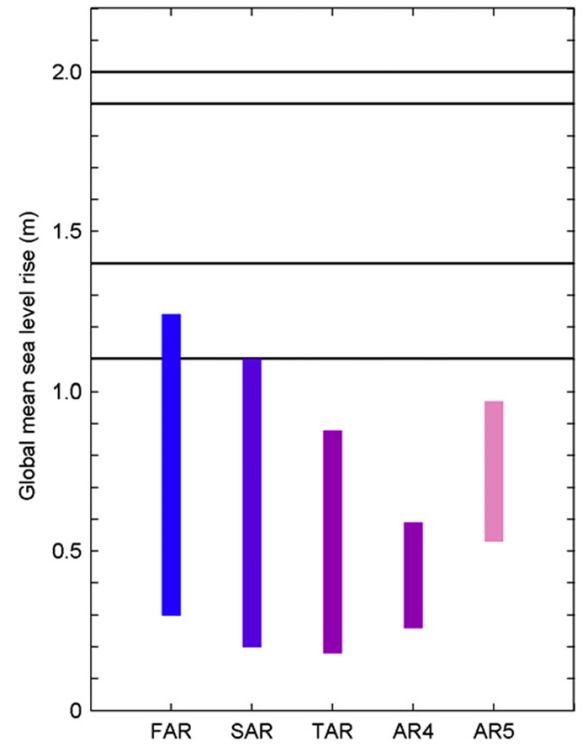
The graph below shows the projections of sea-level rise from all five IPCC Assessment Reports since the IPCC was founded in 1988, based on a ‘business as usual’ scenario where carbon emissions continue to rise.

Screenshot 2014-10-21 13.34.49

The range of global mean sea level projections for 2100 under business-as-usual scenarios from five IPCC Assessment Reports. From the First Assessment Report (FAR) on the left to the Fifth Assessment Report (AR5) on the right. The black horizontal lines represent ‘low probability-high impact’ scenarios used in national planning assessments: 110 cm from the Delta Commission in the Netherlands, 140 cm from the Scientific Committee on Antarctic Research, 190 cm from UK Climate Projections 2009, and 200 cm from the US National Oceanic and Atmospheric Administration.  Jevrejeva et al. (2014)

The projections have changed over the years as understanding of sea level changes has improved. The projection range from AR5 is higher than the Fourth Assessment Report (AR4), for example, because AR4 didn’t consider the contribution of Greenland and Antarctic ice sheets.

Flood protection

The graph also shows sea level projections used in national planning as a series of horizontal black lines. You can see how much higher these are than the IPCC ranges.

So why the difference? Worst case scenarios are necessary in planning for future climate, particularly when the potential cost of any damage is high.

The upper end of the IPCC projections is not a worst case scenario, but rather the largest rise that they consider ‘likely’.

Designers of flood protection need to be sure that they will be able to cope with more than just the ‘likely’ increase in sea levels; therefore, other scenarios have been developed to consider larger, albeit less likely changes.

In the most recent set of climate projections for the UK, for example, the Met Office produced a ‘High++’ scenario of up to 190 cm of sea level rise for just these situations. It takes into account large changes in ice sheets that could cause much larger sea level rises than the IPCC range includes.

The upper end of the High++ scenario “provides a plausible but highly uncertain and very unlikely scenario”. It’s being used in the Thames Estuary 2011 Project to assess the flood risk to London through the 21st century.

While large changes in the ice sheets are unlikely, the thinking goes that there is too much at risk to plan for only an average amount of sea level change. These scenarios are not there to worry people, but to ensure our flood protection can cope with whatever the sea might throw at us.

Jevrejeva et al. (2014) Upper limit for sea level projections by 2100, Environmental Research Letters, doi:10.1088/1748-9326/9/10/104008 [This article is open-access and therefore available to download for free]

  • Arctic ice melt sends Alaskan temperatures soaring by 7C

    Respond Magazines
    COP20 news
    Blog
    Guide
    Calendar
    Awards
    Partners
    About us
    Contact us

    RTCC Respond Magazine 2014

    Most read
    Latest
    Recommended

    Concern mounts in Marshall Islands as high tides swamp capital

    Concern mounts in Marshall Islands as high tides swamp capital
    15 October
    Sweden calls on EU to agree 50% carbon cuts for 2030

    Sweden calls on EU to agree 50% carbon cuts for 2030
    16 October
    UN climate talks in Bonn: Day 1

    UN climate talks in Bonn: Day 1
    20 October
    World of clean energy is possible by 2050 say scientists

    World of clean energy is possible by 2050 say scientists
    10 October
    UN climate talks to test New York summit gains

    UN climate talks to test New York summit gains
    19 October
    Legal elements in proposed UN climate deal find mixed support

    Legal elements in proposed UN climate deal find mixed support
    15 October
    Antarctic sea ice reaches record high, as Arctic hits 2014 minimum

    Antarctic sea ice reaches record high, as Arctic hits 2014 minimum
    22 September
    US climate strategy: ‘goad’ leaders into voluntary action

    US climate strategy: ‘goad’ leaders into voluntary action
    15 October
    Take on the “fatcats” or scrap EU carbon market – think-tank

    Take on the “fatcats” or scrap EU carbon market – think-tank
    15 October
    Windmills, snails and science tales: Paterson comes out of his shell

    Windmills, snails and science tales: Paterson comes out of his shell
    16 October
    Climate change is like Ebola – World Bank chief

    Climate change is like Ebola – World Bank chief
    13 October
    Energy companies unprepared for climate risks – study

    Energy companies unprepared for climate risks – study
    14 October
    Private sector backing could transform UN’s Green Climate Fund

    Private sector backing could transform UN’s Green Climate Fund
    13 October
    Global shipping emissions set to rise unchecked

    Global shipping emissions set to rise unchecked
    17 October
    Biodiversity: the ‘stepchild’ of international talks

    Biodiversity: the ‘stepchild’ of international talks
    16 October
    Arctic ice melt sends Alaskan temperatures soaring by 7C

    Last updated on 20 October 2014, 4:54 pm

    Scientists in the northern Alaska outpost of Barrow have linked 7C temperature rise to the decline in Arctic sea ice
    The visitors’ centre in the speedily warming town of Barrow, Alaska (Pic: Terry Feuerborn/Flickr)

    The visitors’ centre in the speedily warming town of Barrow, Alaska (Pic: Terry Feuerborn/Flickr)

    By Alex Kirby

    If you doubt that parts of the planet really are warming, talk to residents of Barrow, the Alaskan town that is the most northerly settlement in the US.

    In the last 34 years, the average October temperature in Barrow has risen by more than 7C − an increase that, on its own, makes a mockery of international efforts to prevent global temperatures from rising more than 2C above their pre-industrial level.

    A study by scientists at the University of Alaska Fairbanks analysed several decades of weather information.

    These show that temperature trends are closely linked to sea ice concentrations, which have been recorded since 1979, when accurate satellite measurements began.

    The study, published in the Open Atmospheric Science Journal, traces what has happened to average annual and monthly temperatures in Barrow from 1979 to 2012.

    Striking

    In that period, the average annual temperature rose by 2.7C. But the November increase was far higher − more than 6C. And October was the most striking of all, with the month’s average temperature 7.2C higher in 2012 than in 1979.

    Gerd Wendler, the lead author of the study and a professor emeritus at the university’s International Arctic Research Center, said he was “astonished”. He told the Alaska Dispatch News: “I think I have never, anywhere, seen such a large increase in temperature over such a short period.”

    The study shows that October is the month when sea ice loss in the Beaufort and Chukchi Seas, which border northern Alaska, has been highest.

    The authors say these falling ice levels over the Arctic Ocean after the maximum annual melt are the reason for the temperature rise. “You cannot explain it by anything else,” Wendler said.

    They have ruled out the effects of sunlight because, by October, the sun is low in the sky over Barrow and, by late November, does not appear above the horizon.

    Instead, they say, the north wind picks up stored heat from water that is no longer ice-covered in late autumn and releases it into the atmosphere.

    At first sight, the team’s findings are remarkable, as Barrow’s 7.2C rise in 34 years compares with a global average temperature increase over the past century of up to about 0.8C. But what’s happening may be a little more complex.

    Warming faster

    The fact that temperatures in and around Barrow are rising fast is no surprise, as the Arctic itself is known to be warming faster than most of the rest of the world.

    The Intergovernmental Panel on Climate Change says observed warming in parts of northern Alaska was up to 3C from the early 1980s to the mid-2000s. It also concludes that about two-thirds of the last century’s global temperature increase has occurred since 1980.

    But Barrow’s long-term temperature rise has not been uniform, the Fairbanks study says. Its analysis of weather records between 1921 and 2012 shows a much more modest average annual rise, of 1.51C. In 2014, the city experienced the coolest summer day recorded − 14.5C.

    So one conclusion is to remember just how complex a system the climate is − and how even 34 years may be too short a time to allow for any certainty.

    This article was produced by the Climate News Network
    – See more at: http://www.rtcc.org/2014/10/20/alaskan-town-warms-7c-in-34-years/#sthash.64K1wTbg.dpuf

  • Renew Economy Daily Update

    Click here to enable desktop notifications for Gmail.   Learn more  Hide
    2 of 3

    Daily update: Wind power is more reliable than gas – and cheaper, too

    Inbox
    x

    RenewEconomy editor@reneweconomy.com.au via mail62.atl51.rsgsv.net 

    3:06 PM (27 minutes ago)

    to me
    The myth that renewables are too unreliable to meet baseload electricity demand is now busted – gas, on the other hand… Plus: Large-scale solar in the gun as Abbott govt reveals RET stance; why whole towns will want to take themselves off-grid; How Victoria could go solar, save millions and boost jobs; Graph of the Day – the rise and rise of distributed solar; Trans-Pacific partnership threatens green trade deal; 167 Teslas for Amsterdam airport; and a quantum leap in solar technology.
    Is this email not displaying correctly?
    View it in your browser.
    RenewEconomy Daily News
    The Parkinson Report
    As Australia’s dance of the seven RET Reviews continues, it seems like a good time to revisit one of the more persistent anti-renewables myths bandied about by fossil fuel types (and most of the Abbott government): that that renewable energy is unreliable in meeting electricity demand.
    Abbott government says no changes to household solar, but wants large scale renewables target slashed by two thirds. So much for ditching the Warburton Review.
    Going off-grid will help towns boost jobs, increase reliability of their energy supply, and lower costs. What’s to lose?
    CEC report says Victoria could easily adjust solar and energy efficiency policy to save hundreds of millions in costs, boost jobs and cut emissions.
    Want proof distributed solar is booming?  Two charts show how it provided over 25% of new US power plant capacity in 2013 and 43% in first half 2014.
    The Trans-Pacific Partnership threatens green trade deal that could ultimately do more to reduce carbon emissions than international climate agreements.
    Amsterdam’s main Schiphol airport has enlisted the aid of 167 Tesla Model S taxi cabs as part of its bid to be among the greenest in the world.
    Micro inverters and smart energy management systems are taking solar into off grid systems, camper vans and pretty much anywhere else you want power.