California drought: Solar desalination plant shows promise
Solar desalination system appears to be cost-effective
Kevin Fagan
Updated 7:45 am, Tuesday, March 18, 2014
Photo: Leah Millis, The Chronicle
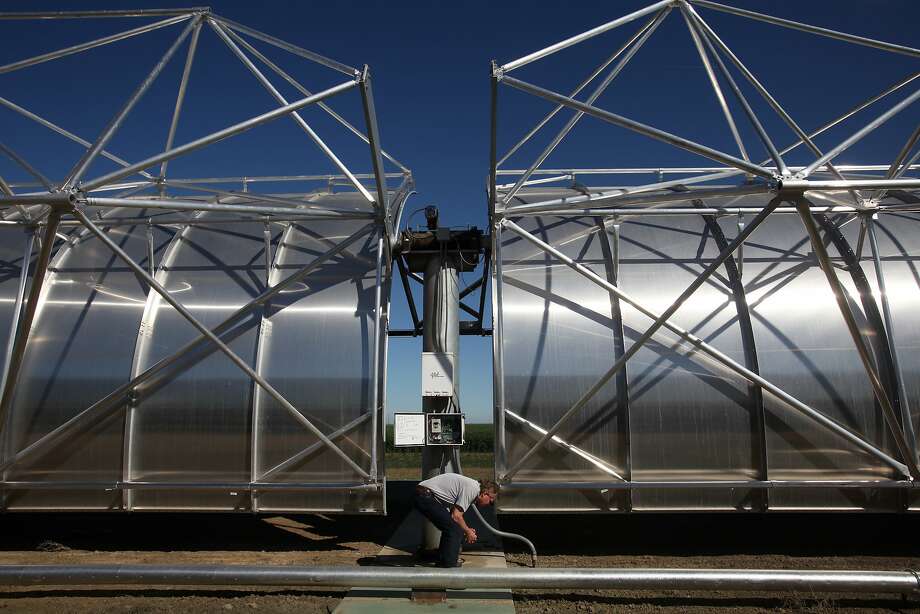
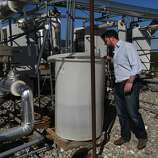
Consultant Bruce Marlow demonstrates a feature at the solar-powered WaterFX desalination plant in Fresno County.
Brian Hicks, 29, checks the water level at one of a few existing wells on his family’s land March 15, 2014 at the Hammonds Ranch, Inc. in Firebaugh, Calif. The family have not had to use the wells in years. Now that they will be using them, instead of checking the levels once a month, Hicks will be checking them once every other week. The Hammonds Ranch is allowing over 4,000 acres of approximately 5,000 acres of farm land to fallow this year because of the drought. This year they will be keeping their grapes and some pistachios alive using well water they haven’t had to tap in years and some supplemental water. Hicks, who lives on the ranch with his wife and young daughter, is a 4th generation Hammonds rancher. He is currently back in school to get his certification in special studies of enology, so he can get into wine making. Hicks says he’s wanted to be part of the family business since he was a child. Despite the uncertainty that the drought brings, he’s still pursuing his dream, “I believe in it, it’s something that everybody needs,” he said. “Food is a necessity of life.”
Firebaugh, Fresno County —
Quietly whirring away in a dusty field in the Central Valley is a shiny solar energy machine that may someday solve many of California’s water problems.
It’s called the WaterFX solar thermal desalination plant, and it has been turning salty, contaminated irrigation runoff into ultra-pure liquid for nearly a year for the Panoche Water and Drainage District. It’s the only solar-driven desalination plant of its kind in the country.
Right now its efforts produce just 14,000 gallons a day. But within a year, WaterFX intends to begin expanding that one small startup plant into a sprawling collection of 36 machines that together can pump out 2 million gallons of purified water daily.
Within about five years, WaterFX company co-founder Aaron Mandell hopes to be processing 10 times that amount throughout the San Joaquin Valley. And here’s the part that gets the farmers who buy his water most excited: His solar desalination plant produces water that costs about a quarter of what more conventionally desalinated water costs: $450 an acre-foot versus $2,000 an acre-foot.
An acre-foot is equivalent to an acre covered by water 1 foot deep, enough to supply two families of four for a year.
Competitive price
That brings Mandell’s water cost close to what farmers are paying, in wet years, for water from the Panoche and other valley districts – about $300 an acre-foot. And that makes it a more economically attractive option than any of the 17 conventional desalination plants planned throughout California.
If Mandell can pull it off, the tiny farming town where he is starting his enterprise could be known as ground zero for one of the most revolutionary water innovations in the state’s history.
“Eventually, if this all goes where I think it can, California could wind up with so much water it’s able to export it instead of having to deal with shortages,” Mandell said, standing alongside the 525-foot-long solar reflector that is the heart of his machine. “What we are doing here is sustainable, scalable and affordable.”
Dennis Falaschi, manager of the Panoche district, and many of the 60 farmers that constitute his customer base say the sooner WaterFX expands, the better.
Saving water
Panoche expects to deliver about 45,000 acre-feet of water this year to its growers. That total is half of what the growers get in wetter years – but because drought and environmentally driven water mandates are not unique to 2014, the district’s farmers are already ahead of the curve on water preservation techniques.
Most use drip irrigation instead of water-intensive sprinklers and are hooked up to an unusual drainage system that captures used irrigation water and directs it into fields of wheatgrass, a salt-tolerant crop sold for cattle feed. But that drainage system is little more than a creative way to get rid of irrigation water that’s too salty for most uses once it leaches through farm soil.
Finding a way to make it suitable for people to drink and use on the crops they eat would be a breakthrough, Falaschi said.
“It appears this solar system will be cost-effective, and if Aaron can perform as we think he can, it can make a huge difference – be a great supplement at the very least,” he said. “We’re talking about basically unusable drainage water that is in everybody’s interest to mine.
“This solar plant could be a very important part of where we want to be in terms of being self-sufficient in the valley.”
Nothing from feds
Panoche, like many districts in the Central Valley – the nation’s most productive agricultural zone – has traditionally bought most of its water from the federally run Central Valley Project. But in this drought year, farmers are likely to get zero allocation from the project.
If that happens, Panoche will have to draw from leftover supply, the expensive spot water market and wells. All of that is pricier than usual, with the spot market alone charging as much as $3,500 an acre-foot.
“This situation right now is a killer, and anything that adds to a potential water supply is good,” said Mike Stearns, a fourth-generation farmer in the Panoche district who is fallowing most of his tomato, onion and other fields this year because of the drought. He’s concentrating on his wine grapes, which are thirsty but promise a good profit even in a drought year.
“And keep in mind that this water shortage doesn’t just affect farmers,” Stearns said. “Think about the jobs that are lost when we have to fallow our fields. Or the taxes that the government won’t get because we aren’t growing and selling. It’s bad. We need to do everything we can about this.”
Simple process
The way the solar plant works is simple, which is why the water it produces is cheap.
Water that dribbles down from nearby hills, and through the soil in the Central Valley after being used for irrigation, collects so much salt, selenium, boron and other minerals that it’s not fit for human consumption. The solar plant captures the foothill runoff and sucks in used irrigation water from a French drain-style system 6 to 8 feet under the crops, and sends that tainted water through a series of pipes and tanks that heat it.
The heat comes from the plant’s huge, parabolic-shaped solar reflector, which focuses the sun on a long tube containing mineral oil. That heated tube in turn creates steam, which condenses the brackish water into usable liquid, separating out the minerals.
The water then goes back out for irrigation. Mandell says that because his condensation method distills the minerals more efficiently than other desalination methods, he is installing a system that will process them for use. Selenium and boron can be vitamin supplements, for example, and gypsum can be used for drywall.
More conventional desalination plants – such as a $1 billion operation being built near San Diego – use a reverse osmosis process, in which brackish water is forced through screens to filter out the contaminants. That requires a lot of energy, which is why it is more expensive.
Raising money
WaterFX’s pilot plant cost $1 million in state grants to build last summer. The expansion of the 36-plant complex would cost as much as $30 million, which Mandell is working on raising.
“It does seem like this system is in a great location,” said Daniel Choi, an analyst with Lux Research, which researches emerging technology. “It’s where it should be – an area with a lot of sunlight, where reverse osmosis doesn’t make the most sense large-scale. It does seem like it’s viable.
“I wouldn’t be surprised if WaterFX expanded to other markets.”
Mandell’s expanded solar plant would be able to deliver 2,200 acre-feet of water next year – and if that performs as hoped, within a few years his ambition is to scale it up to 20,000 acre-feet. That would meet nearly half of the current demand from Panoche district farmers.
“Eventually we could process not just drainage water, but industrial and residential wastewater as well as groundwater that now is too salty to use,” Mandell said. Such desalination already happens on a large scale in other parts of the world, particularly the Middle East, he pointed out.
Sinking land
Drawing groundwater, however – even groundwater that’s now too salty to drink – could prove problematic in the Central Valley. Years of tapping usable groundwater have so depleted aquifers that in some places the land has sunk 30 feet since the 1920s.
There are trillions of gallons of brackish groundwater available in California, said Claudia Faunt, a U.S. Geological Survey hydrologist, and much of that has not been tapped because it is closer to the surface than the purer liquid deeper down. However, “to say there wouldn’t be subsidence (if it were tapped) is an unknown,” she said.
For now, Mandell said, he and his partners are focusing on drainage water – and that alone is a major issue.
“Look, there are 200 million tons of salt on the land in the Central Valley, and billions of gallons of drainage water, and cleaning up that drainage water is a huge issue,” said WaterFX’s chief consultant, Bruce Marlow. “I’d say if we can control the saline in the valley, in 10 years we might not have to rely on the federal water system here at all.”
Online extra: For more on California’s water issues, go to SFGate.com/drought.
California drought: Solar desalination plant shows promise
Solar desalination system appears to be cost-effective
Kevin Fagan
Updated 7:45 am, Tuesday, March 18, 2014
Photo: Leah Millis, The Chronicle
Consultant Bruce Marlow demonstrates a feature at the solar-powered WaterFX desalination plant in Fresno County.
Brian Hicks, 29, checks the water level at one of a few existing wells on his family’s land March 15, 2014 at the Hammonds Ranch, Inc. in Firebaugh, Calif. The family have not had to use the wells in years. Now that they will be using them, instead of checking the levels once a month, Hicks will be checking them once every other week. The Hammonds Ranch is allowing over 4,000 acres of approximately 5,000 acres of farm land to fallow this year because of the drought. This year they will be keeping their grapes and some pistachios alive using well water they haven’t had to tap in years and some supplemental water. Hicks, who lives on the ranch with his wife and young daughter, is a 4th generation Hammonds rancher. He is currently back in school to get his certification in special studies of enology, so he can get into wine making. Hicks says he’s wanted to be part of the family business since he was a child. Despite the uncertainty that the drought brings, he’s still pursuing his dream, “I believe in it, it’s something that everybody needs,” he said. “Food is a necessity of life.”
Firebaugh, Fresno County —
Quietly whirring away in a dusty field in the Central Valley is a shiny solar energy machine that may someday solve many of California’s water problems.
It’s called the WaterFX solar thermal desalination plant, and it has been turning salty, contaminated irrigation runoff into ultra-pure liquid for nearly a year for the Panoche Water and Drainage District. It’s the only solar-driven desalination plant of its kind in the country.
Right now its efforts produce just 14,000 gallons a day. But within a year, WaterFX intends to begin expanding that one small startup plant into a sprawling collection of 36 machines that together can pump out 2 million gallons of purified water daily.
Within about five years, WaterFX company co-founder Aaron Mandell hopes to be processing 10 times that amount throughout the San Joaquin Valley. And here’s the part that gets the farmers who buy his water most excited: His solar desalination plant produces water that costs about a quarter of what more conventionally desalinated water costs: $450 an acre-foot versus $2,000 an acre-foot.
An acre-foot is equivalent to an acre covered by water 1 foot deep, enough to supply two families of four for a year.
Competitive price
That brings Mandell’s water cost close to what farmers are paying, in wet years, for water from the Panoche and other valley districts – about $300 an acre-foot. And that makes it a more economically attractive option than any of the 17 conventional desalination plants planned throughout California.
If Mandell can pull it off, the tiny farming town where he is starting his enterprise could be known as ground zero for one of the most revolutionary water innovations in the state’s history.
“Eventually, if this all goes where I think it can, California could wind up with so much water it’s able to export it instead of having to deal with shortages,” Mandell said, standing alongside the 525-foot-long solar reflector that is the heart of his machine. “What we are doing here is sustainable, scalable and affordable.”
Dennis Falaschi, manager of the Panoche district, and many of the 60 farmers that constitute his customer base say the sooner WaterFX expands, the better.
Saving water
Panoche expects to deliver about 45,000 acre-feet of water this year to its growers. That total is half of what the growers get in wetter years – but because drought and environmentally driven water mandates are not unique to 2014, the district’s farmers are already ahead of the curve on water preservation techniques.
Most use drip irrigation instead of water-intensive sprinklers and are hooked up to an unusual drainage system that captures used irrigation water and directs it into fields of wheatgrass, a salt-tolerant crop sold for cattle feed. But that drainage system is little more than a creative way to get rid of irrigation water that’s too salty for most uses once it leaches through farm soil.
Finding a way to make it suitable for people to drink and use on the crops they eat would be a breakthrough, Falaschi said.
“It appears this solar system will be cost-effective, and if Aaron can perform as we think he can, it can make a huge difference – be a great supplement at the very least,” he said. “We’re talking about basically unusable drainage water that is in everybody’s interest to mine.
“This solar plant could be a very important part of where we want to be in terms of being self-sufficient in the valley.”
Nothing from feds
Panoche, like many districts in the Central Valley – the nation’s most productive agricultural zone – has traditionally bought most of its water from the federally run Central Valley Project. But in this drought year, farmers are likely to get zero allocation from the project.
If that happens, Panoche will have to draw from leftover supply, the expensive spot water market and wells. All of that is pricier than usual, with the spot market alone charging as much as $3,500 an acre-foot.
“This situation right now is a killer, and anything that adds to a potential water supply is good,” said Mike Stearns, a fourth-generation farmer in the Panoche district who is fallowing most of his tomato, onion and other fields this year because of the drought. He’s concentrating on his wine grapes, which are thirsty but promise a good profit even in a drought year.
“And keep in mind that this water shortage doesn’t just affect farmers,” Stearns said. “Think about the jobs that are lost when we have to fallow our fields. Or the taxes that the government won’t get because we aren’t growing and selling. It’s bad. We need to do everything we can about this.”
Simple process
The way the solar plant works is simple, which is why the water it produces is cheap.
Water that dribbles down from nearby hills, and through the soil in the Central Valley after being used for irrigation, collects so much salt, selenium, boron and other minerals that it’s not fit for human consumption. The solar plant captures the foothill runoff and sucks in used irrigation water from a French drain-style system 6 to 8 feet under the crops, and sends that tainted water through a series of pipes and tanks that heat it.
The heat comes from the plant’s huge, parabolic-shaped solar reflector, which focuses the sun on a long tube containing mineral oil. That heated tube in turn creates steam, which condenses the brackish water into usable liquid, separating out the minerals.
The water then goes back out for irrigation. Mandell says that because his condensation method distills the minerals more efficiently than other desalination methods, he is installing a system that will process them for use. Selenium and boron can be vitamin supplements, for example, and gypsum can be used for drywall.
More conventional desalination plants – such as a $1 billion operation being built near San Diego – use a reverse osmosis process, in which brackish water is forced through screens to filter out the contaminants. That requires a lot of energy, which is why it is more expensive.
Raising money
WaterFX’s pilot plant cost $1 million in state grants to build last summer. The expansion of the 36-plant complex would cost as much as $30 million, which Mandell is working on raising.
“It does seem like this system is in a great location,” said Daniel Choi, an analyst with Lux Research, which researches emerging technology. “It’s where it should be – an area with a lot of sunlight, where reverse osmosis doesn’t make the most sense large-scale. It does seem like it’s viable.
“I wouldn’t be surprised if WaterFX expanded to other markets.”
Mandell’s expanded solar plant would be able to deliver 2,200 acre-feet of water next year – and if that performs as hoped, within a few years his ambition is to scale it up to 20,000 acre-feet. That would meet nearly half of the current demand from Panoche district farmers.
“Eventually we could process not just drainage water, but industrial and residential wastewater as well as groundwater that now is too salty to use,” Mandell said. Such desalination already happens on a large scale in other parts of the world, particularly the Middle East, he pointed out.
Sinking land
Drawing groundwater, however – even groundwater that’s now too salty to drink – could prove problematic in the Central Valley. Years of tapping usable groundwater have so depleted aquifers that in some places the land has sunk 30 feet since the 1920s.
There are trillions of gallons of brackish groundwater available in California, said Claudia Faunt, a U.S. Geological Survey hydrologist, and much of that has not been tapped because it is closer to the surface than the purer liquid deeper down. However, “to say there wouldn’t be subsidence (if it were tapped) is an unknown,” she said.
For now, Mandell said, he and his partners are focusing on drainage water – and that alone is a major issue.
“Look, there are 200 million tons of salt on the land in the Central Valley, and billions of gallons of drainage water, and cleaning up that drainage water is a huge issue,” said WaterFX’s chief consultant, Bruce Marlow. “I’d say if we can control the saline in the valley, in 10 years we might not have to rely on the federal water system here at all.”
Online extra: For more on California’s water issues, go to SFGate.com/drought.