Author: Neville

  • [New post] Tasmania 2014 – Lyons

    Why this ad?
    Torrens Uni. Australiatua.edu.au/Master's_in_Education – Study Online at Torrens University. Request Information Right Now!

    [New post] Tasmania 2014 – Lyons

    Inbox
    x
    The Tally Room <donotreply@wordpress.com>
    9:30 AM (1 hour ago)

    to me

    New post on The Tally Room

    Tasmania 2014 – Lyons

    by Ben Raue

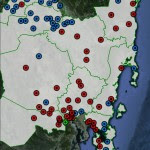
    Lyons4-toppollingLyons covers the centre of Tasmania, and is the largest electorate in the state.

    The electorate of Wilmot was renamed to Lyons at the 1986 election, which saw a 4-3 split in favour of the Liberal Party.

    In 1989, Christine Milne won a seat in Lyons for the Greens, producing a 4-2-1 split in favour of the Liberal Party. This was maintained in 1992, and a 3-3-1 split in 1996.

    The reduction in numbers in 1998 saw Milne, by then the Greens leader in the Assembly, lose her seat along with a Liberal MP, producing a 3-2 split for the ALP.

    The Greens returned to Lyons in 2002, producing a 3-1-1 split that was repeated in 2006. In 2010, the ALP lost a seat to the Liberal Party.

    The Liberal Party will require a large swing to gain a seat off either the ALP or the Greens – but Lyons saw a huge swing at the 2013 federal election which could indicate potential for such a large shift.

    Lyons is represented by Rene Hidding (LIB), Tim Morris (GRN), Michael Polley (ALP), Mark Shelton (LIB) and Rebecca White (ALP).

    Read more

     
  • Australian heatwaves more frequent, hotter and longer: Climate Council report

    Australian heatwaves more frequent, hotter and longer: Climate Council report

    Extreme weather ‘can be attributed to climate change’


    Updated 6 hours 12 minutes ago

    Heatwaves in Australia are becoming more frequent, hotter and are lasting longer because of climate change, a report released today by the Climate Council says.

    The interim findings of the report, titled Australian Heatwaves: Hotter, Longer, Earlier and More Often, come as southern Australia swelters through a heatwave, with the temperature in Adelaide today forecast to hit 46 degrees Celsius.

    The report says heat records are now happening three times more often than cold records, and that the number of hot days across Australia has “more than doubled”.

    It says the duration and frequency of heatwaves increased between 1971 and 2008, and the hottest days have become hotter.


    And it predicts that future heatwaves will last up to three days longer on average, they will happen more often, and the highest temperatures will rise further.

    “It is clear that climate change is making heatwaves more frequent and severe,” report co-author Professor Will Steffen said in a statement.

    Defining a heatwave

    For the first time, the Bureau of Meteorology has provided a national definition of a heatwave.

    It says there are three grades of heatwave, with severe and extreme posing the most serious risk.

    Read more here.


    “Heatwaves have become hotter and longer and they are starting earlier in the season.”

    After notching up two consecutive days over 40C, Melbourne is on track to record its second-longest heatwave since records began in the 1830s.

    The temperature is expected to reach 41C today before increasing to 42C tomorrow.

    The longest heatwave in Melbourne was in 1908, when there were five consecutive days over 40C.

    Temperatures have also regularly surpassed 40C in South Australia and Western Australia recently.

    Report co-author Dr Sarah Perkins says the change has occurred mostly in Australia’s south-east and west.

    “So particularly areas around Adelaide and Perth that are currently experiencing heatwave conditions,” she said.

    “They seem to be the hardest hit in terms of the number of heatwaves, they’ve increased, and also the intensity of heatwaves as well.”

    Report key findings:

    1. Hot days, hot nights and heatwaves are one of the most direct consequences of climate change;
    2. Heatwaves have increased across Australia;
    3. Climate change is making many extreme events worse in terms of their impacts on people, property, communities and the environment;
    4. Record hot days and heatwaves are expected to increase in the future.


    Extreme weather ‘can be attributed to climate change’

    Professor Steffen says the extreme weather patterns can be attributed to climate change, with the continued burning of fossil fuels trapping more heat in the lower atmosphere.


    Professor Steffen says large population centres of south-east Australia stand out as being “at increased risk from many extreme weather events, including heatwaves”.

    “The current heatwave follows on from a year of extreme heat, the hottest summer on record and the hottest year on record,” he said.

    The latest temperatures have driven electricity demand to its highest level since the heatwave which preceded the Black Saturday bushfires five years ago.

    Regulators say the predicted high temperatures for the rest of the week could see new records set for peak electricity demand in Victoria and South Australia.

    About 10,000 homes in Melbourne were without power yesterday afternoon as electricity suppliers struggled with the demand.

    The State Government has warned Victorians that up to 100,000 properties could be affected by outages over the next two days.

    The South Australian Government has also flagged possible power cuts to ensure the grid copes under pressure, with Adelaide reaching 43.7C yesterday afternoon.

    The interim Climate Council report will be released in Sydney at 11:00am (AEDT).


  • Increasing Threat of Intense Tropical Cyclones Hitting East Asia

    Science News

    … from universities, journals, and other research organizations

    Increasing Threat of Intense Tropical Cyclones Hitting East Asia

    Jan. 15, 2014 — The intensity of tropical cyclones hitting East Asia has significantly increased over the past 30 years, according to a new study published today.


    Share This:

    The coastlines of China, Korea and Japan in particular have experienced increasingly stronger cyclones, which the researchers have attributed to increasing sea surface temperatures and a change in atmospheric circulation patterns over the coastal seas.

    According to the study, the changes in sea surface temperature and wind flows meant that cyclones were more likely to track along coastal seas from the South China Sea upwards, meaning that by the time the cyclones hit the north-east coast of Asia they had gathered more energy than usual and were at their maximum intensity.

    The study, which has been published today, 16 January, in IOP Publishing’s journal Environmental Research Letters, involved an analysis of five separate data sets that documented the evolution of tropical cyclones across the north-west Pacific between 1977 and 2010.

    The researchers also found that in south-east Asia, in countries such as Taiwan and Vietnam, there was no substantial change in the intensity of tropical cyclones. Here, they found that tropical cyclones had started to generate too close to land in the South China Sea to gather enough energy to reach maximum intensity as they approached land.

    In addition to increasing sea surface temperatures in the western Pacific, which have notably warmed over the past 30 years, the researchers also attributed the changes to the strengthening of the Walker circulation — an ocean-based atmospheric circulation system that exists over the Pacific.

    According to the researchers, the Pacific Walker circulation strengthens as the difference in sea surface temperature between the warmer western Pacific and the colder central-eastern Pacific increases. The result is that the wind flows associated with the circulation pattern force the tropical cyclones towards the north-east coast of Asia, where they reach maximum intensity.

    Although the study only accounts for natural variations in sea surface temperature and the Walker circulation retrospectively, over the past 30 years, the researchers do predict that the tropical cyclones hitting East Asia will only strengthen under human-induced climate change.

    Professor Chang-Hoi Ho, from Seoul National University, said: “Noticeable increases of greenhouse gases over the globe could influence rising sea surface temperature and change large-scale atmospheric circulation in the western North Pacific, which could enhance the intensity of tropical cyclones hitting land over East Asia.

    “If the past changes of large-scale environments are evidence or a result of global warming, it can be assumed that, in the future, more catastrophic tropical cyclones will strike East Asia than ever before.

    “The next stage of our research is to use climate models to predict future tropical cyclone landfall intensity in these regions.”

    Share this story on Facebook, Twitter, and Google:
  • Wet, wetter; dry, drier: U.S. oceanographer has hit with climate-change haiku

    Latest

    Wet, wetter; dry, drier: U.S. oceanographer has hit with climate-change haiku

    Source: Reuters – Thu, 16 Jan 2014 12:25 AM

    Author: Reuters
    cli-cli hum-dis cli-pol
    Tweet Recommend Google + LinkedIn Bookmark Email Print

    Jump down to related content

    By Jonathan Kaminsky

    Jan 15 (Reuters) – An American oceanographer who helped write an international report on climate change has condensed several of its key findings – such as how choices made today may shape the future world – into a collection of succinct poems in the Haiku style.

    The poems came to Gregory Johnson, a 20-year veteran of the National Oceanic and Atmospheric Administration, as he pored over an executive summary of “Climate Change 2013: The Physical Science Basis,” while holed up in his Seattle home on a recent weekend with the flu, he said.

    “I thought that if I tried distilling these ideas into haiku, maybe that would help fix them in my mind,” said Johnson, a lead author on the chapter of the report dealing with the effects of global warming on oceans. “This was not intended for anything but my own personal consumption.”

    After penning the poems and painting watercolors accompanying each of them, Johnson, heartened by feedback from friends and family, agreed to publish them on the website of the Sightline Institute, a Seattle-based environmental policy think-tank.

    Several of the haikus highlight the report’s findings that near-term reduction in greenhouse gas emissions would reduce future warming, but that, as one poem concludes, “rising seas certain.”

    Others deal with regional weather patterns that climate change is expected to reinforce.

    “Wet will get wetter/ and dry drier, since warm air/ carries more water,” reads another of the poems.

    Haiku, a sparse Japanese poetry form, consists of three lines of five, seven and five syllables respectively.

    Johnson emphasizes that the haikus represent his own personal views and not those of NOAA or the international team of scientists responsible for the report. He was not paid for the poems’ publication, he said.

    If the haikus get more people engaged in climate change issues, he said, that would be reward enough.

    “If I could steer a few people to look at the official summary (of the report) that would be lovely,” he said. (Editing by Cynthia Osterman)

  • Suppressing the truth GET-UP

    1 of 34
    Why this ad?
    Want To Publish A Book?www.bookpublishers-uk.com – Sign Up Today & Get Recommended With The Perfect Publisher For You.

    Suppressing the truth

    Inbox
    x
    GetUp!
    8:36 PM (19 minutes ago)

    to me
    NEVILLE –

    In a striking attempt at a media blackout, Immigration Minister Scott Morrison has just upped the ante. Yesterday, the Minister confirmed that he has no plans to tell the public what’s happening – not when refugees are arriving, not the conditions they live in, not when boats are turned back, and not when asylum seekers in our detention centres are suffering.

    The goal, it seems, is to keep any meaningful stories about asylum seekers out of the media and strangle all sources of information, in the hopes we’ll all just forget about our detention centres and the people within them. If Minister Morrison is going to suppress information and refuse to be held accountable for asylum seekers under Australia’s care, there’s only one thing left to do: get these stories out in any way we can.

    If enough of us chip in now, we can end the media blackout and fund investigations into places like Nauru, Manus Island and Christmas Island. We can uncover the truth about our offshore detention centres and the genuine stories of the people within them. Can you pitch in to end the secrecy around our asylum system?

    https://www.getup.org.au/help-end-the-secrecy

    Those who have been inside Australian-run detention centres have witnessed conditions that qualify as torture – including limited access to water, and more than a hundred young men housed in the stifling heat and humidity of corrugated iron sheds. Worse still, Minister Morrison’s changes mean that our government will refuse to be transparent about even basic information and statistics, nor incidents of asylum seeker self-harm or suicide.

    The Australian Government has already made it difficult for journalists to pursue these harrowing facts, and the costs are becoming prohibitively high for most journalists. The Nauru Government has played its role too, by increasing the cost of a journalist visa by 3900% – from $200 to $8000 – for, essentially, a gag visa[1]. Reporting on these places might be expensive, but it’s vital. With our Immigration Minister refusing to be accountable, how else are we to find out about human rights abuses that happen in our name?

    Getting these stories out won’t happen easily, and won’t happen fast. But we’ve already spoken to journalists who’ve expressed interest in being involved – and the more that GetUp members chip in, the more these journalists will be able to do. Chip in, and you’ll make it possible to publish journalism that lifts the veil on our government’s secrecy:

    https://www.getup.org.au/help-end-the-secrecy

    This we know: if we let Minister Morrison’s actions continue unchecked, the honest stories about asylum seekers could evaporate from media sources entirely – our government could be free to get away with untold atrocities.

    We can – and should – expect our government to be scrutinised. If you can help cover the costs of investigations into what happens inside Australian-run detention centres in Nauru, Manus Island and Christmas Island, we can ensure the centres are subject to the scrutiny they deserve, and release real stories from the asylum seekers who are under our watch and care.

    Thank you for being a part of it,

    The GetUp team

    PS – This is another piece in a familiar puzzle. Past and present governments have gone to great lengths to put asylum seekers out of our sight, and out of mind. Last year, GetUp members responded by giving national coverage to the powerful stories, drawings and words of asylum seekers being held in Manus Island’s detention centre. Now let’s prove again that strangling information sources won’t deter us from finding the truth: https://www.getup.org.au/help-end-the-secrecy

    [1] An $8000 Gag Visa, Nick Olle for The Global Mail, January 8, 2014

  • Lack of research linking climate change and floods is a ‘scandal’

    10 January 2014 Last updated at 18:12

    Lack of research linking climate change and floods is a ‘scandal’

    Matt McGrath By Matt McGrath Environment correspondent, BBC News

    flood Flood events in the UK have impacted both coastal areas and towns near rivers like Tewkesbury

    Questions about the link between flooding in the UK and climate change could be answered within two years, according to a leading scientist.

    Prof Myles Allen from Oxford University said the only thing holding back the work was the lack of investment.

    Around £10m a year would provide a real-time attribution system on the role of humans in extreme weather.

    He said it was a “scandal” that the public should be denied clarity on this issue.

    Scientists are notoriously cautious about linking single weather events, such as the recent storms and flooding in the UK, to rising global temperatures.

    Continue reading the main story

    “Start Quote

    The public is paying that money in the name of doing something about climate change, they deserve to know what climate change is doing to them”

    Prof Myles Allen Oxford University

    Researchers can discern a human fingerprint in extreme weather, but it has required huge amounts of computing power to calculate all the possible outcomes.

    Definitive answersSpeaking at a news conference in London, Prof Allen said that an investment of around £10m a year would solve that problem.

    “You’d actually have definitive answers to these questions as events happen so that we don’t end up flapping our hands and saying we’re not quite sure. We’d be able to quantify how much human influence on climate has made some events more likely.

    “It is a matter of investment from the UK government that we are not able to answer your questions at the moment – and that’s a scandal frankly,” he said.

    Prof Allen explained that his research team had carried out an analysis of the climate change influence on the UK floods of 2000. It had taken 10 years.

    Continue reading the main story

    Analysis: Climate complexities

    Teasing out the true impact of global warming on recent weather events would be difficult without enormous computing resources.

    Scientists understand that because of warming that’s already taken place the atmosphere is capable of holding more moisture, about 4% more than the 1970s.

    This means that when storms occur they are likely to unleash more rainfall than in the past.

    But against this is the fact that scientists expect rising emissions of carbon dioxide to weaken the temperature contrast between the Poles and the Equator leading to potentially weaker storms.

    “We had to rely on computing resources donated by the general public. If these questions matter, it shouldn’t be down to university research projects using spare computer capacity donated by the public.

    “This needs to be part of what we ask our weather forecasting services to do.”

    His views were supported by Dr Peter Stott from the UK Met Office who said that the science of attribution was advancing.

    “There is a lot of variation in UK rainfall and storminess – can we link it yet [to climate change]? Yes, we have not made an attribution study of the recent events, but we could do that.

    “It would be a probabilistic-based conclusion; this would be saying that the risk has increased or not, or maybe decreased as a result of anthropogenic climate change.”

    A number of British universities are now involved in a European climate and weather attribution initiative, said Dr Stott. The aim would be to provide reliable information on the climate impact on heat waves, cold spells, floods and droughts.

    floods The flood waters are still rising in many parts of England despite a change in the weather

    Both Prof Allen and Dr Stott agreed that the Prime Minister was essentially correct when he linked a rise in extreme events to climate change in the House of Commons this week.

    Prof Allen said that Mr Cameron had got the balance “about right” in his comments. But the public needed to have clarity on the issue.

    “There are also the very substantial sums being spent on decarbonisation. The public is paying that money in the name of doing something about climate change. They deserve to know what climate change is doing to them.”

    While developing an attribution system wouldn’t “save any lives”, it would improve our understanding of weather and would help ensure that decisions about future flood defences were more accurately made.

    The question of resources in this area was put in the spotlight recently when the chief executive of the Environment Agency told a magazine that government cuts would impact mapping and modelling.

    Follow Matt on Twitter @mattmcgrathbbc.

    More on This Story

    Related Stories