Author: Neville

  • Connecting the dots can turn the table on denialist prime minister

    Connecting the dots can turn the table on denialist prime minister

    Posted: 26 Oct 2013 04:28 PM PDT

    by David Spratt, first published at The Guardian and RenewEconomy

    It’s hard to imagine that one tweet from Australian Greens deputy leader Adam Bandt could change the terms of the climate change policy debate in Australia. But it has.
    View PDF of how the story evolved

    On 17 October, as fierce, out-of-season bush fires erupted around Sydney and destroyed 200 houses after the hottest year on record in Australia, Bandt tweeted that Australia would experience more terrible climate impacts if newly-elected conservative prime minister Tony Abbott got his way and abandoned the carbon pricing and renewable energy legislation enacted by the Labor government in 2010.

    The previous day, Bandt had written in The Guardian that: “Faced with the biggest ever threat to Australia’s way of life (bush fires), Tony Abbott is failing in the first duty of a prime minister which is to protect the Australian people.” This struck a chord with many people and launched a long overdue, but until now suppressed, public discussion about the relationship between a hotter and more extreme climate and worsening disasters.

    A taboo had been broken, and amidst intense debate the dam wall broke.

    Support for this necessary conversation came from everywhere: climate action advocacy groups, Labor backbenchers Kelvin Thompson and Doug Cameron, senior political commentators, scientists and editorial writers. Lenore Taylor observed that “policymakers can no longer credibly look away.” UN climate chief Christiana Figueres told CNN that the Abbott government would pay a heavy political and economic price for going backwards on climate action.

    For three years, Abbott has dominated the public climate debate with a relentless negative campaign on Labor’s carbon tax, a fig leaf for his long-term climate denialism that “the science isn’t settled”, is “highly contentious” and “not yet proven”, that “it’s cooling” and “it hasn’t warmed since 1998” and there’s “no correlation between carbon dioxide and temperature”.
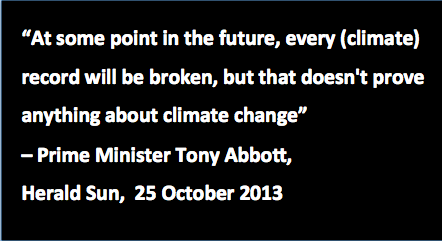
    Now accused of “failing to protect his people”, Abbott refused to respond for days, and instead headed off for duty with his local volunteer fire brigade. But shouldn’t the Prime Minister be leading the country, not his local fire brigade, at a time of emergency? For the first time in years, the prime minister was no longer on the front foot in the climate policy discussion.

    That climate change would load the dice in favour of more intense disasters is well established. Fire researchers in 2007 estimated that climate change would result in a two-to-fourfold increase in extreme fire days. Between 1973-2010, Melbourne and Adelaide recorded a 49% increases in their cumulative annual Forest Fire Danger Index. And in February 2009 Victoria’s Black Saturday bushfires killed 173 people, injured 414, destroyed 2,029 homes, and cost $4.4 billion in damage. The fire index was an unprecedented 190 on a zero-to-100 scale. Yet the possible impact of climate change on the days’ events and planning for the future was excluded from the subsequent royal commission’s terms of reference.

    This week the NSW fire commissioner spoke of “unparalleled conditions” and “a whole new ball game”. Conservative NSW premier Barry O’Farrell, when asked asked if climate change made disastrous events such as the NSW fires more likely, replied: ”Well, clearly, I think that’s the science.”

    Now the taboo has been broken, what does in mean for the debate in Australia as prime minister Abbott prepares to trash Labor’s legislation?

    Labor and the climate advocacy movement made a strategic mistake in 2010 by trying to sell the climate legislation as about “clean energy futures” and “saying yes” without talking about how climate change would affect people’s lives. It was all about selling good news and not mentioning bad news, selling an answer without elaborating the question. Public support went down.

    “Climate change is a choice
    between increasing harm, or
    acting to restore safety.”

    Climate change is a choice between increasing harm, or acting to restore safety. All the studies on health and safety promotion — smoking, obesity, drink driving, HIV, workplace safety — show same thing. Be honest about the problem and tell it like it is; show a better alternative, the benefits of changing behaviour; and finally demonstrate an efficacious path, the “you can do it” actions that the person or society is empowered to take to move from fear to success.

    The debate which has erupted over extreme climate events has important lessons for all those urging more, not less, action on climate change. The story should be about people in Australia and not distant places, about now and not just the distant future, about connecting the dots between extreme events and global warming. It is a story about record heat and bush fires, about how family and friends will live in a hotter and more extreme world, about how a retreating coastline will affect where we live and work, a story about health and well-being, about increasing food and water insecurity, and the more difficult life that children and grandchildren will face. This makes climate action a values issue, the choice between increasing climate harm and climate safety.

    Australian per capita income is the highest in the world, yet we are less happy than citizens in austerity-riven Spain. Society’s pace of change is creating new fears and insecurities as people struggle to keep up. They fear for the future in which their children will live. Hyper-consumption is being driven by anxiety — fear of being left behind, of being “unfashionable” in the broad meaning of the term — and an increasing sense of self-entitlement.

    Sociologist Zygmunt Bauman says that “human vulnerability and uncertainty is the foundation of all political power”. Abbott understood the politics of fear in his tearing down of the Labor government.

    Can he now be stopped by constructing a narrative that recognises reasonable fear and provides a clear path to climate safety, rather than increasing personal and planetary insecurity? Can John Howard’s and Tony Abbott’s “battlers” become safe-climate champions?

    You are subscribed to email updates from Climate Code Red
    To stop receiving these emails, you may unsubscribe now.
    Email delivery powered by Google
    Google Inc., 20 West Kinzie, Chicago IL USA 60610
  • Judicial Inquiry into pink batts scheme Oct. 27, 2013, 12:16 p.m.

    Sunday October 27, 2013
    Larger / SmallerNight Mode

    Judicial Inquiry into pink batts scheme

    Oct. 27, 2013, 12:16 p.m.
    • Prime Minister Tony Abbott and Joe Hockey. Photo: Dominic LorrimerPrime Minister Tony Abbott and Joe Hockey. Photo: Dominic Lorrimer

    Treasurer Joe Hockey has added to calls for a judicial inquiry into the home insulation fiasco to include witnesses from the senior ranks of the first Rudd Government, including Kevin Rudd himself.

    Mr Hockey said on Sunday that no one should be immune from giving evidence about the so-called pink batts scheme in which four young men died.

    “I don’t think anyone should be excluded from providing full and frank and honest evidence in front of a judicial inquiry,” he said.

    According to reports, the draft terms of reference for the inquiry call for a full explanation of the then government’s decisions about the $2.8 billion program, and if any steps could have been taken to avoid the deaths of four young insulation installers.

    Mitchell Sweeney, Marcus Wilson, Matthew Fuller and Rueben Barnes died between 2009 and 2010 while working on jobs funded by the capital spending program at the height of the global financial crisis.

    “The judicial commission is to be conducted in such a manner as to enable the families of the deceased tradesmen and all others who have suffered loss and damage (to get) the maximum transparency and access to information disclosed by the evidence before it,” the terms of reference say.

    The ten terms of reference include:

    – The process and basis of government decisions while establishing the program, including risk assessment and risk management;

    – Whether the death of the four men could have been avoided;

    – What if any advice or undertakings given by the government to the industry were inaccurate or deficient, and;

    – What steps the government should have taken to avoid the tragedies.

    If Mr Rudd is called it is almost certain that his then environment minister Peter Garrett will also be called to give evidence and former senator Mark Arbib who was parliamentary secretary to the minister and worked on designing and delivering the program.

    The inquiry, which could pave the way for compensation claims by the families of the dead men, is due to be finalised by June 30 next year.

    Three Queensland businesses were prosecuted for workplace health and safety breaches as a result of the pink batts tragedies and a NSW gave evidence before a NSW coroner’s inquest.

    A spokeswoman for Mr Rudd said he had no comment.

  • Acidification of oceans threatens to change entire marine ecosystem

    Acidification of oceans threatens to change entire marine ecosystem

    By Larry Pynn, Vancouver Sun October 25, 2013
    8
    Acidification of oceans threatens to change entire marine ecosystem

    Ocean acidification due to excessive release of carbon dioxide into the atmosphere is threatening to produce large-scale changes to the marine ecosystem affecting all levels of the food chain, a University of B.C. marine biologist warned Friday.

    Photograph by: Nick Didlick , VANCOUVER SUN

    Ocean acidification due to excessive release of carbon dioxide into the atmosphere is threatening to produce large-scale changes to the marine ecosystem affecting all levels of the food chain, a University of B.C. marine biologist warned Friday.

    Chris Harley, associate professor in the department of zoology, warned that ocean acidification also carries serious financial implications by making it more difficult for species such as oysters, clams, and sea urchins to build shells and skeletons from calcium carbonate. Acidic water is expected to result in thinner, slower-growing shells, and reduced abundance. Larvae can be especially vulnerable to acidity.

    “The aquaculture industry is deeply concerned,” Harley said. “They are trying to find out, basically, how they can avoid going out of business.”

    While there is potential for, say, commercial oyster growers to reduce acidity for larvae in land-based facilities, the greater marine environment doesn’t have that luxury. “For wild populations, you can’t just take part of their lifecycle and babysit it,” he said.

    A total of 10,000 tonnes of oysters, clams, scallops and mussels worth $21.7 million were harvested in B.C. in 2010. The sea urchin fishery was worth another $9 million, based on a harvest of 2,300 tonnes.

    Lab studies at the University of B.C. also show that acidic water can impair the ability of salmon to grow and smell properly, which has implications for their ability to find native spawning streams. Research in Australia’s coral reefs has found that acidity can erode a fish’s ability to sniff out their best habitat and to avoid predators.

    Development of small creatures such as pteropods — free-swimming snails that are food for salmon — will also be stunted by acidity.

    Harley was speaking in an interview at the conclusion of a week-long meeting on ocean acidification involving some 20 scientists and research students from Canada, the U.S., Scandinavia, Australia, Italy, Great Britain, and Hong Kong.

    Harley said that research into ocean acidification is only about a decade old, which is why it is important to bring researchers together from different parts of the world to share findings and better understand the big picture.

    “We know the impacts are going to be really widespread. The last big unknown is whether species will be able to adapt.”

    Coral reefs in tropical waters also stand to be severely impacted, which he described as a pending “biodiversity catastrophe.”

    On the other hand, kelp and seaweed, including those found on the B.C. coast, may benefit from increased carbon dioxide through enhanced photosynthesis. They will also benefit from a decline in grazers such as urchins and snails. “If they become less abundant or smaller, they’ll eat less kelp and that’s a win-win for the kelp.”

    Purple sea stars also grow faster under acidic conditions. “That good for them, but it’s bad for the mussels, which are their favourite food,” Harley noted.

    Average pH levels in the oceans have dropped form 8.2 to 8.1 and are “headed to 7.8 or below by the end of this century,” he said.

    While part of the equation involves the upwelling of naturally acidic waters from the deep ocean, researchers believe that the major driver is carbon dioxide released from burning fossil fuels.

    While the issue is global in scale, there are steps that can be taken locally to lessen the impact such as by reducing fertilizer runoff from farms and protecting biodiversity through measures such as marine protected areas.

    “Every little bit helps. The more we can transition from fossil fuels, the better off we’ll be.”

    lpynn@vancouversun

    We encourage all readers to share their views on our articles and blog posts. We are committed to maintaining a lively but civil forum for discussion, so we ask you to avoid personal attacks, and please keep your comments relevant and respectful. If you encounter a comment that is abusive, click the “X” in the upper right corner of the comment box to report spam or abuse. We are using Facebook comments
  • Ocean acidification

    Why this ad?
    Master of Public Healthtua.edu.au/Master_of_Public_Health – Study Online at Torrens University. Enrol Now! Courses Start Jan 2014.

    Ocean acidification

    Inbox
    x
    Ocean acidification oaiccproject@gmail.com via google.com
    12:03 AM (5 minutes ago)

    to me

    Ocean acidification


    Acid Ocean trailer (video)

    Posted: 25 Oct 2013 06:19 AM PDT


    Scientists unlock the secrets of ocean acidification, one of the biggest environmental challenges facing our planet today.

    From the icy polar seas to the world’s most pristine coral reefs, ACID OCEAN tracks the latest in marine scientific research. It meets an Australian scientist whose unique discovery opens a window to the future of our oceans.

    As carbon emissions rise and the world’s oceans absorb an increasing amount of carbon dioxide, scientist fear thousands of species are in danger. The seawater chemistry is changing. And in increasingly acidic waters, marine animals can’t form the skeletons and shells vital for their survival.

    Already the multi million dollar shellfish industry in America’s Pacific North West teeters on the brink of disaster as millions of oyster larvae are unable to make their shells.

    Among the volcanic islands of Milne Bay, Papua New Guinea, Australian coral ecologist Dr Katharina Fabricius and her team from the Australian Institute of Marine Science are working in an extraordinary natural laboratory — a stunning coral garden where tiny bubbles of pure CO2 erupt from cracks in the ocean floor. The water chemistry here is what’s predicted for much of the ocean at the end of the century. The team conducts a raft of experiments, studying the impact of acidity on coral diversity, young corals and the resilience of fish, with fascinating results.

    And it’s not just coral reef systems facing danger. Polar expert Dr Donna Roberts is studying how ocean acidification will affect tiny pteropods, or sea butterflies, a crucial food source for many fish. The news is not all bad. In the US, Dr Gretchen Hofmann has found some marine creatures are using genetic tools to adapt to the higher acidity.

    With the clock ticking, the teams of marine scientists face the test of their careers. Can they uncover the secrets of the acid ocean and will these incredible marine creatures adapt and evolve to survive potential disaster?

    Producer/Director Sally Ingleton, 360 Degree Films, 2013. Video.


  • A new European report on climate extremes is out

    RealClimate logo


    Technical Note: We have changed the contact email for the blog to reduce the amount of unsolicited email. If you want to contact us at the blog, please use contact-at-realclimate.org.

    A new European report on climate extremes is out

    A new report on extreme climate events in Europe is just published: ‘Extreme Weather Events in Europe: preparing for climate change adaptation‘. It was launched in Oslo on October 24th by the Norwegian Academy of Science and Letters, and the report is now available online.

    Front cover of 'Extreme Weather Events in Europe: preparing for climate change adaptation'

    Front cover of ‘Extreme Weather Events in Europe:
    preparing for climate change adaptation’

    What’s new? The new report provides information that is more specific to Europe than the SREX report from the Intergovernmental Panel on Climate Change (IPCC), and incorporate phenomena that have not been widely covered.

    It provides some compelling information drawn from the insurance industry, and indeed, a representative from Muncih Re participated in writing this report. There is also material on convective storms, hail, lightening, and cold snaps, and the report provides a background on extreme value statistics, risk analysis, impacts, and adaptation.


    The main difference with the recent IPCC reports (e.g. the SREX) is the European focus and that it includes more recent results. The report writing process did not have to follow as rigid procedures as the IPCC, and hence the report is less constrained. For instance, it provides set of recommendations for policymakers, based entirely on scientific considerations.

    The report, in which I have been involved, was initiated by the Norwegian Academy of Science and Letters, and was written by a committee of experts across Europe. Hence, the final report was published as a joint report by the Norwegian meteorological institute, the Norwegian Academy of Science and Letters, and the European Academies Science Advisory Council

  • Fracking for Geothermal Heat Instead of Gas

    Fracking for Geothermal Heat Instead of Gas

    AltaRock has figured out how to use fracking to get more heat out of a geothermal well, but work remains before the energy source can dent carbon emissions.

    The use of hydraulic fracturing has unlocked vast new reserves of natural gas. Now Alta Rock, a startup based in Seattle, is developing technology that might do the same for geothermal resources, turning a marginal power source into a major source of carbon-free electricity and heat in the United States.

    Earlier this year near the Newberry Volcano in Oregon, Alta Rock demonstrated a key part of that technology, a process akin to fracking. Just as fracking involves pumping high-pressure liquid into underground shale formations to unlock natural gas and oil that’s been trapped there, the new technology could unlock heat trapped deep underground. Unlike solar and wind power, that heat would be available around the clock and in all sorts of weather.

    Geothermal power plants now provide a tiny fraction of the world’s energy needs—in the U.S., one of the world’s biggest producers of geothermal energy, the total geothermal capacity is about 1 percent of the country’s coal power capacity.

    The main problem is that conventional geothermal plants rely on a rare combination of geological features. Hot rock has to be accompanied by large amounts of hot water or steam that can easily be pumped to the surface, where it would drive steam turbines to generate electricity. The rock formation needs to be porous enough that the water can be continuously recirculated and reheated to keep a power plant running. (Geothermal pumps are sometimes used to heat and cool homes, but these are inadequate for generating electricity because they work at much lower temperatures.)

    Although such formations are rare, the amount of heat underground is actually huge (see “Abundant Power from Universal Geothermal Energy”). There’s enough heat trapped under the United States within drilling distance (as deep as 10 kilometers) to supply its energy needs for thousands of years. AltaRock is one of several companies trying to figure out how to access more of that heat (see “Cracking Rock to Get More from Geothermal Fields” and “Using CO2 to Extract Geothermal Energy”).

    The basic idea is to modify the rock to allow water to flow through it (researchers call the resulting reservoirs enhanced geothermal systems, or EGS). This involves pumping cold water into rock in just the right way to trigger existing fractures in the rock to expand and allow water to flow through. It’s been tried many times in the past—with efforts stretching back for decades. But it’s been hard to get enough hot water flowing to justify the expense of drilling a well and building a power plant.

    AltaRock’s solution borrows a play from the natural gas industry. One of the key advances that allowed companies to produce economic amounts of natural gas from shale rock is the ability to fracture rock at several points along a single well, which reduces the number of wells that need to be drilled. They do this by temporarily plugging up part of a well so that they can apply hydraulic pressure to one section, and then move on to another part.

    It’s long been known that doing the same thing could increase hot water production from a geothermal well. But it’s not possible to use the same techniques used in fracking to plug the well. Geothermal wells are typically hotter, and they need to be engineered for higher amounts of water flow.

    AltaRock has essentially invented a new plug. At a well near the Newberry Volcano, it has demonstrated that it’s possible to temporarily plug a geothermal well with a special polymer. The material degrades after it’s been down in the hot rock for a certain amount of time, allowing the company to move on to another part of the well. The company fractured three separate areas of one well using the technique. In a future commercial project, it might do seven or more per well, which “could dramatically lower the cost,” says Susan Petty, the president and chief technology officer at AltaRock. She says the technology could be key to making EGS competitive with coal.

    But while the AltaRock technology is a key advance, it’s still early days for geothermal power. “AltaRock’s technology is important, but it’s only one part of the puzzle,” says Jefferson Tester, professor of Sustainable Energy Systems at Cornell University. He says there are several remaining engineering challenges, and solving them will require sustained funding, not just for the project AltaRock is working on, but for several others as well. He says what’s needed is a critical mass of demonstrations to prove to businesses that geothermal power plants are a sound investment. He estimates that it will take decades for geothermal to account for even 10 percent of the total power in the United States.

    Petty says that the Newberry site could be producing power by as early as 2016, but much work remains. The next step for AltaRock is to drill another well nearby that will intersect with the porous rock it created with its fracturing technique. Engineers will pump water down the first well, which will circulate through the rock and heat up. Then it will be pumped out of the second well and used to produce steam at a power plant.

    In past EGS projects, several problems have arisen at this stage. Sometimes the water flows too quickly from one well to the other, and so it doesn’t get hot enough. At other times water disappears down unknown crevices in the rock, never to be seen again. To address these issues, AltaRock is developing new technologies for monitoring where water is flowing.

    AltaRock is also working with GE on an improved process for using hot water to generate electricity. It involves improving heat transfer from the hot water to a working fluid that drives a turbine. The approach could increase power output from a geothermal site still more.

    @count comment.” data-lf-format-plural=”@count comments.” data-lf-display-parents=”.has-comments” data-lf-display-alt-parents=”a” data-lf-display-alt=”.no-comments”>30 comments. Share your thoughts »

    Credit: Image by Newberry Geothermal EGS Demonstration

    Tagged: Energy, climate change, natural gas, fracking, geothermal, enhanced geothermal

    Reprints and Permissions | Send feedback to the editor