Author: Neville

  • Is climate change already dangerous? (4): Tipping points and climate modelling

    Is climate change already dangerous? (4): Tipping points and climate modelling

    by David Spratt

    Fourth in a series

    A tipping point may be understood as a step change, or passing of a critical threshold, in a major earth-climate system component, where a small perturbation (a small push or change) unleashes a bigger change in the component.  Potsdam Institute Director, Prof. Hans Joachim Schellnhuber, says that tipping points “identify the most vulnerable components (tipping elements) of the Earth System, the critical warming thresholds where the respective Earth System elements flip into a qualitatively new state”.  These elements include ecosystems, major ocean and atmospheric circulation patterns, the polar ice sheets, and the land- and ocean-based carbon stores.

    This process is often tied to positive feedbacks, where a change in a component leads to other changes that eventually “feed back” onto the original change to amplify it.  The classic case in global warming (or, in reverse, cooling) is the ice-albedo feedback, where decreases (increases) in the ice cover area change surface reflectivity (albedo), trapping more (less) heat and producing further ice loss (gain).
    In some cases, passing one threshold will trigger further threshold events, for example where substantial releases from permafrost carbon stores increase warming, releasing more permafrost carbon but also pushing other systems, for example parts of the Antarctic ice sheet, past a threshold point.

    Once a tipping point is crossed, it is irreversible (under natural conditions) within certain time frames, so the consequence is to significantly affect the earth’s climate and ecosystems, for example by raising temperatures or greenhouse gas levels, or changing the efficiency of the land and ocean carbon sinks.  Given enough time and the right conditions, most processes (but not extinctions, for example) can be reversed.

    In a period of rapid warming, most major tipping points once crossed (ice sheet loss, large-scale land carbon store releases such as permafrost) are irreversible on human time frames running to a few generations, principally due to the longevity of atmospheric CO2 (several thousand years). Large-scale human interventions in slow-moving earth system tipping points might allow a tipping point to be reversed (for example, a large-scale atmospheric CO2 drawdown program, or solar radiation management).

    There is discussion, for example, that Arctic sea-ice loss is “easily reversible” in a cooling world, but that is easier said than done.  That would require greenhouse gas levels to be reduced significantly, below the level equivalent to the temperature at which the sea-ice system tipped in 2007, to produce a sufficiently cooler world.  This would be around 300–325 ppm CO2, compared to the present level of 400 ppm, so it is not so “easy” in the real world.

    The scientific literature on tipping points is relatively recent, with a significant contribution by Lenton, Held et al. in 2008 on “Tipping elements in the Earth’s climate system” in an issue of the journal Proceedings of the National Academy of Sciences devoted to the subject. However, our knowledge is limited because “a system-level understanding of critical Arctic processes and feedbacks is still lacking” (Maslowski, Kinney et al.) and “no serious efforts have been made so far to identify and qualify the interactions between various tipping points” (Schellnhuber).

    Climate models are not yet good at dealing with tipping points. This is partly in the nature of tipping points, where a particular and complex confluence of factors suddenly change a climate system characteristic and drives it to a different state. To model this, all the contributing factors and their forces have to well identified, as well as their particular interactions, plus the interactions between tipping points. Duarte, Lenton et al. conclude that “complex, nonlinear systems typically shift between alternative states in an abrupt, rather than a smooth manner, which is a challenge that climate models have not yet been able to adequately meet”.

    The classic case was the Arctic sea ice “big melt” in 2007. Many models, including those on which the 2007 IPCC report had relied to conclude that Arctic sea-ice was pretty much likely to remain till the end of the century, did not fully capture the dynamics of sea-ice loss. Thus when in 2007 the summer sea-ice extent dropped radically compared to previous years, some model-oriented researchers exclaimed that the Arctic was melting “a hundred years ahead of schedule”.

    Even today, papers are still being published with modelling that suggests a sea-ice free Arctic will not occur till mid-century. Given the observations, it’s difficult not to conclude that given a choice between their models and real-world observations, some modellers will always choose the former.

    In an overview of the current state of Arctic climate research, Maslowski, Kinney et al. conclude that: “Model limitations are hindering our ability to predict the future state of Arctic sea ice”, and that the majority of general climate models (GCMs) including those used in IPCC (2007) “have not been able to adequately reproduce observed multi-decadal sea-ice variability and trends in the pan-Arctic region”, and their ensemble mean trend in September Arctic sea-ice extent “is approximately 30 years behind the observed trend”.

    For example, what would be the impact of a sea-ice-free Arctic summer and the consequent amplified regional warming on the stability of the Greenland Ice Sheet (GIS)? Research does not yet provide a robust framework for considering such questions, yet most scientists if asked for their expert elicitation would probably say that it is hard to imagine the GIS doing anything other than melting at an accelerating rate and passing a critical tipping point in such circumstances.

    The sea-ice model that has performed best (acronym NAME), is one of a new range of more specialised regional climate models developed by Dr Wieslaw Maslowski and colleagues. Maslowski is highly regarded, in part because his position at the American Naval Postgraduate School has given him unique access to half a century of Arctic sea-ice thickness scans from polar US military submarines. Maslowski told BBC News:

    In the past… we were just extrapolating into the future assuming that trends might persist as we’ve seen in recent times. Now we’re trying to be more systematic, and we’ve developed a regional Arctic climate model that’s very similar to the global climate models participating in IPCC assessments. We can run a fully coupled model for the past and present and see what our model will predict for the future in terms of the sea ice and the Arctic climate.

    He emphasizes “the need for detailed analyses of changes in sea ice thickness and volume to determine the actual rate of melt of Arctic sea ice”, and concludes that:

    The modeled evolution of Arctic sea ice volume appears to be much stronger correlated with changes in ice thickness than with ice extent as it shows a similar negative trend beginning around the mid-1990s. When considering this part of the sea ice–volume time series, one can estimate a negative trend of −1,120 km3 year−1 with a standard deviation of +/-2,353 km3 year−1 from combined model and observational estimates for October–November 1996–2007. Given the estimated trend and the volume estimate for October–November of 2007 at less than 9000 km3, one can project that at this rate it would take only 9 more years or until 2016 +/-3 years to reach a nearly ice-free Arctic Ocean in summer. Regardless of high uncertainty associated with such an estimate, it does provide a lower bound of the time range for projections of seasonal sea ice cover.

    The point cannot be emphasised enough that the best-performing Arctic sea-ice model projects 2016 +/-3 years to reach a nearly ice-free Arctic Ocean.
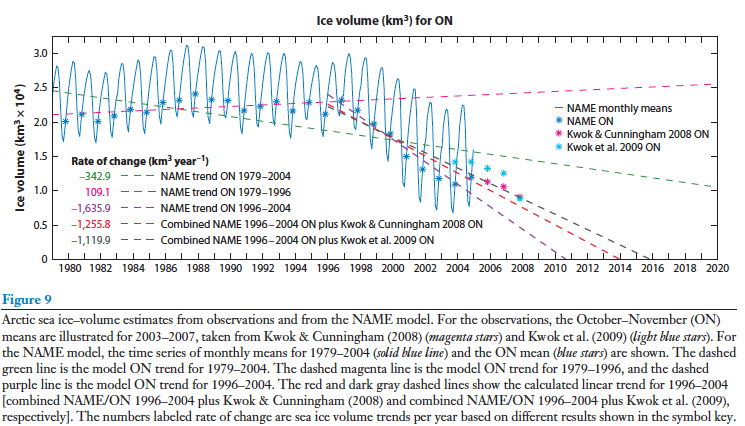
    Arctic sea ice volumes estimates from observations and from the NAME model
    (Maslowski, Kinney et al., 2012, Figure 9)

    The non-linear problem still plagues many Arctic GCMs, and indeed parts of the IPCC process which largely excludes tipping points and carbon cycle feedbacks from consideration, exemplified by the 2007 IPCC’s reticence on sea level rises. Several fundamental projections found in IPCC reports have consistently underestimated real-world observations in at least eight key areas.  In its February 2007 report on the physical basis of climate science, the IPCC said that Arctic sea-ice was responding sensitively to global warming: ‘While changes in winter sea-ice cover are moderate, late summer sea-ice is projected to disappear almost completely towards the end of the twenty first century.’ And apparently the forthcoming 2013 IPPC AR5 has omitted consideration of permafrost feedbacks – another glaring example of that body’s scientific reticence (Romm, 2012).

    • Concluding post: Summing up

    No comments:


    Post a Comment


    Subscribe to: Post Comments (Atom)

    RECEIVE NEW POSTS BY EMAIL (1-2 per week)

  • Wind and Rain Belts to Shift North as Planet Warms: Redistribution of Rainfall Could Make Middle East, Western US and Amazonia Drier

    Wind and Rain Belts to Shift North as Planet Warms: Redistribution of Rainfall Could Make Middle East, Western US and Amazonia Drier

    Sep. 23, 2013 — As humans continue to heat the planet, a northward shift of Earth’s wind and rain belts could make a broad swath of regions drier, including the Middle East, American West and Amazonia, while making Monsoon Asia and equatorial Africa wetter, says a new study in Proceedings of the National Academy of Sciences.


    Share This:

    The study authors base their prediction on the warming that brought Earth out of the last ice age, some 15,000 years ago. As the North Atlantic Ocean began to churn more vigorously, it melted Arctic sea ice, setting up a temperature contrast with the southern hemisphere where sea ice was expanding around Antarctica. The temperature gradient between the poles appears to have pushed the tropical rain belt and mid-latitude jet stream north, redistributing water in two bands around the planet.

    Today, with Arctic sea ice again in retreat, and the northern hemisphere heating up faster than the south, history could repeat itself. “If the kinds of changes we saw during the deglaciation were to occur today that would have a very big impact,” said the study’s lead author, Wallace Broecker, a climate scientist at Columbia University’s Lamont-Doherty Earth Observatory.

    Marshaling climate data collected from around the world, from tree-rings, polar ice cores, cave formations, and lake and ocean sediments, Broecker and study coauthor, Aaron Putnam, a climate scientist at Lamont-Doherty, hypothesize that the wind and rain belts shifted north from about 14,600 years ago to 12,700 years ago as the northern hemisphere was heating up.

    At the southern edge of the tropical rain belt, the great ancient Lake Tauca in the Bolivian Andes nearly dried up at this time while rivers in eastern Brazil slowed to a trickle and rain-fed stalagmites in the same region stopped growing. In the middle latitudes, the northward advance of the jet stream may have caused Lake Lisan, a precursor to the Dead Sea in Jordan’s Rift Valley, to shrink, along with several prehistoric lakes in the western U.S., including Lake Bonneville in present day Utah.

    Meanwhile, a northward shift of the tropical rains recharged the rivers that drain Venezuela’s Cariaco Basin and East Africa’s Lake Victoria and Lake Tanganyika. Stalagmites in China’s Hulu Cave grew bigger. Evidence for a stronger Asian monsoon during this time also shows up in the Greenland ice cores.

    The process worked in reverse from about 1300 to 1850, the study authors hypothesize, as northern Europe transitioned from the relatively warm medieval era to a colder period known as the Little Ice Age. Ocean circulation slowed, and sea ice in the North Atlantic Ocean expanded, the climate record shows. At the same time, rainfall declined in Monsoon Asia, leading to a series of droughts that have been linked to the decline of Cambodia’s ancient Khmer civilization, China’s Ming dynasty and the collapse of kingdoms in present day Vietnam, Myanmar and Thailand.

    In the southern hemisphere, the reconstruction of glacier extents in New Zealand’s Southern Alps suggests that the mid-latitudes may have been colder during medieval times, supporting the idea of a temperature contrast between the hemispheres that altered rain and wind patterns.

    A similar migration of Earth’s wind and rain belts happens each year. During boreal summer, the tropical rain belt and mid-latitude jet stream migrate north as the northern hemisphere heats up disproportionately to the south, with more continents to absorb the sun’s energy. As the northern hemisphere cools off in winter, the winds and rains revert south.

    Sometimes the winds and rains have rearranged themselves for longer periods of time. In the 1970s and 1980s, a southward shift of the tropical rain belt, attributed to air pollution cooling the northern hemisphere, is thought to have brought devastating drought to Africa’s Sahel region. The tropical rain belt has since reverted back, and may be moving north, the study authors say, as suggested by a number of recent droughts, including in Syria, northern China, western U.S., and northeastern Brazil.

    Consistent with the study, at least one climate model shows the tropical rain belt moving north as carbon dioxide levels climb and temperatures warm. “It’s really important to look at the paleo record,” said Dargan Frierson, an atmospheric scientist at University of Washington whose modeling work supports the authors’ hypothesis. “Those changes were huge, just like we’re expecting with global warming.”

    The study authors acknowledge that their hypothesis has some holes. In the past, changes in sea ice cover drove the temperature gradient between the two hemispheres while today rapidly rising industrial carbon emissions are responsible. So far, there is also no clear evidence that ocean circulation is increasing in the North Atlantic or that the monsoon rains over Asia are strengthening (though there is speculation that sulfate aerosols produced by burning fossil fuels may be masking this effect).

    As air pollution in the northern hemisphere declines, temperatures may warm, creating the kind of temperature contrast that could move the winds and rains north again, said Jeff Severinghaus, a climate scientist at Scripps Institution of Oceanography who was not involved in the study.

    “Sulfate aerosols will probably get cleaned up in the next few decades because of their effects on acid rain and health,” he said. “So Broecker and Putnam are probably on solid ground in predicting that northern warming will eventually greatly exceed southern warming.”

    Share this story on Facebook, Twitter, and Google:

    Other social bookmarking and sharing tools:


    Story Source:

    The above story is based on materials provided by The Earth Institute at Columbia University.

    Note: Materials may be edited for content and length. For further information, please contact the source cited above.


    APA

    MLA

    The Earth Institute at Columbia University (2013, September 23). Wind and rain belts to shift north as planet warms: Redistribution of rainfall could make Middle East, Western US and Amazonia drier. ScienceDaily. Retrieved September 24, 2013, from http://www.sciencedaily.com­ /releases/2013/09/130923155540.htm?utm_source=feedburner&utm_medium=email&utm_campaign=Feed%3A+sciencedaily%2Fearth_climate%2Foceanography+%28ScienceDaily%3A+Earth+%26+Climate+News+–+Oceanography%29

    Note: If no author is given, the source is cited instead.

    Search ScienceDaily

    Number of stories in archives: 143,410

    Find with keyword(s):
    Enter a keyword or phrase to search ScienceDaily’s archives for related news topics,
    the latest news stories, reference articles, science videos, images, and books.

    Recommend ScienceDaily on Facebook, Twitter, and Google:

    Other social bookmarking and sharing services:


    Interested in ad-free access? If you’d like to read ScienceDaily without ads, let us know!

    Social Networks


    Follow ScienceDaily on Facebook, Twitter,
    and Google:

    Recommend ScienceDaily on Facebook, Twitter, and Google +1:

    Other social bookmarking and sharing tools:

    Breaking News

    … from NewsDaily.com

    In Other News …

    Science Video News


    North American Monsoon

    Traveling to the coast of Western Mexico, U.S. researchers are studying the North American Monsoon, which brings humid air and heavy rain by blowing. …  > full story

    Strange Science News


    Free Subscriptions

    … from ScienceDaily

    Get the latest science news with our free email newsletters, updated daily and weekly. Or view hourly updated newsfeeds in your RSS reader:

    Feedback

    … we want to hear from you!

    Tell us what you think of ScienceDaily — we welcome both positive and negative comments. Have any problems using the site? Questions?


  • $250k in 24 hours! The Climate Council gets off to a flyer

    $250k in 24 hours! The Climate Council gets off to a flyer

    Inbox
    x
    Cameron Neil via CommunityRun camneil76@gmail.com via controlshiftlabs.com
    6:22 PM (39 minutes ago)

    to me

    Hi everyone

    It has been an amazing day for our new citizen-funded Climate Council!

    Because of people like you, like us, The Climate Council has already raised $250,000 in less than 24 hours – half way to its goal of $500,000 for the week. You can see the update and message of thanks from The Climate Council here: http://youtu.be/M5_Sd17Tkkk and check out the website here http://www.climatecouncil.org.au/.

    The support has been truly inspiring! In addition to the 4,300 of you who have signed this petition, The Climate Council now has almost 20,000 likes on Facebook, 4,154 followers on Twitter, was trending on Twitter this morning, had its twitter account suspended because it grew so fast, had their site crash because of so much traffic, and has been generating a huge amount of media interest all day!

    I encourage all of you, having signed our petition here, to head over to The Climate Council’s website, if you haven’t already, and both sign up as a supporter, and donate some cash.

    For those of you who want to contribute skills or time, you can go here and register your interest: https://docs.google.com/forms/d/1nqhDf-Yj_2xoqf2wYSiG0Koz5OfGpVRsk7rb2e68sXg/viewform?edit_requested=true

    I’ve had quite a few emails from people about wanting to make monthly and tax deductible contributions to The Climate Council – what I have done is made a donation today, through the website, with an expectation that once they have their initial funding and are up and running, The Climate Council will let us know how to set up ongoing monthly contributions. They may not be able to offer tax deductibility – again, that will have to be something they explore after getting themselves re-established with our help.

    Finally, amidst a sea of media today (I’ve done a few radio interviews, hopefully doing our collective voices justice), we did get a shout out in a Guardian Australia article here: http://www.theguardian.com/environment/2013/sep/24/climate-council-faces-titanic-struggle?CMP=soc_567.

    Thank you all for your support!

    Cameron

    ps some of you have been asking – I have no affiliation or role with The Climate Council.

    You received this email because you signed the petition ‘We’ve done it! Your ‘citizen-funded Climate Commission’ = the new Climate Council!’. If you don’t want to receive emails from the ‘We’ve done it! Your ‘citizen-funded Climate Commission’ = the new Climate Council!’ campaign in the future, please unsubscribe.

    YouTube – Videos from this email
  • Climate Council faces ‘titanic struggle’, says Tim Flannery

    Climate Council faces ‘titanic struggle’, says Tim Flannery

    Donors to reborn climate body include ‘James of NSW’ who gave first $15, and former Defence Force chief Chris Barrie

    Tim Flannery in the studio
    Tim Flannery says the council will act ‘largely in the same way as the commission’. Photograph: guardian.co.uk

    Tim Flannery has said that Australia is set for a “titanic struggle” over how to deal with the challenge of climate change, as he revealed further details on how his “Obama-style” funded Climate Council will operate.

    Flannery, who last week lost his job as the head of the Climate Commission after the government axed its funding, announced the resurrection of the body on Tuesday morning under the new guise of the Climate Council.

    The council will act “largely in the same way as the commission” according to Flannery, with a remit to inform the public of the impact of climate change. Instead of government funding, the organisation will be supported with donations from the public, with each of the former climate commissioners working pro bono.

    The first donation came at midnight last night, a sum of $15 from “James of NSW”, Flannery said, with a further 1,000 donations since then. Nearly 4,000 people have signed a petition calling for the work of the Climate Commission to continue.

    Details have not been released of other donors, although former Defence Force chief Chris Barrie has confirmed he has provided funds, calling the work of the commission “fantastic”.

    Flannery said: “We’ll be raising money Obama-style, via small donations made online from ordinary Australians, although in my view they are extraordinary Australians. They are the ones who have stepped up and recognised the need and sacrificed just a bit to ensure the job gets done.

    “We’ve been blown away by people’s generosity and we hope more and more people will join that move to donate and ensure the message remains strong.

    “We [the former climate commissioners] agree that without an informed public, Australia is unlikely to make the decisions to safeguard us against a dangerous climate.

    “This work is really important to me, personally. When you look at the business-as-usual projections for climate change, I can tell you the outcome looks horrific. I’m filled with horror at the thought of those young Australians facing that dismal future. In fact, it is utterly unacceptable.”

    Flannery added: “Make no mistake, we are in the middle of a titanic struggle. Indeed, the fight for a clean and safe future is reaching its peak. We can, and indeed the science tells us we must, in the next few decades shift decisively away from fossil fuels and to a clean energy technology.

    “Resistance and disinformation keep growing. This isn’t a time for giving up; rather it’s time for determination, for standing up for what’s right.”

    Flannery said the Climate Council will be apolitical and “fiercely independent”. Its first work, to be conducted by former climate commissioners Lesley Hughes and Will Steffen, will be distilling the message of the upcoming IPCC climate change reports.

    Greg Hunt, the environment minister, said that the rebirth of the commission as the Climate Council vindicated the government’s decision to scrap the body.

    “That’s how democracy should work,” he told the ABC. “If people want to invest in those with a particular view, they have a right and a freedom to do that, and our job is to make sure that we deal with the core scientific agencies, that we protect the taxpayers’ funds.

    “The fact that this can be done at the private level shows that taxpayers’ funds were not required from the outset.”

    The government predicts it will save $580,000 this year and $1.6m in future years from ditching the Climate Commission. The work of providing analysis of climate change will be shared among the Department of Environment, the Bureau of Meteorology and the CSIRO.

    Green light

    close

    Sign up for the Green light email

    The most important environment stories each week including data, opinion pieces and guides.

    Sign up for the Green light email

  • Dr David’s Suzuki’s Speech

    If you’re watching #qanda and want more David Suzuki, we have his 70 min speech from @MelbFestival 2010 right here: http://wheelercentre.com/videos/video/david-suzuki/ …

    Retweeted by x4media
  • Abbott Has Got The Culture War He Wanted

    24 Sep 2013

    Abbott Has Got The Culture War He Wanted

    By Ben Eltham

    Abbott has nixed the Climate Commission and authorised a round of high profile funding cuts and sackings. Progressives are well equipped to fight back – and must, writes Ben Eltham

    So much for a “no surprises government”. The first fortnight of the Abbott Government has been nothing if not full of surprises.

    The biggest surprises haven’t come from Tony Abbott and his ministers themselves, but rather from how quickly they have reignited the culture wars. Whatever the weary protests of those burnt out from the last round of conflict during the Howard era, the culture wars are unmistakably back.

    In part, this is due to the amazingly ideological nature of the new government’s targets: senior public servants, scientists, climate change bodies, public health agencies, academic researchers and the board of the National Broadband Network. The score-settling has been open and unashamed.

    Tim Flannery, for instance, has long been a bête noire for conservatives. Few progressives grasp the figure of hate he has become for right-wing bloggers and agitators. The abolition of the Climate Commission was indeed an election promise, but the fact that the Coalition scheduled it right at the top of their first term agenda tells us how influential the climate sceptics in the Liberal Party have become.

    How did the right react to the news of the Climate Commission’s destruction? Ecstatically. Prominent climate skeptic Jo Nova crowed that “the science-propaganda agency is gone for good.” Andrew Bolt thundered that Greg Hunt should ask Flannery to pay back his salary. “Hunt should instead have asked Flannery how much of his $180,000 a year salary he’d refund after getting so many predictions wrong,” Bolt wrote.

    The war on science is just getting started. Immediately after being sworn in, Abbott sacked three department secretaries, and arranged the retirement of a fourth. Two were key drafters of Labor’s carbon policies: Martin Parkinson and Blair Comley. One was highly respected Immigration Department boss Andrew Metcalfe, whose principled opposition to towing back boats in Senate Estimates marked him for destruction. The Coalition plans to cut $100 million from the Australian Research Council and abolish a string of public health agencies that perform such wasteful functions as publishing health statistics and researching crime.

    Shooting the messenger, or at the very least controlling the message, seems to be a general theme of the new Coalition government.

    Over at Operation Sovereign Borders, new Immigration Minister Scott Morrison has overtly stated he will withhold critical information of boat tow-backs and asylum seeker arrivals, ostensibly for “operational” reasons. Apparently, informing Australian citizens about the arrival of seaborne asylum seekers, as Labor did, is merely helping the people smugglers. This didn’t seem to worry Scott Morrison when he was in opposition: as shadow immigration spokesman, he liked to drive a big truck around marginal seats advertising the number of boats that had turned up on Labor’s watch. Now in government, his conversion from valor to discretion is complete.

    The dismissal of the NBN board by Malcolm Turnbull is another example of the trend. At first blush, Turnbull’s objection seemed like it was payback for Siobhan McKenna and her temerity in pushing on with the legislated functions of the company she chaired. But Turnbull was really attacking the idea of the NBN as a universal provider of telecommunications services. Turnbull’s underlying issue was with the idea of the NBN as a monopoly infrastructure project. That’s incompatible with the Liberal belief that the private sector will always deliver such services more efficiently – the dismal history of Australian telecommunications companies notwithstanding.

    Some on the left have decried the new outbreak of the culture wars, claiming that it distracts from the real issues. Writing in The Guardian, for instance, Jeff Sparrow argued last week that the storm of controversy over Abbott’s blokey cabinet choices played into conservative hands. “If the left doesn’t understand the logic of culture wars,” Sparrow wrote, “we are doomed to be defeated in them.”

    A glance at the way the right sees the coming culture wars shows how wrong Sparrow is. Quite apart from the fact that the gender make-up of the key decision-making body of the land is more than a symbolic issue, the very idea that the symbolic content of politics can somehow be divorced from the material aspects seems mistaken, almost quaint.

    The right understands that symbols are every bit as important as policy details – much more important, in fact. That’s why the Abbott Government and its right-wing cheerleaders are pursuing the climate scientists with such vigour. The right knows that our disintegrating global environment is the largest challenge to the hegemony of capital since Marx. Climate change questions the very fundamentals of neoliberal ideology, including the centrality of economic growth and the idea – explicit in the tenets of monotheistic religions like Christianity – that the natural environment is a resource that exists for the beneficial exploitation of humans.

    Right-wingers know they’ve rejoined battle. They’re itching for a fight they think they can win. A typically grandiloquent article today from Nick Cater, who is leaving The Australian, illustrates the point. “The Left will have to man up if it intends to fight back,” Cater intones, with apparently unconscious paternalism, “for the momentum is running against progressive conformity.” For Cater, “the dismissal of Flannery” signals that Tony Abbott’s government “will not bow to political correctness and has little time for the nanny state.”

    Like it or not, the next three years will see bitter battles over culture, the humanities and science. If the left decides not to fight them, they are battles that will be certainly be lost.

    As it turns out, I think the left will fight. Indeed, the next three years are likely to see a much wider and more effective mobilisation of progressive sentiment than Tony Abbott and the tacticians at Crosby Textor may have bargained for.

    In that respect, this morning’s announcement of the rebirth of the Climate Commission as the crowd-funded and independent Climate Council is a straw in the wind. Only days after its abolition, Flannery and his colleagues at the Commission have reconstituted themselves with the help of a groundswell of community support. As independent analysts, they loom as far more effective critics of Greg Hunt and Tony Abbott’s risible Direct Action policy than they would have been while still formally part of the government.

    The rebirth of the Climate Council could not have occurred with anything like this speed and flexibility in the Howard years. It is a sign that the tools for community opposition to Tony Abbott’s agenda are effective and potentially highly disruptive. Like many a general before him, Abbott may soon realise that getting into a culture war is much easier than getting out.

    PrintPrint

          googleplus