Author: Neville

  • Weather disasters on the rise and taxpayers are getting the bill

    Weather disasters on the rise and taxpayers are getting the bill

    by Kate O’Connell, in Rochester, NY
    May 23, 2013 — The impact and severity of weather events like the tornado that hit Oklahoma City are increasing due to a changing global climate, according to research from the National Resources Defense Council (NRDC).

    And more of the related economic burden is being carried by taxpayers. In 2012, federal spending directed toward disaster response for storms, wild fires, floods and drought reached nearly $100 billion, the NRDC report says, beating out funding for education and transport.


    Share this

    Facebook
    Twitter
    Tumblr
    Email

    Explore this

    Reported by

    Kate O’Connell
    Reporter, The Innovation Trail

    Laurie Johnson, chief economist for the NRDC’s climate and clean air program, says not only is the damage from severe weather increasing, but those costs are being met with federal dollars.

    “Increasingly the insurance industry is getting out of the business, because it’s not good business. So, as the private insurance industry has been pulling out of the market, starting with Katrina really, the government has had to step in and to take care of these disasters.”

    In 2012, she says, the costs amounted averaged out to roughly $1,100 per tax payer, including those not directly affected by disasters.

    Tim Dodge from the Independent insurance agents and brokers of New York says it’s true that in the national context, insurers are less likely to cover damage from weather disturbances.

    But, he says it’s different in upstate New York.

    “Upstate has its vulnerabilities but we’re not as vulnerable as other parts of the state and other parts of the country and so insurance companies, all things being equal, will be more inclined to continue writing insurance policies up here that they might not be so eager to do in other parts of the country.”

    Dodge says as weather events grow increasingly severe, and with the Atlantic Hurricane season beginning on June 1st, people in the North-east need to get insurance and be prepared.


    Reporting by the Innovation Trail is supported by the Corporation for Public Broadcasting. Visit innovationtrail.org.

  • Weather Service systems crumbling as extreme weather escalates

    Weather Service systems crumbling as extreme weather escalates

    By Jason Samenow, Published: May 23, 2013 at 11:14 amE-mail the writer

    nws-logo1As painfully obvious from the recent events in Oklahoma, tornado season is in full gear. Meanwhile, hurricane season is a week away.  Yet budget woes and multiple system failures at the National Weather Service in the past week, not to mention staffing shortages, are raising concerns that its ability to warn the public of hazardous weather could crack at any time.

    In the past 5 days alone, a telecommunications outage near Chicago made it difficult for NWS forecasters to issue warnings, a major weather satellite failed, the website for the entire NWS Southern Region went down, and a NWS official in tornado alley declined to launch a weather balloon citing budget concerns.

    These problems are symptomatic of insufficient funding and dated infrastructure, advocates for more generous NWS budgets say. What follows is an overview of the problems NWS has encountered, just since Sunday.

    Telecommunications outage

    Late Monday evening, just hours after the Moore, Okla. tornado carved a deadly, 17-mile path, a Verizon telecommunications outage occurred at a facility outside Chicago, affecting 6 forecast offices according to Chris Vaccaro, a National Weather Service spokesperson.

    At the forecast office serving Chicago in Romeoville, Ill., when forecasters attempted to issue a severe thunderstorm and flash flood warning for the Windy City, systems went down. Forecasters were unable to disseminate the warnings according to Eugene Izzi, a forecaster at the office and also a representative of the National Weather Service Employees Organization (NWSEO), a labor union.

    “We and our neighboring offices lost internet and we were unable to transmit any products, we only received some limited data (our own radar, but no other sites) and we were essentially left crippled,” explained Izzi in a Facebook post.

    The Romeoville office contacted its secondary back-up office in Milwaukee and, over the phone, dictated the warning information.

    “Thankfully, it was a run of the mill ordinary marginal wind event for our county warning area,” Izzi said. “Think of how close this was to being a catastrophe. If this had happened hours earlier during the Moore tornado, I shudder to think of the results.”

    The cause of the outage is unclear, but Vaccaro stressed it was “not related to any failure of NWS equipment.”

    Dan Sobien, president of the NWSEO, questioned why there was no back-up.

    “If NWS has to rely on Verizon to get its warnings out, then it’s doing something wrong,” Sobien said.

    Major weather observing satellite fails

    On Wednesday, the weather satellite that keeps an eye on the sky over much of eastern North America and the western Atlantic ceased operating.  The satellite, known as GOES-13, had failed one time earlier last fall and was restored.

    As a temporary solution to the current outage, NOAA switched its other primary weather satellite, GOES-15, which focuses on the West Coast and parts of the Pacific, into “full-disc mode” to provide broader coverage and fill the gap left by GOES-13.

    But meteorologists warned the quality of the substitute imagery would be compromised due to the larger viewing angle.

    “The satellite coverage from GOES-15 results in distorted images of the eastern U.S. and the western Atlantic and would be a significant concern for forecasters and the public at large going into the Atlantic hurricane season,” wrote AccuWeather meteorologist Alex Sosnowski.

    NOAA said that a European satellite provides high quality substitute imagery in the gap region and it plans to turn on its backup satellite, GOES-14, today to resume dedicated coverage there.

    But if GOES-13 cannot be fixed and GOES-14 encounters technical difficulties, there is no backup (aside from relying on European data) until NOAA’s next generation weather satellite GOES-R is launched in 2015. And that launch has encountered delays.

    In February, the Government Accountability Office classified the possible satellite gap among the top 30 challenges facing the Federal Government.

    Southern Region websites down

    Since Wednesday evening, National Weather Service websites for the entire Southern Region have functioned only intermittently. This has limited public access to forecasts and warnings. The Southern Region covers a huge area from Florida to Oklahoma including areas under a heightened risk of severe weather today in Texas.

    Although the website operations have been spotty, the public can (and could) still access forecast and warnings for these areas from NWS’ main portal, weather.gov.

    Last fall, during and following Hurricane Sandy, the website for the Eastern Region of the NWS experienced an outage and was out of commission for several days. The NWS post-storm assessment recommended: “NWS needs to develop redundancies in web services prior to the 2013 hurricane season to ensure backup in case of equipment failure.”

    We are awaiting word from the National Weather Service on the cause of the current problem and the status.

    (Update: The websites came back online late this morning and have remained in working order.)

    Special weather balloon launch opportunity turned down

    Just hours before several tornadoes touched down in Oklahoma on Sunday, the Midland, Texas, an official at the National Weather Service forecast office turned down a voluntary opportunity to launch a midday weather balloon to sample atmospheric conditions, citing budget concerns.

    Morning and evening balloon launches are mandatory. Forecast offices may initiate “special” midday balloon launches when severe weather is expected in the region to provide additional data. Several offices in the Plains, including Norman, Okla., released special launches during the Sunday and Monday severe weather outbreaks, although Midland passed on the opportunity.

    “Given our budget (cough) situation, I’ll decline,” typed Brian Curran, Science Operations Officer at the Midland NWS office, into the agency’s internal chat system.

    Midland was not in an elevated risk zone for severe weather at the time.

    Chris Vaccaro, an NWS spokesperson, said the decision not launch the balloon had “no effect” on subsequent severe weather watches and warnings.  He also stressed Curran’s decision was a personal one and “not a direction.”

    But Dan Sobien, president of the NWS Employees Organization, said he thought the data would have been a useful input to forecasts and that to decline the request was unusual.

    “I’ve never seen [a balloon launch request] shot down like that before,” Sobien said. “Not for budget reasons.”

    Broader implications

    In addition to these budget and technology systems issues, forecast offices are short-staffed. There is a 10 percent vacancy rate within the NWS, and hiring is frozen as a cost savings measure motivated by the sequester.

    Related: Hiring freeze hobbling operations at local Weather Service office

    The Department of Commerce had also proposed four days furlough days for NWS forecasters, a move that was challenged by Congressman Frank Wolf (R-Va.) Wednesday.

    “The severe weather events in Oklahoma this week have further convinced me that we should not take any chance that avoidable furloughs might result in a degradation of weather prediction and forecasting services,” Wolf said in a letter to Rebecca Blank, acting secretary of the Department of Commerce.

    The NWS Employees Organization has persistently voiced objections about vacancy rates, the furlough plan, hiring freeze, tight forecast office budgets and aging technology infrastructure.

    “The NWS is falling apart, it’s not funded correctly,” said Dan Sobien, NWSEO president. “The NWS has been neglected for a decade.”

    Marshall Shepherd, president of the American Meteorological Society, used the Oklahoma twister’s aftermath to express significant concerns about the various troubles facing the NWS.

    “I, and other colleagues, have repeatedly warned that we are risking lives with bad decisions on weather funding, staffing, satellite capacity, etc.,” Shepherd wrote on his Facebook page.

    “We need a national response, sound policy/decisions, no posturing on sequester/budgets,” Shepherd said.

    Jason Samenow is the Capital Weather Gang’s chief meteorologist and serves as the Washington Post’s Weather Editor. He earned BA and MS degrees in atmospheric science from the University of Virginia and University of Wisconsin-Madison.
  • Greiner resignation signals ‘no-confidence’ in O’Farrell

    Greiner resignation signals ‘no-confidence’ in O’Farrell

    By state political reporter Liz Foschia, ABCUpdated May 24, 2013, 4:54 pm

    NSW Premier Barry O’Farrell is facing accusations that departures at the top of Infrastructure New South Wales amount to a vote of no-confidence in him.

    In State Parliament yesterday, Mr O’Farrell announced the resignations of the advisory body’s inaugural chairman Nick Greiner and chief executive Paul Broad after just two years.

    Mr O’Farrell says it is the right time to transition to a new leadership but State Opposition Leader John Robertson claims Mr Greiner, a former NSW Premier, and Mr Broad are moving on because they are frustrated with the Government.

    “Nick Greiner has been all over town critical of Barry O’Farrell for building the North West Rail Link, for building CBD light rail, rather than building the major infrastructure that will grow the economy in NSW,” he said.

    “This is nothing more than his judgement of Barry O’Farrell after just two years.”

    Greens MP John Kaye fears Mr Broad’s new job as chief executive of Snowy Hydro will put the privatisation of Snowy Hydro back on the agenda.

    Infrastructure NSW and the state Commission of Audit have both recommended the State Government consider options for privatising the power generator, but Mr O’Farrell says it is not Government policy.

    “This is bad news for those of us who are committed to ongoing public ownership of Snowy Hydro,” Dr Kaye said.

    “Paul Broad is a self-confessed admirer of Jeff Kennett and his privatisation program.

    “Now he’s been appointed to the CEO of Snowy Hydro one can only assume this is yet another step towards privatising the national icon.”

  • Mount Everest’s glaciers shrinking at increasing rate, say researchers

    Mount Everest’s glaciers shrinking at increasing rate, say researchers

    Glaciers on or around Everest have shrunk 13% in 50 years with the snow line 180 metres higher than it was 50 years ago

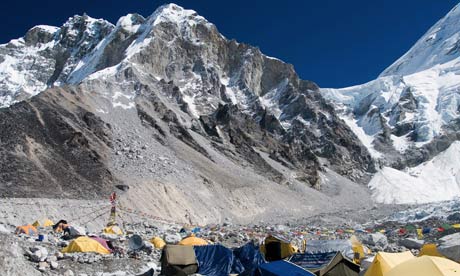
    Base Camp at the foot of Mount Everest

    Researchers say they suspect that the decline of snow and ice in the Everest region is a result of changes in global climate. Photograph: Rafal Belzowski/Getty Images

    Global warming is melting snow and ice on the world’s highest mountain at an accelerating rate, researchers have claimed.

    A study by a team led by a Nepali scientist at the University of Milan has found that glaciers on or around Mount Everest have shrunk by 13% in the last 50 years with the snow line 180 metres higher than it was 50 years ago. The glaciers are disappearing faster every year, it says.

    The 60th anniversary of the first ascent of the 8,848 metre (29,028ft) peak by Sir Edmund Hillary and Sherpa Tenzing Norgay will be celebrated next week.

    The researchers say they suspect that the decline of snow and ice in the Everest region is a result of changes in global climate caused by human-generated greenhouse gases. However, they have not yet established a firm connection, Sudeep Thakuri, who led the team, said.

    The landscape around Mount Everest has changed dramatically since the world’s highest mountain was first climbed. Mountaineers now report more rock and less snow and ice on well known routes. The ends of glaciers around the peak have also retreated by an average of 400 meters since 1962, the new research found, and some smaller glaciers were now nearly half the size they were in the 1960s.

    The researchers used satellite imagery of the peak and the 713-square-mile Sagarmatha national park around the mountain as well as long-term meteorological data.

    Small glaciers of less than a square kilometre (about 247 acres), are vanishing fastest, registering a 43% decline in surface area since the 1960s, Thakuri said.

    Specialists in Kathmandu said the rate of change through the Himalayas was variable. Though clear in places such as Nepal, at the eastern end of the chain, the situation was different in Pakistan and further west, said Arun Shrestha of the International Centre for Integrated Mountain Development in Kathmandu.

    “The glaciers are in retreat but rates are different,” he said. “It is quite rapid in the east Himalaya but in the west some are advancing while others are in retreat.”

    Other research suggests the ice of the main Khumbu glacier which flows down from Everest is less thick than it was previously.

    The issue of the future of glaciers in the Himalayas is highly controversial. A United Nations report in 2007included a false claim that the Himalayan glaciers would disappear by 2035.

    Though all say there is a change, scientists working in the field urge caution over any estimates, saying data is insufficient especially when looking at a small area.

    “It is very difficult to scientifically say what are the trends on one particular mountain,” Shrestha said.

    The impact of climate change on the Himalayas will have consequences across south Asia and beyond. Rivers such as the Indus, Ganges and Brahmaputra depend to some extent on seasonal glacier melt. Countries across the region are already suffering acute water shortages.

    “The Himalayan glaciers and ice caps are considered a water tower for Asia since they store and supply water downstream during the dry season,” said Thakuri. “Downstream populations are dependent on the melt water for agriculture, drinking and power production.”

    Daily Email

    close

    Sign up for the Guardian Today

    Our editors’ picks for the day’s top news and commentary delivered to your inbox each morning.

    Sign up for the daily email

  • Ford’s exit spells the end of the road for manufacturing

    24 May 2013, 6.36am EST

    Ford’s exit spells the end of the road for manufacturing

    “You’ll never see Japanese cars in an RSL car park.” That was Bill Bourke, Ford Australia’s sales supremo of the ’60s. Bourke was wrong. Dead wrong. In 2016, Ford will cease manufacturing in Australia. The company, headquartered in Broadmeadows, Victoria, has lost $600 million over the past five years…

    Kgnbk84z-1369284210
    Ford’s impending shutdown of its car-making plants in Australia does not bode well for an already ailing manufacturing sector. AAP

    “You’ll never see Japanese cars in an RSL car park.”

    That was Bill Bourke, Ford Australia’s sales supremo of the ’60s.

    Bourke was wrong. Dead wrong.

    In 2016, Ford will cease manufacturing in Australia. The company, headquartered in Broadmeadows, Victoria, has lost $600 million over the past five years. Neither sales nor subsidies can justify continuing its domestic manufacturing operations in Australia.

    Gone are the days when Ford could build legendary sports sedans, like the Falcon GTHO Phase III. In 1971, it was the fastest four-door saloon in the world.

    Fans of this era cite Holden and Chrysler’s supercars as well: the Monaro 350; the Torana L34 and A9X; and Chrysler’s E38 and E49 Chargers.

    But nostalgia isn’t what it used to be.

    The heyday of Ford and Holden’s domination of Australian motor industry are long gone. In the 1980s, Japanese firms, such as Toyota, completed their long march to the top of the Australian car sales charts.

    By the 2000s, South Korean brands, such as Hyundai, also began to dominate as imported car sales outstripped locally-produced models.

    Consumers changed. Tastes changed. With a plethora of 4WD and SUV imports to choose from, as well as high-quality, economical four and six-cylinder cars from Japan, Korea and Europe, by 2012, Australian consumers could choose from up to 500 models from 50 different brands.

    Ford arrived late with the local manufacture of the 4WD Territory, which has been a modest sales success, particularly the diesel variant. The petrol model employs Falcon’s six-cylinder engine.

    But Territory sales couldn’t offset the disastrous plummet in Falcon sales, which has been the mainstay of Ford’s range since the 1960s. Corporate fleet and government sales, which account for two thirds of large, local car sales in Australia, are insufficient to meet the volumes required to keep products like Falcon profitable and viable.

    The news is devastating for 1200 Ford workers, with over 600 employees in Geelong and more than 500 in Broadmeadows, losing their jobs by October 2016. Previously, in July 2012, Ford announced 440 redundancies (although, ultimately 100 were redeployed) as Falcon sales continued to sink.

    In Geelong, the news comes on the back of Shell’s announcement in April this year that it would sell its Geelong refinery. The move threatens 450 jobs, plus hundreds more who have contracts with the Shell operation.

    Long history

    The company’s departure also represents the end of 90 years of Ford manufacturing in Australia, going back to Henry Ford I’s Model T.

    From the 1960s, like Holden, Ford counted on sheltering behind the high tariff walls that rendered imported vehicles less competitive. They depended on Australians buying their luxury car derivatives, the Ford Fairlane and LTD and the Holden Statesman, instead of imported BMWs, Mercedes-Benzes and Jaguars. Tariffs and taxes meant German cars cost twice as much in Melbourne as in Munich. Even more modest German imports, like VW’s Golf, cost more than an average Australian car.

    That’s still true today, despite the slashing of tariffs. As a little exercise, look at the retail price of a 2013 BMW 750i. About $281,000. Right? Now look at the US price: about $85,000.

    Despite the tariffs and the luxury car taxes, Australians buy plenty of BMWs, Lexus-es and Toyota Landcruisers. The biggest-selling car in Australia in February 2013 was the Mazda 3 (somewhat ironically, Ford had effective day-to-day control of Mazda until 2008, via a large minority holding, although the company owns only 3% of Mazda now).

    Small, efficient, quality cars: precisely what Ford and Holden couldn’t deliver.

    Like everyone else, Australians are car snobs. Like Alec Baldwin’s character in 30 Rock, they wouldn’t be seen dead in an American car.

    Small wonder Falcon is dead and Commodore is on the endangered species list. Nobody buys cars out of patriotism anymore — not even RSL members.

    Endgame: cost versus scale

    Two basic economic propositions underscore Ford’s decision to withdraw from manufacturing in Australia: returns to scale; and factor costs.

    At the peak of Falcon and Holden Commodore production, the local manufacturers could count on 100,000 sales annually. But with the Falcon counting only around 14,000 units annually, its continued production does not justify the enormous R&D expenditure (supported only to a relatively small degree by subsidies) required to develop a new model, which would also need to comply with forthcoming emissions standards.

    There’s the rub. One of the core reasons for Ford’s decision to wield the axe is Australia’s adoption of the Euro 5 vehicle emissions standard, which will come into effect in November 2013. The more stringent Euro 6 standard, which Australia has also adopted, will be implemented by mid-2018.

    Euro 5 would have required major re-engineering of Ford’s six-cylinder engine, which would be costly and an unviable proposition, given Falcon sales have fallen by around 75% over the last few years.

    Sales have not been not helped by the four-cylinder EcoBoost Falcon, which received $230 million in government subsidies and has proven a sales failure, with few consumer or government orders.

    The other contributor to Ford’s decision to shut down local production is cost. Ford Australia’s CEO, Bob Graziano, noted that it cost twice as much to build a Ford in Australia as it does in Europe. And Australian production costs four times as much as building a Ford in Asia.

    Do the maths: Lousy scale x escalating costs = shutdown

    The loss of 1,200 jobs in Broadmeadows and Geelong is only the tip of the iceberg. Victoria, the manufacturing hub of the country, is in recession. The high Australian dollar is killing the manufacturing sector. Sectors of the farm industry are in huge trouble. Much of the world economy is in an extended state of recession and austerity.

    If the mining super-profits boom has plateaued or, worse, disappeared, as some pundits have predicted, then Australia is in for a long winter of discontent.

    Neither side of politics has any solution to these problems. Future Australian governments face a hollowed-out manufacturing sector, declining revenues from resources and an ageing farm population facing import competition as never before.

    Australia rode out the GFC on the back of virtually unprecedented mining boom and a fiscal revenue position that was Made in China. But that was a thin, glossy veneer on what was – and is – in reality a deficit-ridden, Dutch-diseased, debt-financed bubble.

    Shell is selling the Geelong refinery. BAE Systems is getting out of Australia. Ford will be gone in 2016.

    Who will be next?

  • Alaska’s Melting Glaciers are Largest Contributors to Rising Sea Levels

    Alaska’s Melting Glaciers are Largest Contributors to Rising Sea Levels

    Published on May 23, 2013 at 5:04 AM

    Alaska’s melting glaciers remain one of the largest contributors to the world’s rising sea levels, say two University of Alaska Fairbanks scientists.

    Anthony Arendt and Regine Hock, UAF Geophysical Institute geophysicists, joined 14 scientists from 10 countries, who combined data from field measurements and satellites to get the most complete global picture to date of glacier mass losses and their contribution to rising sea levels.

    “Sea level change is a pressing societal problem,” Arendt said. “These new estimates are helping us explain the causes of current sea-level rise.”

    Their findings appear in a Science magazine article on May 17.

    The study’s main finding is that from 2003-2009, the world’s mountain glaciers added just as much melt water to rising sea levels as did the Greenland and Antarctic ice sheets, said Alex Gardner, main author on the study, and an assistant professor at Clark University in Massachusetts. The melt from the mountain glaciers alone explains one third of current sea level rise of about 2.5 millimeters, or a tenth of an inch, yearly, with glacial melt, ice sheet melt and the warming of ocean water equally sharing responsibility.

    The study was compiled in order to provide new estimates to the Intergovernmental Panel on Climate Change, a global report compiled every six years, summarizing scientists’ best estimates of the environmental impacts of climate variations.

    Part of Arendt’s and Hock’s contribution to the study was to assist in compiling a globally- complete inventory of Earth’s glaciers, with a focus on Alaska’s glaciers. Before the study, only about 40 percent of Alaska’s glaciers were inventoried. The two researchers also helped compile the most recent estimates of Alaska glacier changes, showing that Alaska remains one of the top contributors to global sea level.

    “Alaska has a considerable amount of glacier ice, much of which is located near the coast, making it particularly susceptible to climate fluctuations,” said Arendt.

    The two researchers emphasized that much work remains to be done. Of all the regions examined, Alaska had some of the largest discrepancies between field and satellite estimates.

    “More field data are needed to supplement satellite observations, so that we can better understand how glaciers in Alaska will respond to future climate variations” said Hock.

    Source: http://uafcornerstone.net/

    Comments
    Tell Us What You Think

    Do you have a review, update or anything you would like to add to this news story?