Author: Wan Kerr

  • West End’s Greek Heritage

    Paniyiri President Chris Kazonis was particularly proud of the community spirit displayed at the festival.

    “All the staff on the park are volunteers, there is not one paid person on the ground,” he boasted to The Westender. Some of the uniformed barristas serving coffee in the various food stands may have been disappointed to hear that, but we do not want to dampen the general high spirits of the day by splitting hairs.

    The commercial strip along Edmonstone Street outside the Greek club boasted solar providers, internet directories and toy stores along with the obligatory food stalls. Inside the Greek club a rolling cooking demonstration with full blown TV cooking contest presentations kept hundreds entertained and well fed as the day rolled on.

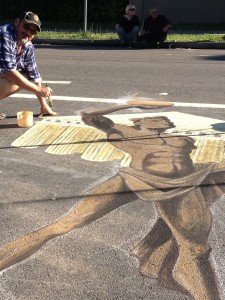
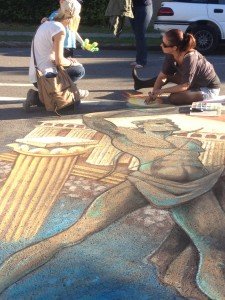
    Dom lays the foundationsAmelia fans the flames

    Among the attractions this year is a sizable piece of chalk art by pavement artists Amelia and Dom. Talking to Westender this afternoon, Dom said that Amelia is the artist and his job is merely to lay down some of the foundation. Westender will return tomorrow to meet Amelia and see how she is filling in the remainder.

    In addition to the frenzy of Zorba music, burning souvlaki and deep-fried loukoumathes a cultural program in one of the meeting rooms at the Greek club, featured lectures on images of femininity in wartime, the journeys of Odysseus and other weighty topics.

    The Greek economic crisis had just reached fever pitch during last year’s Paniyiri and was further marred by the nasty eviction of the indegenous tent embassy to make way for festivities.

    Images of five rubber-gloved police wrestling an Aboriginal man to the ground prompted a wave of protest and satire, including the picture postcard story – Paniryi Irony

    For the thousands of festival goers, though, Paniyiri is about indulgence and satisfaction to the sound of Greek dance music. There was an almost endless supply of that to go around.

  • Govt agrees dole too low

    ACOSS CEO Dr Cassandra Goldie said, “The failure to include an increase in the abysmally low $35 a day payment in Tuesday’s Budget was not good enough.”

    She described it as “cruel” for the government to acknowledge the payment is not enough and yet do nothing about it.

  • Parents switch off NAPLAN

    The Golden Beach State School on the Sunshine Coast is accused of coercing parents of slower students to release their students from the test.

    The principal of Canberra’s Erasmus Christian School, Paul Marshal, advised parents via the school website that he does not value the tests. “The decision to allow your children to take the NAPLAN test rests with you,” he writes on the school website.

  • Ghostnets haunt the Gabba

    What is the Problem?

    Nearly all (90%) of the marine debris entering the coastal regions of northern Australia is of a fishing nature and originates from all parts of South East Asia. For the most part the nets arrive during the monsoonal season from November to March (red arrows) but on the western shores of the Gulf of Carpentaria the nets get swept in during the south east trade winds mainly between May – September (blue arrows). The reason is because the Gulf experiences a circular current or gyre similar to that which has created the large island mass of rubbish in the NW Pacific Ocean.

    Context in which we work – “Caring for Country”

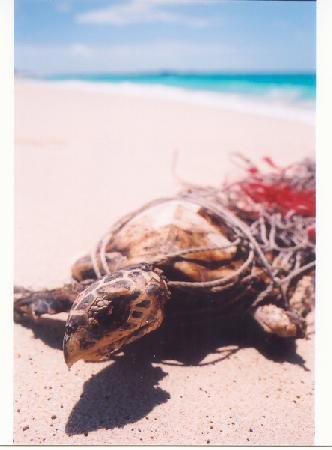
    Turtle killed in a ghost net“The Ghost Net Project is for people from (Indigenous) communities to find ways to work together to get rid of marine debris in their sea country.” Djawa Yunupingu, Dhimurru.

    We are working in an environment that is extremely remote and unpopulated with areas difficult to access by land. The people are mostly Indigenous scattered in isolated pockets, some in townships created by the establishment of mines and the rest in homelands. This means they have culturally diverse backgrounds and a wide range in their capacity to do things but they all aspire to have greater influence on the management of their coastal resources including threats to those resources. Ghost Net work is but a small part of the larger “Caring for Country” activities that are performed by rangers and community organisations across the whole northern Australia.

    Caring for Country is best summed up by a team of medical researchers in their publication:

    Healthy country, healthy people: the relationship between Indigenous health status and “caring for country” [Burgess CP, 2009]

    For Indigenous peoples, “country” encompasses an interdependent relationship between Indigenous peoples and their ancestral lands and seas. [Burgess, CP 2008] “Country is multi-dimensional – it consists of people, animals, plants, Dreamings; underground, earth, soils, minerals and waters, air. . . People talk about country in the same way that they would talk about a person: they speak to country, sing to country, visit country, worry about country, feel sorry for country, and long for country.” [Rose D. 1996]

    “Caring for country” means participating in interrelated activities on Aboriginal lands and seas with the objective of promoting ecological, spiritual and human health. It is also a community driven movement towards long-term social, cultural, physical and sustainable economic development in rural and remote locations, simultaneously contributing to the conservation of globally valued environmental and cultural assets. [Morrison J, 2007]

    For more information – check out the Ghost Nets facebook page

  • Cheap drugs on the table in Lima

    Australia, so far, has stood up to the international bullying. The Australian position has won accolades around the world. This has not yet made headlines locally but is profound and far reaching. It goes to the very core of corporate governance in the face of globalisation and deserves the kind of attention that is normally reserved for major international decisions such as the carbon tax or the invasion of Iraq in 2003.

    This article provides a very high level overview of the reasons why these negotiations are so critical to our future and a plea to bring all the pressure we can to bear on politicians of all stripes to maintain our proud bipartisan stance on this issue.

    What is this thing called TPP?

    This is essentially a free trade partnership between the nations of the Asia Pacific. It currently engages Brunei Darussalam, Chile, New Zealand, Singapore, Australia, Canada, Japan, Malaysia, Mexico, Peru, the USA and Vietnam. It seeks to facilitate the economic integration of the Pacific region and provide the infrastructure to make this the Pacific Century.

    There are many sources of information about the nature of the agreement and the details of the current negotiations. The wikipedia site is outdated and has not been significantly updated since February this year. The article on the Australian Department of Foreign Affairs website is as good as any and is written in language that makes sense to most Australians

    What’s wrong with free trade anyway?

    The historical problem with free trade partnerships has been the tensions between rich and poor nations. The reason that the Dohar round of Free Trade Talks failed in November 2011 is because India, Brazil, China and South Africa refused to accept that they should be raped and pillaged by wealthy robber barons posing as international diplomats. Those are strong words, but they sum up the mood of the frustrations that emerged over ten years of talks. That’s right, the talks took ten years and effectively ended multilateral trade talks for ever. For a more measured account that verifies the intent of that statement read the Indian Economic Times article.

    The alternative to these global talks have been Free Trade Agreements between pairs of country or specific regions. The Free Trade Talks between China and Australia have been in the news recently following China’s request to have the same right to buy Australian farms as the US and New Zealand without scrutiny by the Foreign Investment Review Board . Australia has a Free Trade Agreement with the USA, negotiated by the Howard Government in 2004.

    This type of Partial Trade Agreement (PTA) are often blamed for the impoverishment of already poor countries.

    How real are these concerns?

    The collapse of the Greek and Spanish economies for example has been blamed by many commentators on the liberalisation of lending to southern institutions by northern investors. As the Germans called in the loans on their southern debtors the northerly flow of money bankrupted the Mediterranean nations.

    The North America Free Trade Agreement has been notorious for the negative impacts it has had on Mexico. US companies move their factories across the border where labour is cheap and environmental laws lax. Where the Mexican government has attempted to tighten laws, or sue companies that have killed Mexicans with toxic pollution, the US companies have sued the Mexican government under the terms of the free trade agreement for interfering with trade.

    The recent collapse of the Mexican states closest to the US border and the murder of journalists and community campaigners can be attributed to the incapacity of the government to impose its will in an area where its authority (and revenue base) has been so seriously undermined by this instrument of international law specifically designed to enrich corporations at the expense of a foreign people.

    But surely corporations only do what the law allows?

    It is true that corporations are simply legal institutions designed to generate profit and that they generally operate within the law, and cannot be blamed if the laws do not protect others from their activities.

    The problem with this benign view, however, is that corporations actively pursue changes to laws that allow them to externalise the costs and internalise the profits. We see this every day through the lobbying that goes on in our media.

    The Minerals Council of Australia spent will in excess of 10 million dollars opposing the first super profits tax, designed to get miners, then effectively paying 13% tax on profits in the tens of billions (they were legally supposed to pay 30% but loopholes allowed them to get away with the much lower figure) to pay their fair share. It is no accident that Gina Rinehart bought 15% of Fairfax newspapers as this kerfuffle unfolded.

    As well documented by Ted Nace in his book Corporate Gangs of America, the global corporation was invented by the railway and oil barons of wall street that wanted to escape the governance of the American Constitution. It was deliberately designed to control corporate greed, specifically banned monopolies and treated corporations of shareholders as temporary project funds, licenced by state governments to operate for limited periods under the supervision of State law.

    The fourteenth amendment defined the rights of an individual under the law and protected the individual from unjust laws of individual states. This was an adjunct to the famou 13th amendment recently depicted in the film Lincoln, which abolished slavery. The corporate barons spent decades cultivating judges to recognise their rights as individuals under the 14th and exonerate them from the governance of the states. It was not until the Great Depression of the 1920s that the US Federal Government saw fit to do anything to rein in the power of these financial power-brokers. Now, with more than 40% of the wealth in the USA in the hands of the top 1%, those corporations are following the same form of breaking government control through these international trade agreements.

    What’s Australia got to do with it?

    Australia is getting global attention for its stand at the TPP talks, precisely because it has drawn a line in the sand and has stood up to for the rights of sovereign governments over corporations.

    Australia has a proud, bipartisan history of taking this position.

    The Howard government stood firm on the right of the Australian government to run a pharmaceutical benefits scheme and subsidise certain drugs. This has been roundly criticised by Big Pharma who strongly lobbied the US government not to accept the compromise and who have made a number of attempts to overturn them since. Peter Sainsbury’s speech at the time the FTA was being negotiated is as good a reference as any.

    Funnily enough this is precisely one of the targets of the TPP negotiations.

    The Australian government has recent experience of how difficult it can be to maintain control of its own destiny when international law is abused by corporations seeking to determine the laws to their own advantage. When it recently passed the plain packaging laws for tobacco, Philip Morris promptly moved their headquarters to Hong Kong and commenced a suit against the Australian Government for breaching its free trade agreement with that special economic zone of China by preventing a Hong Kong based company from freely selling its products into the country.http://theconversation.com/government-wins-first-battle-in-plain-packaging-war-8855

    What on earth can we do?

    In 1932 the Premier of NSW, Jack Lang, established the Lang Plan to address the impacts of the depression on the NSW economy. In part this plan included the reduction of interest payments to British based banks, which he said could be better spent on the poor of NSW. At the demand of the British Parliament, the Australian Government instructed him not to follow the plan upon which he withdrew all the state’s funds from the bank, using the NSW police to convey the money to the Trades Hall Council, triggering a financial crisis that brought down his government and led to many years of conservative rule in NSW.

    Clearly, it is extremely difficult to withstand the forces of the global bankers.

    A government the size of Australia, though, is big enough and has the strategic power to do it.

    We must all lobby our local members of parliament to make sure that Australia maintains its proud bilateral history of standing up to the bullies of global capitalism and holds firm at the TPP.

    Since the talks do not conclude until at least October, there is a reasonable chance that it will be an incoming conservative government who will conclude negotiations. We must secure their promise, now, that they will not cave on this critical issue.

  • Expo ’88 – a lot to celebrate?

    When I first moved to South Brisbane with my wife in 2009 I had no historic knowledge about the West End and South Bank area. I had however been told that South Bank, when walking through the parklands with some locals, had some remnants from a world expo some decades ago.

    I then decided to look up Expo ’88, but I only ended up scratching the surface, that it was an expo to show the world Brisbane could pull this off well. An event that could make West End and South Bank more appealing to the greater public, so I was made to believe.

    The same stories started to crop up again this year during its 25th anniversary, how Expo ’88 was such an amazing event – great for the whole of Brisbane and its future. Like the banner in South Bank claimed, “there’s a lot to celebrate.”

    That of course depends on whom you ask, which I decided to do. Hear what the locals from the area truly thought about Expo ’88 and its impact on South Brisbane.

    What I unearthed, still feeling that I only have scratched the surface of the truth, was rather unpleasant.

    Sifting through the book Expo ’88 Revisited by Denise Dillon Bolland took me through a very scary journey. A less positive experience of what happened before, during and after Expo ’88.

    It was announced in the Courier-Mail in 1983 that “Expo gets power to take land.” Furthermore, Joh-Bjelke Petersen had said that Musgrave Park should be included in Expo ’88.

    I heard stories, again only scratching the surface, such as the one about Rosalita being razed. A boarding house that was home to twelve pensioners, a group of humans already struggling, would be evicted from what they called home.

    West End Community House coordinator Joe Hurley said that the general feeling in the community was that they would have preferred to not have the Expo ’88 there.

    “Not just because of impacts on housing, but also some of the changes in culture, and disenfranchisement of different groups,” Joe said.

    “This worked against diversity and continued residence of indigenous persons and working class of the area.”

    “Leading up to the Commonwealth Games and the Expo ’88, there were a lot of indigenous activism for being recognised for their place in the community, and recognised as the custodians of the land.”

    Joe said that Musgrave Park became a central point for these protests. Remembering one of the very important slogans during that time, “Expo ’88 – demonstrate, don’t celebrate.”

    The Gabba Ward Cr Helen Abrahams came to live in Brisbane four months before the Expo.

    “You were aware, even not living in the area, of the community action getting considerably publicity at the time,” Cr Abrahams said.

    “There are still people in the West End community who will not go to South Bank, because of what Expo ’88 did to this community.”

    “The Brisbane elders still do not have a meeting place,” Cr Abrahams adds, “The aboriginal community is left in the dark.”

    “It is still eminently possible for council to give to the aboriginal community the Jaggara Hall on a long-term lease, for them to manage and reap the benefits of the rentals.”

    “It is totally inappropriate when Aunty Mullinjarlie, in her seventies, has to ask the local councillor so she can have her birthday party in the Jaggara Hall, which is land that is so important to the aboriginal community.”

    When hearing such stories, it does make you wonder if Expo ’88 is something we should be celebrating, considering what impact it had on the community and still has.

    Nor should we forget that in the period between ’87 and ’88 between 2000 to 3000 residents of West End were evicted because their landlords decided they wanted to make a quick buck from those visiting Expo ‘8, seeing a sharp 62% increase in rent for some.

    If an increase like that happened in West End today, many of us would most likely be packing our belongings reluctantly to find a new place to live – again.

    It definitely explains why people of West End are quick to object to change, when they themselves have experienced that change is not always positive, that change often has casualties if not everyone has agreed to it.

    Joe Hurley also told me about when Expo ’88 was announced, that in South Brisbane there was a lot of property speculation, which in turn pushed out the working class, the poor and students from the community.

    “I had a two-bedroom half-house down in West End in the period leading up to the Expo, and the landlord said when the lease is up for renewal, we have to double the rent,” Joe said.

    “It is emotional when you see your neighbours or your friends or your colleagues not being able to live where they want to live anymore.”

    Cr Helen Abrahams adds that the community was polarised against property owners who were making a quick buck.

    “Some of the social services, such as West End Community House, came out of the huge displacement of people within the community for short period of time.”

    “It united people too, because they were fighting for people […] for their urban environment and their heritage buildings.”

    It is then tempting to say that Expo ’88 made the West End and South Bank community stronger. However, judging by how strongly the community reacted to the impact of the event, it is obvious the strength was already there within the community. It was just unfortunate such a strong community had to be torn apart this way.

    The reaction to the displacement of their own was only natural, like how a parent reacts when their child is taken away from them for no good reason.

    We can not always escape change. It is often inevitable. That of course does not mean we can not have our own impact on it, which is what the West End and South Brisbane community fought for, to be able to have a say how the government would utilise their land and their community – their home.

    As Joe told me, “the best judges of how a community could develop are its residents.”

    Expo ’88 is not something many of the residents of West End and South Bank want to celebrate, nor remember. On the other hand, what is worth celebrating is the community spirit of this area. An area of Brisbane that refuses to accept change other than on its own terms, and is more than willing to fight for it any day.

    When The Sky Needle caught fire in 2006, the last iconic structure from Expo ’88, Joe remembers it as a very eerie experience, as if it were a final end to Expo ’88 in the West End area.