Category: Archive

Archived material from historical editions of The Generator

  • Algeria increases the price of oil

    Not included in the public announcement:

    • existing oil and natural gas contracts are worthless. If a foreign oil company wants to continue its operations in Algeria, it will have to agree to new contract terms;
    • it also remains to be seen if these taxes will decrease the profits of the participating oil companies, or increase the price of gasoline, diesel, propane and heating oil fuels.

    National mandates to increase the fees and taxes charged against production and refining is happening throughout the world. Existing contract obligations are disregarded at the whim of each nation’s political establishment. This trend guarantees higher prices are a permanent fixture of the world’s oil and natural gas supply chain.

    Who will pay the bill?

    If we take a holistic approach to the study of oil depletion, this trend is simply another confirmation we are approaching “Peak Oil”. Greed – always a driver of producer nation policy – has now been unfettered by a recognition that oil supplies are both limited and finite.

    But there is a significantly more troubling consequence. This trend implies consumer nations will never be able to reach a long term contractual relationship with producer nations for the allocation of earth’s remaining oil and natural gas resources. Producer nations will continue to pursue pricing and production decisions based on their selfish best interest.

    Including the quest for greater political power.

    Ronald R. Cooke
    The Cultural Economist

  • The thousand millenia warning

    Scientists from the US Energy Department are working on signage designed to last, and be intelligible, for hundreds of millenia warning future generations about the dangers of nuclear waste.

    Nuclear warning sign from Millpnd USA

    Today’s warning signs may mean nothing in 10,000 years

    The Waste Isolation Pilot Plant, thousands of metres underground, is designed to hold tonnes of plutonium and radiated labroratory equipment in safe storage. The plant is designed to collapse in one thousand years, locking the waste up for ever.

    The problem is that civilisations beyond that first millenia are likely to be interested in what is buried there and must be warned not to open the vault.

    A team of scientists including linguists and archeologists are working on the warning system which will take over a century to complete. The first level of defense is a 10 metre high berm built from 32.5 million tonnes of stone.

    Powerful magnets and radar reflectors would be buried inside the berm so that remote sensors could recognize the site as purposefully and elaborately designed. Twenty pillars each wighing105 tonne  will be covered in warnings in different languages and complemented by a series of plastic, metal and ceramic disks scattered around the site, and an entire museum built specifically to provide permanent warnings, explanations and translation tools for future civilisations.

    The waste dump is expected to be complete in 2033, and guarded for a century before being abandoned. Full story on LA Times  

  • Brazilian berry destroys cancer cells in lab

    “This was only a cell-culture model and we don’t want to give anyone false hope,” Talcott said. “We are encouraged by the findings, however. Compounds that show good activity against cancer cells in a model system are most likely to have beneficial effects in our bodies.”

    Other fruits, including grapes, guavas and mangoes, contain antioxidants shown to kill cancer cells in similar studies, he said. Experts are uncertain how much effect antioxidants have on cancer cells in the human body, because factors such as nutrient absorption, metabolism and the influence of other biochemical processes may influence the antioxidants’ chemical activity.

    Another UF study, slated to conclude in 2006, will investigate the effects of acai’s antioxidants on healthy human subjects, Talcott said. The study will determine how well the compounds are absorbed into the blood, and how they may affect blood pressure, cholesterol levels and related health indicators. So far, only fundamental research has been done on acai berries, which contain at least 50 to 75 as-yet unidentified compounds.

    “One reason so little is known about acai berries is that they’re perishable and are traditionally used immediately after picking,” he said. “Products made with processed acai berries have only been available for about five years, so researchers in many parts of the world have had little or no opportunity to study them.”

    Talcott said UF is one of the first institutions outside Brazil with personnel studying acai berries. Besides Talcott, UF’s acai research team includes Susan Percival, a professor with the food science and human nutrition department, David Del Pozo-Insfran, a doctoral student with the department and Susanne Mertens-Talcott, a postdoctoral associate with the pharmaceutics department of UF’s College of Pharmacy.

    Acai berries are produced by a palm tree known scientifically as Euterpe oleracea, common in floodplain areas of the Amazon River, Talcott said. When ripe, the berries are dark purple and about the size of a blueberry. They contain a thin layer of edible pulp surrounding a large seed.

    Historically, Brazilians have used acai berries to treat digestive disorders and skin conditions, he said. Current marketing efforts by retail merchants and Internet businesses suggest acai products can help consumers lose weight, lower cholesterol and gain energy.

    “A lot of claims are being made, but most of them haven’t been tested scientifically,” Talcott said. “We are just beginning to understand the complexity of the acai berry and its health-promoting effects.”

    In the current UF study, six different chemical extracts were made from acai fruit pulp, and each extract was prepared in seven concentrations.

    Four of the extracts were shown to kill significant numbers of leukemia cells when applied for 24 hours. Depending on the extract and concentration, anywhere from about 35 percent to 86 percent of the cells died.

    The UF study demonstrates that research on foods not commonly consumed in the United States is important, because it may lead to unexpected discoveries, said Joshua Bomser, an assistant professor of molecular nutrition and functional foods at The Ohio State University in Columbus, Ohio.

    But familiar produce items have plenty of health-giving qualities, he said.

    “Increased consumption of fruits and vegetables is associated with decreased risk for many diseases, including heart disease and cancer,” said Bomser, who researches the effects of diet on chronic diseases. “Getting at least five servings a day of these items is still a good recommendation for promoting optimal health.”

    Writer Tom Nordlie, tnordlie@ifas.ufl.edu,

  • This is Not a Place of Honor

    The offending nuclear waste will be stored far underground at each of these facilities, but there is still a danger that future generations might stumble across it. WIPP is located in the desert outside Carlsbad, New Mexico, and its storage areas are located 2,150 feet underground. Yucca Mountain’s facilities in the Nevada desert are intended to house waste at 1,000 feet deep. Between the two, they are meant to entomb tens of thousands of metric tons of nuclear waste, most of which will remain dangerous for centuries. Each of these locations was selected due to its relative geologic stability, theoretically allowing facilities there to contain the waste for the required 10,000 years.

    Ten thousand years ago, early humans were still painting images on the walls of caves. Some of those primitive messages managed to survive ten millennia, and they also remain somewhat meaningful. But of course our ancient cave-painting ancestors weren’t attempting to illustrate complex ideas as far as we know.

    Before one can communicate with unknown future societies about deadly nuclear waste, it is important to consider with whom precisely one is trying to communicate. Such people may be part of a highly advanced civilization, they may be a society much less advanced than our own, or they may have comparable technology to that which we have today. Further, they may not be directly descended from local cultures. Messages will thus need to communicate to anyone– regardless of their culture, technology, or political structure– that intruding upon the repository is not in their best interest.

    The essence of the message itself is simple: Warning, dangerous materials are buried below. But how to communicate this to all possible discoverers using an enduring medium? To help answer this question during the preparations for the WIPP facility, panels of experts were assembled comprised of individuals with backgrounds in history, future studies, economics, law, physics, sociology, geography, engineering, political science, risk analysis, agriculture, climatology, history, and demographics. This group was called the Futures Panel, and they were tasked with creatively exploring the possible reasons why a future society might penetrate these deep underground storage facilities. They were also asked to advise on how to universally warn away would-be intruders.

    The potential causes of future intrusion were imagined to be: water impoundment, resource exploration/extraction, scientific investigations, archaeological exploration, reopening the facilities for additional storage, waste disposal by injection wells, explosive testing, underground transportation tunnels, and weather modification. With these possibilities under consideration, the Futures Panel proceeded with the assumption that intelligent beings would halt any of these activities if the monuments were successful at conveying their warning. The panel roughly defined the intended message with the following:

    This place is a message… and part of a system of messages… pay attention to it!

    Sending this message was important to us. We considered ourselves to be a powerful culture.

    This place is not a place of honor…no highly esteemed deed is commemorated here… nothing valued is here.

    What is here is dangerous and repulsive to us. This message is a warning about danger.

    The danger is in a particular location… it increases toward a center… the center of danger is here… of a particular size and shape, and below us.

    The danger is still present, in your time, as it was in ours.

    The danger is to the body, and it can kill.

    The form of the danger is an emanation of energy.

    The danger is unleashed only if you substantially disturb this place physically. This place is best shunned and left uninhabited.
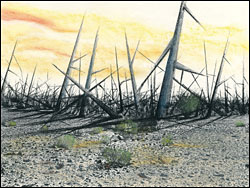
    thorn forest warningThe ideas that sprang from the panel were varied and interesting. It was decided that the markers would need to be designed to impart multiple levels of information, ranging from the rudimentary– something made by humans is here– to the more complex, such as the exact composition of the waste. This approach, coupled with redundancy, was hoped to allow future discoverers to realize that the site was significant, but also providing detailed information should future society have the means to read the data. They also pointed out that the markers should be made of ordinary materials and absent of beauty, lest the finders see value in removing the markers from the site.

    Panelists described culture-independent ideas which are intended to trigger the danger reflex in all of humanity. One example indicated a massive "landscape of thorns," made up of fifty-foot-high concrete spires with sharp points jutting out at all angles. Another intriguing idea was an arrangement of gigantic, black, "forbidding blocks" which are too close together and too hot to provide shelter.

    Ultimately, the decision for the WIPP markers was motivated by cost-effectiveness. Current plans call for the area over the waste storage panels to be outlined by "earthen berms," which is another way of saying "large piles of dirt." These berms will be jagged in shape and will radiate out from a central, generally square area. The jagged nature of the berms is meant to convey a sense of foreboding, and the exact size, shape, and configuration of the berms will be such that they will not quickly be eroded or covered. The four corner berms will be higher than the others to provide vantage points to see the area as a whole. Inside the corner berms will also be buried concrete rooms containing highly detailed information, such as maps, the periodic table, and astronomical charts indicating the date that the facility was sealed. This data will be engraved upon stone slabs which are too large to be removed from the rooms’ entrances.

    Inside of the square arrangement of berms, multiple granite "message kiosks" will be engraved with more basic information describing the site’s contents. This text will be provided in all of the official UN languages and Navajo (the local indigenous language). Additionally, space will be left on the kiosks for a future generation to inscribe the message in another language. The granite surfaces will be protected by a concrete "mother" wall, and the messages will be placed up high to prevent them from being defaced or buried by the desert sand.

    Lastly, the berms and the area they surround will be peppered with underground "time capsules" at varying depths. These clay, ceramic, glass, and aluminum oxide disks will be inscribed with warning information, and may contain samples of wood to allow a future society to date themarkers using carbon-14 dating.
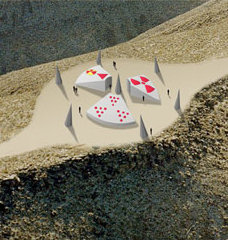
    Yucca Mountain information center conceptYucca Mountain information center concept
    The plans for the Yucca Mountain warning markers are a bit different. Twenty-five foot monuments are intended to be inscribed with text and pictographs warning visitors of the dangers below, as well as a series of nine-inch markers embedded in the earth. Surrounding the area will be several large information-center monuments in the shape of the universal radiation symbol.

    Other creative suggestions have been put forward for these warning markers, some of them coming from outside of the official panels. For instance, one individual suggested planting genetically-engineered blue cacti at the site to indicate its importance. Another suggested leaving significant human remains above-ground at the site, to frighten off any who might stumble across it. Still others advised against erecting any warning monuments at all, worrying that the markers themselves– if not properly interpreted– may rouse the curiosity of their discoverers enough that they might explore further, to disastrous ends.

    In any case, WIPP is not scheduled to be sealed until the year 2038, and Yucca Mountain may be operating well into the 24th century; so humanity still has a little time to contemplate its warning to the future.

     
    Further reading:
    Summary of WIPP warning markers (PDF)
    Report on WIPP Markers from Sandia Labs (large PDF)
    Excerpts from Sandia report, including interesting concept images
    Fact sheet on Yucca Mountain markers

    Related Articles:
    NASA’s Messages to the Great Unknown
    Subterranean Cities
    New Year’s Eve 11999
    Watch the Skies in the Year 52,007 A.D.
    The Crypt of Civilization

  • U.S. and Britain to mobilize in Gulf

    Vice Admiral Patrick Walsh, commander of naval forces across the U.S. military’s Central Command, said that while "Iranian tone and rhetoric creates an environment of intimidation and fear," the United States "must be careful not to contribute to escalation."

    One purpose of the deployment, they said, is to make clear that the focus on ground troops in Iraq has not made it impossible for the United States and its allies to maintain a military watch on Iran. That would also reassure Washington’s allies in the region who are concerned about Iran’s intentions.

    The officials said the planned growth in naval power in the Gulf and surrounding waters would be useful in enforcing any sanctions that the United Nations might impose. Washington says Iran wants to acquire nuclear weapons and is seeking to punish it for that.

    The buildup would address another concern: that Iran could attempt to block oil shipments from the Gulf in retaliation for UN sanctions or other U.S.-led pressure.

    Steps are already being taken to increase the number of minesweeping vessels and magnetic sleds carried by helicopters to improve the ability to counter Iranian mines that could block oil-shipping lanes, Pentagon and military officials said.

    As part of future deployments after the first of the year, the British Navy plans to add two mine-hunting vessels to its ships that already are part of the international coalition patrolling waters in the Gulf.

    A British Navy news release said the ship movements were aimed at "maintaining familiarity with the challenges of warm-water mine-hunting conditions." But a senior British official said: "We are increasing our presence. That is only prudent."

    Military officers said doubling the aircraft carrier presence in the region could be accomplished quickly by a shift in sailing schedules.

    As opposed to ground and air forces that require bases in the region, naval forces offer the ability to project power into parts of the world where a large U.S. presence is controversial, unwanted even by allies. Many of the ships could be kept over the horizon, out of sight but close enough.

    In an interview from his headquarters in Bahrain, Walsh declined to discuss the specifics of future deployments. "To assure our friends, we have to have capabilities to secure the critical sea lines of communication," Walsh said.

    "They need reassurances that we expect to be part of the effort here for the long term, that we will not run away from intimidation and that we will be part of the effort here for security and stability at sea for the long term," he added. "Our position must be visible, and it must have muscle in order to be credible. That requires sustained presence."
    Other military officials did describe specifics of the planned deployments in order to clarify the rationale for the movement of ships and aircraft, but they would not do so by name because Gates has not yet signed any deployment orders.
    Pentagon officials said the military’s joint staff, which plans operations and manages deployments, had recently received a formal request from commanders for a second aircraft carrier strike group in the region. That request was mentioned in various news accounts over the past few days.

    The aircraft carrier Dwight D. Eisenhower and its strike group — including three escort ships, an attack submarine and 6,500 sailors in all — entered the Gulf on Dec. 11 after an autumn naval exercise to practice halting vessels suspected of smuggling nuclear materials in waters across the region.
    A carrier had not been inside the Gulf since the Enterprise left in July, according to Pentagon officials. The next carrier scheduled to sail toward the Middle East is the John C. Stennis, already set to depart Bremerton, Washington, for the region in late January, according to naval officers.

  • Double Decker Reds Go Green

    The new fleet of buses are created by Transport for London, whose primary role is to implement the Mayor’s Transport Strategy and manage services across the Capital. They are responsible for all the City’s buses, the Underground, the Dock-land’s Light Railway, the management of Croydon Tramlink, London’s River Services, Victoria Coach Station and the Transport Museum. These new buses are a central part of the City’s plans for a cleaner and greener fleet. They will contribute to cutting London’s carbon dioxide emissions – an important step towards meeting the Mayor’s long-term goal of a low carbon-hydrogen-based transport system.


    “Hybrid vehicles could make a real contribution to a cleaner, greener public transport network for the capital,” said Ken Livingstone. “All bus manufacturers and operators now need to rise to this challenge and make this economically and financially feasible.”


    The adoption of these Hybrid double decker buses is a key part of a range of measures being developed by London’s Mayor and Transport for London. Their Transport and Air Quality Strategies are designed to give Londoners a cleaner and much healthier future, while also enabling the City to meet its targeted contribution to tackling the problems of climate change.


    As one of the most accepted solutions to overcrowding in inner city areas, it makes sense that public transport is not a major pollutant. Cities around Europe, including London, Hamburg, Barcelona and Stockholm, are all taking part in a pioneering project, by road testing the first generation of zero-emission fuel cell buses. The results of this trial are eagerly awaited by transport authorities and governments across the globe.


    Greater London Authority, City Hall,

    The Queen’s Walk, London, SE1 2AA

    Tel: 020 7983 4000

    Website: www.london.gov.uk


    London’s Mayor Ken Livingstone. Photo: © Liane Harris