Category: Archive

Archived material from historical editions of The Generator

  • Scientists support Gore’s movie

    Rebuttal on each of critic’s claims: Judd Legum, research director at the Center for American Progress, a liberal think tank, rebutted each of Balling’s claims on the Think Progress Web site. For instance, some of the most dramatic images in the film show the rapid retreat of glaciers all over the world, including the melting snows of Mt. Kilimanjaro.

    Declining atmospheric moisture not the reason: Balling said the snowpack retreat on Kilimanjaro is caused by declining atmospheric moisture, which has been going on for more than 100 years, not global warming. Legum replied that scientists had shown that the Kilimanjaro glacier previously survived a 300-year drought and its retreat could not be fully accounted for by changes in atmospheric moisture, especially the shrinking that has occurred in recent decades.

    Rebuttal could have been stronger: Steig confirmed the facts in Legum’s rebuttal. "All those points are accurate," he wrote in an e-mail. "Some of them could probably have been stronger; that is, Balling is even more wrong that Legum indicates."

    Movie presents scientifically valid view: Climate scientists who have seen Gore’s film said that overall it presented a scientifically valid view of global warming and did a good job of presenting what was likely to occur if human-induced greenhouse gas emissions continued unabated.

    NASA climate modeller agrees: Dr Gavin Schmidt, a climate modeller for the National Aeronautics and Space Administration (NASA) was pleased the film didn’t say: "You’re all going to die, woo-hoo."

    Movie plays it relatively safe: Schmidt, who stressed his views were his own, not NASA’s, said the movie played it relatively safe by saying, "These are the things that have happened so far. These are the things that are likely to happen should we continue on the trajectory we’re on, and these are the moral consequences of it."

    Reference: Digest of latest news reported on website of Climate Change Secretariat of United Nations Framework on Climate Change Control (UNFCCC). 22 July. Address: PO Box 260 124, D-53153 Bonn. Germany. Phone: : (49-228) 815-1005, Fax: (49-228) 815-1999. Email: press@unfccc.int
    http://www.unfccc.int


  • US study shows GM fails promise

    The findings will undermine claims by the biotechnology industry that GM technology can boost food production without necessarily damaging the environment with pesticides.

    Scientists from Cornell University in Ithaca, New York, carried out the study which involved interviews with hundreds of Chinese farmers who had switched to cotton that had been genetically modified with a gene for a bacterial toxin.

    The toxin – known as Bt – is secreted by the GM cotton plant and is highly effective at stopping the growth of bollworm, a major pest of the crop that can cause millions of pounds worth of damage.

    Major cotton producers, the United States, China, India and Argentina, quickly adopted Bt cotton after it was introduced in 1996 by Monsanto, the American biotechnology company.

    Today, more than a third of the global cultivation of cotton is accounted for by Bt cotton, ranging from 42.8 million hectares in the United States to 3.7 million hectares in China.

    Before the introduction of the GM crop into China, farmers in the country had to spray on average 20 times each growing season to control bollworm but, with Bt cotton, the average number of treatments fell to below seven.

    The amount of pesticide also fell by 43.3kg per hectare in 1999, which was a decrease of about 71 per cent on previous years.

    However, Professor Per Pinstrup-Andersen and his colleagues at Cornell found that all those benefits have since been largely lost due to the rise of other pests that were not considered a problem for cotton.

    "Using a household survey from 2004, seven years after the initial commercialisation of Bt cotton in China, we show that total pesticide expenditure for Bt cotton farmers in China is nearly equal to that of their conventional counterparts," the scientists say in their report.

    "Bt farmers in 2004 on the average have to spray pesticide 18.22 times, which is more than three times higher compared with 1999.

    "Detailed information on pesticide expenditures reveals that, though Bt farmers saved 46 per cent of bollworm pesticide relative to non-Bt farmers, they spend 40 per cent more on pesticides designed to kill an emerging secondary pest," they say.

    Secondary pests, such as a type of leaf bug called mirids, are not normally a problem in cotton fields because bollworm, and sprays against bollworm, tend to keep them in check.

    However, because Bt cotton is targeted mainly against bollworm, other pests are able to exploit the relatively low use of pesticide that such fields need.

    "These results should send a very strong signal to researchers and governments that they need to come up with remedial actions for the Bt-cotton farmers, otherwise these farmers will stop using Bt cotton and that would be very unfortunate," Professor Pinstrup-Andersen said.

  • Lebanon and global oil

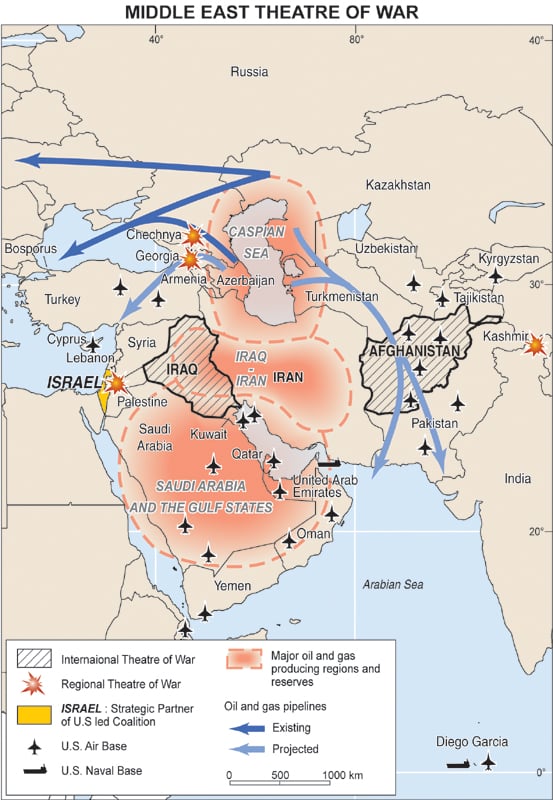
    The BTC pipeline totally bypasses the territory of the Russian Federation. It transits through the former Soviet republics of Azerbaijan and Georgia, both of which have become US "protectorates", firmly integrated into a military alliance with the US and NATO. Moreover, both Azerbaijan and Georgia have longstanding military cooperation agreements with Israel. In 2005, Georgian companies received some $24 million in military contracts funded out of U.S. military assistance to Israel under the so-called "Foreign Military Financing (FMF) program".

    http://www.jewishvirtuallibrary.org/jsource/states/GA.html

    Israel has a stake in the Azeri oil fields, from which it imports some twenty percent of its oil. The opening of the pipeline will substantially enhance Israeli oil imports from the Caspian sea basin.

    But there is another dimension which directly relates to the war on Lebanon. Whereas Russia has been weakened, Israel is slated to play a major strategic role in "protecting" the Eastern Mediterranean transport and pipeline corridors out of Ceyhan.

    Militarization of the Eastern Mediterranean

    The bombing of Lebanon is part of a carefully planned and coordinated military road map. The extension of the war into Syria and Iran has already been contemplated by US and Israeli military planners. This broader military agenda is intimately related to strategic oil and oil pipelines. It is supported by the Western oil giants which control the pipeline corridors. In the context of the war on Lebanon, it seeks Israeli territorial control over the East Mediterranean coastline.

    In this context, the BTC pipeline dominated by British Petroleum, has dramatically changed the geopolitics of the Eastern Mediterranean, which is now linked , through an energy corridor, to the Caspian sea basin:

     "[The BTC pipeline] considerably changes the status of the region’s countries and cements a new pro-West alliance. Having taken the pipeline to the Mediterranean, Washington has practically set up a new bloc with Azerbaijan, Georgia, Turkey and Israel, " (Komerzant, Moscow, 14 July 2006)

    Israel is now part of the Anglo-American military axis, which serves the interests of the Western oil giants in the Middle East and Central Asia.

    While the official reports state that the BTC pipeline will "channel oil to Western markets", what is rarely acknowledged is that part of the oil from the Caspian sea would be directly channeled towards Israel. In this regard, an underwater Israeli-Turkish pipeline project has been envisaged which would link Ceyhan to the Israeli port of Ashkelon and from there through Israel’s main pipeline system, to the Red Sea.

    The objective of Israel is not only to acquire Caspian sea oil for its own consumption needs but also to play a key role in re-exporting Caspian sea oil back to the Asian markets through the Red Sea port of Eilat. The strategic implications of this re-routing of Caspian sea oil are farreaching.

    What is envisaged is to link the BTC pipeline to the Trans-Israel Eilat-Ashkelon pipeline, also known as Israel’s Tipline, from Ceyhan to the Israeli port of Ashkelon. In April 2006, Israel and Turkey announced plans for four underwater pipelines, which would bypass Syrian and Lebanese territory.

    "Turkey and Israel are negotiating the construction of a multi-million-dollar energy and water project that will transport water, electricity, natural gas and oil by pipelines to Israel, with the oil to be sent onward from Israel to the Far East, 

    The new Turkish-Israeli proposal under discussion would see the transfer of water, electricity, natural gas and oil to Israel via four underwater pipelines.

    http://www.jpost.com/servlet/Satellite?cid=1145961328841&pagename=JPost%2FJPArticle%2FShowFull

    “Baku oil can be transported to Ashkelon via this new pipeline and to India and the Far East.[via the Red sea]" 

    "Ceyhan and the Mediterranean port of Ashkelon are situated only 400 km apart. Oil can be transported to the city in tankers or via specially constructed under-water pipeline. From Ashkelon the oil can be pumped through already existing pipeline to the port of Eilat at the Red Sea; and from there it can be transported to India and other Asian countries in tankers. (REGNUM

    Water for Israel

    Also involved in this project is a pipeline to bring water to Israel, pumping water from upstream resources of the Tigris and Euphrates river system in Anatolia. This has been a long-run strategic objective of Israel to the detriment of Syria and Iraq. Israel’s agenda with regard to water is supported by the military cooperation agreement between Tel Aviv and Ankara.

    The Strategic Re-routing of Central Asian Oil

    Diverting Central Asian oil and gas to the Eastern Mediterranean (under Israeli military protection), for re-export back to Asia, serves to undermine the inter-Asian energy market, which is based on  the development of direct pipeline corridors linking Central Asia and Russia to South Asia, China and the Far East.  

    Ultimately, this design is intended to weaken Russia’s role in Central Asia and cut off China from Central Asian oil resources. It is also intended to isolate Iran. 

    Meanwhile, Israel has emerged as a new powerful player in the global energy market.

    Russia’s Military Presence in the Middle East

    Meanwhile, Moscow has responded to the US-Israeli-Turkish design to militarize the East Mediterranean coastline with plans to establish a Russian naval base in the Syrian port of Tartus:

    "Defense Ministry sources point out that a naval base in Tartus will enable Russia to solidify its positions in the Middle East and ensure security of Syria. Moscow intends to deploy an air defense system around the base – to provide air cover for the base itself and a substantial part of Syrian territory. (S-300PMU-2 Favorit systems will not be turned over to the Syrians. They will be manned and serviced by Russian personnel.)

    (Kommerzant, 2 June 2006, http://www.globalresearch.ca/index.php?context=viewArticle&code=IVA20060728&articleId=2847

    Tartus is strategically located within 30 km. of the Lebanese border.

    Moreover, Moscow and Damascus have reached an agreement on the modernization of Syria’s air defenses as well as a program in support to its ground forces, the modernization of its MIG-29 fighters as well as its submarines. (Kommerzant, 2 June 2006). In the context of an escalating conflict, these developments have farreaching implications.  

    War and Oil Pipelines

    Prior to the bombing of Lebanon, Israel and Turkey had announced the underwater pipeline routes, which bypassed Syria and Lebanon. These underwater pipeline routes do not overtly encroach on the territorial sovereignty of Lebanon and Syria.

    On the other hand, the development of alternative land based corridors (for oil and water) through Lebanon and Syria would require Israeli-Turkish territorial control over the Eastern Mediterranean coastline through Lebanon and Syria.

    The implementation of a land-based corridor, as opposed to the underwater pipeline project, would require the militarisation of the East Mediterranean coastline, extending from the port of Ceyhan across Syria and Lebanon to the Lebanese-Israeli border.

    Is this not one of the hidden objectives of the war on Lebanon? Open up a space which enables Israel to control a vast territory extending from the Lebanese border through Syria to Turkey.

    "The Long War"

    Israeli Prime minister Ehud Olmert has stated that the Israeli offensive against Lebanon would "last a very long time". Meanwhile, the US has speeded up weapons shipments to Israel. 

    There are strategic objectives underlying the "Long War" which are tied to oil and oil pipelines. 

    The air campaign against Lebanon is inextricably related to US-Israeli strategic objectives in the broader Middle East including Syria and Iran. In recent developments, Secretary of State Condoleeza Rice stated that the main purpose of her mission to the Middle East was not to push for a ceasefire in Lebanon, but rather to isolate Syria and Iran. (Daily Telegraph, 22 July 2006)

    At this particular juncture, the replenishing of Israeli stockpiles of US produced WMDs  points to an escalation of the war both within and beyond the borders of Lebanon.

    Michel Chossudovsky is the author of the international best seller "The Globalization of Poverty " published in eleven languages. He is Professor of Economics at the University of Ottawa and Director of the Center for Research on Globalization, at   www.globalresearch.ca . He is also a contributor to the Encyclopaedia Britannica.  His most recent book is entitled: America’s "War on Terrorism", Global Research, 2005. To order Chossudovsky’s book  America’s "War on Terrorism", click here.

    Revised, 28 July 2006.


    Annex

    The BTC Co. shareholders are: BP (30.1%); AzBTC (25.00%); Chevron (8.90%); Statoil (8.71%); TPAO (6.53%); Eni (5.00%); Total (5.00%), Itochu (3.40%); INPEX (2.50%), ConocoPhillips (2.50%) and Amerada Hess (2.36%). (source BP)


    Route of the Baku-Tbilisi-Ceyhan pipeline

    © Map by Eric Waddell, Global Research, 2003.  (click to enlarge) 

    For details on th Campaign against the pipeline see http://www.bakuceyhan.org.uk/more_info/bp_pipeline.htm

  • Israel’s new Middle East

    On Wednesday, 12 July 2006, a Hezbollah unit attacked two armoured Jeeps of the Israeli army, patrolling along Israel’s border with Lebanon. Three Israeli soldiers were killed in the attack and two were taken hostage. At a news conference held in Beirut a couple of hours later, Hezbollah’s leader, Sheikh Hassan Nasrallah, explained that their aim was to reach a prisoner exchange where, in return for the two captured Israeli soldiers, Israel would return three Lebanese prisoners it had refused to release in a previous prisoner exchange. Nasrallah declared that "he did not want to drag the region into war", but added that "our current restraint is not due to weakness… if they [Israel] choose to confront us, they must be prepared for surprises." (1)

    The Israeli government, however, did not give a single moment for diplomacy, negotiations or even cool reflection over the situation. In a cabinet meeting that same day, it authorized a massive offensive on Lebanon. As Ha’aretz reported, "In a sharp departure from Israel’s response to previous Hezbollah attacks, the cabinet session unanimously agreed that the Lebanese government should be held responsible for yesterday’s events." Olmert declared: "This morning’s events are not a terror attack, but the act of a sovereign state that attacked Israel for no reason and without provocation." He added that "the Lebanese government, of which Hezbollah is a part, is trying to undermine regional stability. Lebanon is responsible, and Lebanon will bear the consequences of its actions." (2)

    At the cabinet meeting, "the IDF [Israeli armed forces] recommended various operations aimed at the Lebanese government and strategic targets in Lebanon", as well as a comprehensive attack on southern Lebanon (where Hezbollah’s batteries of rockets are concentrated). The government immediately approved both recommendations. The spirit of the cabinet’s decision was succinctly summarized by Defence Minister Amir Peretz who said: "We’re skipping the stage of threats and going straight to action." (3)

    At 2150 that same day, Ha’aretz internet edition reported that, by that time, Israel had already bombarded bridges in central Lebanon and attacked "Hezbollah’s posts" in southern Lebanon. (4) An Amnesty International press release of the next day (13 July) stated that, in these attacks, "some 40 Lebanese civilians have reportedly been killed… Among the Lebanese victims were a family of 10, including eight children, who were killed in Dweir village, near Nabatiyeh, and a family of seven, including a seven-month-old baby, who were killed in Baflay village near Tyre. More than 60 other civilians were injured in these or other attacks."

    It was at that point, early on Wednesday night, following the first Israeli attack, that Hezbollah started its rocket attack on the north of Israel. Later the same night (before the dawn of Thursday), Israel launched its first attack on Beirut, when Israeli warplanes bombed Beirut’s international airport and killed at least 27 Lebanese civilians in a series of raids. In response, Hezbollah’s rocket attacks intensified on Thursday, when "more than 100 Katyusha rockets were fired into Israel from Lebanon in the largest attack of its sort since the start of the Lebanon war in 1982". Two Israeli civilians were killed in this attack, and 132 were taken to the hospital. (5) When Israel started destroying the Shi’i quarters of Beirut the following day, including a failed attempt on Nasrallah’s life, Hezbollah extended its rockets attacks to Haifa.

    The way it started, there was nothing in Hezbollah’s military act, whatever one may think of it, to justify Israel’s massive disproportionate response. Lebanon has had a long-standing border dispute with Israel: in 2000, when Israel, under Prime Minister Ehud Barak, withdrew from southern Lebanon, Israel kept a small piece of land known as the Shaba farms (near Mount Dov), which it claims belonged historically to Syria and not to Lebanon, though both Syria and Lebanon deny that. The Lebanese government has frequently appealed to the US and others for Israel’s withdrawal also from this land, which has remained the centre of friction in southern Lebanon, in order to ease the tension in the area and to help the Lebanese internal negotiations over implementing UN resolutions. The most recent such appeal was in mid-April 2006, in a Washington meeting between Lebanon’s Prime Minister Fouad Siniora and George Bush. (6) In the six years since Israel withdrew, there have been frequent border incidents between Hezbollah and the Israeli army, and ceasefire violations of the type committed now by Hezbollah have occurred before, initiated by either side, and more frequently by Israel. None of the previous incidents resulted in Katyusha shelling of the north of Israel, which has enjoyed full calm since Israel’s withdrawal. It was possible for Israel to handle this incident as all its predecessors, with at most a local retaliation, or a prisoner exchange or, even better, with an attempt to solve this border dispute once and for all. Instead, Israel opted for a global war. As Peretz put it: "The goal is for this incident to end with Hezbollah so badly beaten that not a man in it does not regret having launched this incident [sic]." (7)

    The Israeli government knew right from the start that launching its offensive would expose the north of Israel to heavy Katyusha rockets attacks. This was openly discussed at this government’s first meeting on Wednesday: "Hezbollah is likely to respond to the Israeli attacks with massive rocket launches at Israel, and in that case, the IDF might move ground forces into Lebanon". (8) One cannot avoid the conclusion that, for the Israeli army and government, endangering the lives of residents of northern Israel was a price worth paying in order to justify the planned ground offensive. They started preparing Israelis on that same Wednesday for what may be ahead: "We may be facing a completely different reality, in which hundreds of thousands of Israelis will, for a short time, find themselves in danger from Hezbollah’s rockets," said a senior defence official. "These include residents of the centre of the country." (9) For the Israeli military leadership, not only the Lebanese and the Palestinians, but also the Israelis are just pawns in some big military vision.

    The speed at which everything happened (along with many other pieces of information) indicates that Israel has been waiting for a long time for "the international conditions to ripen" for the massive war on Lebanon it has been planning. In fact, one does not need to speculate on this since, right from the start, Israeli and US official sources have been pretty open in this regard. As a senior Israeli official explained to the Washington Post on 16 July, "Hezbollah’s cross-border raid has provided a ‘unique moment’ with a ‘convergence of interests’." (10) The paper goes on to explain what this convergence of interests is:

    For the United States, the broader goal is to strangle the axis of Hezbollah, Hamas, Syria and Iran, which the Bush administration believes is pooling resources to change the strategic playing field in the Middle East, US officials say. (11)

    For the US, the Middle East is a "strategic playing field", where the game is establishing full US domination. The US already controls Iraq and Afghanistan, and considers Egypt, Saudi Arabia, Jordan and a few other states as friendly cooperating regimes. But even with this massive foothold, full US domination is still far from established. Iran has only been strengthened by the Iraq war and refuses to accept the decrees of the master. Throughout the Arab world, including in the "friendly regimes", there is boiling anger at the US, at the heart of which is not only the occupation of Iraq, but the brutal oppression of the Palestinians, and the US backing of Israel’s policies. The new axis of the four enemies of the Bush administration (Hamas, Hezbollah, Syria and Iran) are bodies viewed by the Arab world as resisting US or Israel’s rule, and standing for Arab liberation. From Bush’s perspective, he only has two years to consolidate his vision of complete US control of the Middle East, and to do that, all seeds of resistance should be crushed in a devastating blow that will make it clear to every single Arab that obeying the master is the only way to stay alive. If Israel is willing to do the job and crush not only the Palestinians, but also Lebanon and Hezbollah, then the US, torn from the inside by growing resentment over Bush’s wars, and perhaps unable to send new soldiers to be killed for this cause right now, will give Israel all the backing it can. As Rice announced in her visit in Jerusalem on 25 July, what is at stakes is "a new Middle East". "We will prevail," she promised Olmert.

    But Israel is not sacrificing its soldiers and citizens only to please the Bush administration. The "new Middle East" has been a dream of the ruling Israeli military circles since at least 1982, when Sharon led the country to the first Lebanon war with precisely this declared goal. Hezbollah’s leaders have argued for years that its real long-term role is to protect Lebanon, whose army is too weak to do this. They have said that Israel has never given up its aspirations for Lebanon and that the only reason it pulled out of southern Lebanon in 2000 is because Hezbollah’s resistance has made maintaining the occupation too costly. Lebanon’s people know what every Israeli old enough to remember knows: that, in the vision of Ben Gurion, Israel’s founding leader, Israel’s border should be "natural", that is, the Jordan River in the East, and the Litani River of Lebanon in the north. In 1967, Israel gained control over the Jordan River, in the occupied Palestinian land, but all its attempts to establish the Litani border have failed so far.

    As I argued in Israel/Palestine, already when the Israeli army left southern Lebanon in 2000, the plans to return were ready. (12) But, in Israel’s military vision, in the next round, the land should be first "cleaned" of its residents, as Israel did when it occupied the Syrian Golan Heights in 1967, and as it is doing now in southern Lebanon. To enable Israel’s eventual realization of Ben Gurion’s vision, it is necessary to establish a "friendly regime" in Lebanon, one that will collaborate in crushing any resistance. To do this, it is necessary first to destroy the country, as in the US model of Iraq. These were precisely Sharon’s declared aims in the first Lebanon war. Israel and the US believe that now conditions have ripened enough that these aims can finally be realized.

    Notes

    1. Yoav Stern, "Nasrallah: Only deal will free kidnapped soldiers," Ha’aretz 13 July 2006.

    2. Amos Harel, Aluf Benn and Gideon Alon, "Gov’t okays massive strikes on Lebanon," Ha’aretz, 13 July 2006.

    3. Ibid.

    4. Amos Har’el, "Israel prepares for widespread military escalation," Ha’aretz internet edition, Last update – 21:50 12 July 2006.

    5. Amos Harel, Jack Khoury and Nir Hasson, "Over 100 Katyushas hit north," Ha’aretz 14 July 2006.

    6. "Lebanese PM to lobby President Bush on Israeli withdrawal from Shaba," by Reuters, Ha’aretz, 16 April 2006: "Lebanon’s prime minister (is) asking US President George Bush to put pressure on Israel to pull out of a border strip and thus enable his government to extend its authority over all Lebanese land… ‘Israel has to withdraw from the Shaba Farms and has to stop violating our airspace and water,’ Siniora said. This was essential if the Lebanese government was ‘to become the sole monopoly of holding weapons in the country…,’ he added. ‘Very important as well is to seek the support of President Bush so that Lebanon will not become in any way a ball in the courtyard of others or … a courtyard for the confrontations of others in the region," Siniora said. Lebanon’s rival leaders are engaged in a ‘national dialogue’ aimed at resolving the country’s political crisis, the worst since the end of the 1975-1990 civil war. One key issue is the disarming of Hezbollah… The Shi’i Muslim group says its weapons are still required to liberate Shaba Farms and to defend Lebanon against any Israeli threats."

    7. Amos Harel, Aluf Benn and Gideon Alon, "Gov’t okays massive strikes on Lebanon’, Ha’aretz,13 July 2006.

    8.Ibid.

    9.Ibid.

    10. Robin Wright, "Strikes are called part of broad strategy," Washington Post, Sunday 16 July 2006; A15.

    11. Ibid.

    12. Tanya Reinhart, Israel-Palestine – how to end the war of 1948, Seven Stories press 2002, 2005, p. 83-87. See " How Israel left Lebanon" (Media articles section, as of Thursday).

  • US climate scientists reject criticism of Gore’s movie

    Climate scientists in America have rejected criticism by Robert C. Balling Jr., a professor of climatology at Arizona State University, of the global warming movie An Inconvenient Truth produced by former Vice-President Al Gore.

    Doubts about melting glaciers: On an industry-backed website, Tech Central Station, Balling posted a purported fact-check of the film titled "Inconvenient Truths Indeed," claiming the movie was "not the most accurate depiction of the state of global warming science," casting doubts on its claims about melting glaciers and intensifying hurricanes.

    Dismissive reaction of criticism: Balling’s critique inspired this dismissive reaction from Eric Steig, an isotope geochemist at the University of Washington: "Some people believe the earth is flat, too." Steig e-mailed his reaction from Greenland, where he is conducting field research on the ice.

    Rebuttal on each of critic’s claims: Judd Legum, research director at the Center for American Progress, a liberal think tank, rebutted each of Balling’s claims on the Think Progress Web site. For instance, some of the most dramatic images in the film show the rapid retreat of glaciers all over the world, including the melting snows of Mt. Kilimanjaro.

    Declining atmospheric moisture not the reason: Balling said the snowpack retreat on Kilimanjaro is caused by declining atmospheric moisture, which has been going on for more than 100 years, not global warming. Legum replied that scientists had shown that the Kilimanjaro glacier previously survived a 300-year drought and its retreat could not be fully accounted for by changes in atmospheric moisture, especially the shrinking that has occurred in recent decades.

    Rebuttal could have been stronger: Steig confirmed the facts in Legum’s rebuttal. "All those points are accurate," he wrote in an e-mail. "Some of them could probably have been stronger; that is, Balling is even more wrong that Legum indicates."

    Movie presents scientifically valid view: Climate scientists who have seen Gore’s film said that overall it presented a scientifically valid view of global warming and did a good job of presenting what was likely to occur if human-induced greenhouse gas emissions continued unabated.

    NASA climate modeller agrees: Dr Gavin Schmidt, a climate modeller for the National Aeronautics and Space Administration (NASA) was pleased the film didn’t say: "You’re all going to die, woo-hoo."

    Movie plays it relatively safe: Schmidt, who stressed his views were his own, not NASA’s, said the movie played it relatively safe by saying, "These are the things that have happened so far. These are the things that are likely to happen should we continue on the trajectory we’re on, and these are the moral consequences of it."

    Reference: Digest of latest news reported on website of Climate Change Secretariat of United Nations Framework on Climate Change Control (UNFCCC). 22 July. Address: PO Box 260 124, D-53153 Bonn. Germany. Phone: : (49-228) 815-1005, Fax: (49-228) 815-1999. Email: press@unfccc.int
    http://www.unfccc.int

    Erisk Net, 27/7/2006