The rise of the Green-Teal tide on the weekend speaks volumes about environmental politics. Geoff Ebbs reflects on the implications for the Liberals and the Greens
The destruction of the Liberal Party by Scott Morrison has many dimensions including integrity, misogyny, gender wars, culture wars and climate wars. Both the Teal independents and the Greens benefited from Labor’s luke-warm stance on any of these issues as they pacify their dominant right wing. Plenty of political commentators will ruminate on those general dimensions of the fundamental shift in Australian politics. This piece specifically focuses on the lessons to be learned from the environmental politics of the last three decades for those of us in a position to shape the future. Two points deserve special attention: the hollowing out of the Liberal Party and the impact of capitalists for climate change (Climate 200) on the environment movement. This article deals with the first.
Howard Hollowed the Liberal Left
Guy Pearse – High & Dry 2008
There is plenty of analysis about the loss of the Liberal moderates and the challenges of the pathway back. The historical part of that analysis has the function of identifying past mistakes to avoid them in the future and to map the path forward. Since Saturday night many Liberals and commentators have identified their pet point: Simon Birmingham nominated Abbott’s choice to blow up the party rather than implement the National Energy Guarantee, Michael McCormack thinks Barnaby may have had something to do with it, others blame Morrison for sacrificing inner-city moderates in a deliberate move to attract outer suburban tradies with huge tax-breaks, injections of cash into domestic construction and dog-whistling on gender politics. In a very nasty outburst on election night, journalist Annabelle Crabbe got stuck into Simon Holmes a Court for interfering in the “normal” political process by funding independents.
All these miss the point that the hollowing out of the Liberal Party was well under way two decades ago under Howard. I interviewed Guy Pearse in 2008 on the launch of his book High and Dry. The snip of him discussing the clearing out of the left of the Liberal Party in the 1990s (25 years ago) and its impact on climate policy is highly instructive. The full version of that interview is available in Part 1 and Part 2 on the EcoRadio website.
Deforestation is a significant contributor to climate chaos, biodiversity loss and depletion of groundwater. It requires significant effort on a number of levels.
There are global certification bodies that provide a form of policing, including the capacity to interrogate the source of timber products using a chain of custody, or record of the handling of the product from forest to retail product. They are far from perfect, however.
There are also significant global reforestation projects that deserve examination for both their success and their failures.
This article provides a quick overview
What’s the problem?
The European Comission provides some clear definitions of sustainable management and the degrees of damage that we need to avoid.
Degradation is the initial phase in which natural forests become damaged, either by unsustainable logging (tree removal in an unselective or concentrated way so that the original forest canopy cannot recover) or by competing land uses such as mining, infrastructure, agriculture, and the resettlement of populations. Often these occur in combination.
Deforestation occurs if degradation goes unchecked. Most or all forest cover is lost. If left undisturbed and not eroded by the elements, many deforested areas can partially or fully recover to their former state. More often however, the pressures from other land use prevents this and result in permanent deforestation.
Desertification happens in areas where the forest cover (continuous canopy) is largely or totally lost and climatic conditions (rain, wind, snow, etc.) intervene destructively so as to impoverish, deplete, or remove soil.
Some of the facts presented by the EC demonstrate the nature of the problem.
Unsustainable management in many tropical countries has led to forest degradation and deforestation, and has contributed 17.5% of all greenhouse gas emissions.
In 2009, the forest certification schemes covered some 74.7 Mha or 42% of EU forests. Globally, they cover only 15% of forests. More than 90 % of certified forests are in OECD countries.
While the figures have changed in the last decade, it is clear that the problem of tropical forest management remains a major challenge.
Next, lets identify the two major forest certification bodies.
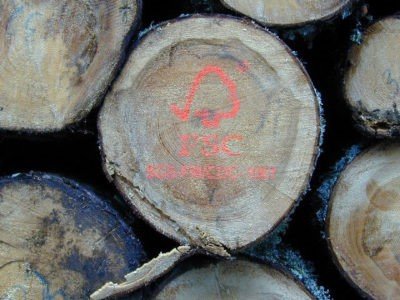
The Forest Stewardship Council (FSC) claims to be the most rigorous form of certification and facilitates and supports a chain of custody, as a commercial service provided by certifying agencies.
The Forestry Stewardship Council certifies forests, timber and operators
The Program for Endorsement of Forest Certification (PEFC) collects and collates information and efforts by national certification authorities. It is known in Australia as Responsible Wood and you can get the general tenor of their approach in this article from 2017.
Geoff interviews the director and marketing officer of Responsible Wood
Natasha Stevenson posted this handy summary of the differences between the two organisations on her linked in feed. https://www.linkedin.com/pulse/5-differences-between-fsc-pefc-natasha-stevenson/
Top Down” vs. “Bottom Up”
FSC is an international standard which is nationally adapted to act as an independent monitoring body, ensuring forestry is working to certain standards -> a “top down” approach PEFC is active in over 30 countries and assesses independent forestry management schemes against international criteria for sustainable forestry -> a “bottom up” approach
The Scale
FSC covers 187 million hectares of forest (30 000 certificates) PEFC covers 260 million hectares of forests (17 800 certificates)
Purpose
FSC was created to prevent illegal timber being consumed and is more focused on the environmental aspects PEFC is essentially a build on from FSC to facilitate certification of sustainable forestry, but adapted especially for small scale land owners
Certificate Types- Level of Commitment
FSC: Forest management, chain of custody and controlled wood PEFC: Forest management, chain of custody and project certification
Certification
FSC is a second party certification; the organisation issues the certificates PEFC is a third party certification; they use certified institutions
Are they working?
The following article is taken from Yale 360 e, an environmental publication of the University.
In a 2014 report, Greenpeace, an FSC member, accused FSC-certified logging companies in Russia of “wood-mining” forests the way they might strip-mine coal, as a non-renewable resource, and of harvesting “areas that are either slated for legal protection or supposed to be protected as a part of FSC requirements.”
In 2015, the U.S. flooring company Lumber Liquidators pleaded guilty to smuggling illegal timber from the last habitat of the Siberian tiger in the Russian Far East. Its main supplier of solid oak flooring was a Chinese company named Xingjia, which held an FSC “chain of custody” certification, meaning it was licensed to handle FSC-certified timber. According to an investigator in the case, another Chinese company marketing to the United States offered to put an FSC label on illegal wood flooring in exchange for a 10 percent markup.
In Peru, investigators determined in 2016 that more than 90 percent of the timber on two recent shipments bound from the Amazon to Mexico and the U.S. was of illegal origin. In what it called an “unprecedented enforcement action,” the Office of the U.S. Trade Representative last October banned the main exporter in those shipments from the U.S. market. That company, Inversiones La Oroza, still boasts on its website that it “complies with the principles and criteria of Forest Stewardship Council (FSC),” though FSC finally suspended its certification in 2017.
In 2015, an undercover investigation implicated an FSC-certified Austrian company, Holzindustrie Schweighofer, in illegal logging in Romania, including some in national parks and other protected areas. An FSC expert panel subsequently recommended that the organization “disassociate” from Holzindustrie Schweighofer based on “clear and convincing evidence” of illegality. FSC opted at first for suspension instead. An outcry from environmentalists soon pushed it to break ties with the company, but FSC is already working on a “roadmap” to bring Schweighofer back into certification.
The cases in China, Peru, and Romania all resulted from undercover operations by the Environmental Investigation Agency, a Washington, D.C.-based nonprofit. “We didn’t mean to go after FSC,” says David Gehl, that group’s Eurasia programs coordinator. FSC just kept turning up in the same places as a lot of illegal logging, he says. Many logging companies appeared to obtain an FSC certification for management practices on one forest, and then use it to cast a halo over their far more extensive dealings in forests elsewhere, with little regard for sustainability or even legality.
The Great Green Wall
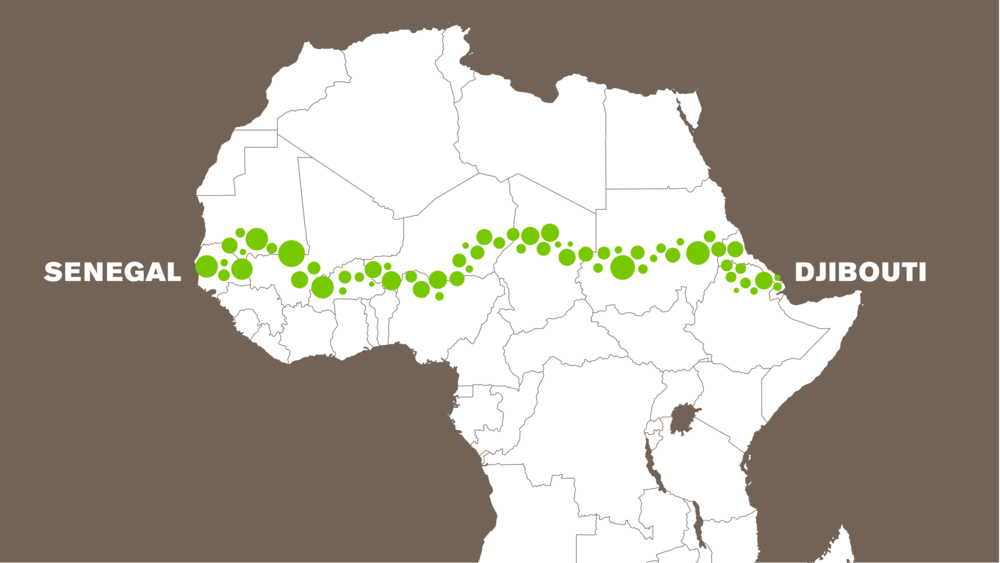
Started in 2007, the Great Green Wall is an enormous project intending to plant a “barrier against climate change running across the Sahel region. This semiarid region of western and north-central Africa extends from Senegal to Djibouti. It forms a transitional zone between the arid Sahara desert to the north and the belt of humid savannas to the south.”
The United Nations and the World Bank have worked with 11 nations across Africa and spent billions of dollars with mixed success.
The challenges faced in such an ambition project include failure to engage local land management practice, exclusion of marginalised groups such as youth, women, or ethnic minorities because of local culture, economics and politics, predatory land trading and agricultural interference, a lack of measurement methods to monitor outcomes, and lack of follow through to ensure that planted forests remain cared for until well established.
The international organisations have worked hard to learn lessons from these struggles and overall, most people consider the project a significant success. The world bank independent assessment group writes …
Many unqualified statements have and continue to attribute Sahelian greening entirely to the actions of farmers.
One specific example of this is described by FAO specialists Moctar Sacande and Nora Berrahmouni (2016). Investigating four cross-border regions of Mali, Burkina Faso, and Niger located in dryland ecosystems of the Sahel, they used local farming expertise to identify the selection of suitable native species for large-scale natural capital restoration in the framework of the GGW. Starting from the assessment of local farming needs, the most environmentally well-adapted and economically relevant species were prioritized, quality seeds were collected, and nursery seedlings produced, all under the technical supervision of the villages. Consequently, ‘‘from 2013 to 2015, 55 woody and herbaceous species were planted to initiate restoration of 2,235 ha of degraded land. On average, 60% of seedlings survived and grew well in the field after three rainy seasons” (Sacande & Berrahmouni, 2016:479).
It is clear then, that while European nations have implemented highly monitored and sophisticated forest management practices, the rest of the world has a long way to go and we have much to learn about supporting nations with limited resources to participate in this important global project.
Activists from legal, communications, mutual aid and class mobilisation backgrounds met to discuss ways that they might be stronger together at a Community Day for Climate at Brisbane’s Northey Street City Farm organised by XR Meanjin.
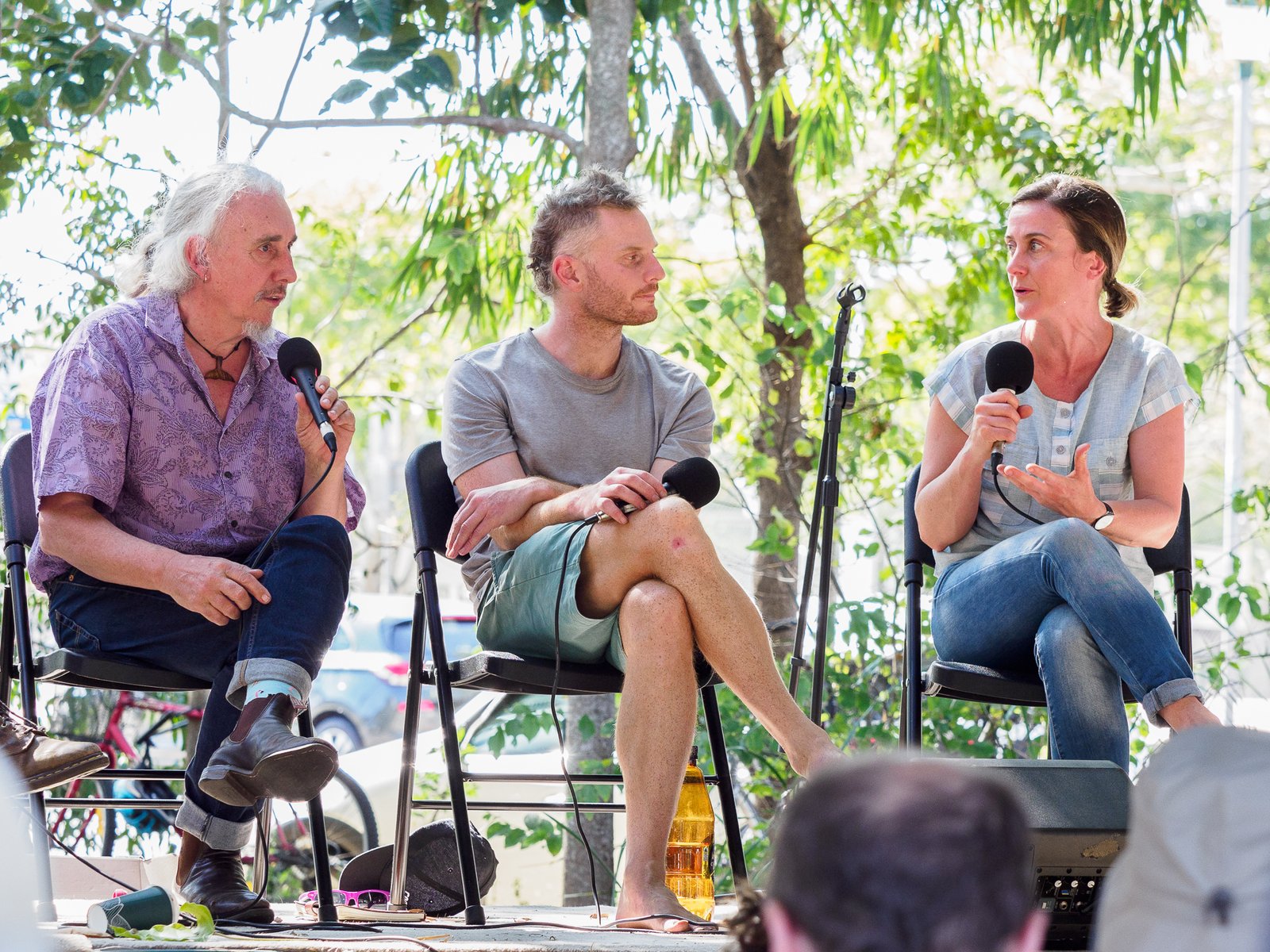
Geoff Ebbs, Andy Paine and Devlin Pointon at XR Community Day for Climate
Writing in this week’s Pearls and Irritations, Peter Sainsbury points out that the most recent Intergovernmental Panel on Climate Change (IPCC) projections regarding climate change assume continual economic growth as fundamental to their projection. Their modelling offsets this with unprecedented technical change, such as green hydrogen and green steel and new, negative emissions technologies. Europe’s Fit for 55 zero-emissions plan, also predicates economic growth, decoupled from environmental harm. Sébastien Wälti of the Swiss National Bank and other degrowth researchers point out that the vast sums of money spent on emissions reduction technologies over the last two decades have had very little impact on emissions. Reducing consumption and population rather than inventing new technologies.
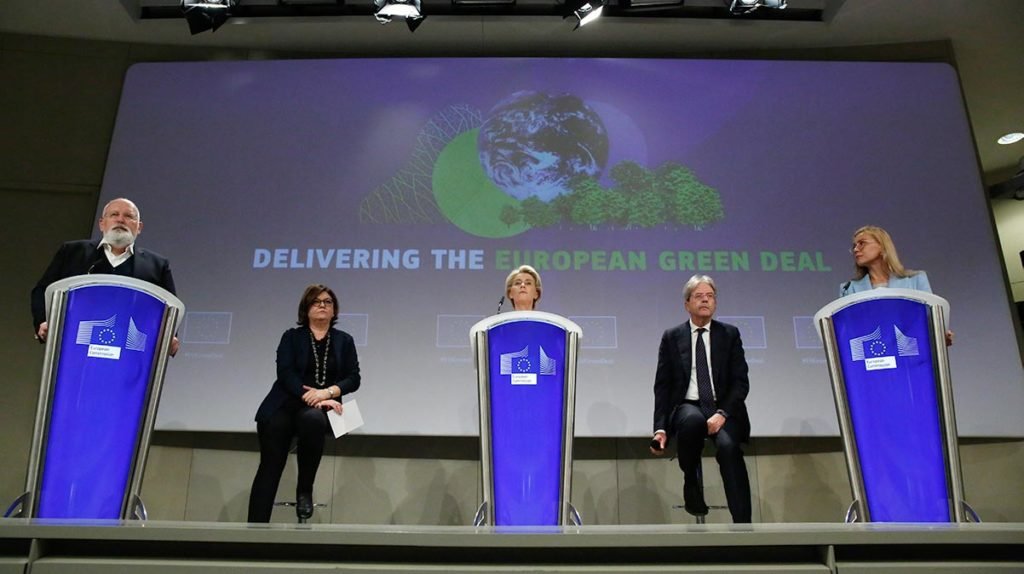
Europe will spend 30% of its total budget on reducing emissions by 50% in the next decade as part of its plan to achieve net-zero emissions by 2050. The Carbon Border Adjustment Mechanism (CBAM) is an essential part of that, putting a carbon price on imports from countries like Australia that do nothing to reduce their own carbon emissions. Economists have joined environmentalists in celebrating the plan as creating a level playing field. “Anyone can get an exemption to the CBAM if they have an equivalent [carbon price] at home,” said energy economist, Sir Dieter Helm. China has criticised the CBAM but, at the same time, is introducing the world’s largest carbon trading scheme. The USA and Canadian governments have proposed similar schemes.
The Generator’s Geoff Ebbs puts Professor Ross Garnaut in the Cage to discuss his new book RESET. A blueprint for a green, socially just future for Australia.
Professor Garnaut, outlines the technology solutions he highlighted in his previous book Superpower, noting that the government’s current technology roadmap largely follows his lead. He discusses the value of clean hyrdrogen in building a clean manufacturing and export business.
In the second part of the interview Geoff and Ross discuss his economic measures to ensure that future growth is socially just. The Australian Income Security and the tax on wealth rather than income.
In this segment, the third part of the interview, Geoff asks Professor Garnaut about the differences between Green Growth and deGrowth, the reality of decoupling economic growth from environmental impact and whether we are creating a scientific dystopia in which wilderness is a theme park.