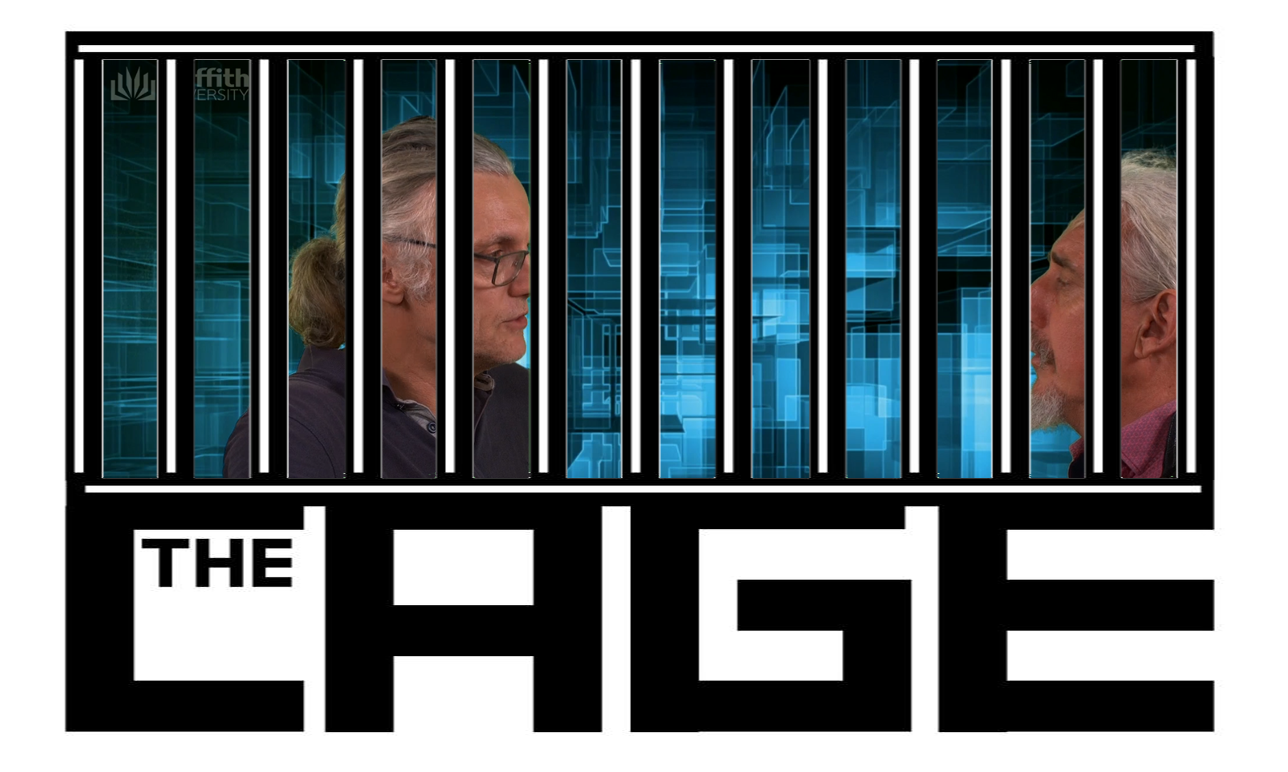
The Cage, like the Matrix, ensnares and enslaves us. We voluntarily assist in building our own trap, borrowing money to make banks richer, plugging ourselves into a system that feeds off our energy and activity to enrich its owners. The Cage started life as a radio show, exposing the workings of the cage by turning the paradigm on its head, locking the powerful into “The Cage” until they answer the question …
A revolting murder. A war between exploitation for profit and land management. Deep insight into the Australian psyche. A small town divided between environmental values of koala habitat and the riches offered by industrial agribusiness. A determined environment officer is killed in cold-blood by a self righteous land developer. How does a community heal such an ugly rift? How does a film maker deal with the divide?
Hear Geoff interview director Gregory Miller, in the Cage. Kate Holden’s new book A Winter Road has caused us to refresh this story.
The Generator’s Geoff Ebbs puts Professor Ross Garnaut in the Cage to discuss his new book RESET. A blueprint for a green, socially just future for Australia.
Professor Garnaut, outlines the technology solutions he highlighted in his previous book Superpower, noting that the government’s current technology roadmap largely follows his lead. He discusses the value of clean hyrdrogen in building a clean manufacturing and export business.
In the second part of the interview Geoff and Ross discuss his economic measures to ensure that future growth is socially just. The Australian Income Security and the tax on wealth rather than income.
In this segment, the third part of the interview, Geoff asks Professor Garnaut about the differences between Green Growth and deGrowth, the reality of decoupling economic growth from environmental impact and whether we are creating a scientific dystopia in which wilderness is a theme park.
Author of Your Life Your Planet, Geoff Ebbs, puts doctor and electric car owner, Erich Schulz, in the Cage for 26 minutes to get a handle on the role of electric cars in building a sustainable future.
This quick snippet shows Erich discussing the role of technological innovation in inspiring people to be sustainable. It is much better than telling them to live more gently on the planet by “pushing their bike up hill and eating mung beans”, he says.
Unkindly referred to as “two old needle-noses with grey, pony-tails arguing about mung beans and bike riding,” the encounter forms the basis of Tip 68 – Alternative Fuels and the experts page, Enter the Electroids.
Erich Schulz and Malcolm Mackenzie contributed to the discussions on energy and transport
Lyn Forester de Rothschilds is a key player in the Council for Inclusive Capitalism with the Vatican.
The article outlines a key alliance between the world’s richest people and the Vatican to create an “inclusive” capitalism that protects the poor and the planet in line with Pope Francis recent dictates.
It criticises the alliance on a number of levels, primarily for the manner in which global agendas have a habit of entrenching power elites in the name of doing good. It compare Pope Francis global agenda with the twelfth century Crusades and highlights connections between, Lyn Forester de Rothschilds, Jeffrey Epstein and the Clintons.
While Neo Journal’s approach concentrates on these seedy connections and the shadowy reputation of some activities by these global philanthropists, The Generator has concentrated on specific problems – such as the concentration of resources in the Doomsday Project, the arbitrary harshness of Modi’s cashless India, and the underlying role of the very small number of people who actually direct the world’s financial systems.
Regular followers of The Generator know that we are rigorous about checking and providing sources and debunking conspiracy theories. That has occasionally put us at odds with facebook – https://thegenerator.news/china-shuts-the-door-on-facebook/ and https://thegenerator.news/soul-sex-facebook-saga-continues/ but has stood us in good stead when reporting controversial issues.
The demise of regional newspapers in Australia is the latest reminder that the business model of media has been broken by the Internet. Funneling tax-payer dollars from the ABC into regional print may not be the most intelligent response, however.
In 1998 Rupert Murdoch received a Papal Knighthood
There is a widely held and often expressed assumption that independent
journalism has flourished under and been supported by “the rivers of gold” that
represented classified advertising in particular but advertising in general. It
follows that the transition of those funding dollars away from traditional
media to facebook, Apple, Google, Amazon et al has created a vacuum once
occupied by the fourth estate, that governments now attempt to address.
This narrative has led to a number of government
interventions, including the attempted regulation of online communication
systems, the calling of executives before committees of elected officials, and threats
to frame legislation that curtails special privileges enjoyed by tech companies
or reinforces the advantages given to traditional media companies.
That narrative is overlaid by privacy concerns, the veracity
of news and the use of mass media by foreign actors to manipulate the
democratic process. All these factors combine to create a wicked problem of the
first order, that will only be resolved over coming decades as we shape a new
communications system and political process that can operate within it.
There are a number of important elements missing from this
narrative, and their absence makes it all the more difficult to understand what
is happening. Adding in these elements, adds to the complexity of the picture
but, at the same time, makes it easier to understand.
Advertising and Journalism: an arranged marriage
Implicit in this narrative is the assumption that a separation
of powers in traditional media allowed journalism to flourish independently from
the influence of powerful advertisers.
Of course, that separation of powers did exist in the great
media properties of our time and launched brilliant examples of holding truth
to power and fine traditions such as the protection of sources and other forms
of immunity that allowed journalists into war zones under similar conditions we
have come to expect for medical services.
It was never universal, however, and it only existed at all
through the impassioned efforts of its greatest defenders.
In general, media owners have wielded great power through
their ownership of communication networks and have used that power in the same way
that bankers have, to control and manipulate the polity for their own ends.
Rupert Murdoch quoted mentor Lord Beaverbrook as “selling to the masses to eat
with the kings” and since backing Fraser in 1975 has consistently taken his
role as king-maker very seriously. He recently re-organised News Limited
specifically to separate the cash-cows from the influence-wielding consumers of
capital. He is not pretending any more that his media ownership is a business
concern.
The first newssheets carried only advertisements and
gradually the printers realised that they could use the “eyeballs” they had
garnered to influence people and thus the editor was born. The relationship
between advertising and journalism is entirely arbitrary and opportunistic with
journalism the dependent parasite feeding on the rivers of gold. The television
headlines, the day’s talking points and the front page of the newspaper have
always been out of the hands of the editorial department and in the hands of
the media proprietor regardless of the popular perception to the contrary.
The significance of this is to recognise that it is up to
the journalism community to follow the money and find the way to use the
evolving platform to promote truth, rather than to preserve some blessed
alliance that is under threat.
Readers Digest, trade press and big data
The manipulation of popular sentiment through public ritual
is as old as religion and has experienced various historical climaxes in Olympic
and Roman Games, public executions, football and mass rallies famously choreographed
by twentieth century dictators.
The far more subtle collection and collation of personal
data by secret police or other informer networks has an equally ancient and
unvenerable history. The techniques were refined by the Catholic Church and the
Communist Party of the Soviet Union.
In a parallel but similar universe, the combination of the printing press, postal system and global capitalism allowed the Readers Digest to create a user-pays, infotainment network in which the customer, come content consumer, pays to build an increasingly accurate profile of their preferences so they can be drip-fed content-on-demand for a fee. The combination of base subscriptions supplemented with one-off fees for special products was well established by the sixties and fed into a burgeoning mail-order network that sold a significant portion of the retail trade operating in that decade.
As a young Packer editor in the 1990s, I was flown to New York and Boston to study the techniques of database mining which was then responsible for a third of US magazine revenue, the other two thirds being cover price and advertising. The value of that information network was confirmed by the business model of the trade magazines which I edited, which had no coverprice and, in the US, made equal amounts from advertising and database sales. The investment Packer made in my trip was to be returned by doubling the revenue of the trade stable using the knowledge newly acquired on that trip.
Computers were instrumental in managing this volume of information,
but there was only a nascent computer network, that information was collected exclusively
via the postal and telephone networks and collated on computers in media
company head offices.
The surveillance state and the commercial publishing industry
moved in parallel to extend those capacities as more of us began to participate
electronically, but the model existed well before the World Wide Web or mobile
phone.
The importance of understanding this is to realise that the
manipulation of people through collecting and collating information about their
participation in public entertainment, spectacle and conversation is not new, and
has always been the justification for funding and developing many of the public
institutions that we consider to be important pillars of civilisation.
Power, the individual and the State
It has always been the case that institutional power, regardless of its philosophical justification, demands the sacrifice of the individual. Every solider is prepared to die for their General, Commander, King or cause. We bow down in worship because we understand, ie stand under, the Omnipresent power of our God, gods, their divine representatives or our local bully boy.
It is the nature of the organisation to protect itself and an essential ingredient of that operating principle that no individual is above the law, the lord, Lord or the lore. The dark side of that principle is intimate state control of your person through surveillance and coercion.
Venice, the Innovation Hub that harnessed the printing press and double entry accounting to dominate European commerce and intellectual life for two centuries used a sophisticated surveillance state to underpin it’s rule of law. Shylock’s pound of flesh was the sacrifice made buy every Venetian to keep the riches flowing.
The notion that the common good is served by individual rights is a relatively modern proposition known as liberal humanism. It assumes that we can align personal desires with the needs of the state and so govern in the broader interests of the people. It conflates all of us, with each of us.
Cooperative sensibilities are generally promoted by conservative
governments in good times and progressive or radical governments in tough times.
We sacrifice our individual freedoms for the common good when we are convinced
we will be better off doing so. Sometimes that conviction stems from fear, at
other times by opportunity, but the system always comes unstuck when the contract
does not hold.
Brexit, Trump, Erdogan, Duterte, and Bolsonaro are all made
possible by the end of the continuous growth enjoyed over the last fifty years.
Thanks to cheap oil, the ‘democratisation’ of debt and an increase in the
global population by an order of magnitude we enjoyed three drivers of economic
plenty that ensured we were each better off than our parents. Now those drivers
have dried up, we fight over the scraps, yelling at each other “What about me?”
The supreme selfishness evolving from a lifetime of unfettered affluence (literally) has now run headlong into the harsh reality that there is rarely enough to satisfy everyone and some of us get our share at the expense of others. The advocates of abundance-thinking do not work in African mines or live in trash mountains on the fringes of the world’s megacities. Europeans across the planet consider their freedom of choice as a benefit of the Enlightenment. The awful truth is that Free Thought has been built on an affluence that has been won by conquest.
The relevance of this to the debate about how to best ‘recover’ the independence of the world’s media is to check our privilege. We have experienced the luxury of the welfare state, a free press and relatively even distribution of wealth, that does not make it our natural right.
The battle for power using new communications technologies is only now taking shape. An attempt to preserve twentieth century business models because we understand them is the modern equivalent of defending horse-drawn transport on the basis of the revolutionary nature of the automobile. It is true, but it is irrelevant. It is a distraction from the real problem of maximising the benefits of the revolution and avoiding its greatest dangers.
Reality Check
I am not advocating that we should roll over to the narco-villians, arms traders or energy ogliarchs, pop the blue pill and harness ourselves to the matrix. I am, though, suggesting that it is not enough to invoke the righteous wrath of John Stuart Mills or the poetry of Pablo Nerada in the hope that we might shame the one-per-crore into putting down the reins of power and raising Vaclav Pavel from the dead so that he can run Google.
Had governments a century ago thought through the impact of the car on the village, the inner city and the market town, transport policy may have been more broadly discussed and less nineteenth century infrastructure dismantled. On the other hand, maintaining horse troughs and street sweepers would not have proved terribly productive.
The role of governments in the media is extremely chequered. The Australian Broadcasting Cooperation like the British version on which it is modeled has a long and proud tradition of independence and calling truth to power. On the other hand government media and communications policy has been shaped to benefit its powerful owners.
We now need to start imagining and demanding the services made possible by the network and imagining the way we communicate in 50, 100 and 500 years. Along the way we will need to crack the heads of the constantly evolving rogues who mis-use it to gain personal advantage at the expense of the rest of us but that regulation is very different role from planning and building it properly.
The printing press combined with numeracy and modern accounting to bring down the Church, empower the Guilds and fund the enlightenment. That involved bloody revolutions, religious fundamentalism and global imperialism at the same time as it nurtured the human rights of Europeans. It banished the epic poem and the oral tradition at the same time as it vastly democratised language, created the scientific journal and the newspaper.
The Internet will have a similar revolutionary effect and
will be just as messy. It is time we stopped bleating about what we are losing
and started focusing on what we might build.