Category: Articles

  • Types of solar collectors for electric generation

    Types of solar collectors for electric generation


    Parabolic troughs, dishes and towers described in this section are used almost exclusively in solar power generating stations or for research purposes. The conversion efficiency of a solar collector is expressed as eta0 or η0.


    [edit] Parabolic trough


    Parabolic trough

    This type of collector is generally used in solar power plants. A trough-shaped parabolic reflector is used to concentrate sunlight on an insulated tube (Dewar tube) or heat pipe, placed at the focal point, containing coolant which transfers heat from the collectors to the boilers in the power station.


    [edit] Parabolic dish


    Solar Parabolic dish

    It is the most powerful type of collector which concentrates sunlight at a single, focal point, via one or more parabolic dishes — arranged in a similar fashion to a reflecting telescope focuses starlight, or a dish antenna focuses radio waves. This geometry may be used in solar furnaces and solar power plants.


    There are two key phenomena to understand in order to comprehend the design of a parabolic dish. One is that the shape of a parabola is defined such that incoming rays which are parallel to the dish’s axis will be reflected toward the focus, no matter where on the dish they arrive. The second key is that the light rays from the sun arriving at the earth’s surface are almost completely parallel. So if dish can be aligned with its axis pointing at the sun, almost all of the incoming radiation will be reflected towards the focal point of the dish — most losses are due to imperfections in the parabolic shape and imperfect reflection.


    Losses due to atmosphere between the dish and its focal point are minimal, as the dish is generally designed specifically to be small enough that this factor is insignificant on a clear, sunny day. Compare this though with some other designs, and you will see that this could be an important factor, and if the local weather is hazy, or foggy, it may reduce the efficiency of a parabolic dish significantly.


    In some power plant designs, a stirling engine coupled to a dynamo, is placed at the focus of the dish, which absorbs the heat of the incident solar radiation, and converts it into electricity. See Knowing Parabolic Concentrators and Concentrating Solar power overview


    [edit] Power tower


    Power Tower

    A power tower is a large tower surrounded by small rotating (tracking) mirrors called heliostats. These mirrors align themselves and focus sunlight on the receiver at the top of tower, collected heat is transferred to a power station below.


    [edit] Solar pyramids


    Another design is a pyramid shaped structure, which works by drawing in air, heating it with solar energy and moving it through turbines to generate electricity. Solar pyramids have been built in places like Australia. Currently India is building such pyramids.[4]


    [edit] Advantages


    • Very high temperatures reached. High temperatures are suitable for electricity generation using conventional methods like steam turbine or some direct high temperature chemical reaction.[citation needed]
    • Good efficiency. By concentrating sunlight current systems can get better efficiency than simple solar cells.
    • A larger area can be covered by using relatively inexpensive mirrors rather than using expensive solar cells.
    • Concentrated light can be redirected to a suitable location via optical fiber cable. For example illuminating buildings, like here (Hybrid Solar Lighting).


    [edit] Disadvantages


    • Concentrating systems require sun tracking to maintain Sunlight focus at the collector.
    • Inability to provide power in diffused light conditions. Solar Cells are able to provide some output even if the sky becomes a little bit cloudy, but power output from concentrating systems drop drastically in cloudy conditions as diffused light cannot be concentrated passively.


  • BNSF Railway and Vehicle Projects Demonstrate Experimental Hydrogen Fuelcell Hybrid Switch Locomotive


    BNSF Railway and Vehicle Projects Demonstrate Experimental Hydrogen Fuelcell Hybrid Switch Locomotive


    30 June 2009


    Bnsffcl
    Rear view of the fuelcell hybrid switch locomotive. The dual Ballard fuel cell stacks are to the left (i.e., rear) of the switcher. Source: Vehicle Projects. Click to enlarge.

    BNSF Railway and Vehicle Projects Inc. of Denver/Golden, Colo., a developer of large fuelcell vehicles such as mine loaders and mine locomotives, unveiled an operational hydrogen fuelcell hybrid switch locomotive at BNSF’s Topeka System Maintenance Terminal. (Earlier post.)


    Following its introduction, the locomotive is heading to the Transportation Test Center in Pueblo, Colo., for additional testing. Late this summer or early fall, depending on the outcome of the testing, the locomotive will go into service in the Los Angeles Basin, where it will face the test of actual service in the railroad environment.


    BNSF operates through several locations that are in non-attainment areas for air quality as designated by the Environmental Protection Agency. We are investigating and experimenting with this hydrogen fuelcell technology for its potential niche application in areas with air quality concerns.


    —Mark Stehly, assistant vice president, Technical Research, Development and Environmental


    Arnold Miller, president, Vehicle Projects, suggests that the fuelcell locomotive is the least-cost solution for such areas when the social costs of diesel-electrics and the infrastructure costs of catenary-electrics are considered.


    The fuelcell powertrain was developed by Vehicle Projects with the support of BNSF, the US Department of Defense and a collaboration of industrial partners. The switcher is being also designed to be able to serve as a mobile backup power source (i.e., “locomotive-to-grid”) for military bases and civilian disaster relief efforts.


    Bnsffcl2
    Expanded view of fuelcell hybrid switcher. Source: Vehicle Projects. Click to enlarge.

    The locomotive features a 240 kW (320 hp) fuelcell prime mover (based on the stacks used in Daimler Citaro hydrogen fuel cell buses. It stores 70 kg hydrogen at 350 bar (5,100 psi) at roofline. A lead-acid traction battery allows transients above 1 MW. The locomotive has 9,000 kg of extra ballast to bring it to 127 tonnes.


    The vehicle platform was based on the Green Goat diesel-battery hybrid switcher.


    Resources


    June 30, 2009 in Fuel Cells, Hydrogen, Rail | Permalink | Comments (7) | TrackBack (0)


    Comments


  • Reality hits PM as millions wasted.


    Of course, government ministers will bleat there was no explicit promise apart from setting up a website, but the expectation was created, no more nor less than John Howard created during the 2004 campaign the expectation of continued low interest rates.

    The folly of FuelWatch to keep petrol prices down was headed off by the Coalition, but the calamity of Grocery Choice was left to prosper.

    A website that didn’t provide real-time grocery price comparisons was useless from day one. Furthermore, Grocery Choice provided only averages for some supermarkets in a region, which were meaningless to shoppers such as me and hundreds of thousands of others who set out on a Saturday morning to hunt and gather the best food prices for their family.

    It was an empty joke from the beginning that had to be sustained to save Labor’s face.

    Initial curiosity over the website, which sustained relatively high hits, quickly faded as shoppers realised they couldn’t work out where to get the cheapest grocery items in their area.

    Shoppers simply continued to shop using their own initiative and left Grocery Choice to die.

    When consumer affairs minister Chris Bowen announced the scheme last year, he said: “Finally, the government is also fulfilling its election commitment made by the then leader of the opposition on (July 11, 2007) to set up a dedicated website that gives consumers a snapshot of local grocery prices.”

    It was a promise that, before the focus shifted to the global financial crisis, was an integral part of Labor’s commitment to fight rising prices.

    It was then, and remains, an empty and costly gimmick – $13million in taxpayer funds during a global recession – that was implemented only to provide a tick in the promises kept box.

    The only saving grace for the government now is that it has decided not to throw more good money down the drain.

    The government had to be seen to be doing something, and Grocery Choice was part of that.

  • Is a green economy possible?

    To explore that question it is important to understand exactly what we mean by a sustainable economy. Obviously it has to be something that can go on for ever. By definition it has to be able to sustain itself, so it has to be able to be sustained by the finite resources of the planet on which we live. Unless we are planning to move to the moon or Mars, that is a self-evident fact.

    There are two pillars that underpin any concept of a Green economy. One is zero growth and the other is zero waste.

    Zero Growth is a critical component because nothing can grow continuously forever in a finite world. The definition of a sustainable economy is one that can be sustained for ever, so the boom and bust cycles that characterise the capitalist economy are not sustainable by definition.

    Zero waste is a slightly more subtle concept but the simple truth is that six billion, going onto nine billion people, cannot continue to use up and destroy finite resources, because we will run out. When we take a complex hydrocarbon, cook it and cure it and turn it into an indestructible plastic and bury that plastic in landfill, we have removed that energy from the planets systems for thousands if not millions of years. If billions of us waste 1 kilogram of plastic a year, that is millions of tonnes of hydrocarbons being wasted every year. This is not sustainable.

    How is this different? Let me count the ways

    A sustainable economy based on zero growth and zero waste is fundamentally different to the economy that we are used to. It is important to understand what is different and why that is so important.

    The importance of growth

    Our newspapers are full of the dangers we face because the economy has stopped growing. The headlines talk about the fear of recession and recession is defined as two quarters of negative growth. We are so focused on growth that we dare not even use the term contraction, or shrinking, we call it negative growth.

    We know that our politicians, bankers and captains of industry are obsessed with growth and that growth makes us all rich, but we rarely question the basic assumptions behind this.

    The fundamental reason why growth is important to our society is because it is driven by capital. People with capital make money by lending or investing that capital to other people who can grow it for them.

    The only reason that you can borrow money from a bank to buy a house, is because your total repayments will double their money over a couple of decades. They will get a return on their investment. The only reason that you are prepared to do that is because you expect that the value of your home will be greater than the total amount you have paid for it. You expect a return on your investment. If the price did not rise, you would be better off paying rent. Your cost of living would be much lower.

    The same is true right across society. Industry borrows money to buy equipment to make things which they can sell to make a profit to repay the bank. Investors put money into companies who will grow and provide them a return on their investment.

    If the economy does not grow the entire financial system collapses. Right now the financial system is collapsing and the economy is not growing, so everyone is panicking and governments are doing every thing we can to start the growth again.

    Instead we should be building new institutions that do not depend on growth.

    The bad news is that this is a major project that will be opposed by the entire financial sector, all investors and most major companies. The good news is that there has never been a time when people are more receptive to the notion.

    The nature of waste

    Achieving zero waste seems a relatively easy concept to deal with. All organic systems are cyclic in nature so we should be able to establish system that usefully recycle our waste and restore the used components into something useful. Permaculture and organic farming are examples of closed systems that work exactly like this.

    Once we try to apply that principle across the entire economy, however we encounter a number of quite challenging problems. The first is the second law of thermodynamics. When we eat a plant we are extracting the energy from it, to build the cells of our body and to fuel our activity. What we excrete may contain the same base elements, chemically transformed by our digestive system but the fundamental difference is that we have consumed the energy captured from the plant by the sun.

    To recycle those nutrients we need to feed them to new plants that can capture more sunlight and convert the low energy nutrients into high energy plant material again. The same is true of recycled paper or glass, aluminium or steel. We live on the energy that we extract from the resources we consume. Even if we recycle or re-use all the material that we employ, we can never recapture the energy that we waste in that lifestyle. Fundamentally, a zero waste lifestyle means a significant reduction in our energy consumption to match the available energy that falls on our share of the earth’s surface.

    A separate issue is the toxic nature of much of the waste that we currently produce. The nature of toxins is to destroy life and so toxins have no place in a zero waste future. They must be eliminated completely.

    When we look at it from an economic point of view, the cost of applying these changes to our process makes much of our existing lifestyle impossible. In fact, the underlying nature of civilisation is built on the use of resources from somewhere else.

    Cities appeared when farmers created more food than they needed and could support others not involved in food growing activities. Farmers did not start doing this naturally however. A king in ancient Iraq made them do it at sword point. Farmers along the Tigris Euphrates valleys grew enough food so those early kings could maintain a standing army and the first cities grew around those military bases. Civilisation grew from there.

    The entire project of the last ten millennia has been based on the extraction of resources from somewhere else, for use in the city, with the waste being deposited somewhere else again. It requires two somewhere else’s to maintain civilisation as we know it: One to extract the resources from, the other to send the waste to. The problem is that civilisation now circumnavigates the globe. We have run out of somewhere else’s. The last forests are being destroyed, we consume more water than is available in our water supplies, the marine ecosystems are collapsing under the stress of feeding us and we are choosing whether to use our land to provide fuel or food.


    See next page

    To explore that question it is important to understand exactly what we mean by a sustainable economy. Obviously it has to be something that can go on for ever. By definition it has to be able to sustain itself, so it has to be able to be sustained by the finite resources of the planet on which we live. Unless we are planning to move to the moon or Mars, that is a self-evident fact.

    There are two pillars that underpin any concept of a Green economy. One is zero growth and the other is zero waste.

    Zero Growth is a critical component because nothing can grow continuously forever in a finite world. The definition of a sustainable economy is one that can be sustained for ever, so the boom and bust cycles that characterise the capitalist economy are not sustainable by definition.

    Zero waste is a slightly more subtle concept but the simple truth is that six billion, going onto nine billion people, cannot continue to use up and destroy finite resources, because we will run out. When we take a complex hydrocarbon, cook it and cure it and turn it into an indestructible plastic and bury that plastic in landfill, we have removed that energy from the planets systems for thousands if not millions of years. If billions of us waste 1 kilogram of plastic a year, that is millions of tonnes of hydrocarbons being wasted every year. This is not sustainable.

    How is this different? Let me count the ways

    A sustainable economy based on zero growth and zero waste is fundamentally different to the economy that we are used to. It is important to understand what is different and why that is so important.

    The importance of growth

    Our newspapers are full of the dangers we face because the economy has stopped growing. The headlines talk about the fear of recession and recession is defined as two quarters of negative growth. We are so focused on growth that we dare not even use the term contraction, or shrinking, we call it negative growth.

    We know that our politicians, bankers and captains of industry are obsessed with growth and that growth makes us all rich, but we rarely question the basic assumptions behind this.

    The fundamental reason why growth is important to our society is because it is driven by capital. People with capital make money by lending or investing that capital to other people who can grow it for them.

    The only reason that you can borrow money from a bank to buy a house, is because your total repayments will double their money over a couple of decades. They will get a return on their investment. The only reason that you are prepared to do that is because you expect that the value of your home will be greater than the total amount you have paid for it. You expect a return on your investment. If the price did not rise, you would be better off paying rent. Your cost of living would be much lower.

    The same is true right across society. Industry borrows money to buy equipment to make things which they can sell to make a profit to repay the bank. Investors put money into companies who will grow and provide them a return on their investment.

    If the economy does not grow the entire financial system collapses. Right now the financial system is collapsing and the economy is not growing, so everyone is panicking and governments are doing every thing we can to start the growth again.

    Instead we should be building new institutions that do not depend on growth.

    The bad news is that this is a major project that will be opposed by the entire financial sector, all investors and most major companies. The good news is that there has never been a time when people are more receptive to the notion.

    The nature of waste

    Achieving zero waste seems a relatively easy concept to deal with. All organic systems are cyclic in nature so we should be able to establish system that usefully recycle our waste and restore the used components into something useful. Permaculture and organic farming are examples of closed systems that work exactly like this.

    Once we try to apply that principle across the entire economy, however we encounter a number of quite challenging problems. The first is the second law of thermodynamics. When we eat a plant we are extracting the energy from it, to build the cells of our body and to fuel our activity. What we excrete may contain the same base elements, chemically transformed by our digestive system but the fundamental difference is that we have consumed the energy captured from the plant by the sun.

    To recycle those nutrients we need to feed them to new plants that can capture more sunlight and convert the low energy nutrients into high energy plant material again. The same is true of recycled paper or glass, aluminium or steel. We live on the energy that we extract from the resources we consume. Even if we recycle or re-use all the material that we employ, we can never recapture the energy that we waste in that lifestyle. Fundamentally, a zero waste lifestyle means a significant reduction in our energy consumption to match the available energy that falls on our share of the earth’s surface.

    A separate issue is the toxic nature of much of the waste that we currently produce. The nature of toxins is to destroy life and so toxins have no place in a zero waste future. They must be eliminated completely.

    When we look at it from an economic point of view, the cost of applying these changes to our process makes much of our existing lifestyle impossible. In fact, the underlying nature of civilisation is built on the use of resources from somewhere else.

    Cities appeared when farmers created more food than they needed and could support others not involved in food growing activities. Farmers did not start doing this naturally however. A king in ancient Iraq made them do it at sword point. Farmers along the Tigris Euphrates valleys grew enough food so those early kings could maintain a standing army and the first cities grew around those military bases. Civilisation grew from there.

    The entire project of the last ten millennia has been based on the extraction of resources from somewhere else, for use in the city, with the waste being deposited somewhere else again. It requires two somewhere else’s to maintain civilisation as we know it: One to extract the resources from, the other to send the waste to. The problem is that civilisation now circumnavigates the globe. We have run out of somewhere else’s. The last forests are being destroyed, we consume more water than is available in our water supplies, the marine ecosystems are collapsing under the stress of feeding us and we are choosing whether to use our land to provide fuel or food.

  • Is a Green economy possible? -Pt 2

    We cannot embark on a project that attempts to stifle innovation and end change, that is not sustainable either. At a local level, life itself involves the destruction and consumption of some resources so that others may live. A rainforest may appear stable from a satellite, but the view from a particular tree is dynamic and dramatic.

    The Shire of the Hobbits may seem idyllic in its pastoral simplicity but it is not only vulnerable to the marauding evil that stalks the globe, it is dependent on any number of larger systems in which it exists.

    We aim to build an economy, then, that is dynamic and evolving, but which is not harmful or wasteful and assumes a finite set of resources that must be recycled.

    The question then becomes, “Where do we find the solutions that will allow us to build a sustainable economy?”

    There might be here

    I first heard the saying “The future is already here, it is just not evenly distributed,” from Bob Metcalfe, the inventor of the Ethernet, which forms the back bone of many computer networks. He had worked at the Hewlett Packard Palo Alto Research Centre (PARC), where the mouse and icon based computer screen that we all use now, was invented. He watched the personal computer and the internet roll out into society with interest, because he and his colleagues had invented it ten years earlier and had learned to use it as it was being created. The rest of society came to terms with it as a complete entity and undertook a completely different journey.

    I like the saying because it reminds me that the gadgets, fashions and cults that will take off and take over tomorrow are already in operation somewhere in the world today. If we want to understand the future, we need to cast our net widely and look at the widest possible range of activities currently taking place to identify those things that will survive and dominate.

    The elements of a sustainable economy, then, are already in position somewhere.

    Amish farmers, for example, have never used fossil fuels, pesticides or fertilisers. Their farms are about half as productive as their neighbours but twice as profitable. They are immune to fluctuations in interest rates, energy prices or the global economy because they are almost self sufficient. There is an example of a sustainable community that has stood the test of time.

    Other intentional communities have been established on different principles. They too have developed many of the elements that will become mainstream as we pass through peak oil, peak water and peak food. Some of them have gone beyond self sufficiency and are dedicated to the important project of building the necessary infrastructure to preserve the knowledge built up over millennia that could disappear if we allow civilisation to collapse untidily.

    These sustainable communities, though, are the obvious places to look. One challenge that they all face is that they deliberately set out to offer an alternative to the attractions of the big city, the cult of greed and laziness. They require a commitment to leave behind the desire for more while doing less that has been perfected by humans but ultimately drives all life and is inbuilt into the law of thermodynamics.

    The future economy may need that commitment built into it, but if we are to develop that without the harsh lessons of repeated Dark Ages then we will need it to come bubbling out of the effervescence of modern youth not from the ponderings of our elders.

    Lessons from the iCult

    One extraordinary development in recent times has been the social, cultural and economic impact of the internet. It has undermined many existing business models and is reshaping human communication in a very fundamental way. One of the key changes has been in the role of publishers, those capital intensive corporations that controlled the manufacture and distribution of films, music, literature and games. Fifteen years ago almost all these publishers dismissed the Internet as a toy that was peripheral to the “real” economy. With the collapse of the dot com bubble in 2000, those corporations claimed the high ground and went on with using the clout of their capital to lobby governments for legislation to protect their interests.

    A decade later, though, and the cracks are opening up. Newspapers collapse, independent bands film-makers and gamesters flourish and the twittersphere and blogsphere challenge the media as the gravitational centre of mass communication.

    The shift from large, centralised, capital-intensive publishers to self forming networks of peer to peer operators characterises both the underpinning nature of the Internet and the future requirements of a sustainable economy.

    Perhaps most significant in this broad movement is the rise of Open Source. The term describes the software free of copyright restrictions, where anyone can contribute to the source code that makes the software work and no-one “owns” the intellectual property that is the software itself. It increasingly applies to other intellectual endeavours, though, where people contribute to libraries of images, written work or research data for the greater good.

    Most significantly, this is not naked altruism performed by charitable individuals working because of an earnest commitment to the greater good, it is a new economic model that pays people’s rent. This is so important it is worth teasing out a little.

    The altruistic drive to share code is classic Darwinian altruism as a means to protect oneself by protecting the community in which one shelters. Accordingly, the Open Source community is dedicated to the philosophical model of the Bazaar as opposed to the Cathedral. That means it can build software that allows its members computers to work properly without being controlled by a corporation that acts in the interests of its shareholders rather than its customers.

    Even that self centred version of altruism does not fully explain the power of the Open Source model as a basis for a new economy. The fact is that most participants in Open Source projects make their living from working with the Open Source software they produce. The community as a whole sells its services to technology consumers and lives from the fees paid for the services they provide.

    The fundamental between this open market of small businesses (the bazaar) as opposed to the corporate publisher (the cathedral) is that no-one owns the core code which drives the whole community. The distributed ownership of the code means that there is no need for capital to drive these projects, so there is no need for growth to maintain them. It is an example of an economy that is unplugged from the financial markets.

    This is largely an accident that has emerged from the peer to peer nature of the Internet. Ironically, that feature of the internet was developed as a military guard against a nuclear attack on a central computer. By distributing the capacity of the network around the edges, the military created a self regulating, self healing system that does not require central control. What is centralised are the regulations that underpin the cooperative nature of the project, the protocols that allow the computers to find each other, talk to each other and ensure that the communications are secure.

    Practice makes perfect

    The evolution of a new economy is not going to come fully formed from the pen of one thinker. It is not going to arrive suddenly at the recognition that the old economy is bankrupt.

    Just as the farmers and small businesses of India have had to march on their parliaments to get regulations to protect them from the ravages of Monsanto and Walmart and are still fighting a public relations battle on behalf of the world’s organic farmers, so every stand against vested interests will be tough.

    Just as the Open Source movement has taken twenty years to get to a point where business owners are prepared to put their mission critical applications onto Open Source software, so will this change come about gradually. And just has Microsoft has actively moved to undermine Open Source by planting code into Windows that inserts flaws into Open Source applications so will those vested interests move to shore up the existing economy.

    The good news is that the power of the economy ultimately lies with the consumer. Without customers there are no retailers. Without retailers there are no wholesalers, manufacturers, steel manufacturers, miners, ports or fossil fuel companies.

    We can effect this change in our own lives immediately by unplugging from the economy that is destroying us. We can grow food in our communities, we can car pool, buy a bike, walk more, stay at home. We can share washing machines, lawnmowers and entertainment devices. We can switch off the television and reclaim our leisure time. We can avoid packaged food by baking our own, growing what we can and by sharing generously.

    Sharing generously is the key to the entire project. As every community attempt to institute bartering systems knows, in the end, all you do is recreate money. As you do, governments get interested and all the overheads associated with accounting re-emerge.

    One of the key lessons to learn from the Open Source community is that by giving freely of your time you build a community that is unassailable because it has nothing to lose. One of the key lessons to learn from ecommerce generally is that, in the end, we are only worth the value we add.

    As you disconnect from the debt-fuelled, energy-intensive lifestyle that global capital and its enslaved governments demand you live, you will find that you have more time to give and less need for the money that drove you to work every day. You will begin to create the sustainable economy straight away without having to lobby, or vote for, a single politician.

    Enjoy.

  • TIDAL POWER

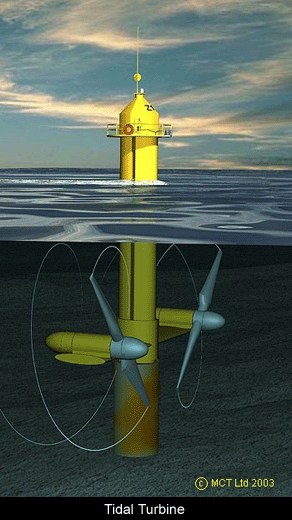
    tidal power

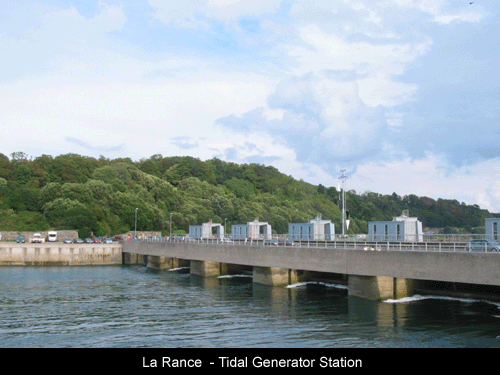
    There is little doubt that the energy potential of tides is huge. The largest power plant is the La Rance station in France which generates a whopping 240 megawatts (MW)of power. The idea of constructing a power plant on the La Rance dates to Gerard Boisnoer in 1921. The site was attractive because there is a large average range between low and high levels (8 metres, with a maximum equinoctial range of 13.5 metres).

    In spite of the high cost of the La Rance project, the plant’s costs have now been recovered, and electricity production costs are lower than for nuclear power generation. (18 Euro cents per kWh, versus 25 per kWh for nuclear). However, the barrage has caused progressive silting of the Rance ecosystem. Sand-eels and Plaice have disappeared, though Sea bass and cuttlefish have returned to the river. There are only two other plants operating worldwide, one being the 20MW Annapolis station in Nova Scotia, and a small 0.5MW plant in Russia.

    la Rance tidal

    Tidal power schemes do not produce energy 24 hours a day. A conventional design, in any mode of operation, would produce power for 6 to 12 hours in every 24 and will not produce power at other times. As the tidal cycle is based on the period of rotation of the Moon (24.8 hours) and the demand for electricity is based on the period of rotation of the earth (24 hours), the energy production cycle will not always be in phase with the demand cycle. This causes problems for the electric power transmission grid, as capacity with short starting and stopping times (such as hydropower or gas fired power plants) will have to be available to alternate power production with these power schemes.

    The less intrusive plants utilising kinetic energy from current flow rather than potential energy of barrage dams would appear to be more environmentally friendly and sustainable in the long term.