Category: Articles

  • Blockchain Technology Explained

    Blockchain Technology Explained

    Author: Alan T. Norman

    ISBN: no ISBN

    Publisher: self-published, Alan T. Norman

    Published in December 2017, Alan T. Norman’s latest book on the technology goes a lot deeper than many of these introductory texts. At 126 pages it simply has more depth and because Norman has written separate books on investing in digital currency and other areas of software development he has a deeper body of work on which to draw.

    As one example of that depth, he actually goes into detail on the specific problems faced by organising financial services online, which BitCoin solves and the technical aspects of that solution. Put simply, the double spend problem is ensuring that money is only spent once and the solution is to combine the power of file sharing technology to ensure that information is widely distributed and always available with encryption to ensure that the distributed information is secure and accurate.

    He builds that picture piece by piece using simple business english, with enough examples that most readers will get the picture, without being buried in technical detail.

    He moves through the blockchain, BitCoin, other digital currencies and their uses and applications, distributed apps and the application of all this technology in corporations, software development and governance.

    He breaks down the hype around the blockchain and distributed apps to paint a realistic picture of its implementation and how it will roll out in our everyday life.

    Norman also goes into sufficient detail about the operation of the technology to explain why it is secure and how it works. These explanations are readable and straightforward without being dumbed down and over-simplistic.

    For example his explanation about the use of cryptography in the blockchain is titled A Deep Dive on How Blockchain Hashing Works

    He opens the chapter with the observation,

    “This chapter is here by popular demand from reader comments. It’s a deep dive into how hashing works. This is going to get very technical, and you don’t have to read this section in order to understand the basics of blockchain.”

    He then launches into a good, high level explanation of the idea of hashing (creating a code that proves online data has not been tampered with) and then, in the next section, how it is used in the blockchain. Once he has explained it as simply as possible he observes,

    “I’ve been defining mining difficulty by the number of leading zeroes a successful hash needs to have, since it’s an easy visual way to understand mining difficulty. The truth is more complicated and variable.”

    In this way, he builds up a complex understanding at the depth required by the reader. As soon as you get bored with the level of detail provided you jump to the next heading. By the end of that particular chapter, he has explained the SHA-256 hashing algorithm in sufficient detail that you could actually map it out and write the code required to perform it. Most readers will skip over some part of it, but it is great to be able to delve into it at your level of interest.

    His discussion of the limitations of BitCoin as an active currency is honest and important. With gateway providers, such as Stripe, dropping support for BitCoin it is imperative that people considering the business applications of these technologies understand the thinking behind it. In a nutshell, that limitation is the time it takes to authorise a transaction on the blockchain. At many minutes that authorisation time is well outside the instant payment systems that we have become used to online rendering Bitcoin on its own useless as a medium for transaction in most ecommerce applications.

    Norman outlines some of the approaches that are being taken to develop solutions to these teething problems but points out that the technology is not ready to sweep the world in quite the way that some of the marketing hype (and some of the less considered books available) suggest.

    In summary, this is a nice combination of a low priced, self-published book and a reasonable depth of information. At the time of writing it was $US1.02 for the Kindle edition and $US9.95 for the paperback. That being said, the book is not as well produced as those from more established publishers. The ability to navigate through the book is limited to the basic functions of the Kindle application on which you are reading it. The layout is basic, there are no footnotes or references in the text and the presentation of headings and lists is primitive.

    These are small sacrifices for the price saving if that matters to you.

  • Blockchain: The Beginners Guide

    Blockchain: The Beginners Guide

    Author: Artemis Caro

    ISBN: 1985574020

    Publisher: self-published, Artemis Caro

    The full title of Artemis Caro’s recent book (February 2018) is Blockchain: The Beginners Guide To Understanding The Technology Behind Bitcoin & Cryptocurrency (The Future of Money). It is a quick overview and introduction aimed to provide introduce the interested reader to the overall concepts. It is cheap, $US3.10 on the Kindle and $US5.49 for the paperback and Kindle combined at the time of going to press. It is short and does not have a lot of depth. That said, it covers the basic questions in an organised fashion and gives you some pointers into what areas you might want to explore further. It sets out to cover the questions:

    • A Brief History of Blockchain Technology
    • Blockchain Basics: Managing Digital Transactions
    • What is a Distributed Ledger?
    • Blockchain Beyond Bitcoin
    • Implications Of Blockchain: Big Data, Privacy & Personal Data
    • Profiting from Blockchain Technologies
    • Limitations & Challenges of Blockchain
    • The Future of Blockchain

    The marketing blurb says “The goal of this book is not to plumb the depths of the mathematical wizardry used to code blockchain-based applications, but rather to serve as an introduction to the broader architecture and conceptual background behind blockchain technology.” That is something of an understatement.

    If you want a quick read to bring you up to speed this is not a bad way to get an overview fast. If you like doing your own research, though, a weekend on the Internet would probably give you more satisfaction.

  • Blockchain: Starting Guide for beginners

    Blockchain: Starting Guide for beginners

    Author: Brian Reel

    ISBN: 1983889105

    Publisher: self-published, Brian Reel

    BLOCKCHAIN: Starting Guide For Beginners, All About Blockchain, Cryptocurrencies, Mining And Future Of Money was self published by Brian Reel in January 2018 and provides a high level overview in straightforward business English.

    Reel takes us through the actual processes of creating, using and trading in BitCoin as well as different ways of using the blockchain on which BitCoin is built. Each topic is dealt with in a practical way. The chapter on mining bitcoins, for example, discusses the method by which the block chain is stored and promulgated and how that is applied in the creation of new BitCoins (mining) and how companies are engaging in that mining exercise.

    The information is general, providing information for the educated layperson, rather than providing technical information or specific methods for engaging in these activities. Like many of the introductory texts, especially those self published, the book is short and snappy, skipping across the surface of these complex topics.

    For those who want to get an overview of the landscape quickly, this is probably ideal. Those who prefer to take more control of their research, though, a weekend on your favourite search engine may produce more useful (and current) results.

    You can buy the ebook for $US0.99 by clicking here.

  • Getting ahead of Bitcoin

    Getting ahead of Bitcoin

    Whether you are an investor, a programmer or an entrepreneur BitCoin will radically and directly change your life in the next couple of years.

    School teachers, activists and artists might not be directly in the firing line but Bitcoin’s underlying technology, the blockchain, is going to affect us all. The questions are how and how fast.

    This article answers your basic questions about the blockchain and tells you where to go for more in-depth information

    What is this thing called Blockchain?

    If you doubt the radical changes that technology has wrought on society in the last three decades, just watch the queue for wifi at the Guangzhou Airport. We are so addicted to the Internet it is the first thing we organise when we get to our accommodation on a weekend away, move house, or plan where we will spend the day working “out of the office”.

    The Blockchain is the next layer of the network that already connects us and enables our communal activity.

    The telecommunications network allowed us to speak to each other, leave messages and then, by 1964, send electronic signals and printed documents. The microchip allowed us to use personal productivity software to do things that had previously required volumes of pen and paper. The combination of the two allows us to maintain our diary, perform our banking, watch movies, take photographs and share all of that activity with loved ones, friends and colleagues over a hand held device. Most of us now see the smart phone and our connection to the network as an essential accessory in our daily life.

    Now, that networked computer has been empowered by the addition of a public record of all the transactions we perform. That public record is called the blockchain and it provides an accurate, immutable history of relevant online activity that will change the nature of trust. That reliable and permanent record of all transactions will rapidly replace the public record, institutions and governance in ways that we can only begin to imagine. It will be applied to supply chain logistics, as well as all transactions where a chain of custody, provenance or proof of ownership is importance.

    Think about it.

    We currently keep our money in a bank because we trust the bank to keep it safe. As that money has become completely virtual, we connect to the bank simply to record our transactions so that we can check our balance and make spending decisions based on accurate, up-to-date information. Now that the network itself has an accurate, up-to-date record of all our transactions and our account balance, the role of the bank is significantly reduced.

    And that is just the role of the BitCoin. Imagine the same technology applied to documents that record ownership. Every online photograph can be registered and every use of it tracked using the blockchain. Lab results, works of art, any object worth protecting can be protected by the blockchain. A complete chain of custody, provenance, or transaction history can be recorded automatically as an object moves through different hands.

    This can be applied to the storage of personal health records, the maintenance history of a car, the tagging of electrical appliances, viewing of online files.

    This transition will take some time, just as the smartcard has taken some time to replace cash. When we think about the transition from credit cards, through eftpos to smartcards and cashless transactions and then the current wave of cardless transactions we can see that these revolutions have long lead times and then very rapid implementations once the technology reaches a critical mass. Each wave of that transition had its own impact on the businesses involved and the impact over the last two decades has been remarkable.

    We are now reaching the point where BitCoin has moved out of the experimental and speculative phase into mainstream investing and blockchain applications are being implemented in organisations worldwide and the technology is being built into mainstream operating systems and development environments.

    What do you need to know?

    RIght now the world of virtual currency is exploding. Initial coin offerings (ICOs) are disrupting the financial landscape and entrepreneurs are exploring a brave new world of distributed applications to facilitate business models that were considered fanciful half a decade ago.

    The adventures of BitCoin have been well publicised – if not well explained – and most of us understand that something big is afoot, but we are not sure exactly what.

    The good news is the basic technologies are now well established and understood and a second generation of books explaining it all has emerged. Luckily, these books are targeted at specific audiences: Entrepreneurs, corporate managers, programmers, academics and investors. There are quick-to-read books that cost little and explain things simply as well as in-depth books to help you to make strategic decisions or, at least, decide strategically where to focus your further investigations. The

    This article introduces you to the cream of the crop. We have deliberately selected books available both physically and as ebooks. We have provided links to Amazon so that you can load them directly into your Kindle at a couple of clicks, but given you the details needed to shop around and get them in your preferred format, from your preferred provider as fast as possible.

    Conclusion

    Some people prefer to do their own research, others to get information packaged in a dense and digestible package, tailored to their needs. The introductory texts discussed here provide a quick introduction in such a manner, though the very short ones do not provide much more depth than a weekend session with Dr Google.

    If you are after an introduction to Blockchain, rather than simply BitCoin, Alan T Norman’s Blockchain Explained is my value-for-money recommendation. You can buy the Kindle edition directly for $US3.14 by clicking here. It is too detailed for some readers, though. Shorter books include Brian Reel’s BlockChain: Starting Guide for Beginner’s and Artemis Caro’s BlockChain: The Beginner’s Guide

    As you would expect, the three O’Reilly publications are more serious works at a more serious price. Each text has a specific audience:

    Blockchain: Blueprint for a new economy is the theoretical high level text aimed at strategic thinkers, Mastering BitCoin is the technical text aimed at tech savvy readers interested in financial applications and Decentralised Applications is aimed directly at programmers in the distributed application space.


  • Too many chillis?

    Too many chillis?

    Summer in subtropical Australia can be a disheartening time in the suburban garden. European vegetables run to seed before maturing, go mouldy in the humidity or burn to a brown leathery crisp after a day in the sun. Tropical fruits, corn, eggplant and chillis are the exceptions that provide the abundance temperate gardeners associate with autumn.

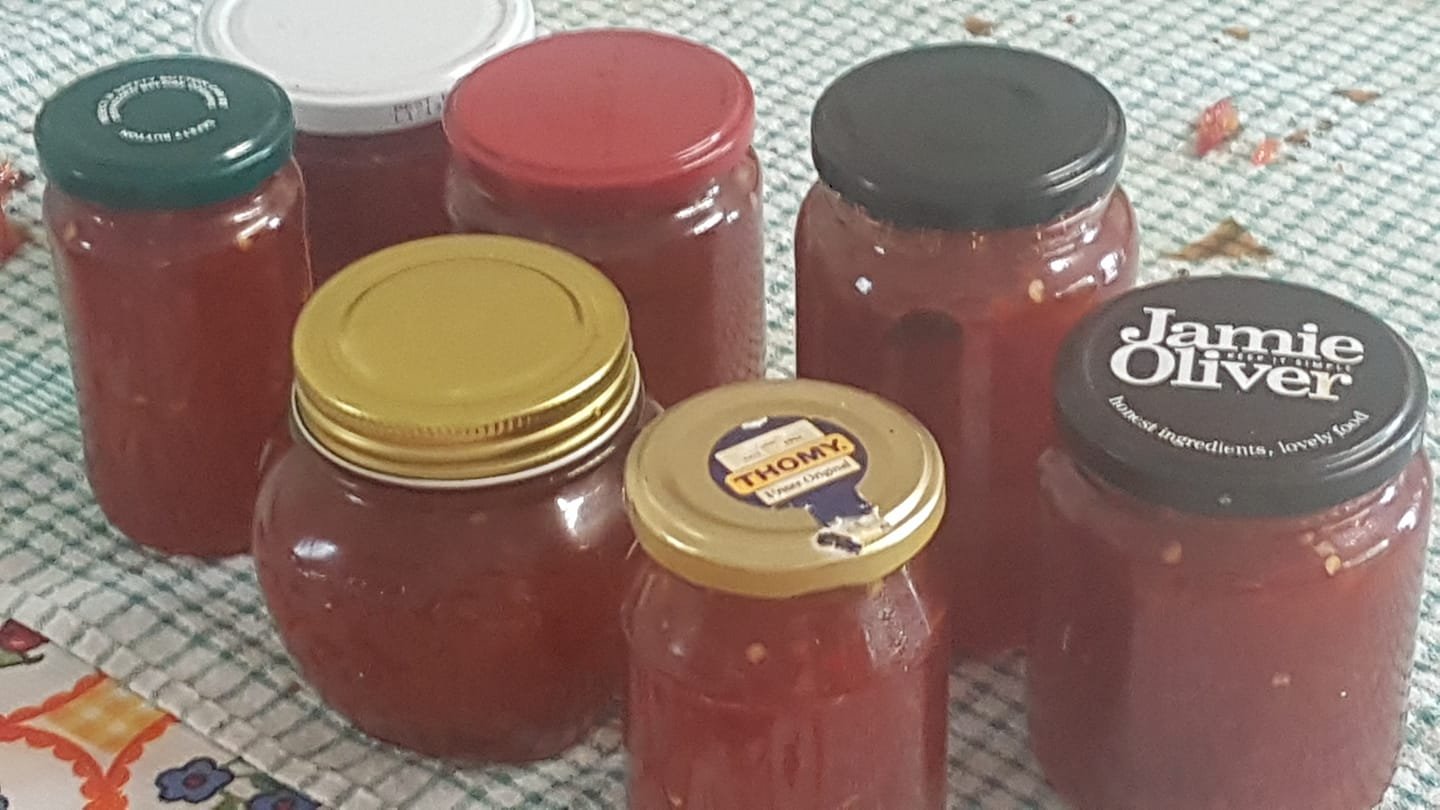
    Final jam in the jars
    Clean and seal the jars while the jam is hot

    The problem with chillis, though, is that you can’t make a meal of them. They are just too strong.

    Here is a chilli jam that is mild enough for most people to heap on a cheese sandwich. Those who like it stronger can simply leave the seeds in. (See the sidebar To Seed or Not to Seed)

    The basic recipe was developed by combining the appropriate features from 15 different recipes at https://chasingchilli.com.au/chilli-jam-recipes-you-need-to-make/

    Sweet peppers provide some bulk of the right colour (they were much, much cheaper than red capsicums at my local shop the day I made the jam) and carrots provide the pectin and body. I originally kept all the vegetable strips quite long in an attempt to create an interesting presentation but, when I saw how hard it was going to be to wrangle into the bottles, I smashed it up in the saucepan with the stick blender.

    The chopped peppers and seeded chillis
    Remove the seeds to reduce the “heat” of the final jam

    Ingredients:

    500g of hot chillis

    500g-1kg of sweet peppers (or capsicums – some people use tomatoes)

    1kg of white sugar

    1 litre of vinegar (I used kambucha vinegar that I had made accidentally by overbrewing my kambucha)

    Method:

    Find enough jars to hold the jam. Allow for a total of about 2 litres for the ingredients listed here.

    Slice and seed the peppers and the chillis (Removing seeds as desired – see discussion below)

    Grate the carrots

    Put the vegetables, sugar and vinegar into a large saucepan

    Put over low heat until it comes to the boil.

    Chilli jam ingredients ready to cook
    Chilli jam ingredients ready to cook

    Turn the oven on low heat

    While the jam is coming to the boil, wash the jars and place in the oven to warm and dry.

    When the jam starts boiling, turn it down as low as possible to keep simmering and stir and test regularly.

    Test by dribbling jam on cold plates and waiting until cool.

    When the jam on the cold plate forms a skin and is sticky, turn off the jam, take the jars out of the oven and place on a clean cloth.

    Ladle the hot jam into the hot jars

    Clean the outside of the jars

    Place lids (or seals) onto the jars while the jam is still hot.

    Allow to cool for 24 hours before moving.

    To Seed or Not to Seed?

    The jam pictured here has the vast bulk of the chilli seeds removed. This makes it much much milder as the seed and the flesh surrounding the seeds contains most of the spice.

    I posted the steps of the recipe on facebook as I prepared the jam and many people commented that they do not remove the seeds. “Leave them in!” “That’s where all the taste is” “My weapons grade sambal uleck retains everything but the stems”

    Regardless of your preference in terms of spice, remember that handling the seeds and the flesh will cause your hands, and anything you touch, to feel like it is burning. I spent one night writhing in agony under a pillow pressed hard against my eyes convinced that I would never see again just because I washed my face with my hands while cleaning up after chopping chillis a couple of years ago.

    One comment on facebook assures me that chilli does not actually burn but only creates the painful sensation of burning. That is good news but most people would prefer to take the precautions and avoid the pain. I do not use gloves, but I am very careful not to touch myself while handling chillis and to wash up regularly with soap and water and lots of rinsing. 18 hours after making the jam my hands still feel hot and swollen.

  • National Guard razes camp at Standing Rock, arresting 76

    National Guard razes camp at Standing Rock, arresting 76

    In this image provided by Morton County Sheriff’s Department, law enforcement and protesters clash near the site of the Dakota Access pipeline on Sunday, Nov. 20, 2016, in Cannon Ball, N.D. The clash came as protesters sought to push past a bridge on a state highway that had been blockaded since late October, according to the Morton County Sheriff’s Office. (Morton County Sheriff’s Department via AP)

    Seventy six protesters were arrested at the Cannon Ball protest camp at Standing Rock in Dakota last week and the camp was razed to the ground. The police and National Guard acted with the US Army Corp of Engineers under direct orders from President Trump to waive a review of environmental impacts and expedite the pipeline. Trump has initiated a vast rollback of environmental legislation and has formally threatened to cut funding from organisations as diverse as University of California Berkeley and the Environmental Protection Authority.

    http://www.countercurrents.org/2017/02/03/police-national-guard-raid-dakota-access-pipeline-protest-camp-arrest-76/

    Sierra Club on Trump’s Fire Sale on Clean Air and Water Safeguards

    Trump signed an executive order this morning requiring that for every new federal regulation implemented, two must be rescinded. “This a pathetic marketing scheme by Donald Trump, not a way to run a country.”

    http://www.commondreams.org/newswire/2017/01/30/sierra-club-trumps-fire-sale-clean-air-and-water-safeguards

    Massive Rollback of Environmental Protections

    http://www.commondreams.org/newswire/2017/01/30/trump-orders-massive-rollback-environmental-protections

    Trump Threatens UC Berkeley Funding Cut After Protest Against Fascistic Provocateur

    Berkeley, one of the top public research institutions in the United States,

    http://www.countercurrents.org/2017/02/03/trump-threatens-uc-berkeley-funding-cut-after-protest-against-fascistic-provocateur/

    US Congress Begins Repeal Of Anti-Pollution Regulations 

    that restricts the dumping of waste by coal companies engaged in a technique known as “mountaintop removal.”

    http://www.countercurrents.org/2017/02/03/us-congress-begins-repeal-of-anti-pollution-regulations/