Category: Climate chaos

The atmosphere is to the earth as a layer of varnish is to a desktop globe. It is thin, fragile and essential for preserving the items on the surface.150 years of burning fossil fuel have overloaded the atmosphere to the point where the earth is ill. It now has a fever. Read the detailed article, Soothing Gaia’s Fever for an evocative account of that analogy. The items listed here detail progress on coordinating 6.5 billion people in the most critical project undertaken by humanity. 

  • G8 leaders agree to emissions cuts and to limit temperatue rise to 2C

    G8 leaders agree to emissions cuts and to limit temperature rise to 2C


    UPDATE: Philip Webster and Nicola Berkovic | July 09, 2009


    Article from:  The Times


    BARACK Obama and other leaders have backed historic new targets for tackling global warming in an agreement designed to pave the way for a world deal later this year.


    For the first time, America and the other seven richest economies agreed to the goal of keeping the world’s average temperature from rising more than 2C.

    They also agreed to cut greenhouse gas emissions by 80 per cent by 2050 as they strove for a worldwide deal at Copenhagen in December.


    The moves were designed to put the squeeze on the world’s developing nations, most of whose leaders will join the G8 for a debate chaired by Mr Obama today.

    There were signs last night that the G13 – the eight joined by China, India, Mexico, South Africa and Brazil – would also sign up to the 2C limit.

    Climate Change Minister Penny Wong, who took part in a marathon meeting of world environment ministers in Rome yesterday, ahead of a meeting of leaders of 17 major economies today, welcomed the G8’s agreement.

    “We welcome the G8 statement today which says quite clearly climate change is a global challenge, it commits these economies to working together and recognises the science that we need to restrain global warming to around two degrees if we are to avoid dangerous climate change,” Senator Wong told the ABC this morning.

    However, Senator Wong said there was still a long way to go to reach agreement on binding targets before December’s global climate change conference in Copenhagen.

    Hopes of an international deal remain on a knife edge because earlier yesterday China and India declined to support the objective of halving their greenhouse gas emissions by 2050, and Hu Jintao, the Chinese President, flew home to deal with escalating problems in his own country.

    While there are signals that India may be prepared to move, G8 leaders do not expect agreement from the developing countries to halve emissions.

    The G8 agreement was also immediately undermined by Russian President Dmitry Medvedev’s top economic aide, who dismissed the target for developed countries to cut emissions by 80 per cent by 2050 as unacceptable.

    “For us the 80 per cent figure is unacceptable and likely unattainable,” Arkady Dvorkovich said.

    “We won’t sacrifice economic growth for the sake of emission reduction.”

    Mr Dvorkovich declined to reveal Russia’s precise targets, saying they ranged from 20 per cent to 60 per cent by 2050.

    “We still have the time to agree our positions before Copenhagan,” Mr Dvorkovich said.

    Even so, the G8 deal was being hailed by leaders.

    British Prime Minister Gordon Brown said the agreement was historic.

    “Today in Italy we have laid the foundations for a Copenhagen deal that is ambitious, fair and effective. The change from where we were two, three, four years ago is significant. The world has now agreed that the scientific evidence on climate change is compelling,” he said.

    The agreement marks a significant step in efforts to limit greenhouse gases, which are blamed for the world’s rising temperature. The G8 previously had not been able to agree on that temperature limit as a political goal.

    It remains only a target, however, and it is far from clear that it will be met, especially as China, India and other rapidly industrialising nations generate and consume more energy from coal and other sources.

    Climate change experts say that the 2C threshold would not eliminate the risk of runaway climate change, but would reduce it. Even a slight increase in average temperatures could wreak havoc on farmers around the globe.

    Mr Brown also welcomed an agreement from the G8 that “significant risks” remained in the world economy and it was too early to start preparing to exit from growth plans at the moment.

    Some leaders, such as Angela Merkel, the German Chancellor, have been calling for early spending cuts to reduce deficits but has been opposed by Britain and America.

    Mr Brown pointed to a sentence in the communique saying that exit strategies should only be put into effect “once the recovery is assured”.

    At a press briefing he said that the G8 had decided to take all necessary steps individually and collectively to deliver global growth. He had been saying that the G8 needed to sound a second wake-up call on the world economy. “That wake-up call is being heard loud and clear,” he said.

    Welcoming the agreement on climate change – made possible by America’s change in stance since Mr Obama succeeded George Bush as president – Mr Brown said: “For the first time the G8 has agreed what I believe are vital decisions that take us on the road to Copenhagen and change the way we look at energy policy.

    “We have agreed for the first time that average global temperatures must rise by no more than 2C. We have agreed as G8 that we want to cut our emissions by 80 per cent by 2050 and we believe this will allow the world to reduce its emissions by 50 per cent.”

    In chairing the major economies forum today, Mr Obama is signalling that he wants to play a big role in the run-up to Copenhagen. The G8 also called on Iran to allow foreign diplomats and visitors to be allowed to conduct their business unhindered. After the violence following the contested election result a number of British Embassy staff were arrested.

    The G8 said embassies in Iran should be allowed to go about their normal business in accordance with the Vienna Convention.
  • Nasa satellites reveal extent of Arctic sea ice loss

    Nasa satellites reveal extent of Arctic sea ice loss


    Study – based on satellite measurements – among first to estimate the thickness of the Arctic ice, rather than surface areas 


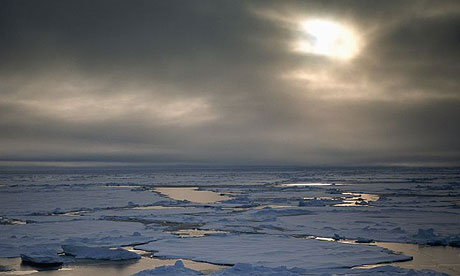
    Near the North Pole in the Russian Arctic

    Arctic sea ice has thinned by more than 40% since 2004. Photograph: Galen Rowell


    The Earth is going thin on top. A new study has revealed that the Arctic Ocean’s permanent blanket of ice around the North Pole has thinned by more than 40% since 2004. Scientists said the rapid loss was “remarkable” and said it could force experts to reassess how quickly the Arctic ice in the summer may disappear completely. They have called for more research to pin down the causes of the change, which they say is probably down to increased melting and shifts in the way the ice moves around.


    The study, based on satellite measurements, is among the first to estimate the thickness of the Arctic ice, rather than just its surface area.


    Ron Kwok, senior research scientist at Nasa’s Jet Propulsion Laboratory in California, said: “Even in years when the overall extent of sea ice remains stable or grows slightly, the thickness and volume of the ice cover is continuing to decline, making the ice more vulnerable to continued shrinkage.”


    The study looked at measurements taken of the Arctic region by the ICESat satellite, launched in 2003.


    Overall, the experts found that the ice, typically up to about 3m thick, thinned by 67cm over the last four winters.


    Converting to ice volume, the scientists worked out the amount of so-called multiyear ice, which persists through Arctic summers, had decreased in the winter by up to 6,300 cubic kilometres since 2005 – a decline of more than 40%. The research is published in the Journal of Geophysical Research: Oceans.


    Kwok said: “Ice volume allows us to calculate annual ice production and gives us an inventory of the fresh water and total ice mass stored in Arctic sea ice. Our data will help scientists better understand how fast the volume of Arctic ice is decreasing and how soon we might see a nearly ice-free Arctic in summer.”


    The Arctic ice cap fluctuates with the seasons, growing in the freezing winter and shrinking over the summer. An important finding of the study is that the majority of Arctic ice no longer survives the summer. In 2003, this multiyear ice made up 62% of the region’s total ice volume. By 2008, this was down to 32%. The remaining 68% was “first-year” seasonal ice, which was open water during the summer, so is thinner and more likely to melt away.


    Earlier this year, scientists warned that sea ice volume reached a record low in 2008 due to an unusually high proportion of the thinner first year ice.


  • G8 polluters drop pledge to cut emissions

    G8 polluters drop pledge to cut emissions


    From correspondents in Italy | July 08, 2009


    Article from:  Australian Associated Press


    MAJOR polluting nations meeting at a G8 summit in Italy have dropped a pledge to halve global greenhouse gas emissions by 2050, a European Union official said.


    “There is indeed a very strong commitment to identify the global goal for substantially reducing global emissions by 2050, but there is no 50 per cent” mentioned in a draft declaration, the official said on condition of anonymity.

    However, the Group of Eight industrialised countries and other major polluters agreed ahead of a three-day G8 summit that the target should be set before a key December climate change meeting in Copenhagen, the official said.


    Leaders are coming under growing pressure to make ambitious commitments to cut greenhouse gas emissions at the summit in L’Aquila ahead of the Copenhagen meeting.

    Officials preparing the summit were “willing” to maintain a target of trying to limit climate warming to two degrees Celsius compared to pre-industrial levels, the official said.

    They also agreed that greenhouse gas emissions should peak “as soon as possible” whereas countries belonging to the G8 were seeking a target of 2020 for the peak in pollution, the official added.


  • Obama makes nuclear compromise to pass clean energy bill

    Obama makes nuclear compromise to pass clean energy bill


    Endorsement of nuclear revival suggests president is open to further compromises in order to pass climate change bill


    The Obama administration endorsed a revival of America’s nuclear industry yesterday in an effort to build forward momentum for climate change legislation before the Senate.


    The seal of approval for nuclear power – a cause embraced by Republican senators – came on day one of a full-on lobbying effort by the White House for one of Obama’s signature issues.


    Obama sent four of his top lieutenants to the Senate – his secretaries of energy, interior, agriculture and the head of the Environmental Protection Agency (EPA) – to try to drum up support for a global warming bill.


    The PR effort saw direct appeals to the farming and nuclear lobbies – some of the fiercest critics of Obama’s clean energy agenda – with Steven Chu, the Nobel-winning energy secretary, calling for new nuclear plants to re-establish America’s technological dominance in the world.


    “I think nuclear power is going to be a very important factor in getting us to a low carbon future,” Chu told the Senate’s environment and public works committee. “Quite frankly, we want to recapture the lead on industrial nuclear power. We have lost that lead as we have lost the lead in many energy technologies and we want to get it back.”


    The endorsement of a nuclear revival – a generation after the last reactor was commissioned – suggests the Obama administration is open to further compromises as it seeks to find a path through the Senate. The House of Representatives narrowly passed a climate change bill late last month.


    Republicans in the Senate, who are almost universally opposed to action aimed at reducing greenhouse gas emissions, as well as Democrats from rust belt states, have been clamouring for a “nuclear renaissance” in America, which would see the construction of 100 new nuclear power plants by 2030.


    The administration officials also tried to make inroads among the powerful farmers’ lobby, saying they hoped the effort could help ensure passage of the bill through the Senate.


    Yesterday’s hearing marks the opening round of a second major push by the White House for Obama’s climate and energy agenda.


    Obama is in Europe where he hopes to persuade the G8 to commit to limiting global warming to 2C, and to persuade Russia to make its lumbering industries more efficient.


    But the White House acknowledges it must also demonstrate American willingness by ensuring passage of a climate bill through both houses of Congress by December, when international climate change negotiations end in Copenhagen. It is widely believed that the international community will not sign up to action on climate change without evidence of US commitment.


    The Democratic leadership in the Senate hopes to use the house bill as a template. It has pencilled in a schedule that would see the bill clear the committee process by mid-September and move to vote by late autumn.


    But the way ahead is daunting. Despite the Democrats’ 77-seat advantage in the house, the bill gained just 219 votes – one more than a bare majority – and the reform package had swollen to more than 1,427 pages. Much of that bloat was in the political sops to ensure the bill’s support: concessions to farmers that ultimately damage the bill, protectionist measures to help heavily polluting industries – and even a hurricane centre in Florida.


    The administration’s case is also damaged by rising criticism of the bill, from environmentalists who say it does not go far enough as well as those opposed to any action.


    Lisa Jackson, head of the EPA, stopped short of endorsing the package yesterday, saying: “It sends the right signal and you all in the Senate have work to do.”


    But she said the Senate had little choice, and that inaction on climate change could lead to America’s global economic decline.


    “Clean energy is to this decade and the next what the space race was to the 1950s and 60s and America is behind,” Jackson told the Senate. “Governments in Asia and Europe are ahead of the United States in making aggressive investments in clean energy technology.”


  • Drought alert as El Nino works up double whammy

    Drought alert as El Nino works up double whammy


    Asa Wahlquist, Rural writer | July 07, 2009


    Article from:  The Australian


    EASTERN Australia is increasingly likely to be hit by the drought-inducing double whammy of an El Nino and a positive Indian Ocean Dipole.


    The Bureau of Meteorology is putting the odds of an El Nino at more than 50 per cent.


    Bureau meteorologist Andrew Watkins said there were several signs of a looming El Nino in the Pacific Ocean. “We have trade winds that are weaker than normal,” he said.


    “We have warmer than normal sea-surface temperatures; they are about one degree warmer than normal in the equatorial Pacific. The water below the surface of the ocean is up to three degrees, or even a bit more, above normal. The SOI (southern oscillation index) has been negative, as well.”


    However, there is not the cloudiness along the equatorial Pacific usually associated with El Nino events. Nor are the ocean and atmospheric systems reinforcing each other, which happens in an El Nino.


    “The climate models are pretty much in agreement there will be a continued warming,” Dr Watkins said. “Most of them are saying there will be an El Nino later in the year.” El Nino events are linked with reduced rainfall in eastern, northern and parts of southern Australia in the second half of the year, and higher daytime temperatures. The last El Nino events occurred in 2002 and 2006, when, according to the bureau, “rainfall deficiencies were widespread and severe”.


    There is also growing interest in the influence the Indian Ocean has on Australia’s rainfall.


    The Indian Ocean Dipole, like El Nino, is a coupled ocean-and-atmosphere phenomenon. When it is in its positive phase, the Indian Ocean is cooler near Australia. Dr Watkins said scientists believed that a positive IOD reduced rainfall over southeastern Australia.


    CSIRO scientist James Risbey said that although most of the models pointed to a looming El Nino, there was less consistency about the IOD.


    “The models may be leaning towards a positive IOD, but some of them have flip-flopped, which lowers our confidence,” he said.


    “And when we look at the observations, it is not classically set up for a positive IOD. We don’t see cold water where we expect it.”


    Some scientists thought the Indian Ocean was “in part a slave to the Pacific Ocean”, Dr Risbey said. “They believe the IOD is just a reflection of what the Pacific Ocean does to the Indian Ocean.”


    There have been 11 positive-IOD events since 1958. Seven of them coincided with El Ninos in 1963, 1972, 1977, 1982, 1994, 1997 and 2006. Dr Risbey said ocean temperature was critical to forecasting because it changed slowly: “Once you get an anomaly in the ocean, it tends to persist for some months.”


    In El Nino years, as was happening this year, Dr Risbey said a big pool of warm water came to the surface in the Pacific Ocean. That not only led to changes in rainfall patterns, it also pushed up global temperatures. “There is a chance we could set a record for global mean temperatures this year with the El Nino,” he said.


    Story Tools


  • Coral condemned to extinction by CO2 levels, warns Attenborough

    Coral condemned to extinction by CO2 levels, warns Attenborough


    Coral is the canary in the cage as damage can be seen most quickly, veteran naturalist tells Royal Socie 


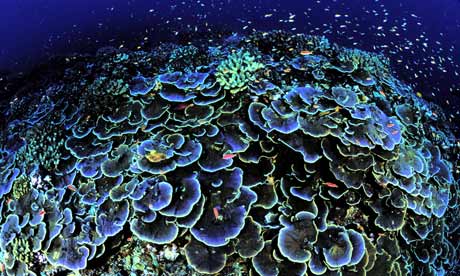
    A coral seen off Jarvis Island in the Pacific Ocean

    A coral seen off Jarvis Island in the Pacific Ocean. Photograph: Jim Maragos/AP


    David Attenborough joined scientists yesterday to warn that carbon dioxide in the atmosphere is already above the level which condemns coral reefs to extinction in the future, with catastrophic effects for the oceans and the people who depend upon them.


    Coral reefs support a quarter of all marine life including more than 4,000 species of fish. They also provide spawning, nursery, refuge and feeding areas for creatures such as lobsters, crabs, starfish and sea turtles. This makes them crucial in supporting a healthy marine ecosystem upon which more than 1bn people depend for food. Reefs also play a crucial role as natural breakwaters, protecting coastlines from storms.


    Attenborough said the world had a “moral responsibility” to save corals.


    He was speaking yesterday at the Royal Society in London, following a meeting of marine biologists. At the current rate of increase of atmospheric CO2, they said, coral would become extinct within a few decades.


    “A coral reef is the canary in the cage as far as the oceans are concerned,” said Attenborough. “They are the places where the damage is most easily and quickly seen. It is more difficult for us to see what is happening in, for example, the deep ocean or the central expanses of ocean.”


    “Anybody’s who’s had the privilege of diving on a coral reef will have seen the natural world at its most glorious, diverse and beautiful,” said Attenborough. “[There is a] moral responsibility one has to the natural world. Also you have responsibility to future generations, to your future grandchildren and great grandchildren.”


    Increasing carbon dioxide in the atmosphere has a double effect on coral. Global warming means warmer seas, which causes the corals to to bleach, where the creatures lose the symbiotic algae they need to survive. Carbon dioxide also makes seas more acidic, which means the corals find it difficult to prevent their exoskeletons from dissolving.


    “We’ve already passed a safe threshold for coral reef ecosystems in terms of climate change. We believe that a safe level for CO2 is below 350 parts per million,” said Alex Rogers of the Zoological Society of London and International Programme on the State of the Ocean, who helped organise yesterday’s meeting.


    Carbon dioxide in the atmosphere has risen from 280 ppm before the industrial revolution to around 387ppm today. Environmentalists say that any new global deal on climate must restrict the growth of CO2 levels to 450ppm, though more pessimistic scientists say that the world is heading for 550ppm or even 650ppm.


    “When we get up to and above 450ppm, that really means we’re into the realms of catastrophic destruction of coral reefs and we’ll be moving into a planetary-wide global extinction,” said Rogers.


    “The only way to get to 350ppm or below is not only to have major cuts in CO2 emissions but also to draw CO2 out of the atmosphere through measures such as geo-engineering.”


    Attenborough said the plight of the corals was another example of why the control of carbon was so important to the world’s inhabitants. “Each ecological disaster or problem traces its cause back to carbon. To quibble about this is really fiddling while Rome burns. If we do not control the emission of carbon, this world is heading for a major catastrophe and this is one of the first to be staring us straight in the face.”