Neville Gillmore
Climate change threatens Ganges, Niger and other mighty rivers
- The Guardian, Wednesday 22 April 2009
- Article history
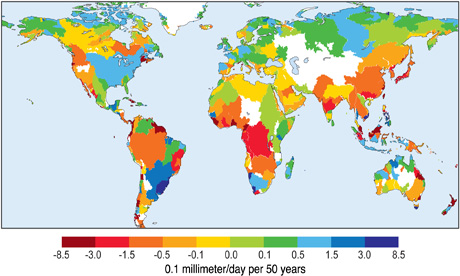
This map shows the change in run-off inferred from streamflow records worldwide between 1948 and 2004, with bluish colors indicating more streamflow and reddish colors less. Graphic: Journal of Climate, modified by UCAR
Some of the mightiest rivers on the planet, including the Ganges, the Niger, and the Yellow river in China, are drying up because of climate change, a study of global waterways warned yesterday.
The study by the National Center for Atmospheric Research in Colorado found that global warming has had a far more damaging impact on rivers than had been realised and that, overwhelmingly, those rivers in highly populated areas were the most severely affected. That could threaten food and water supply to millions of people living in some of the world’s poorest regions, the study warned.
“In the subtropics this [decrease] is devastating, but the continent affected most is Africa,” said NCAR’s Kevin Trenberth. “The prospects generally are for rainfalls, when they do occur, to be heavier and with greater risk of flooding and with longer dry spells in between, so water management becomes much more difficult.”
The scientists examined recorded data and computer models of flow in 925 rivers, constituting about 73% of the world’s supply of running water, from 1948-2004. It found that climate change had had an impact on about a third of the major rivers. More than twice as many rivers experienced diminished flow as a result of climate change than those that saw a rise in water levels.
In addition, those rivers that did see a rise were in sparsely populated, high latitude areas near the Arctic Ocean where there is rapid melting of ice and snow.
The authors said their study brought new clarity to an understanding of the long-term effects of climate change on waterways. “I think our study settles the question regarding long-term trends in global streamflow,” said Aiguo Dai, the lead author of the report.
The greatest danger was posed to those dependent on the Niger in West Africa, the Ganges in South Asia and the Yellow river in China. The Colorado river in the US was also experiencing a drop in water levels.
Other big rivers in Asia, such as the Brahmaputra in India and the Yangtze in China, remained stable or registered an increase in flow. But the scientists said they too could begin shrinking because of the gradual disappearance of the Himalayan glaciers.
The only rivers that could gain strength from climate change were those that flow north of the 50th parallel. “Global warming raises temperature and precipitation there and it may not be a bad thing,” said Dai. “However, these are sparsely populated regions.”
The study found that climate change, which had disrupted rain patterns and evaporation, had a far greater and more damaging effect on the world’s rivers than other human-made factors such as dams, and diverting water for irrigation. “For many of world’s large rivers the effects of the human activities on yearly streamflow are likely small compared with that of climate variations during 1948-2004,” the study said.
It also had a knock-on effect because the rivers empty into the world’s oceans. As the rivers shrink, oceans were growing saltier. During the lifespan of the study, fresh water discharge into the Pacific ocean fell by about 6% – or roughly the annual volume of the Misssissippi.
