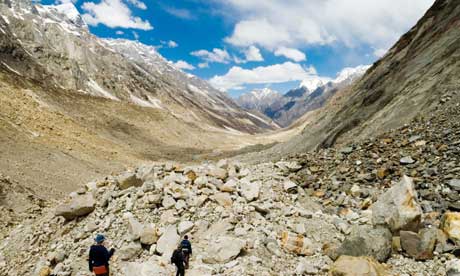
Trekkers crossing Gangotri glacier in Indian Himalayas. Photograph: Alamy
For centuries, writers, painters and photographers have been drawn to the wild and seemingly indestructible beauty of glaciers. More practically, they are a vital part of the planet’s system for collecting, storing and delivering the fresh water that billions of people depend on for washing, drinking, agriculture and power. Now these once indomitable monuments are disappearing. And as they retreat, glacial lakes will burst, debris and ice will fall in avalanches, rivers will flood and then dry up, and sea levels will rise even further, say the climate experts. Communities will be deprived of essential water, crops will be ruined and power stations which rely on river flows paralysed.
As a result, people will have to change their lifestyles, their farming, even move their homes, says Achim Steiner, executive director of the United Nations Environment Programme (UNEP). He also fears the problem could exacerbate tensions over inadequate supplies between neighbouring states and countries, possibly spilling over into conflict.
‘We’re talking about a major transformation, from household livelihood to big industries,’ says Steiner. ‘While I’m always cautious about “water wars”, certainly the potential for water to become a trigger for more tension and, where there’s already conflict, to exacerbate conflict is another issue that’s not hypothetical.’
The scale of the problem so alarms Lester Brown, a leading environmental thinker, that he fears huge populations dependent on glacier-fed rivers in Asia – 360 million on the Ganges in India and 388 million on the Yangtze in China alone – will not be able to feed themselves, with devastating effect on already rising global food prices.
‘These populations are larger than the populations of any other country in the world,’ said Brown. ‘We know from models there will be shifts in rainfall, crop yields reducing, but these are theoretical. Here there’s a degree of certainty we’ve not seen before in terms of an historically negative effect on food security.’
Glaciers act like gigantic water towers: snow falls on the top in wet seasons, where it freezes and compacts over years, while melting water at the bottom is released gradually, keeping rivers flowing even in the hottest weather. ‘Glaciers are like a bank,’ says Professor Wilfried Haeberli, director of the World Glacier Monitoring Service. ‘You have income – mainly snow – and you have expenditure – mainly melting: the difference between snowfall and melting is the yearly balance.’
Since at least 1980 the service has kept a constant record of this net gain or loss in mass balance of 30 ‘reference’ glaciers in nine mountain ranges around the world. It has also used travellers’ diaries, photographs, and the clues left on landscapes scarred by the moving mass of ice and debris to map historic growth and the gradual decline of glaciers since the mid-19th century.
From 1850 to 1970, the team estimates net losses averaged about 30cm a year; between 1970 to 2000 they rose to 60-90cm a year; and since 2000 the average has been more than one metre a year. Last year the total net loss was the biggest ever, 1.3m, and only one glacier became larger. Worldwide, the vast majority of the planet’s 160,000 glaciers are receding, ‘at least’ as much as this, says Haeberli, probably more – a claim supported by evidence from around the world.
In North America, Dr Bruce Molina of the US Geological Survey says that in Alaska ’99-plus per cent of glaciers are retreating or stagnating’.
In the European Alps, a report last year by UNEP said glaciers declined, from a peak in the 1850s, by 35 per cent by 1970 and by 50 per cent by 2000, and lost 5-10 per cent in the mega-hot year of 2003 alone.
UNEP has also reported declines in the last 50-150 years of 1.3 per cent in the Arctic islands to 50 per cent in the North Caucasus in Russia, 25-50 per cent in central Asia, a 2km retreat of the massive Gangotri glacier which feeds the Ganges, 49 to 61 per cent in New Zealand, and 80 per cent in the high mountains of southern Africa. There is also ‘considerable’ shrinking of medium and small glaciers in central Chile and Argentina accompanied by ‘drastic retreat’ of glaciers in Patagonia to the south.
The only region where glaciers are advancing is Scandinavia, where climate change has increased precipitation to more than compensate for higher melting, and even there the growth has stagnated, says Haeberli.
Based on the forecast increase in global temperatures this century, the UNEP report warned of ‘deglaciation of large parts of many mountain regions in the coming decades’. Perhaps most shockingly, it predicted two-thirds of China’s glaciers would disappear by 2050, and ‘almost all would be gone by 2100’.
Ironically, the immediate local threat is that more meltwater will combine with rains to cause floods – a problem already suspected in parts of China, says Molina: ‘Some large floods have destroyed their infrastructure, taking out bridges, roads and villages. Another threat is that meltwater will collect in glacial lakes until they burst. In the Himalayas, UNEP says some lakes have grown 800 per cent since the 1970s.
Longer term, though, the problem is less water, as even fast-melting glaciers are too small to keep rivers flowing during dry seasons. To make matters worse, freshwater supplies are also threatened by evaporation in warmer temperatures, pollution and growing demand from a rising and more affluent population. And – like glaciers – snow and thus snowmelt is also declining in the same areas.
This would have an immediate effect on people who depend on rivers for washing and drinking, irrigating crops, powering hydroelectric stations, transport and – often – religious and cultural traditions. Further afield, drying rivers would no longer be able to recharge groundwater tables used by cities.
The problem is perhaps most acute in Asia, where glaciers are an important source for nine major rivers which run through land occupied by 2.4 billion people. In Pakistan, for example, 80 per cent of agricultural land is irrigated by the Indus, which the WWF last year highlighted as one of the world’s 10 big at-risk rivers because retreating glaciers provide 70-80 per cent of its flow.
On a global level, scientists warn that melting glaciers are contributing more than ever to rising sea levels: expansion of warmer water is estimated to cause two-thirds of the problem, but melting glaciers and icecaps are the second biggest contributor. A recent paper published by Science calculated acceleration of glacier melt could add 0.1-0.25m to sea-level rise by 2100.
Globally there are also concerns that water and food shortages will force more people to flee: just last week the European Commission predicted climate change would be a ‘major driver’ for ‘millions’ of environmental migrants within a decade.
Experts are calling on political leaders to step up attempts to cut greenhouse gas emissions to slow and eventually stop global warming. Before then, however, they say governments need to do much more to encourage water efficiency, change to less water-thirsty crops and build flood protection and storage where possible. ‘It’s not a reason to sit back and say “it’s all too late”,’ insists Steiner.