Category: General news

Managing director of Ebono Institute and major sponsor of The Generator, Geoff Ebbs, is running against Kevin Rudd in the seat of Griffith at the next Federal election. By the expression on their faces in this candid shot it looks like a pretty dull campaign. Read on

  • The John James Newsletter 102

    The conversation has been marked as not important.
    1 of 8

    The John James Newsletter 102

    Inbox
    x

    John James

    8:20 AM (7 minutes ago)

    to John
    The John James Newsletter 102
    30 January 2016
    The Roman Empire had no need for diplomacy. Nor does the US. Power is enough. Only the weak rely on it 
    Boutros Boutros-Ghali
    Terrorism is the war of the poor. War is the terrorism of the rich
    Leon Uris
    The Zika virus foreshadows our climate future
    I’ve spent much of my life chronicling the ongoing tragedies stemming from global warming: the floods and droughts and storms, the failed harvests and forced migrations. But no single item on the list seems any more horrible than the emerging news from South America about the newly prominent Zika disease.
    Zika and the New Climate Dystopia
    Human Hothouse as Disease Multiplier: authorities in Brazil, Colombia, Jamaica, El Salvador and Venezuela were urging women to avoid getting pregnant… It is unthinkable: the absolute core of a dystopian future. Microcephaly among infants is terrifying. Its impact strikes at the very heart of what it means to be a human being.
    More holes than fingers? Beijing struggles to plug capital flight
    The risk for policymakers is that so much money will exit China it will undo their efforts to reinvigorate flagging productive investment. In graphs and numbers, Li’s slideshow ran through some of the reasons why many are sceptical that the wobbly economy is turning around soon: an aging society, slowing growth, and the slide of the yuan against the dollar.
    Trudeau launches Canada into a radically new approach to Indigenous affairs 
    During the 2015 election campaign, Trudeau made major Indigenous policy commitments. More than C$3 billion in new funding was promised for Indigenous education, infrastructure and post-secondary support for Indigenous students.
    Plastics Will Soon Outweigh Fish in World’s Oceans
    Plastics production will account for 20% of oil consumption and 15% of the global annual carbon budget by 2050.
    Which European countries have produced the most ISIS fighters?
    About a fifth of all foreign fighters in Iraq and Syria now come from Western Europe. Belgium, for example has more citizens fighting in Iraq and Syria per capita than any other European country
    Australia’s Dark Secrets and Dishonest Politics
    Is Australia a version of apartheid South Africa? Ask a black South African who has looked behind the facades. No country since apartheid South Africa has been more condemned by the UN for its racism than Australia.
    The Storm That Will Unfreeze the North Pole
    Warm Arctic storms set to unfreeze the North Pole — That’s 55F above normal for January
    Australian coalmines are one of riskiest investments in the world 
    Australian, Chinese and US coal-fired power stations are the most vulnerable to environmental dangers
    Australia drops 10 spots in Greg Hunt’s most trusted climate rankings
    Environment minister has described Yale’s environmental performance index as ‘the most credible in the world’ but Australia performs badly in latest ratings leaving only Saudi Arabia with a worse ranking among wealthy nations.
    15 economic milestones which have led to the current eurozone crisis
    the seeds of the current eurozone woes were first sown as far back as three decades ago.
    India ranks 76 in Corruption Perception Index
    See map: many “clean” countries – Denmark Finland, Sweden, Norway and Netherlands have “dodgy records elsewhere”.
    The men in the middle
    Two young, charismatic leaders in Israel and Turkey are taking on right-wing governments and trying to transform their countries’ politics. Can they change the Middle East without firing a shot?
    The Silence of Ageism in the Progressive Movements
    In much of the progressive social sector there has been what can only be called a de-commissioning of older activists. To be clear, by “older”—and I don’t want to scare you—I mean people over the age of 45. http://www.telesurtv.net/english/opinion/The-Silence-of-Ageism-in-the-Progressive-Movements-20160104-0006.html
    Another earthquake hits Oklahoma as concern rises over wastewater injection 
    Oklahoma has become one of the most earthquake-prone areas in the world, with the number of quakes magnitude 3.0 or greater skyrocketing from a few dozen in 2012 to more than 800 in 2015. Many of the earthquakes are occurring in swarms in areas where injection wells pump salty wastewater
    A single gas well leak is California’s biggest contributor to climate change
    Enormity of Billowing Methane Plume in California ‘Cannot Be Overstated’
    The leak is spewing 50,000 kilograms of gas per hour—the equivalent to a volcanic eruption.
    Mapping Methane Leaks with Google Street View Cars 
    Google partnered with the Environmental Defense Fund on a project to use Google’s fleet of Street View cars to map methane levels in three US cities to record methane leaking from city pipes
    Killed ISIS Commander’s Cell Phone Shows Direct Ties to Turkish Intelligence
    This is the second NATO country implicated in assisting the IS. The first was Canada.
    Obama is an exceptionally weak, and even clueless, President. 
    The man has no vision, no understanding of international relations, his culture is minimal while his arrogance appears infinite – he is all about form over substance.
    Australian regulators struggle with shift to an energy democracy
    Ever since the theories of Thomas Edison lost out to those of fellow energy pioneer Nikolai Tesla a century ago, the electricity industry has been dominated by centralised power.
    Palestinian Uprising Is About More Than Knives
    Palestinians form a human chain around Jerusalem’s Old City on 26 December, calling on Israel to return the bodies of Palestinians slain by its forces
    and
    China Wades Into The Iran-Saudi Swamp
    Warrior prince Mohammed bin Sultan is thinking of selling Aramco. Why not offer it to Beijing? But be prepared to be paid in yuan. And all the oil goes to China. Talk about a New Silk Road offer one can’t refuse.
    Why the million-dollar view is bad for our body and our soul
    What we therefore ought to realise is that the million-dollar view is the bait of a modern trap – its fatal destiny, most tellingly settled by T.S. Eliot, is simply to be “distracted from distraction by distraction”.
    Examining the Syria War Chessboard
    The war in Syria is an unparalleled crisis. It has gone far beyond an internal political struggle and is marked by a complex array of forces that the U.S. Empire hopes to command: Saudi Arabia, Turkey, Kurdistan, Iran, Lebanon, Iraq and more.
  • The John James Newsletter 101——————–

    4 of 16

    The John James Newsletter 101

    Inbox
    x

    John James

    7:50 AM (4 hours ago)

    to John
    The John James Newsletter 101
    23 January 2016
    Government is the Entertainment Division of the military-industrial complex
    Frank Zappa
    Political Correctness is a doctrine, recently fostered by a delusional, illogical minority and promoted by a sick mainstream media, which holds the proposition that it is entirely possible to pick up a piece of shit by the clean end
    Harry Truman
    Extreme Arctic Methane Threat
    Sudden high Arctic methane release at Svalbard in late 2010 and similar sudden methane peaks also occurred at Barrow Point. Giant fountains/torches/plumes of methane entering the atmosphere up to 1 km across on the East Siberian Shelf. Methane eruption is now so similar to Permian extinction event temperatures and methane data. This paints a frightening picture of the beginning of the now uncontrollable destabilisation of the subsea Arctic methane hydrates which started in late 2010. This process of methane release will accelerate exponentially, release huge quantities of methane into the atmosphere and lead to the demise of all life on earth BEFORE the middle of this century.
    This is a dense article and some of the diagrams are so jam-packed with information that you have to spend time on them. We should understand how few years we have left – not from C02 but from methane. Go to a companion article for some very instructive diagrams, and follow them from beginning to end.
    Light made forward estimates 4 years ago that complete Arctic sea ice melt would start at the end of last year. This was correct (see next item) and in Figs.15 and 22 he shows that by 2050 we could have complete destabilisation of all ice sheets that would raise sea levels 63 metres. That’s a while away, but its the process that’s important, for rising seas do not arrive in a moment, but are gradually stretched over time (see later items on melting Greenland): Fig.20 forecasts that by the end of 2018 lots of Bangladesh could be inundated, and we can imagine the consequences of that. The point is that we don’t have much time to develop the RESILIENCE these times will require of us.
    25 years of Arctic ice melt in one minute – Timelapse
    Arctic Ocean ice levels are in decline and large ice packs which survive more than one summer are less frequent
    Greenland’s ice becoming ‘Swiss cheese’ due to global warming
    “We no longer see giant icebergs calving from glaciers, releasing ice into the sea, The majority of water is coming from surface melt. Greenland is melting ahead of schedule.”
    Icebergs are Showing up off Newfoundland in January, four months early
    A Terrifying Jump in Global Temperatures — December 2015 at 1.4 C above 1890
    A monster El Nino firing off in the Pacific. A massive fossil fuel driven accumulation of greenhouse gasses pushing CO2 levels well above 400 parts per million. The contribution of other greenhouse gasses pushing the total global heat forcing into the range of 485 parts per million CO2e. Given this stark context, we can definitely say this is serious.
    and our Sydney Morning Herald
    and James Hansen
    and our own Climate Council
    Australia snubs 1st major post-Paris summit after killing renewables target
    While Australia’s renewable energy target is at a standstill global investment in renewables reaches record levels.
    Australia 5th in world in small scale rooftop solar PV in 2015, and spent $2.2 billion
    A Crisis Worse than ISIS? Bail-Ins Begin
    Your life savings could be wiped out in a massive derivatives collapse. Bank bail-ins have begun in Europe, and the infrastructure is in place in the US
    The worst year for asset allocation funds since 1937
    The wealth of the richest 62 jumped 44% in 5 years while the poorest 3.6 billion plunged 41%.
    Ultra-Rich ‘Philanthrocapitalist’ Class Undermining Global Democracy
    Powerful philanthropic foundations—controlled by wealthy individuals—are actively undermining governments. setting the agenda for international bodies like the UN and are undermining democracy and local sovereignty.
    Collapse  
    Afghanistan, after the longest military campaign in US history, is being handed back to the Taliban. Iraq no longer exists as a sovereign nation, but has fractured into three pieces, one of them controlled by radical Islamists. Egypt has been reformed into a military dictatorship. Libya is a defunct state in the middle of a civil war. The Ukraine has been reduced to pauper status in record time—less than a year.
    We have overwhelming global power
    “We are history’s designated custodians of the international system. When the Soviet Union fell, something new was born: a unipolar world dominated by a single superpower unchecked by any rival and with decisive reach in every corner of the globe. This is a stagering new development in history, not seen since the fall of Rome. Even Rome was no model for what America is today.”
    A failed strategy
    US bases have cost tens of billions and provided support for a long list of undemocratic regimes, including Saudi Arabia, Bahrain, Qatar, and Djibouti. They have enabled a series of military interventions which have turned the Middle East into a cauldron of sectarian-tinged power struggles, failed states, and humanitarian catastrophes, fuelled radicalism, anti-Americanism, and the growth of the very terrorist organizations now targeted by the supposedly new strategy.
    Lavrov: Americans are ‘running the show’ in Ukraine
    Who Stole 143 Tons of Gold From the Libyan People?
    Clinton’s Emails Have Disclosed the Real Reason for Gaddafi’s Overthrow
    and
    Chaos has escalated since Gaddafi’s death. 
    ISIS  have built a stronghold in Sirte and earns money through running the migrant boat trade.
    1,000 crack British troops deployed to Libyan oil fields to ‘halt the advance of ISIS’ 
    Mapping words around Australia
    Togs or swimmers? Why Australians use different words to describe the same things. A series of maps showing differences has sparked fierce debates online over the virtues of calling a barbecued sausage served in a single slice of bread a “sausage in bread” or a “sausage sandwich”.
    Autistic explosions abound 
    The rise of autistic spectrum disorder is a cultural phenomenon, linked to how the news media interact with and reinforce trends in other branches of the culture.
    How the Oil Industry Conquered Medicine, Finance and Agriculture
    Brilliant investigative journalism reveals how the oil industry has shaped and is ruling the world
    Irradiated
    The hidden legacy of 70 years of atomic weaponry: At least 33,480 Americans dead and 107,394 diagnosed with cancers and other diseases after building the nation’s nuclear stockpile over the last seven decades.
    Inside IS Terror Weapons Lab
    From a “jihadi university” in the Syrian city of Raqqa, the IS scientists have stunned western weapons experts by producing a homemade thermal battery for surface-to-air missiles.
    The “Hong Kong” of ancient Egypt
    Wood from Greek ships and Egyptian figurines dedicated to a “festival of drunkenness” are among more than 10,000 artefacts discovered on the site of the city of Naukratis, which was on the Nile delta and reveal a vast trading network befitting an international city with a history spanning 1,000 years.
    US police killed 1,126 people in 2015 – video 
    Doubting The Oil Peak
    Russia has peaked. China also and Brazil is very close to peaking if it has not already. I just don’t see the promise of a resurgent oil production that will surpass the 2015 peak.
    London Gold Fix Closed – Sign of Drastic Changes the World Financial System Is To Go Through
    There are many indirect signs that the Rothschilds  played the game of lowering the gold price to automatically strengthen the dollar. The Rothschilds  used different shady schemes to buy the precious metal, so, naturally, they needed the lowest price possible. London gold fixing functioned to carry out this task. They got gold from everywhere they could. Central banks and treasuries were the main sources. According to official data, there are 8100 tons of gold in Fort Knox. The storage has not been audited for sixty years. According to my estimates, the probability this gold being there is nil.
    Is this why the Saudis may sell part of Aramco?
    Washington Lining Up House of Saud For The Chop?
    The US has allowed the Saudi elite to “fund Islamic terrorists” in a tawdry trade-off for the supply of oil.
    Desperation does not even begin to describe the current plight of the House of Saud.
    Wind power a false dream
    It would be elegant if wind and solar energy capturing devices could actually maintain a modicum of the wonderfully rich lifestyles many of us live, but large wind turbines have an eco-cost.
  • VStrange bedfellows

    The conversation has been marked as not important.
    8 of 24

    Strange bedfellows

    Inbox
    x

    Ellen Sandell MP

    2:08 PM (7 hours ago)

    to me

    Engie, the owner of Hazelwood power station, has just launched a massive global solar initiative. It’s more urgent than ever to Replace Hazelwood – can you ask your friends to sign the petition now?

    Dear Neville,

    There’s something strange about this.

    Engie, a multinational energy giant, has announced its plan to champion a 1000 gigawatt global solar initiative. But tucked away in Engie’s back pocket is Hazelwood, Australia’s dirtiest power station.

    At the World Future Energy Summit this week, Hazelwood’s owner Engie launched the Terrawatt Initiative, a global plan to install 1000 GW of solar by 2030. Engie’s latest commitment to solar makes it clearer than ever that the writing is on the wall for coal plants like Hazelwood.

    Engie has realised the age of coal is over. Coal-fired power stations like Hazelwood are now toxic assets, and a threat to Engie’s new, renewables-friendly image.

    The Andrews Labor Government needs to act now to responsibly phase out Hazelwood and replace it with clean energy — before Engie simply locks the doors and walks away, leaving the Latrobe Valley community stranded next to a big hole in the ground.

    Can you forward this email to five friends and ask them to click here & sign the petition to Replace Hazelwood with clean energy?

    Hazelwood is embarrassing for Engie, and it’s embarrassing for Victoria. It’s time the Labor Government took responsible action to replace Hazelwood with clean energy and implement a transition plan in the Latrobe Valley.

    Help us build the pressure on Labor to act now – forward this email to five friends and ask them to add their name to the petition at www.replacehazelwood.com.au.

    Thanks for standing with me,

    Ellen

    Follow Elle
  • 700,000 Australian buildings at risk from Sea Level Rise

    Friday, March 16, 2007

    700,000 Australian buildings at risk from Sea Level Rise

    An Insurance industry study in Australia has identified 700,000 buildings at risk nationwide from rising sea levels caused by human induced climate change. The study was done in 2006.
    Karl Sullivan from the Insurance Council of Australia said “We’re working closely with government to try to map and understand what those risks are as climate change starts, or what the exact details of climate change may be and how it may manifest.” according to the ABC 7.30 Report.

    According to 7.30 Report journalist Matt Peacock the Insurance report specifies that Sea Level Rise associated with King tides and storm surges may effect more than 700,000 buildings on the Australian coast. “In the Northern Territory nearly 900 coastal buildings, mainly in Darwin, are at risk. Along the Tasmanian coastline, more than 17,000 addresses are considered vulnerable. More than 60,000 in South Australia, mostly around Adelaide, and along the Victorian coast over 80,000, mainly around Melbourne. In Western Australia, 94,000 buildings have been identified around Perth, but the biggest concern is along the eastern seaboard; more than 200,000 buildings are considered vulnerable on the NSW coast, including Sydney. Queensland faces the largest risk, with almost 250,000 buildings under threat, stretching from the Gold Coast to the Sunshine Coast.”

    Barrie Pittock, former head of the CSIRO and a contributor to the IPCC report, said on the 7.30 Report: “We have an increase in the outflow of glaciers from Greenland and parts of Antarctica already that have been observed. The latest papers suggest a rise by 2100 between about 50 centimetres and 1.5 metres, which is quite a lot more than the IPCC report.”

    Barrie Pittock said that there is a crude rule of thumb effect of sea level rise which applies theoretically just to straight sandy beach, which suggests for every metre rise in sea level the coastline will retreat or go inland by 100m.

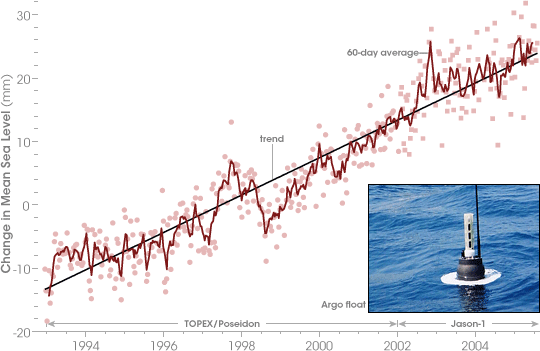
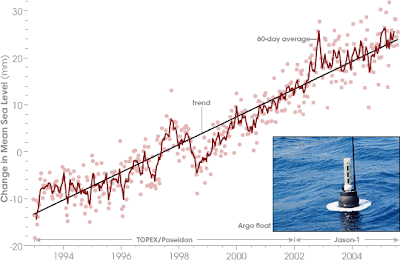
    In Hobart this week (March 12-15) a conference of about 200 scientists met to discuss oceanography, including Sea Level Rise and ongoing monitoring of the earth’s oceans. Much of the accurate measurment data is collected from the Jason 1 satellite. Satellite measurements suggest that global warming is doubling the number of intense storms and coastal flooding on the West and East Australian coasts, and the rate of sea level rise is being severely underestimated by the IPCC recent report.

    David Griffin from the CSIRO said that available data indicates that sea levels are rising faster than expected, and the main reason is climate change. His comments indicate a more accurate model is required to explain the rapid rate in sea level rise. “Well that underpins the importance to understand why the observed rate of sea-level rise is greater than the models can explain,” he said. “We’re relying on those models to make projections for the next 100 years. If they can’t actually explain the last 10 years, then we know that we’ve got more work to do.”

    The head of NASA Oceanography, Eric Lindstrom, attending the conference, was reported by the ABC as saying that a lot of scientists are wondering when society will wake up to the seriousness of climate change. “I’d say the major force involved in these changes is human-induced climate change, global warming,” he said. “I consider this data very serious and that there is climate change happening and that we need to be concerned about it.”

    ======================================

    So how bad could sea level rise be? The rule of thumb, according to Barrie Pittock is that for every 1 metre rise in sea level, the coast moves about 100 metres. If the Greenland and West Antarctic Ice sheets disintegrate rapidly, then sea levels may change at the rate of up to 1 metre per 20 years.

    Outspoken NASA climate scientist, Jim Hansen, was interviewed by Kerry Obrien on the ABC TV current affairs program, The 7.30 Report. He gives a very graphic and detailed view of what we are facing with climate change and sea level rise. Interview Reproduced in full.

    Australian Broadcasting Corporation
    TV PROGRAM TRANSCRIPT
    LOCATION: http://www.abc.net.au/7.30/content/2007/s1870955.htm
    Broadcast: 13/03/2007
    Scientist predicts disastrous sea level rise

    Reporter: Kerry O’Brien

    KERRY O’BRIEN: Welcome to the program and first, as the world continues to absorb the import of the recent UN intergovernmental report on climate change, with its projections for increased temperatures, violent storms and rising sea levels, one of America’s pioneering climate change scientists has raised a much more frightening scenario. Dr James Hansen, a prominent and controversial NASA scientist, has written a paper predicting catastrophic sea level rises from the disintegration of polar ice sheets if the globe heats up by two to three degrees Celsius this century. The IPCC report, written by hundreds of the world’s top scientists, has predicted temperature rises of from two to six degrees Celsius if greenhouse emissions aren’t reduced. Dr Hansen, who had a much publicised run-in with the Bush White House after accusing the administration of trying to gag him, has told this program that he expected both west Antarctica and parts of Greenland to collapse if temperatures reached 2 or more per cent, which could cause sea levels to rise at a rate of a metre every 20 years. Last night’s program showed how up to 700,000 homes around the Australian coastline have been identified as being at risk from much lower sea level rises. The Hansen scenario would potentially displace hundreds of millions of people around the world. I spoke with Dr Hansen from London earlier today.

    KERRY O’BRIEN: Jim Hansen, now we’ve had the IPCC report, do you believe the world has an accurate picture of the risks ahead for global warming?

    DR JAMES HANSEN, NASA CLIMATOLOGIST: There is quite a large gap between what is understood about global warming by the relevant scientific community and what is known by the public. The one thing that I’ve become particularly concerned about is sea level rise, where the current IPCC report is going to suggest smaller numbers than the last report, although all of the information that we’re getting in the last year or two points in a very much different direction. Now, in defence of IPCC, their procedure required that they stop getting new inputs more than a year ago and a lot of the data on ice sheet stability has come up in just the last year or two.

    KERRY O’BRIEN: What are your particular fears with regard to the melting of the polar ice caps?

    JAMES HANSEN: Well, the problem is that the climate system in general has a lot of inertia and that means that it takes time for the changes to begin to occur but then, once they do get under way, it becomes very difficult to stop them and that is true in spades for the ice sheets. If we once begin to disintegrate it will become very difficult, if not impossible, to stop them and we are beginning to see now on both Greenland and west Antarctica disintegration of those ice sheets. They’re both losing ice at a rate of about 150 cubic kilometres per year and that’s still not a huge sea level rise. Sea level rise is now going up about 3.5 centimetres per decade. So that’s more than double what it was 50 years ago. But it’s still not disastrous; it’s a problem, but it’s not disastrous. But the potential is for a much larger sea level rise. If we get warming of two or three degrees Celsius, then I would expect that both West Antarctica and parts of Greenland would end up in the ocean, and the last time we had an ice sheet disintegrate, sea level went up at a rate of 5 metres in a century, or one metre every 20 years. That is a real disaster, and that’s what we have to avoid.

    KERRY O’BRIEN: What is the most recent evidence of what’s really going on with the ice caps, the Arctic and the Antarctic?

    JAMES HANSEN: There are two things that are cause of concern. First of all, if we look at the history of the Earth, we know that at the warmest interglacial periods, which were probably less than 1 degree Celsius warmer than today, it was still basically the same planet. Sea level was perhaps a few metres higher. But if we go back to the time when the Earth was two or three degrees Celsius warmer, that’s about three million years ago, sea level was about 25 metres higher, so that tells us we had better keep additional warming less than about one degree. And the other piece of evidence is not from the history of the Earth but from looking at the ice sheets themselves, and what we see is that the disintegration of ice sheets is a wet process and it can proceed quite rapidly. We see that the ice streams have doubled in their speed on Greenland in the last few years and even more concern is west Antarctica because it’s now losing mass at about the same rate as Greenland, and west Antarctica, the ice sheet is sitting on rock that is below sea level. So it is potentially much more in danger of collapsing and so we have both the evidence on the ice sheets and from the history of the Earth and it tells us that we’re pretty close to a tipping point, so we’ve got to be very concerned about the ice sheets.

    KERRY O’BRIEN: How good are the models on which world science is basing its climate change predictions?

    JAMES HANSEN: Temperature we can, we now have that calibrated quite well, both in terms of how fast the Earth is now warming, which is about two-tenths of a degree Celsius per decade, and the climate models reproduce that, and the climate models can also reproduce the magnitude of the climate change from glacial to interglacial periods. So we’re pretty confident of climate sensitivity, and what that sensitivity tells us is that if we want to keep warming less than one degree Celsius additional above that of today, we had better keep CO2 less than 450 parts per million, and perhaps even less than that. So we’re really getting close to the tipping point, because CO2 is now 380 parts per million. It started out, 100 years ago, at 280, it’s now 380 and it’s going up 2 PPM per year. So if we stay on as business as usual, within about 30 years we will be past this level that, I think, is a very dangerous level.

    KERRY O’BRIEN: You said a year ago that in your 30 years working in government you’d never seen such constraints on communication between scientists and the public. What’s the evidence of that?

    JAMES HANSEN: Well, it worries me a lot because in our country the government science agencies have public affairs offices which are now staffed with political appointees and those political appointees have a big impact on what science gets reported and how it’s reported. And I’m very disturbed about that. I think that public affairs officials should be helping scientists speak in a language that the public can understand but they shouldn’t be massaging the information. And the other example is reporting, testifying to Congress. I don’t understand why a scientist’s testimony has to be approved by the White House. Government scientists are paid by the public, paid by taxes and I think we’re working for the public and for Congress, as well as for the executive branch, and I don’t think that our testimony should be filtered.

    KERRY O’BRIEN: You said just a couple of weeks ago that there should be a moratorium on building coal fired power plants until the technology to capture and sequester carbon dioxide emissions is available. But you must know that that’s politically unacceptable in many countries China, America, Australia for that matter, because of coal industry jobs and impact on the economy.

    JAMES HANSEN: Well, it’s going to be realised within the next 10 years or so that we have no choice. We’re going to have to bulldoze the old style coal fired power plants. We can burn coal, provided we capture the CO2 and sequester it, and we’re working on technology that would allow us to do that and we should have been working a little harder but, nevertheless, we will have, within five to 10 years, we will have that technology. In the meantime, we should be emphasising energy efficiency so that we don’t need new old style coal fired power plants. We’re just not doing that. Buildings could be 50 per cent more efficient. The architects and engineers will tell you they have the technology to do that, but if it’s not required it’s not likely to happen.

    KERRY O’BRIEN: After your 20 years as a scientist of trying to raise awareness of the dangers of global warming, are you ultimately optimistic or pessimistic about the future?

    JAMES HANSEN: I think that we’re likely to pass the 450 parts per million, which is probably the dangerous level. However, I think there is a lot of encouraging evidence in the last year or two that people are starting to get it, and so – if we can keep it close to that level, and take some additional actions. You know, there are other climate forces besides carbon dioxide, and some of those – it would be very useful to reduce those. And so if we begin to address carbon dioxide and methane and black carbon and tropospheric ozone then I think we can avoid the dangerous climate change but we’ll have to get going very soon.

    KERRY O’BRIEN: Jim Hansen, thanks for talking with us.

    JAMES HANSEN: Thank you.

    =========================================================

    Sources:
    West Australian 6 March, 2007 – Scientists to discuss global sea rise
    http://www.thewest.com.au/aapstory.aspx?StoryName=361931

    ABC News 12 March, 2007 – The CSIRO says sea levels are rising faster than expected
    http://www.abc.net.au/news/newsitems/200703/s1869919.htm

    ABC News 12 March, 2007 – NASA official ‘surprised’ climate change still debated
    http://www.abc.net.au/news/newsitems/200703/s1869676.htm

    The 7.30 Report – ABC TV – 12 March 2007 – Coastal areas face environmental threats
    http://www.abc.net.au/7.30/content/2007/s1869888.htm

    PM – ABC Radio – 13 March 2007 – Global warming doubling number of intense storms
    http://www.abc.net.au/pm/content/2007/s1870888.htm

    The 7.30 Report – ABC TV – 13 March 2007 – Scientist predicts disastrous sea level rise
    http://www.abc.net.au/7.30/content/2007/s1870955.htm

    NASA – The Earth Observatory = June 2006 – The Rising Sea Level
    http://earthobservatory.nasa.gov/Newsroom/NewImages/images.php3?img_id=17300

  • Misleading UN report confuses Paris climate talks outcome of 3.5C by 2100 climate code red

    More

    3 of 13

    climate code red

    Inbox
    x

    Climate Code Red <noreply+feedproxy@google.com> Unsubscribe

    8:45 PM (11 hours ago)

    to me

    climate code red


    Misleading UN report confuses Paris climate talks outcome of 3.5C by 2100

    Posted: 07 Nov 2015 10:29 PM PST

    by Joe Romm, Climate Progress

    Memo to media: If countries go no further than their current global climate pledges, the earth will warm a total of 3.5°C by 2100.

    A very misleading news release from the U.N. Framework Convention on Climate Change (UNFCCC) — coupled with an opaque UNFCCC report on those pledges, which are called intended nationally determined contributions (INDCs) — has, understandably, left the global media thinking the climate talks in Paris get us much closer to 2°C than they actually do.

    Indeed, the news release contains this too-cleverly worded paragraph quoting UNFCCC Christiana Figueres, Executive Secretary:

    The INDCs have the capability of limiting the forecast temperature rise to around 2.7 degrees Celsius by 2100, by no means enough but a lot lower than the estimated four, five, or more degrees of warming projected by many prior to the INDCs,” said Ms. Figueres.

    I’m a fan of Figueres and all that she has accomplished in the lead-up to Paris. Indeed, as I’ve written, “the INDCs have bought us another five to 10 years of staying close to the 2°C path,” which is the defense line against very dangerous-to-catastrophic global warming.

    But, to repeat, assuming countries meet their current global climate pledges — but go no further — the earth will warm a total of 3.5°C by 2100 (but see note at the end). Climate Interactive has added up the latest commitments and here is where they lead:

    CI-INDC-3.5c

    Significantly, while China has agreed to peak CO2 emissions by 2030, “total GHG emissions are likely to continue increasing until 2030, as China has not yet implemented sufficient policies addressing non-CO2 GHG emissions (methane, nitrous oxide, HFCs etc.),” as the analytical team at Climate Action Tracker explains. Also, India has specifically not committed to peak its CO2 emissions yet (nor have some other developing countries that are not yet at India’s stage of economic growth).

    I have no doubt that countries will make stronger pledges in the future — indeed, China just announced with France that it wants every country to have five-year check-ins to assess progress on the climate commitments. But those pledges have not been made yet, we do not know what they might be, and we certainly should not count them in any analysis of what Paris will achieve.

    So why does Figueres say the Paris pledges will limit warming to 2.7°C by 2100? In fact, she doesn’t say that. She says they “have the capability of limiting the forecast temperature rise to around 2.7 degrees Celsius by 2100.” What does that mean?

    It means that the overwhelming majority of the pledges end by 2030 — but most of them imply a rate of reduction in CO2 emissions between now and 2030. So, if you assume countries will commit in the future to keep reducing emissions after 2030 at the rate they did before 2030 — and make a bunch of other optimistic assumptions — you can limit warming to 2.7°C in 2100.

    Here’s a quick analogy. You weigh 400 pounds with many weight-related health problems, and a team of doctors say you need to cut your weight sharply. You agree to go on a supervised weight loss regime for two years that will take you down to 300. Should you start telling all of your friends that you’ll weigh 200 pounds in 4 years?

    Of course not. You’ve got a long way to go. Heck, you’re not even at 300 yet.

    Actually, it is worse than that because the 2.7°C scenario requires a whole other level of effort. Here’s one possible 2.7°C pathway:

    CI-2c post-2030 v2

    As you can see, India would have to plateau around 2030 (as would other developing countries). India has has not made such a commitment yet. One of the country’s leading politicians says it can do it. Indeed, I believe the combination of ever worsening climate impacts and rapidly dropping costs for clean energy make it all but inevitable that India will ultimately do so — and that the vast majority of other countries will also make stronger pledges in the years to come.

    But India has not made a pledge to peak yet, nor have other major developing countries, nor has China agreed to start slashing emissions in 2030, nor has our country agreed to steady reductions in CO2 emissions post-2025.

    Here’s another analogy. You weigh 400 pounds with weight-related health problems, and a team of doctors say you have to lose weight sharply. But you are still gaining 10 pounds a month. You agree to go on a supervised diet and exercise regime that will stop your weight from rising beyond 450 pounds in twelve months. Should you tell everyone that you’ll weigh 300 pounds in 3 years?

    Of course not.

    And the UNFCCC understands all this, which is why, immediately after Figueres’ quote in the news release, the very next paragraph is: 

    The secretariat report does not directly assess implications for temperature change by the end of the century under the INDCs because information on emissions beyond 2030 is required. However, other independent analyses have, based on a range of assumptions, methodologies and data sources, attempted to estimate the impact of the INDCs on temperature leading to a range of average estimates below, at or above 3 degrees C.

    That means the UK Guardian had the story wrong when they wrote:

    “Pledges by most of the world’s countries on climate change are likely to lead to less than 3C of global warming over the century, analysis of the data by the United Nations suggests.”

    The UNFCCC never made any such analysis or claim. And the only way to make such a claim is to go far beyond the current pledges. But, again, the mistake is understandable since the news release was very misleading on this point.

    The best we can say right now is that, if we consider the Paris climate pledges and nothing further, the earth will warm a total of 3.5°C by 2100. Of course, we can continue to say that keeping total warming to 2°C is super cheap because we know that is also true.

    Note to nerdtastic readers: Yes, the 3.5°C calculation does assume that no unmodeled carbon cycle feedbacks kick in — such as the permafrost melting. I’ll cover issue that in a later post.

  • Our plan to kick the big polluters out Sam LR – GetUp!

    1 of 10

    Our plan to kick the big polluters out

    Inbox
    x

    Sam LR – GetUp! Unsubscribe

    10:18 AM (5 minutes ago)

    to me

    Recently you took a survey to help determine GetUp’s priorities on climate change. We’ve taken your feedback and turned it into an ambitious plan to give the big polluters a run for their money. Can you chip in to make it a reality?

    This is absurd, NEVILLE.

    French mining company Engie (previously known as GDF-Suez) owns Australia’s dirtiest coal plant Hazelwood, and guess what? They’re sponsoring the UN climate talks!1

    The UN conference at the end of this month will be crawling with big coal and their mates trying to block action on the climate disaster they’ve created. For the past two decades, the coal lobby has funded think tanks for dodgy sceptics like Bjorn Lomborg, bankrolled lobbyists to pollute our politics behind closed doors and devised misinformation campaigns straight from the big tobacco playbook.2

    So while they’re on the inside trying to hold us back – we need to be on the outside pushing forward. Forward to a safer climate and a better life free from polluting energy. That’s why we’re mobilising en masse for People’s Climate Marches across Australia to show the world we’re ready to play our part in tackling global warming.

    To take on the big polluters in the lead up to the Paris climate talks, right through to the next federal election, we need resources, which is why we’re asking you to step up and become a GetUp core climate member. Can you make a small weekly donation?

    We’ve already hit the ground running. Your money will provide organisers on the ground, phones for phone bankers, t-shirts for volunteers, clipboards for doorknockers, and the promotional materials we need to make these marches the biggest we’ve ever seen.

    Big coal might have a lot of money, but we’ve got something much more powerful: YOU, NEVILLE, and a million more GetUp members ready to kick polluters out of politics.

    As a core member, you’ll join hundreds of Australians to fund:

      1. The biggest, coordinated doorknock for climate action the country has ever seen.
      1. The massive People’s Climate March for 2015, which last year was used as real-time evidence of the world’s demand for climate action by leaders like Ban Ki Moon and President Obama.
      1. A people’s policy platform led by researchers, policy experts, economists and movement partners to show politicians the pathway to a 100% renewable powered future.
    1. All the hard-hitting ads, high-profile actions, and electoral organising we need to turn climate change into a major issue at the next federal election.

    If fossil fuel lobbyists are running the show on the inside, whispering nonsense in the ear of our Prime Minister, let’s raise an alarm on the outside that they can’t ignore.3,4 Our plan is designed to get global media taking our actions here at home all the way to Paris.

    But to change everything, we’ll need everyone. Click here to fund our fight for a cleaner, safer future.

    If big polluters are going to keep trying to hold us back then we need to step up and show the way forward.

    Are you in? www.getup.org.au/power

    In hope,
    Sam and Adam, for the GetUp team

    PS – There’s never been a more important time to fire up our movement and demand action with a strong, united voice. Last week we saw what happens when big coal writes the PM’s political propaganda – a whopping 72% of Liberal Party supporters still don’t realise human activity causes climate change.5 Thanks Tony Abbott. But now is the time for Malcolm Turnbull to do better. Chip in now to support our plan to tackle the big polluters.


    References
    [1] France defends ‘imperfect’ fossil fuel sponsors for Paris climate summit, The Guardian, 30 May 2015
    [2] Fossil fuel firms are still bankrolling climate denial lobby groups, The Guardian, 26 March 2015
    [3] Coal industry lobbying Government ahead of climate change talks, ABC Online, 27 October 2015
    [4] How the Minerals Council of Australia has government’s ear on coal, The Saturday Paper, 24 October 2015
    [5] Most Coalition voters do not believe in human-induced climate change – CSIRO, The Guardian, 4 November 2015