Category: General news

Managing director of Ebono Institute and major sponsor of The Generator, Geoff Ebbs, is running against Kevin Rudd in the seat of Griffith at the next Federal election. By the expression on their faces in this candid shot it looks like a pretty dull campaign. Read on

  • THE FINANCIAL REVIEW HAS HEARD US

    Click here to enable desktop notifications for Gmail.   Learn more  Hide
    1 of 1
    Web Clip
    Dictionary.com Word of the Dayoeuvre: the works of a writer, painter, or the like, taken as a whole. – 11/1

    The Financial Review has heard us

    Inbox
    x

    Vicky – 350.org Australia vicky@350.org.au via list.350.org 

    2:41 PM (8 minutes ago)

    to me

    Dear friend,

    Thank you so much for asking the Australian Financial Review (AFR) to report responsibly on the biggest story of our time – climate change, rather than lambasting ANU’s decision to divest.

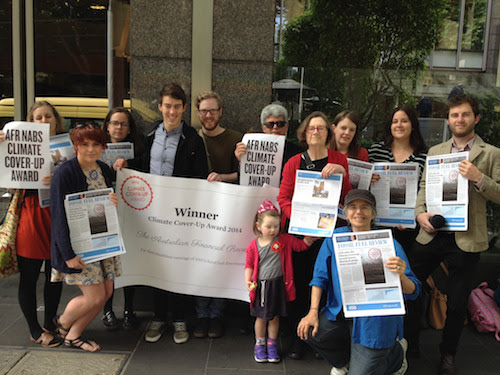
    Last Thursday, 350.org and the Australian Youth Climate Coalition took your message, along with the messages of over 7,000 Australians, to the Fairfax Annual General Meeting. Click on the image below for highlights from the day:

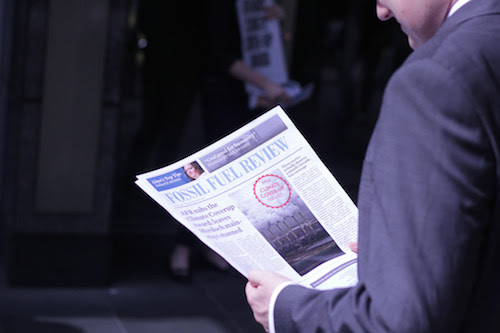
    We distributed it along with copies of our very own Australian Fossil Fuel Review.

    And we presented the AFR with their very own Carbon Cover-Up Award which they accepted:

    We will find some space in the trophy cabinet for the Carbon Coverup Award given to us by the anti-fossil fuel 350.org campaign.” – Australian Financial Review, 8th November

    Smart people know that the world needs to leave fossil fuels in the ground. They know that a huge transformation is underway, disrupting old dirty energy’s business model and shifting hundreds of billions of dollars in assets. And we all know that it is these groundbreaking stories that the Financial Review needs to tell their readers about, rather than running a month long anti-divestment push.

    Thankyou for helping us take this message to the heart of Australia’s financial press.

    Yours for a brighter future,

    Vicky for the 350.org Australia team

    PS: Here are just three of the many sources of fair and balanced reporting on climate and fossil fuel divestment:

    PPS: Checkout this great article by Fossil Free ANU’s Tom Swann on the AFR’s coverage of ANU’s divestment decision.


    350.org is building a global climate movement.You can connect with us on Facebook, follow us on Twitter, and become a sustaining donor to keep this movement strong and growing.

  • NO ONE LIKES TO BE LEFT BEHIND

    1 of 6
    Web Clip
    triple j music newsWatch NOFX make amends with the fan Fat Mike assaulted1 day ago

    No one likes to be left behind

    Inbox
    x

    Amanda McKenzie – Climate Council via sendgrid.info 

    2:45 PM (0 minutes ago)

    to me
    Dear Inga,

    It’s common sense to most of us that as one of the sunniest and windiest countries in the world Australia has unrivalled renewable energy potential. But our latest report finds that we’re losing out on opportunities and investment to countries like China and the US – who are surging ahead with renewable energy.

    In the past year alone investment in Australian renewables has dropped back 70%.

    Read our latest report to see more about how Australia’s efforts to tackle climate change measure up against the rest of the world.

    The good news story globally is that China consolidated its position as the world’s renewable energy powerhouse in the past year with 2.6 million people employed in renewable energy jobs and renewables providing nearly one fifth of China’s annual electricity generation.

    China installed more renewable energy capacity than fossil fuels in 2013. It also retired 77 gigawatts (GW) of coal power stations between 2006 and 2010 and aims to retire a further 20 GW by 2015.

    The US is also rapidly exploiting the global shift to renewable energy, coming second only to China for installed renewable energy.

    Read our latest report for more on the global response to climate change and how Australia measures up. 

    What’s clear is that the world is building towards a tipping point of action and nations are now fiercely competing for low carbon investment. The global energy transition from fossil fuels to renewable energy is now underway.

    Whereas in the past China and the US may have been viewed as laggards, today they they have stepped up to the plate and are providing substantial global leadership.

    Australia continues to lag behind the rest of the world on tackling climate change. There is much more to be done if we are to protect Australians from a changing climate. Please help me to make sure as many people as possible are aware of this by sharing the report’s important findings with your networks. 

    Onwards

    Amanda McKenzie

    CEO Climate Council

    P.S. The media is already reporting on Australia’s lack of action – see The Australian, the BBC, the Daily Telegraph, The Sydney Morning Herald, ABC News, Prime 7, and Sky News. Help us make this story bigger by sharing the report and the coverage

  • Population Growth is our Planet’s Number one Problem

    Privacy and cookiesJobsDatingOffersShopPuzzles SubscribeRegisterLog in

    Telegraph.co.uk

    Monday 10 November 2014

    Population growth is clearly our planet’s number-one problem

    You don’t need to be a ‘greenius’ to know that our numbers are growing too fast for planet Earth – so why don’t we do anything about it, asks Alex Proud

    ‘Virtually every environmental problem would be smaller if there were fewer of us’ Photo: Alamy

    There are so many elephants in the room these days that I often find myself wondering if those ancient Hindu cosmologists might have been on to something. Perhaps the world really is just one giant room, supported on the back of four elephants. I’m not sure what this means for the giant turtle on whose back the elephants are meant to be standing. Perhaps turtles are the new elephants.

    Anyway, in the modern British discourse, our unaddressed elephants make for depressing reading. The NHS going broke in a decade. Plump-pensioned, equity-rich septuagenarians sunning themselves in the Maldives while the young can barely afford the rent on someone else’s buy to let dump. The last Londoner moving out of Zone One. Corporations with more power than sovereign states. The worst PM in living memory. An opposition leader who makes him look good.

    But while these are big problems, they’re not the biggest problem. The bull elephant of problems was bought home to me a month ago when the WWF released its Living Planet Report which said that half the wild animals in the world (no doubt some of them elephants) had disappeared in the last 40 years. There’s only one reason for this. And that is us. The world’s hyper-successful, amped-up, technologically-leveraged apex predator. More of us means less of them. Sorry turtles. Sorry pandas. Sorry elephants. The world is finite and there’s only so much space.

    For the few last decades it’s been fashionable to say that the limits of the world aren’t really a problem. I can see some of this thinking. I’m no Malthusian and I believe that science can sustain population growth for quite some time. GM crops have the potential to significantly increase yields while massively reducing fertiliser and pesticides use, thus improving everything from our coastal seas to our honeybees. I emphatically believe that GM is the the key to a second green revolution and will greatly improve the world, rather than make Jolly Green Giant a Frankenfood reality.

    But even delicious hamatoes and all the other wonders that science can deliver only delay the day of reckoning so far. So assuming we’re not all about to upload to the cloud, we have to accept that there are limits to our numbers and lifestyles and that, unless things change drastically, we’re pretty close to many of these limits. Given this, I find it weird that we never really talk about the end game. Discussions about a post-growth world should be mainstream, not eccentric fringe.

    By growth I’m talking about the big two measures that tend to result in fewer gorillas, coral reefs, rainforests and icebergs: population and GDP. The first of these needs to stop growing (and go into reverse) and the second needs to plateau or at least stop being everyone’s go-to indicator for everything; ideally, it might become irrelevant.

    Just by writing this, I feel that I may have placed myself in tinfoil-hat territory. But I don’t think either of these inevitabilities need to be bad things and I’m not nursing Hollywoodish post-apocalyptic fantasies populated by suspiciously good looking 18-25 year olds. However, I do believe that at some point the 20th century model of pretty much everything has to cease. As a leading indicator of this, you can already see that the model that worked so brilliantly for America in the 20th century is working a lot less well for China.

    Let’s take population. You don’t need to be a genius or green (or even a greenius) to realise that our numbers are growing too fast for our planet. Virtually every environmental problem would be smaller if there were fewer of us. Rainforests would stay unfelled and beautiful coastlines undeveloped. The Med and the North Sea would be full of fish. China wouldn’t be buying chunks of malnourished Africa to farm in place of the land it has polluted or covered in megacities. In the UK, there would be no debate about paving over the few remaining green spaces in the South East (or for that matter ineffectual hand-wringing about London property prices).

    In fact, if there were a lot less of us, we could behave as badly as many reactionary types would like us to. We’d be able to take monster trucks on rhino-hunting safaris. We could dine off roast panda and have tiger-skin wallpaper. We’d all be able to live like America’s fossil fuel lobbyists want us to. A lot less of us – say 60-90pc, would solve most of our environmental problems in one fell swoop. However, that’s not going to happen unless the hype around Ebola really delivers.

    In the meantime, we have another, related problem. Not only are there more of us, but we’re all living larger – especially in developing countries where, in the past, living large was the preserve of a tiny elite. While rising living standards may be a good thing for individuals and societies, in terms of the planet, it would be much, much better if we all lived like Bangladeshis.

    Quite what a problem this is is illustrated by the section of the Living Planet Report which calculates humanity’s “ecological footprint” or the amount of planet needed to support each person. The report concludes that at today’s average global rate of consumption, humanity would need 1.5 planet Earths to provide for its needs sustainably (i.e. without trashing the future). However, if we all lived like Brits, we’d need 2.5 earths and if we all lived like Americans we’d need four. It’s another indicator (as if one was needed) that points to us living beyond our means.


    Lunar New Year travellers cram into West Railway Station in Beijing (AFP/Getty)

    When it comes to business, my dad taught me to do a few very basic checks on the financials. These are usually sums you can do in your head and, if they don’t stack up or are based on pie-in-the-sky predictions, you don’t go near whatever it is. But when it comes to humanity having a decent, comfortable, pleasant future on Earth, it strikes me that we’re prepared to accept a set of figures that would have had investors wetting their pants with laughter at the height of the dot.com boom.

    The two mainstream are options are: pretend that the elephant doesn’t exist. A strategy that had some currency back in, say, 1970, when the end game was 60 years off, less so now. Or you just sit there and say that science will come up with a solution. Again, ask yourself, would you invest in a company that told you this? Worse still, the relatively low-ball population ceiling predictions that had lulled everyone into thinking we’d be OK are starting to look very conservative indeed. That reassuring nine billion figure is unlikely. What is now more likely is 11 billion plus, all of whom will, on average, be consuming more methane-generating cows than we do today.

    So, again, why aren’t we talking about this? Really, we should be talking about how to solve this – to the exclusion of virtually everything else. In the medium term, nothing is more important.

    The solutions do exist. Societies can and do successfully curb their growth. Japan and most of Europe are now below the replacement birth rate for their populations. Some growth in Europe comes from immigration but, in Japan, which restricts immigration, adult nappies famously now outsell infant nappies. This is usually portrayed as a bad thing, but I fail to see why. In many ways, Japan is just grasping the nettle and dealing with the problems we’ll all have to deal with soon. Perhaps we should start looking at what they’re doing right.

    We might also recognise that many of our own values naturally lead to this end – and that, again this is a good thing. The biggest drivers of low birth rates are modern western values – the education of women, women in the workforce, easy availability of contraception and so on. The factors that drive population growth are largely their opposites – including all those religions which are more concerned about controlling women than the quality of life their children have.

    We also need to look beyond GDP, because wealth is a kind of sufficient factor. In the US, there are innumerable studies which show that although GDP per capita has risen greatly since the 1970s, the average person is no happier. Of course, you can argue that, in America, much of this extra has gone to the top 1pc, but there are plenty of other examples that show the relationship between wealth and happiness is not linear. Indeed, the research tends to show that if you are dirt poor, a bit more money will make you happier, but if you are comfortable it makes no difference.

    In the West many of us are already well beyond the GDP-satiety point, so perhaps it’s time we started devising different, more useful measures of national success. Serious, important types have tended to pooh-pooh alternative measures as hippy-dippy rubbish. But it’s worth remembering a few things here. One is that today’s politicians and economists are like generals who are always fighting the last war. Their failure to anticipate everything from the dot.com bubble to the banking crisis makes me wonder not why we still listen so closely to them, but why we listen at all.

    The second is that much of the Western economy is essentially a pyramid scheme based on having ever more economically productive people. This is at its most clear with pensions – and, as we are never going replicate the post-war era, we need to think differently. Finally, there is the problem that the WWF points to and which China seems to be discovering: that, as every student’s favourite native American proverb has it, “…you can’t eat money.”

    This doesn’t come easily to me. I’ve always been OK with my status as a carnivore who likes cars whose personal ecological footprint is probably 0.1 of a planet. But, I can do the maths – and all the maths and all the science is telling me that the sandal wearing, lentil-eating hippies I used to laugh at were right. We need to reduce our numbers and we need to tread more lightly on the earth. If we don’t, as lot of people have pointed out, we will eventually become part of the great mass extinction that we’ve already started.

    I’m not calling for a Russell Brand style destruction of our entire economic system. But I am suggesting that there are good reasons to believe that the assumptions that have served us well in the past will not continue to do so in the future. We need to start talking about this. Not least because, if we don’t, the elephants in the room will be the only elephants left.

  • Can you back me on this Via Get-UP

    1 of 12
    AdCompare Electricity Plansiselect.com.au/Electricity – Find a Range of Plans to Match Your Needs. You Could Save at iSelect.

    Can you back me up on this?

    Inbox
    x

    David Bruer – via GetUp!

    6:46 PM (3 minutes ago)

    to me

    Below is a message from David Bruer, a GetUp member and grape farmer from South Australia. Your details have not been shared with David or anyone else.

    Hi NEVILLE,

    I’m at the airport about to get on a plane for Brisbane and I’m writing you this email because I’m really hoping you can help me out!

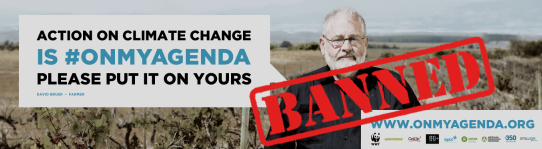
    I shared my story as part of a billboard campaign targeting our world’s leaders as they arrive in Brisbane, highlighting the need to talk about how the world tackles climate change at this year’s G20 meeting. Then I found out that my story – your billboard – had been banned. Apparently asking for climate change to be on the agenda was “too political”.

    I’m no politician. I’m a farmer. I’ve been a grape farmer for 42 years, and for 42 years I’ve been gradually noticing the profound effects that human caused climate change is having on my work, my income, my livelihood and my family’s future. In January, my Verdelho grapes were destroyed by sunburn for the first time in nearly 40 years of farming. On that day $25,000 worth of fruit was destroyed in a single day.

    I’ve been told that I may get a meeting with airport executives as soon as tomorrow, so we can talk about getting the billboard back up. Working with Earth Hour and GetUp, I’ll be delivering a petition so that I can show just how much support there is for this ban to be lifted.

    If I can go into that meeting with as many signatures as possible, we stand a much better chance of getting out message our there, before it’s too late. Will you help me? http://www.getup.org.au/onmyagenda

    Twenty years ago we were picking grapes at the end of February, two years ago it was the end of January. And there are reports that show these are not isolated incidents – it’s a trend, and climate change is behind much of it1.

    I’m far from the only person who is speaking out. The billboards supported by organisations including WWF, GetUp, Australian Youth Climate Coalition, Oxfam, Australian Conservation Foundation, 350 Australia, One Million Women, Greenpeace and Earth Hour also feature firefighter Dean McNulty. Dean and I are both working on the front line when it comes to climate change – we’re not just reading the science, we’re seeing it play out in our daily lives and daily work. I’m speaking out on behalf of many people just like me who are doing it tough and want to see Australia take tough action to tackle climate change.

    It’s a real shame that our Prime Minister has refused to put climate change on the agenda for this year’s G20 – just weeks after the IPCC has released the most unequivocal scientific evidence supporting everything that I’m seeing with my own eyes, as a farmer. But there is some good news – apparently there are world leaders coming to the meeting who are keen to talk about the issue, and we can help them get it on the agenda. How? Imagine if the first thing they see when they get off the plane is our billboards, featuring everyday Australians like Dean and I, calling for action on this critical issue.

    That’s where your help would be great. I’m going to do my best to talk the Brisbane airport executives into putting the billboard back up, and I’d love to show them how many people are with me on this.

    Can you back me up, and sign it before I deliver it? We don’t have a lot of time – sign it now and if you could share it with as many people as possible that would be great. http://www.getup.org.au/onmyagenda

    Thanks,

    David Bruer, grape farmer and GetUp member from South Australia

    PS from GetUp – David’s story has already got a pretty good run in the press this week, especially since Brisbane Airport have allowed ads from Chevron preaching the perks of coal and coal seam gas – and that’s not political? Help David out by signing here: http://www.getup.org.au/onmyagenda

  • We Did It Coal Terminal Action Group

    1 of 13
    AdCompare Electricity Plansiselect.com.au/Electricity – Find a Range of Plans to Match Your Needs. You Could Save at iSelect.

    We did it! 10,000 signatures to get the wagons covered

    Inbox
    x

    Coal Terminal Action Group via sendgrid.info 

    5:12 PM (44 minutes ago)

    to me

    Coal Terminal Action Group

    Nevile —
    We have some very exciting news indeed.

    It is with great community pride that we can today announce: WE DID IT!

    10,000 signatures on the Cover the Wagons Petition

    We have gathered over 10,000 signatures from people just like you right across New South Wales who are fed up with coal pollution in their suburbs and in their kid’s schools.That’s more than 10,000 people who know that uncovered coal wagons are a major source of particle pollution, causing serious cardiovascular and respiratory illnesses.

    It’s also more than 10,000 people who know that there is one simple, affordable solution. Together, we have sent the NSW Government one clear demand: the time for talk is over – it’s now time to cover and wash coal wagons!

    We are closer than we’ve ever been to getting action from Government on clean air. And it’s all thanks to you. From the bottom of our hearts, we’d like to thank everyone who made this outcome possible – all the doorknockers, stall workers, collectors, collators and petition captains. It has been an outstanding grassroots effort all round.

    Today, we’d like to invite you to thank the NSW Labor Party, who will be tabling this petition in the Parliament tomorrow morning. The Shadow Minister for the Hunter Sonia Hornery and Shadow Health Minister Dr Andrew McDonald have been supportive of covered coal wagons and this petition, and we are deeply grateful to them for speaking out on our behalf.

    Click here to send a thank-you message to the ALP, and to encourage more ALP Parliamentarians to follow Sonia and Andrew’s example, and stand proudly with the community in defense of our right to clean air.

    10,000 signatures doesn’t just demonstrate the community support for action against coal pollution – it is also the magic number that triggers a debate in the Parliament. You can also include a line in your thank-you letter to call for parliamentary debate on coal pollution to be prioritised and brought forward as a matter of urgency.

    Click here to send the letter now.

    Thanks again for all of your efforts! We hope you are as proud as we are of this show of people power!

    John Mackenzie
    on behalf of
    Coal Terminal Action Group
    http://coalterminalactiongroup.nationbuilder.com/

  • The John James Newsletter No. 28

    1 of 13


    AdCompare Electricity Plansiselect.com.au/Electricity – Find a Range of Plans to Match Your Needs. You Could Save at iSelect.

    The John James Newsletter 28

    Inbox x

    John James

    5:06 AM (2 hours ago)
    to John

    The John James Newsletter 28

    10 November 2014. 

    Am I not destroying my enemies when I make friends of them? — Abraham Lincoln


    Ring The Bell: This Is Our Future – John James

    I have been asked to describe the world under 2,3 or 4 degrees and what it would be like in our lifetimes and those of our children? This is my answer, based on what most of us are likely to experience during the next few decades……. unless!

    http://www.countercurrents.org/james071114.htm

    Methane Erupting From East Siberian Arctic Shelf 

    Nations are ignoring this growing danger. As the oceans keep warming, the Gulf Stream will keep moving ocean heat into the Arctic, triggering increased methane eruptions from the seafloor that threatens to further accelerate warming in the Arctic, resulting in ever more methane being released .. ad infinitum.

    http://arctic-news.blogspot.com.au/2014/11/methane-erupting-from-east-siberian-arctic-shelf.html

    California County Makes History By Passing Self-Governance Law

    Over the past century, both corporations and state governments have restricted the authority of municipal corporations so the people have very few rights. Your right to govern your own county has been canceled out by the “rights” of corporations, and the authority of the State to preempt your lawmaking. This measure, though “illegal”, is about changing the law by challenging the law. Openly, frontally, and directly. The current system of law does not allow you to say “no” to fracking within the County. You therefore have a choice – you can either accept that current status of the law, or you can challenge what the law “is” and adopt a new system of law which enables you to control what happens in the County.

    http://www.zengardner.com/california-county-makes-history-passes-self-governance-law/

    Sao Paulo running out of water as rain-making Amazon vanishes

    São Paulo with 20 million people is suffering its worst drought in at least 80 years, with key reservoirs that supply the city dried up. Humidity from the Amazon has dropped dramatically, are all because of deforestation. That is altering the climate in the region by drastically reducing the release of billions of liters of water by rainforest trees. It is a collapse like we have never seen before. The severity of the situation in recent weeks has led government leaders to finally admit Brazil’s financial powerhouse is on the brink of a catastrophe.

    http://www.trust.org/item/20141024121030-es9ea/?source=hpMostPopular

    The collapse of the Amazon is one of the anticipated tipping points. Its massive rain forests have been soaking up enormous quantities of carbon, as well as keeping the planet’s weather equitable. Neither of these benign effects can be expected in the future. John

    Abdul Kareem: a seed sent from heaven.

    Almost 40 years ago, Abdul Kareem bought five acres of land in what was then a sparsely inhabited area in northern Kerala. Shortly after, he bought some more land, and in just a few years, his 32 acres were transformed into a thick, vibrant forest, making Abdul Kareem one of the few people in India to have actually created a forest—and that too almost single-handedly.

    http://www.goodnewsindia.com/Pages/content/inspirational/abdulKareem.html