|
|
Justice for Bulga – will you stand with us?
|
Inbox
|
x |

|
12:27 PM (2 hours ago)
 |
|
|||
|
Managing director of Ebono Institute and major sponsor of The Generator, Geoff Ebbs, is running against Kevin Rudd in the seat of Griffith at the next Federal election. By the expression on their faces in this candid shot it looks like a pretty dull campaign. Read on
|
|
|
Inbox
|
x |
|
12:27 PM (2 hours ago)
|
|
|||
|
|
|
|
Inbox
|
x |
|
3:05 PM (3 hours ago)
|
|
|||
Neville,
I never thought I’d be saying this but the fossil fuel industry is fast becoming public enemy number one. When the divestment campaign started three years ago, few of us anticipated the response….From a few US liberal-arts colleges committing to quit their investments in coal, oil and gas companies, this movement has now swelled to over 450 institutions around the world. But we need your help to keep up the momentum
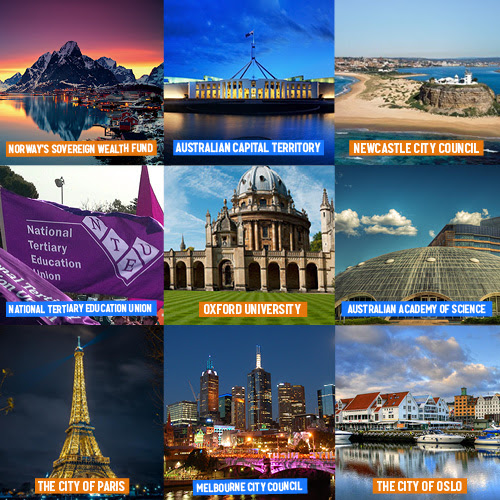
This year alone, we’ve seen international commitments from the likes of Norway’s $1.15 trillion Sovereign Wealth Fund, the US’ largest pension fund CALPERs, the Rockefeller Brothers Fund, the Guardian Media Group, universities like Oxford and Georgetown and cities like Paris and Oslo. Even Leonardo DiCaprio has joined the call!
Here at home, the commitments are also coming thick and fast. Over 40 Australian institutions have now committed to go fossil free including: Newcastle, home to the world’s largest coal port; the A.C.T., formerly home to the world’s largest coal lover; and Melbourne, home to some of you. The National Tertiary Education Union and our foremost scientific body – the Australian Academy of Science – are the most recent institutions to join the growing chorus of voices calling for a future beyond fossil fuels.
Our movement now influences institutions who collectively manage $2.6 trillion – a 50-fold increase on where we were 12 months ago.
Can you help us keep up this divestment momentum in 2016?
Our movement is hitting the fossil fuel industry where it hurts and helping to sow the seeds of genuine political change.
Coal companies are lashing out against us in the media. Gas companies are investing millions in elaborate re-branding campaigns. Oil companies are being exposed for decades’ worth of devastating climate cover-ups.
Two of the world’s most fossil fuel loving politicians (our Abbott and Canada’s Harper) are now out of power. Global support is mounting for a moratorium on new coal mines. Former head of the Reserve Bank, Bernie Fraser, just rejected our Government’s assertion that digging up coal is moral. Even, the birthplace of the coal industry itself – the United Kingdom – is seriously considering shutting all of its coal plants, forever.
Can you donate to help us to aim higher and hit harder than ever before in 2016?
Together, one institution at a time, we are helping to challenge the most powerful industry on the planet so that we can tackle the greatest moral challenge of our time.
But there’s more to be done. Extreme weather events are hastening. Another angry summer is on its way. Next month, world leaders will congregate in Paris to again attempt a climate treaty and again, there is no guarantee of success.
We can turn this around — the more institutions that divest, the more we can take away the fossil fuel industry’s power to pollute our politics and our planet.
In 2016, 350.org Australia has plans to grow the divestment movement like never before. Imagine dozens of local governments going fossil free and putting pressure on our Federal Government to follow. Imagine an ambitious national campaign ahead of the Federal election calling upon our politicians to stop giving to and taking from the big polluters. Imagine more of our universities and super funds kissing goodbye to their investments in the worst industry on the planet.
The stakes have never been higher, the momentum never stronger.
Yours for a fossil free future,
Blair
PS: Can’t afford to give regularly but keen to make a one-off donation? Click here!
PPS: Checkout some of the institutions that have divested this year — click on the graphic to help us grow this movement even stronger in 2016:

350.org is building a global climate movement.You can connect with us on Facebook, follow us on Twitter, and become a Climate Defender and donate monthly to help 350.org keep Australia’s fossil fuels in the ground.
|
Inbox
|
x |

|
7:28 PM (15 hours ago)
|
|
|||
We’re not going to let up.
When Australia imprisons people seeking safety, locking them up on remote Pacific islands – for the second time in our history – it takes guts to keep pushing for things to change. But just last week, GetUp members showed that we have what it takes. Together, we blasted a hole in the whole torturous machine of Australia’s asylum seeker policy.
Take a moment to read the story below. It’s a good one, I promise. But first, let’s talk about what comes next.
Broadspectrum (formerly known as Transfield Services) might have changed its name, but not its motivation. It’s the corporation paid billions to run the government’s offshore detention camps. After our shenanigans at last week’s AGM, Broadspectrum are feeling the heat. But to change their behaviour we need to hit them where it hurts – their bottom line.
Broadspectrum happens to be a key contractor in our hospitals, schools, universities and local government. So next week we’re launching a massive grassroots campaign, led by people like you, asking every council in Australia to refuse to contract with Broadspectrum and all businesses that profit from the abuse of people seeking asylum. Then, we’ll demand the same of our hospitals, universities, schools, and we won’t stop until Broadspectrum stops profiting from abuse.
But to make this happen, we need funds to develop and distribute activist toolboxes and media kits, and to train community campaigners . We need to link GetUp members across Australia to each other and to other organisations so we can work in tandem to demand compassion, not cruelty, towards people seeking asylum.
As we take the fight to end business in abuse to the next level, can you become a core supporter of the campaign by chipping in with a small weekly donation?
Yes, I’ll become a core supporter!
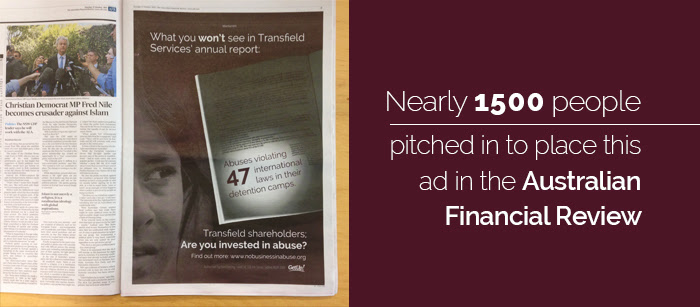
On Tuesday, GetUp released the No Business in Abuse report, outlining Transfield/Broadspectrum’s complicity in human rights abuses1. In case you missed it, here’s the topline:
Inside Transfield’s (now Broadspectrum’s) detention camps there have been abuses violating a massive 47 international laws.
Horrifying, right? Thanks to GetUp members, Broadspectrum shareholders all over the country woke to find this statistic as a full-page ad in Australia’s leading business newspaper – the day before their annual general meeting (AGM).
Together we put Broadspectrum’s appalling human rights record front of shareholders’ minds at the AGM.
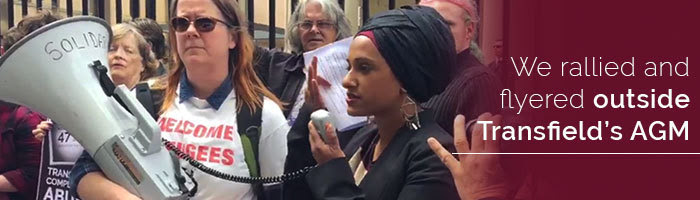
Then, we put this information into the hands of shareholders as they entered the AGM. And as they met inside, GetUp members rallied outside with our allies from the Refugee Action Coalition.
And you helped make our message heard inside the AGM as well.
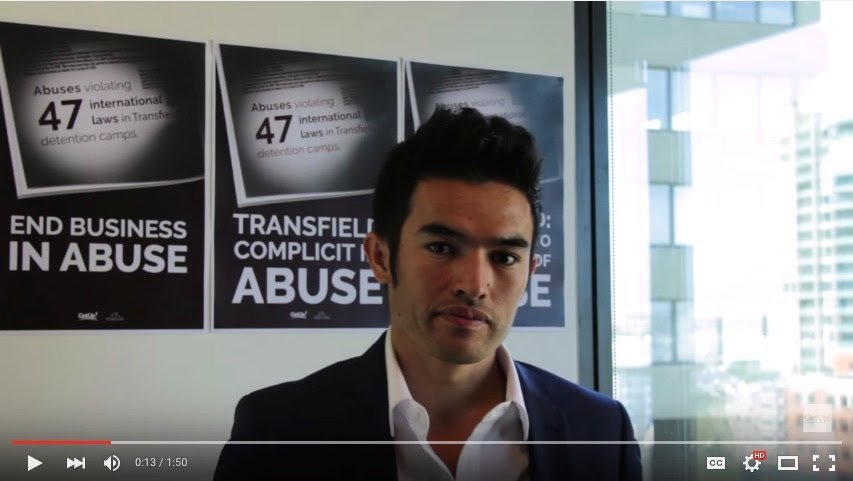
With your support, Mohammad Ali Baqiri, a former child detainee on Nauru, was able to fly down to the AGM, where he spoke truth to power.2
You can listen to Mohammad’s story here:
Finally, on that same day as the Broadspectrum AGM, we received word that Abyan* was being brought back to Australia.
Abyan* is the refugee who became pregnant after being raped on Nauru. She was initially brought to Australia for medical care, including an abortion – only to be sent back without treatment, having been denied counselling and an interpreter.3
Huge public outcry on her behalf – including from tens of thousands of GetUp members who called, emailed and petitioned Malcolm Turnbull – prompted a response from the government who confirmed she will now receive the medical care she so desperately needs.4
Small, regular donations from hundreds of GetUp members make it possible to do things like fly Mohammad from Melbourne to Sydney at short notice, and rapidly respond to emergency stories like Abyan’s. Will become a core supporter of our refugee campaign to make sure this work can continue in the weeks and months ahead?
Yes, I’ll become a core supporter!
We’ll be back in touch soon with the campaign’s next steps. For now, thank you so much!
Shen, Aurora and Matt for the GetUp team
*Abyan is not her real name; it is the name used by the media to protect her identity.
References
[1] “Transfield given $1.5bn over three years to manage Nauru and Manus centres”, The Guardian, 27 October 2015
[2] “Transfield Services chairman Diane Smith-Gander stares down protestors”, Sydney Morning Herald, 28 October 2015
[3] “Australia secretly flies pregnant refugee out of country before hearing”, The Guardian, 16 October 2015
[4] ‘Pregnant Somali refugee ‘Abyan’ to return to Australia for medical advice: Peter Dutton’, Sydney Morning Herald, 29 October 2015

Accessibility tools
Service tools
Language
Navigation path
Page navigation


UN negotiations are under way to develop a new international climate change agreement that will cover all countries.

The new agreement will be adopted at the Paris climate conference in December 2015 and implemented from 2020. It will take the form of a protocol, another legal instrument or ‘an agreed outcome with legal force’, and will be applicable to all Parties. It is being negotiated through a process known as the Durban Platform for Enhanced Action (ADP).
The European Commission has set out the EU’s vision for a new agreement that will, through collective commitments based on scientific evidence, put the world on track to reduce global emissions by at least 60% below 2010 levels by 2050.
The EU wants Paris to deliver a robust international agreement that fulfils the following key criteria. It must:
The EU’s contribution to the new agreement will be a binding, economy-wide, domestic greenhouse gas emissions reduction target of at least 40% by 2030.
The climate conferences in Warsaw (2013) and Lima (2014) agreed that all countries are to put forward their proposed emissions reduction targets for the 2015 agreement as “intended nationally determined contributions” well in advance of the Paris conference.
The contributions will be prepared at national level by each Party, as the EU has done, and submitted to the UNFCCC.
The UNFCCC secretariat will publish these contributions and prepare, by 1 November 2015, a synthesis report to assess whether they put us on track to keep global warming below 2°C.
A negotiating text for the 2015 agreement was agreed in Geneva in February 2015. Before the Paris conference, negotiations will continue at inter-sessional UN meetings in June, September and October in Bonn.
|
Inbox
|
x |
|
11:45 AM (1 hour ago)
|
|
|||
|
 |
|
||||
1 of 49
| Inbox | x |
| Andrew Glikson | 1:48 PM (21 hours ago) | ||
|
|||
3 older messages
| Andrew Glikson | 10:46 AM (23 minutes ago) | ||
|
|||
|
11:05 AM (4 minutes ago) |
This is how your items would appear on the Generator where I can tweet them
I can add any comments before tweeting. Some graphics may be missing,
On Sat, Oct 31, 2015 at 10:46 AM, Andrew Glikson <Geospec@iinet.net.au> wrote:
Hi Neville This is most helpful. Would you be able to re-tweet the book brochure and the Endorsements, appended below, to your distribution, following the statement: “Had humanity understood the full consequences of atmospheric CO2 above 400 ppm and 4 degrees Celsius it would have ceased carbon emissions today” (if this statement is too long, let me know and I will shorten it). Before you Twit this material on your distribution list please send me a draft so that I can see what the Twit looks like? Many thanks Andrew31-10-2015 Endorsements:“Andrew Glikson and Colin Groves’ new book “Climate, Fire, and Human Evolution” traces the fascinating and complex history of the Earth over the past 4 billion years. It explores the fundamental context of the Earth’s climate system, the cycles of carbon, oxygen and nitrogen, and the crucial role of fire, to provide the critical baseline for our understanding of how a single species, Homo sapiens, has changed the atmosphere, oceans and biosphere. The fate of our species, and all the others with which the share this planet, is now in peril from the unintended consequences of our development, and especially our use of energy. I commend this scholarly yet readable work as a vital reference for understanding our past and present, and hopefully, for saving our future.”
Professor Lesley Hughes, Macquarie University“This is a most innovative and challenging book. One of its most interesting features is the explicit use of the stratigraphic record – the timeline of Earth History – to trace (or infer) the evolution of life on the planet (and not just human evolution). The co-evolution of life and the geosphere is fascinating. It certainly gave rise to the inter-discipline of biogeochemistry (the great element cycles of the planet), which in turn has become a key component of Earth System science. Importantly, this book uses the frame of Earth System science throughout, and shows the close nexus between the long-term geological record and Earth System science in its broadest sense.”
Professor Will Steffen, Australian National University“This masterful and overarching book could only have been written by geoscientists that had delved into both the earliest evidence preserved on Earth and into the youngest perturbations of our human-overwhelmed biosphere. Beginning with the earliest Earth systems, the crucial presence of liquid water and the dawn of simple life, the book traces the explosions of Phanerozoic life, interrupted only by several mass extinctions. And so, genetic evolution leads to the cultural evolution of humanity involving the iconic mastery of fire, the agricultural revolution and the explosion of human populations. The accelerating effects of human activities on the ecology and therefore on human health have become the focus of our modern world: the Anthropocene. Finally, this book tackles the perennial question, “Are we alone in this Universe” that involves the evolution of intelligence in the context of randomness or chaos. Congratulations to both authors.”
Professor Victor Gostin, University of Adelaide’ “With the continuing accumulation of CO2 in the upper atmosphere now exceeding the 400 ppm worrisome barrier with no sign of a diminishing trend, Andrew Glikson’s extended edition provides a timely and perhaps final alarm. It includes an anthropological dimension by Colin Groves that better contextualizes his message of grave concern and places it ever more firmly where it belongs: on the shoulders of those people who are complicit in promoting, directly and indirectly, the demise of life on Earth.”
Professor emeritus Colin L. Soskolne, University of Alberta
“This book is about the Earth, how its systems work, how it has evolved and where it may be heading.”The writing is clear and the sources of information are well documented, making this an excellent resource book for anyone who seeks a clear picture of the evolution of life on Planet Earth, and the forces that control our climate now, and have controlled our climate in the past. The book closes with consideration of the future and some philosophical words about human nature, the present situation, how it developed and how we have responded.”
Professor Hugh Davies, University of Papua New Guinea
|
|||