The Westender has received another quirky media release from the Urban Utilities team tunneling their way underneath Mollison Street, outside the Coles supermarket. Here it is. This week sees our tunnel borer machine spring back into action as we come out of hibernation and recommence our tunnelling from the ‘garden bed’ in front of 26 & 30 Mollison Street towards Monty’s Spare Parts. We also expect new shoots to sprout up from our shopping centre shaft as we expand our budding network and drill our way towards the Boundary Street intersection. Now blossoms, this part is going to be a bit hayfevery as when we have to work in the intersection (possibly as early as this Monday, 8 September 2014) we will have to work at night due to the high traffic volumes in the daytime . It will be unseasonably noisy and we will have to close one lane of Melbourne Street for safety reasons.  To help you cope with our new spring growth, we are offering you a free ‘poo-motional’ item (see pic left) to help you with your spring cleaning. Please email me at dylan.olliver@urbanutilities.com.au if you’d like some for your home or office, as this limited spring edition is a ‘collectors’ item. Finally, a huge thank you to you all for your amazing understanding throughout our winter of discontent, we greatly appreciate your ongoing support. Have a blooming marvellous week Yours Springcerely Dylan Olliver Communications Consultant Marketing and Communications
Category: General news
Managing director of Ebono Institute and major sponsor of The Generator, Geoff Ebbs, is running against Kevin Rudd in the seat of Griffith at the next Federal election. By the expression on their faces in this candid shot it looks like a pretty dull campaign. Read on
-
Tunnel borer “springs” back into action
-
Dick Warburton’s 10 minutes of woe

Share story
Print
Email
Dick Warburton, chair of the government’s review of the Renewable Energy Target, had a horror interview with Fran Kelly of ABC’s Radio National a day after his report was released. In just under 10 minutes, Warburton found himself tied up in knots as he tried to justify his recommendation to shut the renewables scheme.
The trouble started at the beginning of the interview, with Warburton disputing Kelly’s suggestion that coal generators would be big winners out of his recommendations. Kelly promptly responded: “But doesn’t your own modelling estimate the value of the existing coal-fired power generators would increase by $9.1 billion?”
“Um … yes,” Warbuton replied. But he then bizarrely asserted this $9.1 billion windfall was of “neutral benefit to them [coal generators]”.
Subsequently, after Warburton admitted the RET would act to reduce retail electricity bills and was also successful at decarbonising electricity supply, the discussion moved to the nub of the review panel’s argument. Warburton explained that even though the RET might be effective at reducing emissions, the government’s proposed Emissions Reduction Fund – the centrepiece of its Direct Action policy – “would be a far less expensive” way of doing the same thing.
What followed was almost farcical.
Kelly, rather puzzled, pointed out that we don’t actually know the cost of reducing emissions under the ERF because the government is yet to release any costings of the scheme (see Hunting for Hunt’s Direct Action costings for background). She then noted that Warburton’s recommendation to cut the RET would pass costs onto, via the ERF, taxpayers to fund achievement of the 5 per cent emission reduction target.
Warburton then appeared to reveal he doesn’t understand the ERF is funded by taxpayers, and oddly disputed her assertion. He then continued to argue that there were “less expensive means of reducing emissions [than the RET].”
Kelly then asked the obvious: “What are those less expensive means, have you modelled those?”
Warburton: “Well, we just said the Emissions Reduction Fund.”
Kelly: “But we don’t know yet how much that’s going to be.”
Warburton then gave the game away, admitting “we don’t know the figure” for the abatement cost of the ERF. But he then confidently asserted it would be way short of the cost of the RET.
While the discussion seems farcical, this is actually quite important.
Basically, Warburton is proposing that the government make a drastic change to a policy that his own review acknowledges is unlikely to save energy consumers money, which will undermine the value of several billion dollars in investment and considerable project development effort, and send a large proportion of renewable energy businesses bankrupt, with their staff made redundant.
This should all be done on the basis of an assertion that the ERF scheme will be cheaper than the RET, yet neither the RET Review team nor the government has actually costed the ERF.
Now, to be fair to Warburton if you refer back to the actual review report, it references work by ClimateWorks to support its assertion that the RET be abolished, or at the very least cut by 60 per cent, because there are cheaper options for reducing emissions. Unfortunately for Warburton, ClimateWorks have rejected his review panel’s interpretation of their research. Yesterday they sent out the following statement:
The panel cited ClimateWorks’ Low Carbon Growth Plan as evidence that there are lower cost abatement measures available than renewable energy. However, our research also clearly shows that we need all of those measures plus renewables if we are to achieve the emissions reductions that scientists … have advised are necessary. In looking beyond 2020 to 2050, ClimateWorks’ new research … shows that ultimately full decarbonisation of the electricity system is necessary. And the most cost effective way to achieve this is with a majority of our electricity coming from renewable energy. For this transition to occur, the RET or an equivalent should be retained and increased over time, not reduced.
One wonders how Warburton can be so confident the ERF will achieve anything meaningful when it is still an unlegislated skeleton. Evan Stamatiou of sustainability advisory firm Net Balance echoed the views of a number of carbon market analysts and lawyers, observing:
While some overarching design elements [of the ERF] have been laid out, the detailed design has not been agreed upon, and there are still numerous and fundamental design challenges that technical experts and bureaucrats are trying to understand and resolve.
The one analyst that has been imaginative enough to attempt to cost the ERF, RepuTex, believes it will involve a cost per tonne of abatement that isn’t cheaper than what the RET Review estimates for the large-scale Renewable Energy Target.
The Abbott Government will be fooling no one about the insincerity of its concern for climate change if it chooses to substantially cut the Renewable Energy Target while arguing that it will all be taken care of by the uncosted, unlegislated and underfunded Emission Reduction Fund.
Connect with Tristan Edis on Google+
More from Business Spectator
-
Limits to Growth was right. New research shows we’re nearing collapse

Limits to Growth was right. New research shows we’re nearing collapse
Four decades after the book was published, Limit to Growth’s forecasts have been vindicated by new Australian research. Expect the early stages of global collapse to start appearing soon
- theguardian.com, Tuesday 2 September 2014 11.15 AEST
- Jump to comments (293)

Piles of crushed cars at a metal recycling site in Belfast, Northern Ireland. Photograph: Alamy The 1972 book Limits to Growth, which predicted our civilisation would probably collapse some time this century, has been criticised as doomsday fantasy since it was published. Back in 2002, self-styled environmental expert Bjorn Lomborg consigned it to the “dustbin of history”.
It doesn’t belong there. Research from the University of Melbourne has found the book’s forecasts are accurate, 40 years on. If we continue to track in line with the book’s scenario, expect the early stages of global collapse to start appearing soon.
Limits to Growth was commissioned by a think tank called the Club of Rome. Researchers working out of the Massachusetts Institute of Technology, including husband-and-wife team Donella and Dennis Meadows, built a computer model to track the world’s economy and environment. Called World3, this computer model was cutting edge.
The task was very ambitious. The team tracked industrialisation, population, food, use of resources, and pollution. They modelled data up to 1970, then developed a range of scenarios out to 2100, depending on whether humanity took serious action on environmental and resource issues. If that didn’t happen, the model predicted “overshoot and collapse” – in the economy, environment and population – before 2070. This was called the “business-as-usual” scenario.
The book’s central point, much criticised since, is that “the earth is finite” and the quest for unlimited growth in population, material goods etc would eventually lead to a crash.
So were they right? We decided to check in with those scenarios after 40 years. Dr Graham Turner gathered data from the UN (its department of economic and social affairs, Unesco, the food and agriculture organisation, and the UN statistics yearbook). He also checked in with the US national oceanic and atmospheric administration, the BP statistical review, and elsewhere. That data was plotted alongside the Limits to Growth scenarios.
The results show that the world is tracking pretty closely to the Limits to Growth “business-as-usual” scenario. The data doesn’t match up with other scenarios.
These graphs show real-world data (first from the MIT work, then from our research), plotted in a solid line. The dotted line shows the Limits to Growth “business-as-usual” scenario out to 2100. Up to 2010, the data is strikingly similar to the book’s forecasts.
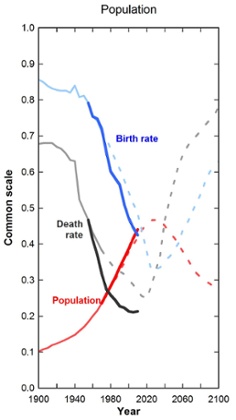
Solid line: MIT, with new research in bold. Dotted line: Limits to Growth ‘business-as-usual’ scenario. 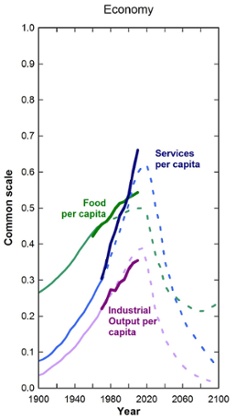
Solid line: MIT, with new research in bold. Dotted line: Limits to Growth ‘business-as-usual’ scenario. Photograph: Supplied 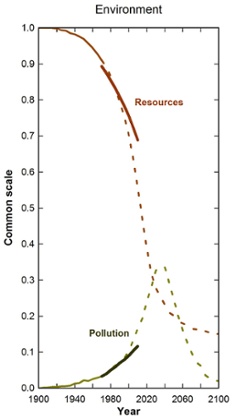
Solid line: MIT, and research in bold. Dotted line: Limits to Growth ‘business-as-usual’ scenario. Photograph: Supplied As the MIT researchers explained in 1972, under the scenario, growing population and demands for material wealth would lead to more industrial output and pollution. The graphs show this is indeed happening. Resources are being used up at a rapid rate, pollution is rising, industrial output and food per capita is rising. The population is rising quickly.
So far, Limits to Growth checks out with reality. So what happens next?
According to the book, to feed the continued growth in industrial output there must be ever-increasing use of resources. But resources become more expensive to obtain as they are used up. As more and more capital goes towards resource extraction, industrial output per capita starts to fall – in the book, from about 2015.
As pollution mounts and industrial input into agriculture falls, food production per capita falls. Health and education services are cut back, and that combines to bring about a rise in the death rate from about 2020. Global population begins to fall from about 2030, by about half a billion people per decade. Living conditions fall to levels similar to the early 1900s.
It’s essentially resource constraints that bring about global collapse in the book. However, Limits to Growth does factor in the fallout from increasing pollution, including climate change. The book warned carbon dioxide emissions would have a “climatological effect” via “warming the atmosphere”.
As the graphs show, the University of Melbourne research has not found proof of collapse as of 2010 (although growth has already stalled in some areas). But in Limits to Growth those effects only start to bite around 2015-2030.
The first stages of decline may already have started. The Global Financial Crisis of 2007-08 and ongoing economic malaise may be a harbinger of the fallout from resource constraints. The pursuit of material wealth contributed to unsustainable levels of debt, with suddenly higher prices for food and oil contributing to defaults – and the GFC.
The issue of peak oil is critical. Many independent researchers conclude that “easy” conventional oil production has already peaked. Even the conservative International Energy Agency has warned about peak oil.
Peak oil could be the catalyst for global collapse. Some see new fossil fuel sources like shale oil, tar sands and coal seam gas as saviours, but the issue is how fast these resources can be extracted, for how long, and at what cost. If they soak up too much capital to extract the fallout would be widespread.
Our research does not indicate that collapse of the world economy, environment and population is a certainty. Nor do we claim the future will unfold exactly as the MIT researchers predicted back in 1972. Wars could break out; so could genuine global environmental leadership. Either could dramatically affect the trajectory.
But our findings should sound an alarm bell. It seems unlikely that the quest for ever-increasing growth can continue unchecked to 2100 without causing serious negative effects – and those effects might come sooner than we think.
It may be too late to convince the world’s politicians and wealthy elites to chart a different course. So to the rest of us, maybe it’s time to think about how we protect ourselves as we head into an uncertain future.
As Limits to Growth concluded in 1972:
If the present growth trends in world population, industrialisation, pollution, food production, and resource depletion continue unchanged, the limits to growth on this planet will be reached sometime within the next one hundred years. The most probable result will be a rather sudden and uncontrollable decline in both population and industrial capacity.
So far, there’s little to indicate they got that wrong.
-
What’s your credit score?
 With the launch of GetCreditScore.com.au, Australians are able to get a snapshot of their credit score, empowering them with information to help negotiate better credit terms. Credit providers such as banks and credit card companies, use credit scores to assess an individual’s credit risk and to mitigate potential losses due to defaults. Increasingly, credit scores are used to determine who qualifies for a loan, at what interest rate, and what credit limits. Financial campaigner and GetCreditScore spokesperson Christopher Zinn welcomed the launch – which helps empower consumers. “Credit scores are becoming increasingly important for Australians, yet most people would not know their score. It is time now for consumers to get informed, find out their score and start pushing for a better deal,” Mr Zinn explained. “GetCreditScore.com.au puts the power back in your hands.” For decades, credit scores have been widely used in most developed economies like England and the United States where people have relied on them as a tool to access credit and even negotiate better terms from banks and other lenders. Australians can now benefit the same way. GetCreditScore features the VedaScore provided by data intelligence and insights company Veda. To get a snapshot of their VedaScore, people can simply visit www.getcreditscore.com.au and fill in some basic information – name, address, date of birth, email and driver licence number or passport number. GetCreditScore.com.au is being launched during MoneySmart Week, Australia’s biggest initiative promoting the importance of financial literacy. GetCreditScore is an initiative of SocietyOne, in conjunction with Veda.
 -
Un-muzzle the scientists? Not so fast.
Un-muzzle the scientists? Not so fast.
Those with the lab coats do not have a monopoly on evidence
August 24, 2014

Getty Images
Every so often, something happens that renews calls in this country for scientists within the federal government to have more unfettered rights to speak to media. This past week, it was the nearly comical number of layers of bureaucracy through which a request to hold a media briefing on the extent of Arctic ice erosion needed to pass. Previously, we’ve seen similar calls motivated by differences between Canadian and U.S. standards with respect to publication of research results or the presence of so-called minders at scientific conferences. I’ve hesitated to write on this despite often engaging in heated discussions on the subject, both on Twitter and in less virtual environments, because it’s not my area of expertise. It’s still not an area in which I have any formal training, and my experience is limited, but I feel that I can comment on some aspects of the debate based on the time I spent on sabbatical at Environment Canada, a department frequently attacked for the so-called muzzling of scientists.
The basic arguments in favour of loosening the controls on government scientists to speak to media often follow from one of two points: either that the research is publicly funded, and so should be accessible to the public; or, that making researchers available to the media would show that the government is hiding evidence that might otherwise undermine its policy agenda. For example, when interviewed at a protest by scientists on Parliament Hill last year, University of Ottawa professor Jeremy Kerr stated that, “the facts do not change just because the Harper government has chosen ignorance over evidence and ideology over honesty.” That’s certainly accurate, at least insofar as the facts being generally invariant to the will of the Prime Minister, but the government of Canada has no monopoly over the facts—there are plenty of entities, government-funded and otherwise, that can do a fine job of holding the government to account externally, as professor Kerr’s comments to the Star illustrate.
Related:
Un-muzzle the scientists: Liberal science critic Ted Hsu responds
When science goes silentFor me, the key questions are whether government researchers should, themselves, be able to speak out when they feel a government policy does not align with the evidence (Added 2014-08-31 – the Professional Institute of the Public Service of Canada raised this question in their Big Chill Survey) and, if so, why we would only restrict that to a particular class of government researchers? To speak out publicly against government policy is, by the current definition, fundamentally at odds with the role of a public servant in our democracy. Public servants are expected to provide impartial advice to the policy development process and loyal implementation of government policies once decisions are taken. They are not supposed to critique that policy publicly when it doesn’t align with their interpretation of the evidence or their beliefs with respect to how that evidence should be weighed. Allowing public servants to be openly critical of government decisions – whether based on scientific evidence or any other criteria – turns the relationship between the bureaucracy and their democratically elected masters on its head, undermining the trust essential to an effective working relationship.
Many would like to have you believe that there are issues for which we could live in a technocracy—where the science speaks so clearly as to the correct policy that there is no role for any other factors. I can’t think of a single instance where that would be so. Often-cited in debates on the muzzling of scientists is my University of Alberta colleague David Schindler and his ground-breaking work at the Experimental Lakes Area. What did that research tell us? It made clear, for the first time, the link between human activity, in particular industrial sulphur emissions and nutrient effluent from agriculture, and the health of lake ecosystems. It told us about the damages from pollution and was some of the most important and policy-relevant pieces of scientific work in this country’s history. What Dr. Schindler’s research alone could not tell us is what we should do about it. It did not tell us what costs we should be willing to impose on industry to prevent these damages, it did not tell us how Canadian economic activity, trade, and employment would react if certain policies were imposed, nor did it tell us how Canadians would prioritize expenses to defray these damages versus other potential uses of government and private sector resources. In other words, it gave us an important piece of the policy puzzle, but not the entire picture. You can’t prove, with science alone, what the policy should be—science isn’t normative—but only what is and what will be if you take a particular action.
In a policy department like Environment Canada, policy decisions are made through a process that involves bureaucrats from different disciplines including scientists, engineers and economists. Senior bureaucrats interact with the minister’s office, with central agencies like the Department of Finance, and with the Privy Council Office, which acts as the bureaucratic liaison to the Prime Minister’s Office. When a policy proposal is on the table, there are different opportunities for arguments to be made, decisions to be challenged, and evidence to be presented. As an economist visiting Environment Canada for the year, I was fortunate to participate in briefings at every level and to be given the opportunity to present evidence on occasion. Sometimes, that evidence carried the day. Sometimes, I came out of a briefing feeling that I’d lost—that economic evidence as to the best policy option, data on the cost of taking one action over another, or predictions of the likely outcome had been ignored in favour of evidence presented by others. In most cases, it hadn’t been ignored, but it just hadn’t been given the weight I thought it should. You might imagine that it was always those with the lab coats pushing stronger action, while the economists pushed for weaker action. It wasn’t. At the end of the day, senior public servants and elected officials did what they were paid to do: they weighed the evidence and made decisions.
The way
thesome unmuzzlers would have you believe that the system should work is that, when senior public servants or elected officials take a decision with which the scientists in the room do not agree, these scientists should — and it is largely those in the “hard” sciences that the unmuzzlers are talking about — because they are on the side of the evidence, be free to speak up and to contest that decision in the public arena. The problem with that, as I see it, is that those with the lab coats do not have a monopoly on evidence: across the federal government, there are a variety of public servants collecting and compiling data, conducting experiments, testing hypotheses, developing numerical models, and the like. Some are scientists in the conventional sense of the word (i.e. they wear lab coats) while some are economists, sociologists, statisticians, and engineers. It’s impossible to draw clear lines between what is “scientific evidence” presented to senior decision makers and what is not.Let’s imagine the government is considering a regulation on an industrial sector and, based on the evidence presented, senior decision-makers conclude that the costs in terms of reduced output, employment, and value-added of enacting stringent regulation are justified based on the benefits to the ecosystem and/or to human health presented by the scientists (in this caricature, you can imagine the scientists wearing their lab coats in the briefing if you prefer). Now suppose that one of the experts involved—an economist in a central agency, for the sake of this caricature—decides that this decision is simply inconsistent with the evidence he or she presented. Suppose he or she decided that, if only the Canadian people were made aware of this economic evidence, they too would side with a “weaker” policy response. Clearly, it’s in the public interest to drop a brown envelope on someone’s doorstep so that the headlines the next morning might read something like, “Government considering regulation that would halt oil sands development, cost thousands of jobs,” with the story crediting an anonymous government economist privy to the discussions, right? That would push the government to make the right decision.
In the caricature I’ve presented, the evidence would all be accurate, but it would be one-sided: the article in the newspaper would show you all of the costs of the policy and none of the benefits. The implication would be clear: that the government had ignored all these costs in reaching its decision, and Canadians should be outraged. The implication would also be entirely false. All that heroic economist would have done with his or her actions would have been to tilt the decision-making process toward their preferred weighing of the evidence. Would it be any different if the decision had gone the other way, toward the less stringent policy, and it were the scientist, clad as ever in his or her lab coat, dropping off the brown envelopes? I think not.
Should we have more open government science? Perhaps. I think the better question is to what degree government-supported research should take place in arms-length agencies (the U.S. model for agencies like NASA and the Energy Information Administration come to mind) or outsourced to universities via government granting agencies as opposed to being housed in policy departments. Research housed outside of government departments would allow elected and bureaucratic offices to determine which questions are being asked by researchers or which subject areas are being explored without having influence over the answers or controlling the message. It would also mean that researchers were not privy to the policy discussions of the day and would not necessarily be involved when their research is used to support a decision. There are also options within the public service: perhaps Statistics Canada could broaden its role to collect and publish more environmental statistics such as the sea ice coverage, which was the subject of so much consternation this week, perhaps absorbing some of the functions now performed within Environment Canada. In the same way in which no one would ask a Statistics Canada official what government should do to combat youth unemployment or to raise median incomes when those data are published, no one would ask whether the extent of sea ice coverage should influence our climate change policy choices. When you’re asking officials from the department with jurisdiction over both our domestic climate change policies and our intervention in international climate change negotiations about sea ice coverage, the implications are very different. The questions to the scientist might even be policy-neutral, but I expect most of the resulting articles would not be.
If you want to take the muzzle off government researchers, that’s fine if you want it for the right reasons. I’m all in favour of increasing the quality of information available both to our decision-makers and to the general public. However, we must do it without skewing the policy process. The only way to make sure that’s true if you want open access to researchers is to disconnect those undertaking primary and policy-relevant research from that process and from those departments. Whether that’s best done through arms-length institutions, through universities, or through agencies such as Statistics Canada is a topic for debate. Of course, there are some topics of current government research not suited to open inquiry, for a variety of reasons. Maybe you’re willing to sacrifice some of those topics for access to information? You might also find that some of our government’s best researchers prefer their seat at the policy table to the front pages of the newspaper. Maybe that’s a sacrifice you’re willing to make? Unfortunately, I doubt you’ll be able to rely on anyone in a lab coat to tell you with certainty which is best for the country.
On the other hand, if your reason for removing the muzzle is because you think policy decisions need to be skewed or the government needs to be challenged, then there’s a better process for that that doesn’t involve sacrificing our public service. Rumour has it it will happen next October, if not sooner.
-
Daily update: Why were RET modellers instructed to ignore commercial reality?
1 of 4 AdDr Green – Solar Power – www.drgreen.com.au/MonthlySpecial – 5kW System only $4490 + Free Meter or $48/wk. Hurry, ends 29th August!
Daily update: Why were RET modellers instructed to ignore commercial reality?
Inboxx 
Renew Economy editor@reneweconomy.com.au via mail12.atl111.rsgsv.net
2:50 PM (32 minutes ago) to meWhy were RET modellers instructed to ignore commercial reality?; Waburton says energy market modelling as bad as climate modelling; India poised to be world solar leader; The WA green power scheme that wasn’t; Queenslanders continue to rush to rooftop solar; Tag Pacific steps in to build solar plant at Rio Tinto mine; Japan JV to build world’s largest floating solar array; Who really benefits from reducing the RET; Cali’s EV strategy opens a portal the U.S. future; and how Germany may get 6-fold boost in wind power from fewer turbines.Is this email not displaying correctly?
View it in your browser. The Parkinson ReportWhy were RET modellers instructed to ignore commercial reality? Giles ParkinsonACIL Allen says it was instructed by RET Review panel – headed by climate skeptic Dick Warburton – to ignore commercial realities around coal-fired generation. Such modelling would be rejected by any company board, and the government should do the same.Warburton says energy market modeling as bad as climate modeling Giles ParkinsonAfter months of denying a bias against renewables and climate science, RET Review head Dick Warburton says globe not warming, developing renewables pointless.New report suggests road map for India’s solar sector to boost nation’s PV capacity by more than 140GW in 10 years.The WA green power scheme that wasn’t Giles ParkinsonWA consumers rail against state-owned retailer Synergy, after being told their premiums were not invested in local environmental schemes.Households and businesses continue to defy expectations, and install large rooftop solar systems in Queensland despite change in tariffs.Tag Pacific steps in to build solar plant at Rio Tinto mine Sophie VorrathLess than two months after Ingenero’s collapse, Tag Pacific signs up to build a 1.7MW solar PV array to power Rio Tinto’s bauxite mine in Weipa, Qld.Japan JV to build world’s largest floating solar array Sophie VorrathKyocera and Century Tokyo Leasing announce plans to build a 2.9MW floating solar plant in in Hyogo Prefecture, west Japan.NSW, SA to suffer most from cuts to Renewable Energy Target The Climate InstituteReducing the RET is a step back from a clean energy economy that rewards coal and gas power companies at the expense of households and small business.California’s EV strategy opens a portal to America’s future Cynthia ShahanCalifornia is poised to open a portal to America’s future, shoving Big Oil off the highways to make room for cleaner transportation alternatives.Germany expected to increase share of wind power from 15% fewer turbines, with overall power consumption remaining basically unchanged. What would that look like?


 Email
Email


Please login or subscribe to post comments
Comments Policy »
I cannot believe what I just read and if it’s true Mr Warburton should be ashamed of himself for being led right royally down the garden path at best, showing his complete ineptitude on the subject and brief he’s been dealing with and more bizarrely allowing him and his reputation to be abused by the government in what is clearly a sham panel review with an planned outcome from the very beginning……and I’m seeing my business go down the drain because of this? I think not. There will be repercussions!!
Even the star commentator Mr Swill (or shrill) cannot be happy with this!!
Why thank you. In truth I doubt many people read these comments – and given my views are unlikely to cut it with most of Tristan’s entourage, they are likely the least read. I like Fran by the way. She is a good journalist with a feisty no nonsense way about her.
Warburton’s behaviour is entirely consistent with the Coalition’s actual position on climate change, which was most accurately described by Malcolm Turnbull in this article –
http://www.smh.com.au/federal-politics/political-opinion/abbotts-climate…
It just goes to show what a waist of time and money this review has been. The government thought this review would have given them a just reason to break yet another promise and scrap or reduce the RET. Even their own hand picked bias mates couldn’t fudge the facts and figures to suite the government’s agenda. Warburton has been caught with his pants down and shown to be a bias fool who should never have been involved in this RET review.
The government may have scrapped the carbon tax but they are showing no decisive action to meet their carbon reduction targets. They are running around in circles and their “direct action” policy is just what most expected from this lying mob “no action.”
A storm in a teacup. Probably just nerves from the poor old duffer.
But he is clearly on the right side of history by searching for the most effective means of abatement and suggesting that it is unlikely to come from a policy that preferences renewables above the cheapest available means.
Dragging down someone who is seeking the best bang for the community’s buck is an unlikely popular cause. He may be a skeptic but he appears to have a degree of common sense about him that is sadly lacking in his critics.
You commented quite a bit that the RET isn’t the cheapest way to achieve cuts in greenhouse gasses. Just wondering what you think the other options are…
haha, nice one “Utility PR Shill”!
Utility PR Shill is right – not many people read this rag or the comments. You can tell because of the dramatic decline in the Comments section since the LNP was elected and particularly since the Carbon Tax was blown away with the dust of Labor history. And today the Mining Tax went, so Labor’s massive negative footprint is being gradually filled in. Soon the RET will go, taking with it the beggars who benefited from it. Now that we have years of measurement showing that dangerous Climate Change exists only in the minds and the models of the anti-Carbon zealots, there is less reason to monitor the “debate”. In fact there is no longer a debate. Rational people are able to confidently shrug and walk away from the placard carriers like the writers in this journal. The one area where this journal and the departed readers can agree is that we all hope the Government drops the “Direct Action” plan. Labor’s opposition will be an accidental force for good if the DA plan is also consigned to the dust of history.
Rational people eh? I’d actually put the people with those kind of views in the same boat as creationists and other such flat earth believers. Bill Maher’s program last night where he interviewed a lot of the religious leaders from these groups was entertaining viewing, and in fact I hope he does a similar one on climate sceptics such as yourself. Be good for a chuckle.
I do like the beggar reference too. How does that comment fit with the Billions of dollars in subsidies that flow to the coal and gas industries? In reality, the RET has merely leveled the playing field for renewable energy, and the main reason they are trying to remove it is because the renewable energy industry does not have the political pull, lobbying power or tax base of the fossil fuel energy sector.
Yours truly – A dedicated anti-carbon zealot (should we call the the church of climatology?!).
Are you encouraging the Coalition to break their promise on Direct Action?
I would suggest caution regarding the use of ClimateWorks work for anything at all until they have released their final report, detail of the actual work done, and responded to our critique. At this time, we are very concerned about that work and the implications it may have treated seriously.
A critique of the draft is published here http://decarbonisesa.com/2014/08/28/critiquing-deep-deep-decarbonisation…
Should “unlikely to save energy consumers money” be “likely to save energy consumers money”?
I like the way Nivek writes. If he wrote for this “rag” maybe some of the ex readers would come back.
Shill – you don’t need to be an apologist for Tricky Dicky – more than capable of handling himself or so he thinks……….or maybe its brain drain, followed closely by his report !
– currently Chairman of Westfield Retail Trust, Magellan Flagship Fund and Citigroup Pty Ltd.
He also serves as Chairman of the Commonwealth Studies Conference, Vice Chair of the Council on Australian Latin American Relations and a Member of the Advisory Council of the Centre for Social Impact.
Dick is a former Chairman and CEO of Dupont Australia and New Zealand, and worked with Dupont for 30 years in marketing, manufacturing, technical and management roles in Australia, USA and Thailand.
He was a Board Member of the Reserve Bank of Australia, Chairman of the Australian Board of Taxation and Chairman of Caltex Australia Ltd, David Jones Ltd, Goldfields Ltd, Tandou Ltd and Wool International and a Director of Southcorp Ltd, Tabcorp Holdings Ltd, Nufarm Ltd and other companies.
Mr Richard Warburton is an advisor to government – yet doesn’t seem to know his way around a financial report!
He tells us in his May 8 interview :
CHRIS UHLMANN: What kind of effect is it having? Just give us a sense of the cost of power and how the renewable energy target has driven that up over time.
DICK WARBURTON: Well, we’re looking at emission, we’ve got a target for an emission control of 5 per cent. That’s a bipartisan approach. And certainly renewables have their place in that particular equation.
I’d like to believe that we’ll look at this and say, now, is the cost of the RET worth the economic pain that you get by imposing it on the electricity consumers?
CHRIS UHLMANN: And there’s no doubt that there is economic pain because of that?
DICK WARBURTON: Yes there is, yes there is economic pain. It is one part of the equation. It is not the whole part of the equation.
CHRIS UHLMANN: Is the cost of energy doing damage to business in Australia?
DICK WARBURTON: Depends on the business, Chris. Some of the businesses that use relatively small bits of electricity, obviously it hasn’t got a great effect. But there are industries that use large quantities of electricity and in those place they’ve been telling us this is having a major impact on their cost side of the balance sheet.
–> Dick – There is NO “cost side” of a balance sheet, you are looking at the P&L.
The RET was killed about 18 months ago when Abbott first flagged he was not completely supportive. The RET will only work when investors are confident re durable bipartisan support. The Senate can’t enforce durable bipartisanship any more than a change of government at the next election will revive the RET.
We have to look at things like the ACT solar auction scheme (which doesn’t need bipartisanship) to drive investment in utility scale renewables. See: http://www.climateplus.info/2014/08/13/replacing-the-ret/