Managing director of Ebono Institute and major sponsor of The Generator, Geoff Ebbs, is running against Kevin Rudd in the seat of Griffith at the next Federal election. By the expression on their faces in this candid shot it looks like a pretty dull campaign. Read on
White Australians struggling with approaches to justice for First Nations people might consider a Radical Republic, writes Geoff Ebbs.
Prince Andrew represents the sickening privilege of our European head of state.
The coincidence of the Queens Birthday long weekend and the Black Lives Matter rallies encouraged me to dust off an old idea during today’s episode of EcoRadio.
Many Australians have had enough of the Sax-Coburg-Gotha regime. Prince Andrew’s privileged attempts to avoid his association with Jeffrey Epstein’s trafficking of children only further sickens the public. The Palace letters between the Queen and her Governor General regarding his dismissal of an elected Australian Government 45 years ago emphasise the fraught nature of our relationship. We care little for an ancient and totally irrelevant European royal family and understand fully why Harry might want to leave the firm. Australian republicans certainly do.
Let’s juxtapose those reflections on the perverted nature of the British Crown with the impassioned demands for justice for the First Nations people over this weekend. This is an ancient and sustainable civilisation who had their land stolen by British colonists. Some of the white guilt accumulated over the last two hundred years has been assuaged by Land Rights legislation, the Mabo case and numerous Royal (there’s that word again) Commissions finding systemic injustice toward our First Nation people. The general feeling after this weekend is that we have talked enough. Now it is time for action and the first order of business is to stop killing black people.
Old White Men
As a stale pale male, literally a patriarch, I cannot and do not pretend to speak for First Nation people. I am speaking on behalf of myself, though, when I propose a simple solution to a purely white construct.
The British Navy came and stuck a British flag on this soil and claimed it for the British Crown using the legal fiction of Terra Nullius to justify the claim. As a result we emboss the Queen’s head on all our coins, we celebrate the Queen’s Birthday with the Queen’s Honours List and our head of state is a vice regal apparatchik reporting directly to the Queen. Any land which has not been bought, sold or assigned to a particular government department is legally known as Crown Land, our armies serve the Queen through our vice-regal head of state. The Governor General of Australia and the Governor of each state report directly to the Queen. All minerals under the surface of the earth are the property of the Crown and the mining companies that dig them up pay royalties to the Crown, collected and managed by the Australian Government on the Crown’s behalf. Public Servants may no longer have a picture of the Queen on every office wall, but they labour On Her Majesty’s Service (OHMS) and swear an oath of allegiance to her as the crowned Head of State. So do any applicants for citizenship to this country.
Give it back
The simple solution is just to give that all back.
Everything that we currently cede to the British Crown should just go back to the sovereign First Nation. This simple move directly reverses the fiction of Terra Nullius. Such a simple, legal declaration does not jeopardise the property rights of any Australians, in fact, the only rights affected are those of the so-called British Royals. The Australian Parliament, public servants, Scout Groups, the local copper and the Defense Forces will all serve the First Nation people in the same way that they have served the Queen.
It is up to the First Nation people how they want to organise their side of this arrangement. They get to decide what goes on the back of the Australian coinage, in the corner of the Australian flag, and on the front of official government correspondence. They determine who the Governor General is and whether any particular Act of Parliament receives assent. The top legal inquiries in the land will no longer be Royal Commissions but XXX Commissions, the lawyers who make representations to the highest courts in the land become XXX Counsels. Australian sailors will no longer serve on Her Majesty’s Australian Ship (HMAS) and so on, down the line.
It is simple, it is just, it is clean and it is logical.
All of the objections I have ever had to the idea are conceptual, rather than practical. Many of them express the view that it would be weird to be ruled by ‘a people’. My response is that it is no more weird to be ruled by a foreign family. The other response is that there is no formal structure to replace the Crown. Interestingly, the British Constitution is not documented. It is simply the accumulation of centuries of precedent. Under British and Australian law, anything that is not nailed down by some other written contract belongs, by default, to the Sax-Coburg-Gothas. I don’t like that.
A radical republic
I, for one, would gladly join a re-invigorated Republican movement dedicated to replacing the rule of the Sax-Coburg-Gothas with the primacy of our First Nations people.
The privacy versus safety debate examines the wrong dilemma, according to Geoff Ebbs.
Numerous podcasts and current affairs programs have raised privacy concerns this week around track and trace software proposed by the Australian government. They generally framed the debate with safety as one horn of the dilemma and privacy as the other. The question is most regularly posed in the form, “How much privacy we are prepared to sacrifice to obtain the safety offered by the track and trace application proposed by the Australian government?”
Privacy is threatened
This article does not seek to devalue privacy concerns.
There is no doubt that governments have aggressively adopted surveillance and centralisation of data to strengthen their power over the population. Although essentially a democrat rather than an anarchist, I have a great deal of sympathy for Proudhorn’s view that “To be GOVERNED is to be at every operation, at every transaction noted, registered, counted, taxed, stamped, measured, numbered, assessed, licensed, authorized, admonished, prevented, forbidden, reformed, corrected, punished.”
Despite the High Court ruling last week that the Australian Federal Police used an illegal warrant to enter the home of journalist Annika Smethurst, they made no ruling to prevent the police from keeping the data they had illegally gained. Despite the High Court ruling last week that the Australian Federal Police used an illegal warrant to enter the home of journalist Annika Smethurst, they allowed the federal police to keep the data they had illegally gained. It is beyond irony that the AFP used illegal means to shut down a journalistic investigation into spying on Australian Citizens by the Australian Signals Directorate. The story involves layers of abuse by government agencies carrying out surveillance on citizens.
So, concerns about privacy are completely legitimate. The
problem emerges in the assumption that there is an inverse relationship between
privacy and safety. That there is a direct trade-off and we must choose how far
we want to push the slider along a spectrum between full privacy at one end and
full safety at the other.
A thought experiment
Without going into the deeper technical details of the
various approaches being proposed to track and trace we can carry out a simple
thought experiment between two possible and radically different approaches to reaching
the end goal of tracking and tracing.
One approach, commonly called the Bluetooth approach, is to provide
unique IDs to each citizen and then to record what other citizens you have
spent more than 15 minutes with in your phone. The other approach is commonly
referred to as the GPS approach and it maps your location over time, providing the
possibility of identifying who you were near at any given time over a certain
period.
The Bluetooth approach is considered superior for a number of reasons, and a version of it has been selected by the Australian government. The most widely discussed reason is the better accuracy of the system. The GPS data is easily confused when people are in the same building, but not near to each other, for example. The Bluetooth method ensures you are close enough to share a signal, which roughly equates to breathing the same air.
There is a fundamental difference to the nature of the data
and the world model involved. This is really important, if a little abstract.
The Bluetooth model, at its simplest, simply stores a list of ids that you have shared space with for more than 15 minutes. It requires a date to be stored along with the ID so that you can eliminate people who you shared space with outside the incubation period of the virus. Other than that, nothing else is required. So, when you are found to have CoViD19, ie test positive for a response to the virus named SARS-CoV2, you supply the list of IDs you have had contact with to the government and they are duly notified. That’s it.
The model of the world maintained by this method is a record of interactions. If that was fully shared, we could build a day by day account of who was with whom, which may be useful for lots of reasons, especially if shared with other data, but in itself it need not constitute surveillance of a particularly invasive kind. It also requires a relatively small amount of data. 1 billion people, each recording a couple of hundred interactions a day, involving two numbers for each transaction – the ID and the date. That is two hundred billion numbers a day, roughly a trillion numbers a week.
The GPS model, on the other hand, records the location of every individual on a map of the world at some time interval, say every minute. This necessarily has to be centrally stored, because the amount of data required to record your location like this would swamp many people’s phones. The result is that your every move is available to the data holder, and everyone who has access to it, for as long as it is stored. The amount of data required is phenomenal. Every person requires at least two numbers to identify which of the 149 million, million square metres of the earth’s land surface that they occupy and another number (or, more usually, pair of numbers) to identify which minute of which day that space is occupied.
Tracking the same billion people requires (1,000,000,000 * 4
* 86,000)= 346 thousand trillion numbers per day or roughly one and half million,
trillion numbers a week. That requires one million times the storage of the
alternative.
There is little wonder that the Morrison government has opted
for the Bluetooth model.
The purpose of this analysis is not to confirm the wisdom of the Morrison government’s decision, indeed they may not implement the simple and benign solution outlined above, but to identify the different dimensions involved in building such solutions and the relationships between the social, political and technical aspects of those solutions.
Extracting some principles
The simplest Bluetooth approach offers a solution that reduces the quantity of data by a factor of one million, that is six orders of magnitude. The elegance of that approach seems inherently valuable just because of these data savings. It also provides a much less intrusive data model by focusing on the data required to achieve the specific outcome.
In this case, the desire to identify who might infect whom requires
us only to record the encounter, not its location, or time. The recording of
the encounter obviates the need for mapping any individual’s journey. The improved
requirements analysis reduces the problem significantly.
The general preference for simple solutions is generally captured by technologists under the heading of elegance. The value of elegance in programming has similarities to the core principle of Occam’s Razor, “Entities should not be multiplied without necessity” or in modern business English, “Keep It Simple Stupid.”
Similar logic applies to the concerns expressed over the
nature of targeted advertising in late 2019. Scott Morrison insisted that Google
and Facebook provide data on who had been shown what advertisements. They
resisted on the basis that it would be impossible. You only have to think for a
moment about the amount of data storage that such an endeavour would require to
realise that it is inordinately easy to imagine systems that generate more data
than it is capable to process. I have crashed more than a few computer systems
in my time with such infinitely expansionary code.
One thing that results from the simple, elegant solution of
capturing only the ID of those in close contact is that it separates the requirement
or tracking and tracing from any external surveillance concerns. The important
thing in this case is that it removes any purported relationship between privacy
and safety.
The bigger picture
Some artificial Intelligence systems apply similar simplification
to resolving navigation problems. I studied an introduction to Robotics with Professor
Agris Nikitenko at Riga Technical University in Latvia. His team has produced world
champion sumo robots using AI sensors that predict the movements of their
opponents.
He told me that the research they are carrying out mimic the
sonar systems of bats and other biological navigation techniques. He said that
one of the key findings was to lose the notion that they had to build a map of
the world and then identify their place in it. “That is a very modern
rationalist approach to the world,” he said, “We can build far more effective
solutions just by recognising what is a door or, more generally, what is a
possible entrance or exit, rather than trying to build an entire map.”
The general approach of modern AI to simply identify
successful results in masses of data, rather than trying to construct a system
of meaning (or map) of how that data might hang together is at the basis of
many systems we use every day. Recommendations of music, entertainment and consumer
goods that we might like, route mapping across cities, risk assessments by insurance
companies and banks; all these use AI that develops solutions from the bottom
up examination of detail rather than the top down application of meaning.
Our understanding of virology and the development of vaccines
has moved in a similar direction, leaving behind the development and testing of
hypothesis to the generation and testing of models based on large data sets.
This mimics the random nature of evolution. It is always
tempting to anthropomorphise evolution by attributing intention to specific
genes. The truth is that quite complex behaviours can be generated and
explained by relatively simple variations in the base coding. The evolution of
an ant colony, for example, can be explained with eleven rules or less,
including simple things like “put waste far away from food.” That includes
quite complex social behaviours such as “older, established ant nests are more
mellow than younger ones which need to be more aggressive to establish their
basic infrastructure.”
Technical co-founder of Sun Microsystems, Bill Joy, once explained
the notion of the company’s slogan “the network is the computer” to me by
describing “the ballet of the network” as data flowed between people. He said
we have moved beyond the Information Age to the Participation Age. His view was
that the network is the wiring for the organism that is civilisation.
In the Selfish Gene, Richard Dawkins proposed the concept of
a meme as conveying “the idea of a unit of cultural
transmission, or a unit of imitation” in a similar way that a gene provides a physiological
unit of transmission.
In 1992 I wrote in PC Week that the concept of Gaia, that
the planet is an organism, meets Dawkins’ concept of the meme and Joy’s concept
of the network in the concept that computer codes is the DNA of civilisation.
In the same way that ancient bacteria exist as individual entities in their
original habitat and also as enzymes in our digestive tract. Just as we humans
are meta-organisms containing the evolutionary history of the cells from which
we are built, so are we nodes in the network which is the organism of the
future.
Architect, philosopher and accidental grandfather of modular
programming, Christoper Alexandar addressed the 1996 convention of Object
Oriented Programmers (OOPSLA) in San Jose with a challenge. His recognition as
a founder of Object Oriented Programming was based on its use of his modular
combination of patterns in architecture to create “good buildings.” He noted
that his life’s work had been to identify what was morally good in architecture
and what was amoral or worse. His challenge to the 1996 conference was that
while they had adopted his approaches to generate efficient, fast and elegant
code, there had been no attempts to build a moral framework into the code
itself.
“What I am proposing here is a view of programming as the
natural genetic infrastructure of a living world which you/we are capable of
creating, managing, making available, and which could then have the result that
a living structure in our towns, houses, work places, cities, becomes an
attainable thing.”
In the discussion of how we best design and manage the
computer systems that increasingly dominate our lives, we need to keep a very
clear head about exactly what it is we are doing.
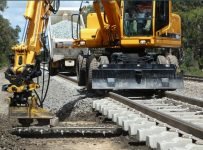
Alarm bells rang in the Cage when a derailment occurred on the Melbourne Sydney track on February 24th 2020 due to “mud holes” on the track. The Rail Tram and Bus Union reported in 2011 that the practice of replacing sleepers without lifting the track, known as sideways replacement, was causing mudholes that could lead to derailment. As a result, then transport minister, Anthony Albanese initiated a study by the Australian Transport Safety Bureau that decided in 2013 the train line was only safe if trains were slowed down and appropriate warnings given.
Last month’s derailment was caused when a train driver travelled at 100kmh through a section of track designated to be safe at speeds of 10kmh apparently unaware of the warning.
The sleepers are inserted without raising the tracks
The 2013 ATSB report concluded:
“the ATSB is satisfied that the necessary steps have been
taken to address any issues that might otherwise compromise the safety of rail
operations … at the expense of operational efficiencies through increased train
running times.”
Industry observers at the time, predicted disaster but, as the official report stopped short of recommending that anything be done about it, everyone, including the national news services packed up and went home until the deaths this week.
The facts are that the Australian Rail Track Company put out a request for tender in 2007 to upgrade the Melbourne to Sydney rail line. The problem was that the old wooden sleepers allowed the guage of the tracks to wander. New concrete sleepers wouild ensure the tracks ran straight and true. That tender was awarded to a consortium using Harry Bilt’s Platypus technology capable of replacing the sleepers without ripping up the rails. According to the ATSB in 2013, the decision to use this controversial technology was that there was not enough money available to do the job properly.
“It is also likely that the cost
associated with addressing the ballast, drainage or formation issues would have
precluded completely re-sleepering the Melbourne to Sydney line with the
funding available and therefore some residual safety risk associated with poor
track gauge would have remained if this path had been chosen.”
The dangers of sideways sleeper replacement have long been a topic for discussion on railway discussion boards such as railpage.com.au, unions such as the Victorian Rail, Tram and Bus Union (RBTU) and international forums. The looseness of the ballast put under the sleeper when it is inserted between the rail and the ground allows water to collect and mud-holes to form. The result is known as “fouled ballast.” These concerns were raised on Radio National when the Australian Transport Safety Board reported in 2013.
The gaps under the rails collect water, leading to mud-holes
The ATSB report suggested both short term and long term risk management processes would need to be employed to avoid a major incident. It spent some time outlining speed restrictions and additional monitoring of track failure as the short term measures but was deliberately vague about the methods of avoiding the risks in the long term.
“Longer term strategies ARTC
implemented … are unlikely to correct the more deep-seated formation problems. …
It is possible that water will continue to weaken the structure in some
locations, with a corresponding requirement for an increased regime of track
maintenance and the application of new or further speed restrictions.”
The final conclusion, that as long as we run the trains very slowly, we should be able to avoid deaths, is hardly a strategy for creating a safe, high speed rail network. Unfotunately, the problems of fouled ballast are not the only failure to maintain the national rail network during decades of cost-cutting. Analysis of the Wallan derailment also reveals issues with signals and possibly internal processes.
The question now is whether the unfortunate deaths of innocent workers and injury to passengers will inject enough steel into future inquiries to ensure that the national rail network is at least made safe and, ideally, brought up to something resembling international standards. 10km per hour is not an acceptable speed for the major passenger link between Australia’s two largest capital cities.
This article is reprinted from CNN Online. Read the original.
There are three main ideas of the Green New Deal Resolution introduced by Congresswoman Alexandria Ocasio-Cortez and Senator Ed Markey.
The first is to decarbonize the US energy system — that is, to end the emissions of carbon dioxide (CO2) from burning coal, oil and natural gas, in order to stop global warming.
Alexandria Ocasio-Cortez launching the Green New Deal
The second is to guarantee lower-cost, high-quality health coverage for all.
The third is to ensure decent jobs and living standards for all Americans, in part by making colleges and vocational schools affordable for all.
The right wing and corporate lobbies are already hyperventilating: It is unachievable; it will bankrupt us; it will make us into Venezuela.
These claims are dead wrong. The Green New Deal agenda is both feasible and affordable. This will become clear as the agenda is turned into specific legislation for energy, health care, higher education, and more.
The Green New Deal combines ideas across several parts of the economy because the ultimate goal is sustainable development. That means an economy that delivers a package deal: good incomes, social fairness, and environmental sustainability. Around the world, governments are aiming for the same end — a “triple-bottom line” of economic, social, and environmental objectives.
In the US, the economy is feeding the wealth of billionaires while leaving tens of millions of households with no financial cushion at all. Meanwhile, the fossil-fuel lobby continues to endanger the planet by promoting the use of fuels that contribute to climate change, raising the risk of mega-floods, droughts, hurricanes, and heat waves, claiming many lives and costing the US more than $450 billion during 2016-18, or more than $150 billion per year on average.
The key ideas of the Green New Deal — decarbonization, lower-cost health care, and decent living standards for the working class — have been studied for years. The Green New Deal Resolution is the opportunity, finally, to put that vast knowledge into effect.
What is absolutely clear is that the Green New Deal is affordable. The claims about the unaffordability of these goals are pure hype. The detailed plans that will emerge in the coming months will expose the bluster.
Decarbonizing energy
Consider the challenge of decarbonizing the energy system. As noted in the Green New Deal resolution, the recent report of the Inter-Governmental Panel on Climate Change calls for global decarbonization by 2050, an achievable goal that requires coherent and accelerated actions by the US and other nations.
The Green New Deal is the occasion to put America’s utilities, builders, and automakers to the challenge of accelerating their technological overhauls to complete decarbonization by 2050 or earlier. The resolution calls for a 10-year mobilization effort to achieve “net-zero greenhouse gas emissions” but not for a precise timeline for completing decarbonization. The timing will depend on the pace of new zero-carbon investments and the phase-out of existing fossil fuel-based technologies.
Decarbonization will include the following measures. Electricity generation will shift from coal and natural gas to wind, solar, hydro, and other zero-carbon technologies. Cars and trucks will shift from gasoline to electricity, using batteries or fuel cells (with hydrogen manufactured by electrolysis). Planes will use electricity for short flights and advanced zero-carbon fuels for longer flights. Buildings will be heated by electricity (such as heat pumps) rather than boilers and furnaces.
The costs of renewable energy are plummeting, making decarbonization eminently feasible. Detailed estimates put the costs of substantial decarbonization (80% or more by 2050) at around 1% of GDP per year or less. (See here for one recent study). In many cases, renewable energy is already at “grid parity,” meaning that it is at a cost point comparable to fossil fuels. Most of the modest costs of decarbonization will never hit the federal budget, as they will be absorbed by the utility industry, the automobile producers, and other parts of the private economy.
Decarbonization is already underway in the US, just not yet with the pace and scale required. US utilities are no longer building coal-fired power plants; many are now scrapping plans for gas-fired plants in favor of renewable energy. Investors and in-house lawyers are warning companies not to invest in fossil fuels, as these investments would be stranded in future years. Automobile companies are rapidly shifting to electric vehicles. New buildings are going electric, with tough efficiency codes. These transformations are being driven mainly by environmental regulations, integrated resource planning by utilities, and market forces, not by federal outlays.
Medicare for all
Lower-cost, high-quality health care for all, for example through Medicare for All, is also within reach. As with decarbonization, the right wing and corporate lobbies are using scare tactics to hide the basic fact: Health care costs in the US can be cut considerably, while improving services.Fighting climate change may be easier than we think
The US spends around 17% of its gross domestic product (GDP) on health care coverage, while other countries spend 10-12%. The main difference lies with the high prices of US health care, for drugs, hospital stays, medical procedures, and other goods and services, rather than with greater utilization of health services. These high prices have resulted in part from the rising concentration and market power of health care providers at the metropolitan level. The result is outlandish salaries, bloated administration, heavy costs of advertising, and other inefficiencies that result in high incomes for the health care industry and exorbitant costs for taxpayers and for workers paying for private health care plans.
The question is therefore not whether we can afford Medicare for All, but whether we will get there before the private health care industry bankrupts us. As one approach, the private insurance premiums now flowing to private health insurers could be re-directed to a Medicare account that would reimburse the health providers at Medicare rates, with much lower management salaries and administrative costs. The nationwide cost savings of Medicare for All — hundreds of billions of dollars per year — could be remitted to taxpayers or used to reduce the federal budget deficit.
College for all
Similar budget analyses demonstrate the feasibility of other parts of the Green New Deal. Can debt-free higher education for all be achieved? The other rich countries all accomplish it. One proposal for “College for All,” presented by Senator Bernie Sanders, would cost around one-quarter of 1% of GDP, a price point that is tiny compared with the burdens of a society weighed down by student debts that create lifelong anxieties until retirement years.
The Green New Deal proponents are absolutely correct on the merits. Decarbonization, Medicare for All, debt-free higher education, and other social benefits are feasible, affordable, and smart. They will deliver great savings in the case of health care, environmental benefits in the case of decarbonization, and renewed social mobility in the case of debt-free higher education.
As a next step, the Green New Deal ideas should be turned into legislation, plans and budgets. When the Federal Interstate Highway System was being debated in 1955, every Congressman received a booklet with detailed maps showing how their district would benefit from an interstate highway system. It’s now important to provide a roadmap of the Green New Deal, showing for each part of the country how the Green New Deal package can be accomplished at low cost and with enormous economic, social and environmental benefits.
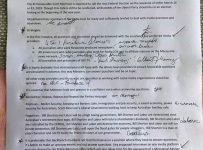
The Liberals internal working paper pictured here sets an election announcement date of late March. This is consistent with the May election already announced by the government.
All parliamenteary members of the Liberal Party should be prepared and on high alert to answer questions about the election from early in the New Year. The paper makes it perfectly clear though, that back benchers should avoid interviews and that Cabinet members should ignore all media except for News Limited, Maquarie Radio and Sky News. These are referred to as “preferred media” on the basis that “favourable questions will be circulated in advance” so “Ministers can answer questions and be on topic.”
If you have any friends that think the criticism of NewsCorporation is a left wing plot, this document may help to convince your friends. Although the media strategy is unsurprising, it is still shocking to see it in stark black and white.
The admonition to Repeat, Repeat and Repat the parties (sic) message of the day and stick to the Coalition’s perceived strong points, border security, immigration, power security and a strong economy are equally simplistic. There is clearly no desire to maintain the correct use of the apostrophe as it is left out a number of times through the document. We are all going to get sick and tired of the phrase Bill Shorten and Labor who will destroy the economy, spend your savings and open the flood gates for people smugglers. Shorten himself will be depicted as being of poor character and unfit to lead this “great nation”. The MP who leaked the paper has helpfully noted in the margin that Shorten is Godless, as well as providing key names of the News, Macquarie and Sky journalists who are working for a Morrison win. God gets another mention in the margin notes, offering to help Murdoch win the election for the Liberals by simply being with them. In this black and white world he is obviously against the ALP.
We can do this, appears to be an oft repeated phrase in the briefing session at which the document was handed out but has not yet made it to official campaign slogan status. No doubt the focus groups are busy rolling it off their tongues as I type. “We can do it” was a second world war slogan in the USA and “We can do this together” is the basis of a number of community and self help campaigns. The full phrase is the title of book by Kate Sutherland launched in September 2017 and subtitled, “10 tools to unleash our collective genius.” No doubt the Liberals’ lawyers’ efforts match that of the focus groups, working hard to determine the resolve of Incite Press to protect their collective genius from pumping up the fortune of the Liberals. Any analysis of the collective genius of current conservative politics in Australia is likely to be marred by today’s story that Andrew Broad poses as James Bond while stuffing his face with prawns and complaining about the prices on the menu while he attempts to seduce a young woman advertising on a Sugar Daddy website that she does not engage in intimacy on professional dates. His text messages to her further drag down the collective genius rating of the coalition and justify his withdrawal from parliament on gross stupidity alone.
The leak conveniently comes in the middle of the ALP conference so that the ALP can determine what parts of its nascent campaign it wishes to release to counter these creative gems without even having to convene an unexpected meeting.
The most recent of the 15 Neolithic masks found in the world came from a farm in the West Bank near the Dead Sea. The mask probably was brought to the surface by agricultural activities that disturbed the soil. The field is full of Neolithic artefacts, indicating that there is an archaeological site underground, The newly discovered mask, and some of the others, have holes drilled around their edges, possibly so that they could be tied around a person’s face or another object. Without much archaeological context for these artifacts, archaeologists don’t know exactly how the masks were used 9,000 years ago.
Only three have the masks come from a known source. One was discovered in a cave, one was from the private collection of Israeli general Moshe Dayan and this one. All were found in a relatively small area near the Dead Sea. The small number of masks and the fact that none of them were scientifically excavated has raised doubts about their authenticity, further encouraging scientists to thoroughly explore the area where this mask was found, It is hoped that such an exploration will reveal details about the transition or humanity from a hunting and gathering community to an agricultural community.