Category: General news

Managing director of Ebono Institute and major sponsor of The Generator, Geoff Ebbs, is running against Kevin Rudd in the seat of Griffith at the next Federal election. By the expression on their faces in this candid shot it looks like a pretty dull campaign. Read on

  • Climate crisis: why business must do more to protect children’s rights

    Climate crisis: why business must do more to protect children’s rights

    The effects of climate change have a disproportionate impact on children and place an ecological debt on future generations

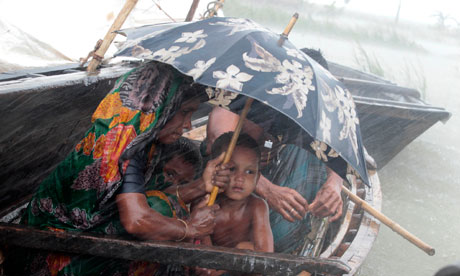
    A woman sits with her child in a boat during heavy rains at a flooded village in Kurigram

    A woman sits in a boat with her children during heavy rains at a flooded village in Kurigram July 2012. Photograph: Andrew Biraj/REUTERS

    In the wake of the continuing negotiations on climate change in Bangkok last week, businesses need to take action to improve the outcomes for future generations.

    Number seven of the Children’s Rights and Business Principles launched by Unicef earlier this year is related to the environment. This has global relevance for all businesses, since all business activities impact directly or indirectly on the world that our children will inherit.

    On a recent trip to Bangladesh, I found that climate-related disasters such as flooding were already having an effect on children’s lives. The country is making efforts to build multi-purpose cyclone shelters, which are also being used as schools. Yet these cyclone shelters, while necessary, may not be sufficient to protect the children in Bangladesh if the world is heading for global warming of more than 3°C.

    The effects of climate change have a disproportionate impact on children as well as other vulnerable groups. Children and women are 14 times more likely to be killed in a disaster. Save the Children has found that half of all those affected in an emergency are children, and that an increase in climate-related disasters would mean millions would die or be forced to flee from their homes.

    Climate change particularly affects agriculture and contributes to rising food prices. Unfortunately, children are particularly vulnerable to this, since malnutrition is already the underlying contributing factor in about one third of all child deaths. The global food crisis of 2008 had a huge impact on child and infant mortality.

    Ecological debt

    Like financial debt, ecological debt places a burden on children and future generations. This links to the debate over the recent financial crisis. There have been calls for businesses and investors to consider the triple bottom line of social, environmental, and economic sustainability – and to reward long-term value creation over the fast buck.

    At the recent Rio+20 Conference, countries reiterated their commitment to protect the climate “for the benefit of present and future generations of humankind”. Should companies also consider this principle of intergenerational equity?

    This principle would mean markets and businesses supply the needs of today, without disregarding the needs of tomorrow. Damaging ecosystems and making species extinct leaves an unwelcome legacy. There is the unsettling possibility that this generation might leave the Earth in a worse state than they found it. The recent study in Nature showed humanity may already be overstepping various planetary boundaries, including on biodiversity, nitrogen and climate change. Scientists have also warned that remaining deposits of several irreplaceable and finite mineral resources are being fast depleted.

    Sourcing and supply chains

    These business-as-usual trends will not just have external impacts, but systemic impacts that harm us all. Recognising the rights of children means companies should consider sourcing from renewable materials, as well as ensuring materials can be re-used, to preserve vital natural resources. Companies with global supply chains may also consider the impact of global operations on vulnerable communities.

    For example, Fairtrade coffee companies have been working with their producers down the supply chain to help them become more resilient. The Fairtrade Foundation highlights that rising temperatures would be a disaster for the coffee industry. Reducing the vulnerability of children is low-cost, like ensuring a water supply, and can help develop skills across communities over a long time period.

    In the UN climate talks in Bangkok earlier this month, the governments of high-emitting countries continued to avoid tackling the issue, often citing financial or competitiveness concerns. Yet in an interconnected world, all businesses will be affected by the emerging challenges for water, food and energy under climate change – of which the 2008 crisis may be a precursor.

    The challenges for businesses are similar to those for governments and individuals: the tendency to focus on short-term rather than long-term concerns. The recession may have made this more difficult. However, with energy and input prices rising, there are clearly opportunities for businesses that move towards green growth. Innovative circular business models will reduce risks in a world where inputs are constrained.

    Previously, corporate considerations of impacts on children were mainly limited to concerns about child labour or health. As the world begins to be hit by climate change, water and resource scarcity, as well as financial crisis, business leaders are in the pivotal position to make decisions that consider wider sustainability and respect the rights of children.

    In the end, relying on growth that degrades basic resources will not only lead to catastrophe for our children but it is not a sustainable business model either.

    Helena Wright is a doctoral researcher at Imperial College London and has attended the UN talks on climate change.

    This content is brought to you by Guardian Professional. Become a GSB member to get more stories like this direct to your inbox

  • Turnbull firms as preferred leader

    Turnbull firms as preferred leader

    Date
    September 17, 2012
    • 11 reading now
    • 13
    Phillip Coorey

    Phillip Coorey

    Sydney Morning Herald chief political correspondent

    View more articles from Phillip Coorey

    Malcolm Turnbull

    Majority support … 63 per cent of all voters would prefer Malcolm Turnbull as the Coalition leader. Photo: Andrew Meares

    MALCOLM TURNBULL has stretched his lead over Tony Abbott as the preferred Liberal leader and for the first time has majority support among Coalition voters.

    The latest Herald/Nielsen poll shows 63 per cent of all voters prefer Mr Turnbull as the Coalition leader, compared with 30 per cent for Mr Abbott.

    Since the question was asked three months ago, Mr Turnbull’s support has risen 2 percentage points and support for Mr Abbott has fallen by 4 points.

    A breakdown shows that in the past three months, support for Mr Turnbull among Coalition voters has risen 4 points to 53 per cent while Mr Abbott has fallen 5 points to 45 er cent, giving Mr Turnbull an eight-point lead.

    Among Labor voters, Mr Turnbull remains very popular, with 73 per cent support compared with 19 per cent for Mr Abbott.

    The poll of 1400 voters was taken from Thursday night to Saturday night and followed a rugged week for Mr Abbott in which he was subject to claims he physically intimidated a female political rival 35 years ago.

    Also during the polling period, Mr Turnbull made a controversial but popular speech in which he lamented the current state of political discourse and the standards of parliamentary question time.

    The poll showed Mr Turnbull more popular than Mr Abbott in all states and in both the city and the country. He was twice as popular than Mr Abbott among both male and female voters.

    Mr Abbott deposed Mr Turnbull as the Opposition Leader in December 2009. Liberals say the party would never return to Mr Turnbull because he is unpopular among many colleagues, especially the right-wingers.

    Only if Labor became competitive in the polls would there be pressure on Mr Abbott’s leadership. The poll shows that while Labor is clawing back slowly under Julia Gillard, an Abbott-led Coalition would win comfortably if an election were held today.

    One scenario that could prompt a return to Mr Turnbull would be for Labor to replace Ms Gillard with Kevin Rudd, who, the poll shows, would lift Labor’s primary vote by 10 points and give it an election-winning lead.

    Labor’s recovery under Ms Gillard appears to be occurring predominantly in Queensland and NSW, states in which Coalition governments have recently announced harsh budget cuts, including big job losses and cuts to front-line services in health and education.

    The poll shows that in the past three weeks, federal Labor’s primary vote in NSW has risen 5 points to 35 per cent, the Liberals have stayed steady at 45 per cent and the Greens fell 5 points to 9 per cent.

    In Queensland, where support for the new Premier, Campbell Newman, has declined, federal Labor’s primary vote has risen 4 points to 30 per cent in three weeks. The Coalition’s has fallen 5 points to 48 per cent.

    The Coalition’s two-party-preferred vote lead over Labor in Queensland has fallen from 63-37 to 58-42.

    Ms Gillard targeted Mr Newman’s ”brutal” budget cuts yesterday in a speech to the Queensland state ALP conference, her first public appearance since her father died last weekend. The government is seeking to portray what Mr Newman is doing as a small version of what Mr Abbott would do if he became prime minister.

    ”Newman’s budget razor is Abbott’s curtain raiser,” she said.

    Labor was crushed in the Queensland state election in March. Ms Gillard told the party’s survivors there that they ”will be on the front line in the fight to come in 2013”, when the federal election is due.

    ”You are the sentries who can tell Australians what’s at risk, what would be coming,” she said. ”You’ve seen it. Tell your story, make sure they know.

    ”Every working Australian must know in 2013 what happened in Queensland in 2012.

    ”The fight is on, it’s the fight of our lives, let’s get out there and win it.”

    Follow the National Times on Twitter


    Read more: http://www.smh.com.au/opinion/political-news/turnbull-firms-as-preferred-leader-20120916-260kj.html#ixzz26gDudVD4

  • Is there even less Arctic sea ice than the satellites show?

    Is there even less Arctic sea ice than the satellites show?

    Only 350 miles from the north pole, possibly 50% of the sea is covered in ice, yet data says there is ice cover at this latitude

    John Vidal in the arctic : Greenpeace MY Arctic Sunrise ship expedition to the Arctic

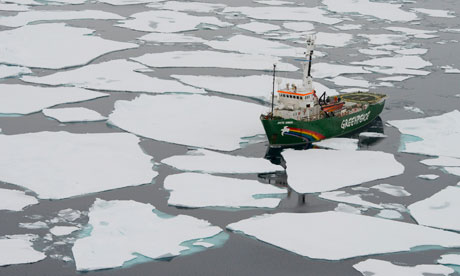
    The Arctic Sunrise ship from the air during an expedition to the Arctic to document the lowest sea ice level on record. Photograph: Daniel Beltra/Greenpeace

    Where is the ice? We are now at 83.20N which is very close to the north pole yet still there is no continuous ice cover (head here for more on my journey through the Arctic). We are mostly among small, thin, one- and two-year-old floes, with very little of the older, harder and more resilient “multiyear”, or permanent ice that you would expect in these latitudes.

    Our ice pilot, Arne Sorensen, went up in the helicopter and found little change even as far north as 83.50 – just 350 miles from the pole. Just finding an ice floe big enough to moor the 50 metre-long Arctic Sunrise for the scientists aboard to conduct their experiments has proven harder than expected – something that many think is almost unheard of at this latitude.

    The obvious inference is that the ice has retreated far further this year than before and we will need to check previous years’ satellite data to confirm this. But there may actually be far less ice in the Arctic than the satellite figures suggest.

    In winter when the sea surface is frozen up here, scientists can be pretty sure how much ice there is. But in the summer months when the ice is melting and there’s much more water around, the satellite can become confused.

    It can think that melt water sitting on the ice floes is open water; it may not be able to tell the size of the floes or the distance between them; it can have problems “seeing” the ice because of clouds and fog.

    In short, the melting effect makes it much harder to quantify the amount of ice there is and the satellite tends to see more ice than there actually is. That’s why monitoring groups such as NSIDC or the university of Bremen try to compensate with weather filters or by calculating the ice extent over a number of days rather than on individual ones.

    We know, here on the ship, how misleading the satellite data can be.

    Here, possibly only 50% of the sea is covered in ice. Yet the data is telling the scientists that there is continuous ice cover at this latitude.

    That’s why Julienne Stroeve, ice expert from NSIDC the folk expected to flag the record minimum ice extent record in a few days’ time – has been filming the ice conditions every few hours.

    When she returns, she hopes to match her real-time observations of the ice conditions with the satellite data. She speculates that the low fog conditions we have experienced could be making it seem there is more ice than there actually is.

    Either way, the situation is deadly serious. Both satellites and human observation suggests that the ice is now so thin over much of the arctic that it doesn’t matter how much it freezes in winter, because it will melt in the summer. That would mean ice-free summers in the arctic coming far sooner than the models have predicted.

    Strangely, what we are beginning to see is just what the old Arctic explorers and visionaries such as Elisha Kane, Isaac Hayes, Captain W E Parry and Sir John Barrow hoped to find. It was widely believed from the 16th century that there was a tepid lake at the north pole, and that another continent lay beyond the ice. The problem facing explorers then was to get beyond the icepack which barred the route. It was this prospect of Arcadian lands that spurred these adventurers.

    Today, the prospect of an ice-free Arctic and easy access to the other side of the world has become the dream of oil, mining and shipping companies. The profits they see inn in the ice free sea are similar to those seen by the British from a clear passage over the top of the world to China and the east.

    But as Shell found off the coast of Alaska this week, nature bites back. No sooner had the company started preliminary drilling for oil in the Arctic Chukchi sea it had to abandon the work because of freezing conditions.

  • Nationals announce $2bn Pacific Hwy deal

    Nationals announce $2bn Pacific Hwy deal

    Updated: 14:22, Saturday September 15, 2012

    A federal coalition will finish the long-awaited upgrade of the Pacific Highway by stripping two billion dollars from a Sydney commuter rail project, a move backed by the NSW government but slammed by federal Labor and the Greens.

    In a pitch to regional voters, including those in the former NSW Nationals seats now held by independents Rob Oakeshott and Tony Windsor, Nationals leader warren truss says Labor’s pledge to complete the Pacific works by 2016 is just another broken promise.

    Mr Truss says a coalition government will deliver a four-lane highway from Sydney to Brisbane by ending a stand-off between cash-strapped NSW and the federal government.

    But Federal Infrastructure and Transport Minister Anthony Albanese says the coalition’s plan means the Pacific Highway upgrade won’t be completed this decade.

    And Greens transport spokeswoman Lee Rhiannon says expanding Sydney’s rail network should not be sacrificed to make the Pacific Highway safer and it shows the axe will fall on public transport under an Abbott government.

  • Liberals seize control of Labor’s ‘backyard’

    Liberals seize control of Labor’s ‘backyard’

    Date
    September 16, 2012
    • 20 reading now
    • 48
    Heath Aston

    Heath Aston

    Sun-Herald state political editor

    View more articles from Heath Aston

    MERCURY NEWS OPPOSITION LEADER picture of NSW Labor leader John Robertson, at City beach today for story reflecting on the first 12 months since the state election 16th of March 2012 Photo by Adam McLean story by Mario Christodoulou

    Red-faced … John Robertson. Photo: Adam McLean

    BLACKTOWN CITY COUNCIL has fallen to the Liberal Party in a knife-edge result that has embarrassed the Labor leader John Robertson, the state MP for the area.

    The fall of Blacktown is another in a string of working-class areas in outer Sydney that swung away from Labor to the Liberals at last Saturday’s elections.

    They include Liverpool, Auburn, Bankstown, Campbelltown and Parramatta.

    In Blacktown, the swing was 10 per cent but it was the victory of independent Russ Dickens over Labor-endorsed independent Kathie Collins that will take the council out of Labor hands for the first time since 1989.

    The NSW Electoral Commission confirmed the result on Friday, with Dr Dickens, a former mayor, prevailing by 868 votes.

    Former Liberal councillor Nick Tyrrell said the area had rejected Labor. ”This has got to be an embarrassment for Robbo. In his own backyard, people are still throwing rocks at the ALP,” he said.

    The new Liberal mayor is likely to be Jess Diaz, a migration lawyer whose son Jayme narrowly lost the seat of Greenway at the last federal election.

    Labor Party assistant general secretary Jamie Clements said that there was no shame in the result for Mr Robertson, whose area overlays wards four and five, where the Labor vote held up. Those wards cover suburbs such as Blacktown, Doonside, Shalvey, Mount Druitt and St Marys.

    ”There has been significant demographic changes in Riverstone and Toongabbie and that’s where the vote was softer. It was only for the quality of the candidate in Nathan Rees that we hung on to Toongabbie at the state election,” he said.

    Meanwhile, Nathaniel Smith, the son of the NSW Attorney-General, Greg Smith, has started his political career, with his election to Kogarah City Council. Mr Smith, a registered lobbyist, is expected to seek preselection to get into state Parliament.

    ”I’ve seen from my father how much work is involved in being a good politician and I am in no rush,” he told The Sun-Herald.

    Despite the O’Farrell government’s laws that forced several MPs to relinquish council seats, there remains a strong link between local government and Macquarie Street.

    Both electorate staff of the Mulgoa MP Tanya Davies were elected. Mark Holmes was elected in Blacktown and Patrick Conolly, the son of the Riverstone MP Kevin Conolly, at Hawkesbury council.

    Steven Issa, son of the Granville MP Tony Issa, will replace him on Parramatta City Council.

    Katherine O’Regan, the chief of staff for the Environment Minister, Robyn Parker, was elected as a Liberal on Woollahra council and will quit her role with the minister as per orders from the Premier, Barry O’Farrell.

    Bernard Bratusa, media adviser to the Sports Minister, Graham Annesley, was waiting to learn whether he had been elected to Penrith City Council.

    Read more: http://www.smh.com.au/opinion/political-news/liberals-seize-control-of-labors-backyard-20120915-25yz7.html#ixzz26aKcXJz7

  • Wanted: message in a battle FEDERAL LABOR

    Wanted: message in a battle

    Date
    September 15, 2012
    Category
    Opinion
    • 4 reading now
    • 1
    Peter Hartcher

    Peter Hartcher

    Sydney Morning Herald political and international editor

    View more articles from Peter Hartcher

    Fear of electoral defeat and a potential leadership challenge are allowing cabinet’s decisions to be ruled by populism.

    Advertisement

    We can’t ignore it. It doesn’t matter how good our policies are if the message isn’t getting through to the electorate, he said. What is our strategy to fix the situation?

    Hayes has a relatively safe seat, Fowler, with a margin of 8.7 per cent. But his seat includes part of Liverpool and the swings against Labor in the council elections, if replicated federally, could wipe him out. Labor did improve its vote in inner west areas, where the Greens lost a good deal of support, but in the outer west it was a bleak picture.

    As the ABC’s psephologist, Antony Green, summarised: ”There were consistent swings of 5 per cent to 10 per cent from Labor to Liberal in Blacktown, Bankstown, Parramatta and Campbelltown.”

    The results, Green said, revealed that Labor had not yet recovered from the drubbing it took at the state election 18 months ago.

    ”More worrying for Labor is that these results may also reflect attitudes to the Gillard government,” he said.

    ”For all the talk of federal Labor’s poor polling in Queensland and Western Australia, it is NSW where the real damage to Labor could be done at next year’s federal election.

    ”Labor still can’t recover its base in western Sydney, even at grassroots elections. It is a serious warning of how bad next year’s federal election defeat could be for Labor.”

    So there was a good deal of caucus interest in Swan’s answer. The survival instinct focuses the mind.

    The Deputy Prime Minister and Treasurer replied that the result was ”patchy”, with some good results and some not so good. He said that, at the same time, there were signs of a revival in the Labor vote in Queensland after the election of the Liberal National Party of Campbell Newman and with the anticlimax of the carbon tax.

    Labor now had some more clear air to get out its message on jobs, education reform and health, Swan said.

    It was designed to be reassuring but it didn’t amount to a strategy and it didn’t satisfy the MPs fearing that they could lose their seats.

    A second backbencher from western Sydney, John Murphy, spoke up. Murphy is especially vulnerable. He holds his seat of Reid by a margin of 2.6 per cent.

    He agreed with Swan that the ALP performance had been ”patchy” and cited two contrasting local experiences. The Labor mayor of Canada Bay council, Angelo Tsirekas, managed to win a 10 per cent swing in his favour.

    But in Auburn, where Labor had long held an unassailable dominance, the party had been outpolled by the Liberals by a margin of two to one.

    If that’s not an alarm, Murphy said, I don’t know what is. We’ve got to take notice and get into these communities, he urged. Canada Bay and Auburn fall within Murphy’s federal electoral boundaries.

    Swan offered a reassurance that things would turn around but again offered no strategy. A third MP, Stephen Jones, echoed the concerns of Hayes and Murphy.

    It was a moment of ironic tang for some in the room. Some caucus members remembered hearing Julia Gillard justify her coup against Kevin Rudd by saying that she was not so much troubled by the Rudd government’s difficulties but by the fact that he seemed to have no plan to get out of difficulty.

    But as the week developed, something of an opportunity arrived for the Gillard government. It came from the Liberal Party. Not the kerfuffle over whether Tony Abbott did – or did not – intimidate a rival in student politics 35 years ago.

    It was the staccato series of announcements from the Liberal state governments of plans to slash health and education services.

    This provided the government with one opportunity after another to lambaste the Liberal premiers for their savage cuts and to warn that an Abbott government would do the same, only bigger. ”It’s a gift from heaven,” one Labor MP crowed.

    By the middle of the week, Kevin Rudd helpfully appeared on TV live from Beijing to help the government frame its attack on the Liberals. The Liberal premiers were the entree, Rudd said, and Abbott was to be the main course.

    Rudd supporters said his interview on 7.30 was a reminder of how effective he could be as a campaigner; Gillard supporters gnashed their teeth and accused Rudd of taking advantage of the Prime Minister’s bereavement to destabilise her government.

    These two themes – a sense of creeping desperation among some in the caucus and the subterranean competitive tension between Gillard and Rudd – help make sense of the most remarkable political development of the week.

    Last week, the government decided to allow the fishing supertrawler, formerly the Margiris but now known as the Abel Tasman, to catch its approved quota under strict conditions. But this week the government reversed its position and changed the law with the specific aim of stopping the ship from operating in Australian waters.

    This was an extraordinarily erratic piece of work by any standard. The Environment Minister, Tony Burke, moved changes to the law specifically to ban such a vessel, aiming at one vessel in particular but only for one year.

    The amendment to the Environment Protection and Biodiversity Conservation Act that the government successfully got through the House gives the Environment Minister an unfettered new power to ban commercial fishing if ”there is uncertainty about the environmental, social or economic impacts of the fishing activity”. And it’s enough for the uncertainty to exist only in the mind of the minister.

    That’s sufficiently sweeping that the minister can stop anything at any time.

    A number of ministers in the Gillard cabinet are privately appalled by the decision. They include the Minister for Agriculture and Fisheries, Joe Ludwig, who argued in the cabinet against arbitrary decisions and in defence of due process and the established scientific evaluation methods, and the Communications Minister, Stephen Conroy, who argued against whimsical bans on economic activity and in favour of commonsense – much as the entire government did last week in its decision on the sale of Cubbie Station to a Chinese-Australian consortium.

    But surely the ban on the supertrawler was a prudent environmental decision to prevent overfishing?

    Not at all. The quota to catch 18,000 tonnes of fish off Tasmania remains intact. It will just be fished by other vessels now, smaller ones. Not one fish’s life has been saved by the decision.

    OK, but the ban will prevent the monster ship’s vast nets from killing dolphins and turtles as ”bycatch”, won’t it? Not at all. The supertrawler’s nets are the same size as the ones already in use on smaller vessels, as my Herald colleague Lenore Taylor has documented this week.

    So why is it called a supertrawler? Because of the size of its capacity to process and refrigerate and store its catch, not because of the the size of its nets.

    In fact, the strict conditions that Burke had already imposed on the Abel Tasman probably would have made it safer than the standard vessels in protecting dolphins and other bycatch. The conditions he laid down last week included the stipulation that two fisheries officials must be on board whenever it is fishing to monitor the catch and that it must position cameras in its nets to guard against collateral damage to species other than fish.

    So what was it all about? It was a populist reversal by a government under attack from environmental campaigners at GetUp! and Greenpeace. And a panicked response to what the Coalition’s Greg Hunt has called ”the Ruddism that has infected the government”.

    That is, policymaking by a government in fear of a Rudd leadership campaign. When a Labor backbencher, Melissa Parke, said she would move a private members’ bill to stop the trawler, she was soon supported by Kevin Rudd.

    Fearing a backbench revolt led by Rudd, the Gillard cabinet reversed its own policy and made a populist decision that was unscientific and economically irrational. And despite superficial assumptions, it offers no improvement of environmental protection.

    The Coalition called it ”government by GetUp!”. But, in truth, it is a government ruled by its own weakness. It is fearful of its electoral standing and fearful of a potential leadership challenge.

    It has made a series of announcements of multibillion-dollar new promises that it cannot afford and now makes a populist, arbitrary and counterproductive policy decision that has some of its most senior members in despair. ”What we see is the collapse of the intellectual capacity of this government,” one cabinet minister lamented privately at the supertrawler decision.

    The Gillard government says it is a year from an election, yet it is so busy campaigning that it is getting very sloppy at governing. The Labor caucus craves a strategy but it is getting a campaign and not a very rational one.

    Peter Hartcher is the political editor.

    Read more: http://www.smh.com.au/opinion/politics/wanted-message-in-a-battle-20120914-25xpx.html#ixzz26XOrIgRr