Category: General news

Managing director of Ebono Institute and major sponsor of The Generator, Geoff Ebbs, is running against Kevin Rudd in the seat of Griffith at the next Federal election. By the expression on their faces in this candid shot it looks like a pretty dull campaign. Read on

  • The Mind Thieves MONBIOT

    Monbiot.com


    The Mind Thieves

    Posted: 10 Sep 2012 11:24 AM PDT

    The evidence linking Alzheimer’s disease to the food industry is strong and growing.


    By George Monbiot, published in the Guardian, 11th September 2012

    When you raise the subject of over-eating and obesity, you often see people at their worst. The comment threads discussing these issues reveal a legion of bullies, who appear to delight in other people’s problems.

    When alcoholism and drug addiction are discussed, the tone tends to be sympathetic. When obesity is discussed, the conversation is dominated by mockery and blame, though the evidence suggests that it can be driven by similar forms of addiction(1,2,3,4). I suspect that much of this mockery is a coded form of snobbery: the strong association between poor diets and poverty allows people to use this issue as a cipher for something else they want to say, which is less socially acceptable.

    But this problem belongs to all of us. Even if you can detach yourself from the suffering caused by diseases arising from bad diets, you will carry the cost, as a growing proportion of the health budget will be used to address them. The cost – measured in both human suffering and money – could be far greater than we imagined. A large body of evidence now suggests that Alzheimer’s is primarily a metabolic disease. Some scientists have gone so far as to rename it. They call it diabetes type 3.

    New Scientist carried this story on its cover last week(5): since then I’ve been sitting in the library trying to discover whether it stands up. I’ve now read dozens of papers on the subject, testing my cognitive powers to the limit as I’ve tried to get to grips with brain chemistry. While the story is by no means complete, the evidence so far is compelling.

    Around 35 million people suffer from Alzheimer’s disease worldwide(6); current projections, based on the rate at which the population ages, suggest that this will rise to 100 million by 2050(7). But if, as many scientists now believe, it is caused largely by the brain’s impaired response to insulin, the numbers could rise much further. In the US, the percentage of the population with diabetes type 2, which is strongly linked to obesity, has almost trebled in 30 years(8). If Alzheimer’s, or “diabetes type 3”, goes the same way, the potential for human suffering is incalculable.

    Insulin is the hormone which prompts the liver, muscles and fat to absorb sugar from the blood. Diabetes 2 is caused by excessive blood glucose, resulting either from a deficiency of insulin produced by the pancreas, or resistance to its signals by the organs which would usually take up the glucose.

    The association between Alzheimer’s and diabetes 2 is long-established: type 2 sufferers are two to three times more likely to be struck by this dementia than the general population(9). There are also associations between Alzheimer’s and obesity(10) and Alzheimer’s and metabolic syndrome (a complex of diet-related pathologies)(11).

    Researchers first proposed that Alzheimer’s was another form of diabetes in 2005. The authors of the original paper investigated the brains of 54 corpses, 28 of which belonged to people who had died of the disease(12). They found that the levels of both insulin and insulin-like growth factors in the brains of Alzheimer’s patients were sharply reduced by comparison to those in the brains of people who had died of other causes. Levels were lowest in the parts of the brain most affected by the disease.

    Their work led them to conclude that insulin and insulin-like growth factor are produced not only in the pancreas but also in the brain. Insulin in the brain has a host of functions: as well as glucose metabolism, it helps to regulate the transmission of signals from one nerve cell to another, and affects their growth, plasticity and survival(13,14).

    Experiments conducted since then appear to support the link between diet and dementia(15,16,17,18), and researchers have begun to propose potential mechanisms. In common with all brain chemistry, these tend to be fantastically complex, involving, among other impacts, inflammation, stress caused by oxidation, the accumulation of one kind of brain protein and the transformation of another(19,20,21,22). I would need the next six pages of this paper even to begin to explain them, and would doubtless get it wrong (if you’re interested, please follow the links on my website).

    Plenty of research still needs to be done. But if the current indications are correct, Alzheimer’s disease could be another catastrophic impact of the junk food industry, and the worst discovered so far. Our governments, as they are in the face of all our major crises, appear to be incapable of responding.

    In this country as in many others, the government’s answer to the multiple disasters caused by the consumption of too much sugar and fat is to call on both companies and consumers to regulate themselves. Before he was replaced by someone even worse, the former health secretary, Andrew Lansley, handed much of the responsibility for improving the nation’s diet to food and drinks companies: a strategy that would work only if they volunteered to abandon much of their business(23,24).

    A scarcely-regulated food industry can engineer its products – loading them with fat, salt, sugar and high fructose corn syrup – to bypass the neurological signals which would otherwise prompt people to stop eating(25). It can bombard both adults and children with advertising. It can (as we discovered yesterday) use the freedoms granted to academy schools to sell the chocolate, sweets and fizzy drinks now banned from sale in maintained schools(26). It can kill the only effective system (the traffic light label) for informing people how much fat, sugar and salt their food contains. Then it can turn to the government and blame consumers for eating the products it sells. This is class war: a war against the poor fought by the executive class in government and industry.

    We cannot yet state unequivocally that poor diet is a leading cause of Alzheimer’s disease, though we can say that the evidence is strong and growing. But if ever there was a case for the precautionary principle, here it is. It’s not as if we lose anything by eating less rubbish. Averting a possible epidemic of this devastating disease means taking on the bullies: those who mock people for their pathologies and those who spread the pathologies by peddling a lethal diet.

    www.monbiot.com

    References:

    1. Caroline Davis et al, 2011. Evidence that ‘food addiction’ is a valid phenotype of obesity. Appetite Vol. 57, pp711–717. doi:10.1016/j.appet.2011.08.017

    2. Paul J. Kenny, November 2011. Common cellular and molecular mechanisms in obesity and drug addiction. Nature Neuroscience, Vol. 12, pp 638-651. doi:10.1038/nrn3105

    3. Joseph Frascella et al, 2010. Shared brain vulnerabilities open the way for nonsubstance addictions: Carving addiction
    at a new joint? Annals of the New York Academy of Sciences, Vol. 1187, pp294–315.
    doi: 10.1111/j.1749-6632.2009.05420.x

    4. Ashley N. Gearhardt et al, 2010. Can food be addictive? Public health and policy implications. Addiction, 106, 1208–1212. ad. d_3301 1208..1212
    doi:10.1111/j.1360-0443.2010.03301.x

    5. Bijal Trivedi, 1st September 2012. Eat Your Way to Dementia. New Scientist.

    6. Sónia C. Correia et al, 2011. Insulin-resistant brain state: The culprit in sporadic Alzheimer’s disease? Ageing Research Reviews Vol. 10, 264–273. doi:10.1016/j.arr.2011.01.001

    7. Fabio Copped`e et al, 2012. Nutrition and Dementia. Current Gerontology and Geriatrics Research, Vol. 2012, pp1-3.
    doi:10.1155/2012/926082

    8. See the graph in Bijal Trivedi, 1st September 2012. Eat Your Way to Dementia. New Scientist.

    9. Johanna Zemva and Markus Schubert, September 2011. Central Insulin and Insulin-Like Growth Factor-1 Signaling – Implications for Diabetes Associated Dementia. Current Diabetes Reviews, Vol.7, No.5, pp356-366. doi.org/10.2174/157339911797415594

    10. Eg Weili Xu et al, 2011. Midlife overweight and obesity increase late life dementia risk: a population-based twin study. Neurology, Vol. 76, no. 18, pp.1568–1574.

    11. M. Vanhanen et al, 2006. Association of metabolic syndrome with Alzheimer disease: A population-based study. Neurology, vol. 67, pp.843–847.

    12. Eric Steen et al, 2005. Impaired insulin and insulin-like growth factor expression and signaling mechanisms in Alzheimer’s disease – is this type 3 diabetes?.
    Journal of Alzheimer’s Disease, Vol. 7, pp.63–80.

    13. Konrad Talbot et al, 2012. Demonstrated brain insulin resistance in Alzheimer’s disease patients is associated with IGF-1 resistance, IRS-1 dysregulation, and cognitive decline. The Journal of Clinical Investigation, Vol.122, No.4, pp.1316–1338. doi:10.1172/JCI59903.

    14. Naoki Yamamoto et al, 2012. Brain insulin resistance accelerates Aβ fibrillogenesis by inducing GM1 ganglioside clustering in the presynaptic membranes. Journal of Neurochemistry, Vol. 121, 619–628. doi: 10.1111/j.1471-4159.2012.07668.x

    15. Eg:
    Wei-Qin Zhao and Matthew Townsend, 2009. Insulin resistance and amyloidogenesis as common molecular foundation for type 2 diabetes and Alzheimer’s disease.
    Biochimica et Biophysica Acta, Vol.1792, pp.482–496. doi.org/10.1016/j.bbadis.2008.10.014,

    16. Sónia C. Correia et al, 2011. Insulin-resistant brain state: The culprit in sporadic Alzheimer’s disease? Ageing Research Reviews Vol. 10, 264–273. doi:10.1016/j.arr.2011.01.001

    17. T. Ohara et al, 2011. Glucose tolerance status and risk of dementia in the community, the Hisayama study. Neurology, Vol. 77, pp.1126–1134.

    18. Karen Neumann et al, 2008. Insulin resistance and Alzheimer’s disease: molecular links & clinical implications. Current Alzheimer Research, Vol.5, no.5, pp438–447.

    19. Eg: Lap Ho et al, 2012. Insulin Receptor Expression and Activity in the Brains of
    Nondiabetic Sporadic Alzheimer’s Disease Cases. International Journal of Alzheimer’s Disease, Volume 2012. doi:10.1155/2012/321280

    20. Suzanne M. de la Monte, 2012. Contributions of Brain Insulin Resistance and Deficiency in Amyloid-Related Neurodegeneration in Alzheimer’s Disease. Drugs, Vol. 72, no.1, pp. 49-66. doi: 10.2165/11597760

    21. Ying Liu et al, 2011. Deficient brain insulin signalling pathway in Alzheimer’s disease and diabetes. Journal of Pathology, Vol. 225, pp.54–62. doi: 0.1002/path.2912

    22. Konrad Talbot et al, 2012. Demonstrated brain insulin resistance in Alzheimer’s disease patients is associated with IGF-1 resistance, IRS-1 dysregulation, and cognitive decline. The Journal of Clinical Investigation, Vol.122, No.4, pp.1316–1338. doi:10.1172/JCI59903.

    23. http://www.guardian.co.uk/politics/2010/nov/12/government-health-deal-business

    24. http://www.guardian.co.uk/society/2012/apr/14/obesity-crisis-doctors-fastfood-deals-ban

    25. http://www.guardian.co.uk/business/2012/jun/11/why-our-food-is-making-us-fat

    26. http://www.guardian.co.uk/education/2012/sep/10/junk-food-academy-schools-claims

  • NSW voters so disillusioned they gave Barack Obama a tick in council elections

    ON THIS BASIS WHY IS VOTING COMPULSORY????

    NSW voters so disillusioned they gave Barack Obama a tick in council elections

    2
    Local Government elections

    NSW local government elections Port Macquarie Picture: Nathan Edwards Source: The Sunday Telegraph

    ONLY 50 per cent of eligible voters turned out for the Sydney City Council election on Saturday, among the lowest in NSW.

    And many of those that did wasted their vote by doodling or nominating US President Barack Obama.

    Did you vote in the council elections? Leave a comment below

    Scrutineers revealed that on many voting forms, instead of numbered boxes, fed-up electorates used the election pamphlet to sketch, some even drawing male genitalia.

    All the results from your local area

    Among the worst was Ashfield, in Sydney‘s inner west, where just 60 per cent of residents voted and of those, 17 per cent were filled out incorrectly, left blank or defaced.

    The informal vote reached heights of 25 per cent in places where voters preferred to draw their own candidate, with Mr Obama and Homer Simpson rating highly.

    “We had about four Barack Obama votes. Many people also voted above and below the line, which meant the vote was invalid,” one scrutineer said.

    In Parramatta and Canterbury nearly a quarter of people didn’t vote properly.

    Burwood, Kogarah, Taree, Campbelltown and Camden had wards where nearly 17 per cent of votes were wasted.

    In Strathfield, the informal vote was 14.58 per cent, while in Hornsby it was 14.03 per cent.

    In Sydney just 52.8 per cent of the 101,846 enrolled voters did so, with 2.9 per cent informal.

    Living Sydney’s Angela Vithoulkas said many people were confused about the election, saying they had already voted.

    “I am completely horrified about that. It is such a shame,” she said.

    “So many people were confused. They kept saying they had already voted. It may have something to do with the apathy and the disappointment in the way politicians behave.

    “They are so concerned with the appearance of doing good than actually doing it.” I think they are sick of federal politics, sick of state politics and it’s all too much in their face.”

    Those who didn’t make it to the polls will get a $55 fine.

    19 comments on this st

  • Forest mortality and climate change: The big picture

    Forest mortality and climate change: The big picture

    Posted: 09 Sep 2012 12:04 PM PDT

    Over the past two decades, extensive forest death triggered by hot and dry climatic conditions has been documented on every continent except Antarctica. Forest mortality due to drought and heat stress is expected to increase due to climate change. Although research has focused on isolated incidents of forest mortality, little is known about the potential effects of widespread forest die-offs.
    You are subscribed to email updates from ScienceDaily: Severe Weather News
    To stop receiving these emails, you may unsubscribe now.
    Email delivery powered by Google
    Google Inc., 20 West Kinzie, Chicago IL USA 60610
  • Caught in the cross fire of futility and cant

    Caught in the cross fire of futility and cant

    Mike Carlton :

    THE scene is now all too familiar. There is the coffin draped in the Australian flag and topped by a slouch hat and medals, borne from the aircraft by solemn young men in khaki.

    A chaplain in vestments and a lone piper walk before it, past the saluting colonels and captains. Somewhere in the background there are grandparents struggling to hold it together for the sake of a grieving widow and her stricken, bewildered children.

    The rest of us watch this on television for our one minute, 45 seconds of couch compassion and then get on with the really important news: the Roosters have sacked their coach, a celebrity chef has lost a Good Food Guide hat, and halfwits have trolled a TV star on Twitter.

    When are we going to cry out that enough is enough? When are we going to rise up to demand that not one more husband, father, brother, mate, should die in this bloody, treacherous and futile war in Afghanistan?

    When will we, the Australian people, shout with one voice that the war is lost and it’s time to bring our soldiers home, not in 2014 but now. I have seen too much of this in my lifetime. In World War II we fought for a noble cause, the defeat of German Nazism, Italian Fascism and Japanese militarism.

    Since then, from Korea to Afghanistan via Vietnam and Iraq, we have become enmeshed in failed conflicts fomented in folly and ignorance, and buttressed by the lies and deceit of politicians, generals and, yes, the media.

    Korea, the so-called forgotten war, was to stop the march of godless communism.

    It ended with 340 Australian dead, although not in a permanent peace but an armistice in which great armies still confront each other.

    Vietnam, you will remember, was justified by the domino theory, which held that if South Vietnam fell the rest of south-east Asia would topple to communism as well, all the way to Indonesia. Better to stop them there than here, was the cry.

    We lost 521 men killed for that lie.

    In Iraq, it was to wipe out al-Qaeda and to seize Saddam Hussein’s weapons of mass destruction. It would be a “cakewalk”; the US Marines would be garlanded with flowers in the streets of Baghdad, “greeted like liberators”, we were told. Australia’s chief contribution to that war was to pump $221.7 million into Saddam’s bank account for “transportation costs” in the still-unpunished Australian Wheat Board scandal.

    Afghanistan was to go after al-Qaeda yet again. When Osama bin Laden was caught not there but, magically, a stone’s throw down the road from the Pakistan Military Academy, the war somehow morphed into a fight against the Taliban, a murderous bunch of Islamic fanatics to be sure, but of no conceivable security threat to Australia. So far it’s 38 Australians killed and counting – dying not for their country, as our mealy-mouthed leaders would have us believe, but in defence of the venal and thuggish Karzai regime.

    The cant and the hypocrisy keep coming. We are there to get the job done, to see the mission through. But we learn nothing from history. When we eventually quit Afghanistan, as the British did in the 19th century and the Soviet Union in the 20th, the place will revert to what it always was , a violent wasteland of warlords growing opium poppies. What fools we are.

    IT’S not only the dead. It’s the wounded, too, the hundreds if not thousands of men who carry the physical and mental scars of battle for life.

    At Christmas 1966 I was an ABC war correspondent in Vietnam, tape-recording greetings from our Diggers to be broadcast to their families on their hometown radio stations.

    There was one bloke lying in an American military hospital outside Saigon. Drips and drains trailed from the bed covers tented over him and he was groggy from the painkillers, but he was glad to hear an Australian accent among all the Yanks and he managed to mumble a cheerful greeting to mum and dad and his little sister somewhere in the Riverina. Don’t you worry, getting better, be home soon.

    When I left his room I asked a nurse what had happened to him. “His balls were blown off by a landmine,” she said. “But he doesn’t know it yet.”

    I saw worse in that war. Corpses fried by napalm; a village well in Cambodia filled with a reeking stew of human remains; dying soldiers crying out for their mothers, as dying soldiers do. But I am haunted today by the memory of that young man because he was my own age, just 20, and I have wondered ever since what happened to him. Perhaps he made it OK. Perhaps he committed suicide like so many of his fellow Vietnam vets. I do not know.

    We treat our wounded veterans differently these days. They and their families are better cared for. But the terrible toll accumulates still, hidden from our sight and our minds. In a couple of weeks, one of our former commanders in Afghanistan, retired Major-General John Cantwell, will publish a book of his memoirs, Exit Wounds.

    I’ve seen an advance copy. Read it and weep.

  • Big shortfall tipped for NSW transport

    Big shortfall tipped for NSW transport

    AAPSeptember 10, 2012, 9:53 am

    NSW Transport Minister Gladys Berejiklian has brushed aside reports of a $74 billion shortfall for the state’s new transport master plan.

    Leaked cabinet documents show the cost of the plan is now $137 billion, which includes the $74 billion shortfall, News Ltd reported on Monday.

    It said the document was a cost plan presentation for the masterplan marked “cabinet-in-confidence” and also tipped that road users face paying at least $22 billion in tolls over 20 years.

    Ms Berejiklian said on Monday she had not seen the document and did not know what it was referring to.

    “We’re a government that delivers what we announce,” she told Macquarie Radio.

    “When we announced the Transport Master Plan last week, we backed it up, we demonstrated the projects’ funding that we have in the next three or four years.”

    The document recommends deferring a second harbour crossing until at least 2023.

  • Canada cuts diplomatic ties with Iran

    Canada cuts diplomatic ties with Iran

    Canada closes Tehran embassy and expels Iranian diplomats over support for Syria, nuclear plans and alleged rights abuses

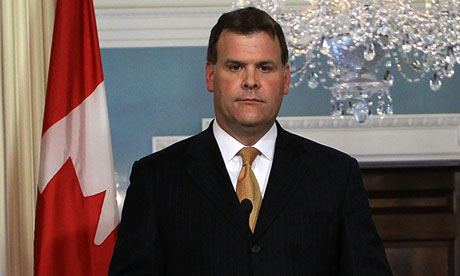
    Canada's foreign minister John Baird announced the cutting of diplomatic ties with Iran

    Foreign minister John Baird said Canada perceived Iran to be the world’s biggest threat to peace and security. Photograph: Alex Wong/Getty Images

    Canada has closed its embassy in Tehran and ordered the expulsion of Iranian diplomats from Ottawa, partly because of the country’s backing of the Syrian regime.

    Canada’s foreign affairs minister, John Baird, cited Iran‘s support for Bashar al-Assad, its disputed nuclear programme and continued human rights violations as reasons behind his country’s decision to sever diplomatic ties with Tehran. He said the Canadian government perceived Iran to be “the most significant threat to global peace and security in the world today”. “Canada has closed its embassy in Iran, effective immediately, and declared personae non gratae all remaining Iranian diplomats in Canada,” Baird said.

    All Canadian diplomatic staff had left Iran and Iranian diplomats in Ottawa had five days to leave the country. Canada joins its main allies, the US and the UK, as countries without diplomatic presence in Tehran.

    “The Iranian regime is providing increasing military assistance to the Assad regime; it refuses to comply with UN resolutions pertaining to its nuclear programme; it routinely threatens the existence of Israel and engages in racist anti-Semitic rhetoric and incitement to genocide,” Baird said in the statement published on Canada’s government website for foreign affairs and international trade.

    Ottawa’s move comes only a week after Iran attempted to seize upon an international conference in Tehran to claim a diplomatic triumph in defiance of western-led efforts to isolate the regime. To the dismay of Iran, two of its main guests for Tehran’s summit of the Non-Aligned Movement, the UN secretary general, Ban Ki-moon, and Egypt’s president, Mohamed Morsi, embarrassed the host by making speeches unwelcome by the regime. Morsi, in particular, stunned Iran, a staunch supporter of Assad, with a plea to the world to back Syrian rebels.

    Canada is an outspoken critic of Iran’s human rights record and has actively pursued the effort to hold Tehran leaders accountable for their right’s violations on international platforms in recent years, including through sanctions.

    Baird said: “[Iran] is among the world’s worst violators of human rights; and it shelters and materially supports terrorist groups, requiring the government of Canada to formally list Iran as a state sponsor of terrorism under the Justice for Victims of Terrorism Act. Moreover, the Iranian regime has shown blatant disregard for the Vienna convention and its guarantee of protection for diplomatic personnel. Under the circumstances, Canada can no longer maintain a diplomatic presence in Iran.Our diplomats serve Canada as civilians, and their safety is our number one priority.”

    Baird appeared to be referring to an incident last November when protesters in the Iranian capital stormed the British embassy in Tehran, ransacking offices and diplomatic residence.

    Payam Akhavan, a professor of international law at McGill University in Montreal, said the recent row was the worst crisis in bilateral relations between Tehran and Ottawa for many years.

    “I think the closure of Iranian embassy in Ottawa should be seen in the context of concerns by the Canadian government about the Islamic republic’s recent activities in its Ottawa mission, including using it to establish wider presence in Canada through a series of ostensibly cultural activities, at universities and other institutes and infiltrating the Iranian diaspora and neutralising opposition to the regime,” he said.

    According to latest official figures more than 400,000 Iranians live in Canada. “There is an significant Iranian diaspora in Canada, we call Toronto, Tehranto, even many regime insiders live here but the majority consists of refugees or migrants,” said Akhavan.

    The Canadian embassy in Ankara, Turkey, will provide services to Canadians living in Iran in the absence of Tehran’s mission. The Canadian foreign ministry has also upgraded its Iran travel advice, urging all its citizens not to travel to Iran.

    “Canadians who have Iranian nationality are warned in particular that the Iranian regime does not recognise the principle of dual nationality,” it said. “By doing so, Iran makes it virtually impossible for government of Canada officials to provide consular assistance to Iranian-Canadians in difficulty.”

    The frosty relations between the two capitals became even more restrained in 2003 when an Iranian-Canadian photographer, Zahra Kazemi, died while in jail in Iran. Iran said she died of a stroke but Canada insisted she died under torture because of a skull fracture.

    A number of Iranian-Canadians are currently held behind bars in Iran, including Hamid Ghassemi-Shall who is facing execution after being convicted of espionage, a charge his family say is trumped-up.

    There was no immediate reaction from Iran in response to Canada’s move but Iranian state news agencies reported Baird’s statement.

    Canada closes Tehran embassy and expels Iranian diplomats over support for Syria, nuclear plans and alleged rights abuses

    Canada's foreign minister John Baird announced the cutting of diplomatic ties with Iran

    Foreign minister John Baird said Canada perceived Iran to be the world’s biggest threat to peace and security. Photograph: Alex Wong/Getty Images

    Canada has closed its embassy in Tehran and ordered the expulsion of Iranian diplomats from Ottawa, partly because of the country’s backing of the Syrian regime.

    Canada’s foreign affairs minister, John Baird, cited Iran‘s support for Bashar al-Assad, its disputed nuclear programme and continued human rights violations as reasons behind his country’s decision to sever diplomatic ties with Tehran. He said the Canadian government perceived Iran to be “the most significant threat to global peace and security in the world today”. “Canada has closed its embassy in Iran, effective immediately, and declared personae non gratae all remaining Iranian diplomats in Canada,” Baird said.

    All Canadian diplomatic staff had left Iran and Iranian diplomats in Ottawa had five days to leave the country. Canada joins its main allies, the US and the UK, as countries without diplomatic presence in Tehran.

    “The Iranian regime is providing increasing military assistance to the Assad regime; it refuses to comply with UN resolutions pertaining to its nuclear programme; it routinely threatens the existence of Israel and engages in racist anti-Semitic rhetoric and incitement to genocide,” Baird said in the statement published on Canada’s government website for foreign affairs and international trade.

    Ottawa’s move comes only a week after Iran attempted to seize upon an international conference in Tehran to claim a diplomatic triumph in defiance of western-led efforts to isolate the regime. To the dismay of Iran, two of its main guests for Tehran’s summit of the Non-Aligned Movement, the UN secretary general, Ban Ki-moon, and Egypt’s president, Mohamed Morsi, embarrassed the host by making speeches unwelcome by the regime. Morsi, in particular, stunned Iran, a staunch supporter of Assad, with a plea to the world to back Syrian rebels.

    Canada is an outspoken critic of Iran’s human rights record and has actively pursued the effort to hold Tehran leaders accountable for their right’s violations on international platforms in recent years, including through sanctions.

    Baird said: “[Iran] is among the world’s worst violators of human rights; and it shelters and materially supports terrorist groups, requiring the government of Canada to formally list Iran as a state sponsor of terrorism under the Justice for Victims of Terrorism Act. Moreover, the Iranian regime has shown blatant disregard for the Vienna convention and its guarantee of protection for diplomatic personnel. Under the circumstances, Canada can no longer maintain a diplomatic presence in Iran.Our diplomats serve Canada as civilians, and their safety is our number one priority.”

    Baird appeared to be referring to an incident last November when protesters in the Iranian capital stormed the British embassy in Tehran, ransacking offices and diplomatic residence.

    Payam Akhavan, a professor of international law at McGill University in Montreal, said the recent row was the worst crisis in bilateral relations between Tehran and Ottawa for many years.

    “I think the closure of Iranian embassy in Ottawa should be seen in the context of concerns by the Canadian government about the Islamic republic’s recent activities in its Ottawa mission, including using it to establish wider presence in Canada through a series of ostensibly cultural activities, at universities and other institutes and infiltrating the Iranian diaspora and neutralising opposition to the regime,” he said.

    According to latest official figures more than 400,000 Iranians live in Canada. “There is an significant Iranian diaspora in Canada, we call Toronto, Tehranto, even many regime insiders live here but the majority consists of refugees or migrants,” said Akhavan.

    The Canadian embassy in Ankara, Turkey, will provide services to Canadians living in Iran in the absence of Tehran’s mission. The Canadian foreign ministry has also upgraded its Iran travel advice, urging all its citizens not to travel to Iran.

    “Canadians who have Iranian nationality are warned in particular that the Iranian regime does not recognise the principle of dual nationality,” it said. “By doing so, Iran makes it virtually impossible for government of Canada officials to provide consular assistance to Iranian-Canadians in difficulty.”

    The frosty relations between the two capitals became even more restrained in 2003 when an Iranian-Canadian photographer, Zahra Kazemi, died while in jail in Iran. Iran said she died of a stroke but Canada insisted she died under torture because of a skull fracture.

    A number of Iranian-Canadians are currently held behind bars in Iran, including Hamid Ghassemi-Shall who is facing execution after being convicted of espionage, a charge his family say is trumped-up.

    There was no immediate reaction from Iran in response to Canada’s move but Iranian state news agencies reported Baird’s statement.

    Canada closes Tehran embassy and expels Iranian diplomats over support for Syria, nuclear plans and alleged rights abuses

    Canada's foreign minister John Baird announced the cutting of diplomatic ties with Iran

    Foreign minister John Baird said Canada perceived Iran to be the world’s biggest threat to peace and security. Photograph: Alex Wong/Getty Images

    Canada has closed its embassy in Tehran and ordered the expulsion of Iranian diplomats from Ottawa, partly because of the country’s backing of the Syrian regime.

    Canada’s foreign affairs minister, John Baird, cited Iran‘s support for Bashar al-Assad, its disputed nuclear programme and continued human rights violations as reasons behind his country’s decision to sever diplomatic ties with Tehran. He said the Canadian government perceived Iran to be “the most significant threat to global peace and security in the world today”. “Canada has closed its embassy in Iran, effective immediately, and declared personae non gratae all remaining Iranian diplomats in Canada,” Baird said.

    All Canadian diplomatic staff had left Iran and Iranian diplomats in Ottawa had five days to leave the country. Canada joins its main allies, the US and the UK, as countries without diplomatic presence in Tehran.

    “The Iranian regime is providing increasing military assistance to the Assad regime; it refuses to comply with UN resolutions pertaining to its nuclear programme; it routinely threatens the existence of Israel and engages in racist anti-Semitic rhetoric and incitement to genocide,” Baird said in the statement published on Canada’s government website for foreign affairs and international trade.

    Ottawa’s move comes only a week after Iran attempted to seize upon an international conference in Tehran to claim a diplomatic triumph in defiance of western-led efforts to isolate the regime. To the dismay of Iran, two of its main guests for Tehran’s summit of the Non-Aligned Movement, the UN secretary general, Ban Ki-moon, and Egypt’s president, Mohamed Morsi, embarrassed the host by making speeches unwelcome by the regime. Morsi, in particular, stunned Iran, a staunch supporter of Assad, with a plea to the world to back Syrian rebels.

    Canada is an outspoken critic of Iran’s human rights record and has actively pursued the effort to hold Tehran leaders accountable for their right’s violations on international platforms in recent years, including through sanctions.

    Baird said: “[Iran] is among the world’s worst violators of human rights; and it shelters and materially supports terrorist groups, requiring the government of Canada to formally list Iran as a state sponsor of terrorism under the Justice for Victims of Terrorism Act. Moreover, the Iranian regime has shown blatant disregard for the Vienna convention and its guarantee of protection for diplomatic personnel. Under the circumstances, Canada can no longer maintain a diplomatic presence in Iran.Our diplomats serve Canada as civilians, and their safety is our number one priority.”

    Baird appeared to be referring to an incident last November when protesters in the Iranian capital stormed the British embassy in Tehran, ransacking offices and diplomatic residence.

    Payam Akhavan, a professor of international law at McGill University in Montreal, said the recent row was the worst crisis in bilateral relations between Tehran and Ottawa for many years.

    “I think the closure of Iranian embassy in Ottawa should be seen in the context of concerns by the Canadian government about the Islamic republic’s recent activities in its Ottawa mission, including using it to establish wider presence in Canada through a series of ostensibly cultural activities, at universities and other institutes and infiltrating the Iranian diaspora and neutralising opposition to the regime,” he said.

    According to latest official figures more than 400,000 Iranians live in Canada. “There is an significant Iranian diaspora in Canada, we call Toronto, Tehranto, even many regime insiders live here but the majority consists of refugees or migrants,” said Akhavan.

    The Canadian embassy in Ankara, Turkey, will provide services to Canadians living in Iran in the absence of Tehran’s mission. The Canadian foreign ministry has also upgraded its Iran travel advice, urging all its citizens not to travel to Iran.

    “Canadians who have Iranian nationality are warned in particular that the Iranian regime does not recognise the principle of dual nationality,” it said. “By doing so, Iran makes it virtually impossible for government of Canada officials to provide consular assistance to Iranian-Canadians in difficulty.”

    The frosty relations between the two capitals became even more restrained in 2003 when an Iranian-Canadian photographer, Zahra Kazemi, died while in jail in Iran. Iran said she died of a stroke but Canada insisted she died under torture because of a skull fracture.

    A number of Iranian-Canadians are currently held behind bars in Iran, including Hamid Ghassemi-Shall who is facing execution after being convicted of espionage, a charge his family say is trumped-up.

    There was no immediate reaction from Iran in response to Canada’s move but Iranian state news agencies reported Baird’s statement.