Managing director of Ebono Institute and major sponsor of The Generator, Geoff Ebbs, is running against Kevin Rudd in the seat of Griffith at the next Federal election. By the expression on their faces in this candid shot it looks like a pretty dull campaign. Read on
The New South Wales Opposition has accused the State Government of ignoring warnings about potential traffic chaos during construction of Sydney’s North West Rail Link.
An environmental impact statement and submissions report shows there will be about 6,500 extra trucks and cars making their way to and from construction sites while the link is built.
Roads and Maritime Services has recommended banning or limiting major works and truck movements during peak periods.
But Transport for NSW has rejected the suggestion, saying it would threaten the project’s viability.
Opposition spokeswoman Penny Sharpe says the Government should be looking into the issue.
“What it means for people trying to get to work for the north-west is they’re going to have many more hours in the car during the construction of the North West Rail Link,” she said.
“As construction unfolds and traffic becomes very difficult for commuters, the Government is going to have to look at how it manages heavy vehicle movements during the peak hour.”
She says Environment Protection Authority warnings about noise and vibrations from tunnel drilling have also been dismissed.
“Tunnelling’s going to be occurring 24 hours, seven days a week. Some of the submissions really have concerns around schools and childcare centres and residential facilities for older people,” Ms Sharpe said.
“The impact on sleep disturbance will be large. The EPA’s submission actually suggested that there’s not very much they can do around noise mitigation – it’s going to be noisy. Transport NSW and the Minister have to make sure that all those issues are carefully managed.”
You may not have noticed, but last week was among the most significant of the Gillard government’s term. The commitments made may do great good, but they will also cause much pain and gnashing of teeth in the years ahead.
Last week the nation made it crystal clear to its political leaders – federal and state – it wanted them to get on with implementing the national disability insurance scheme. After decades of turning a blind eye to the difficulties faced by the disabled and their carers, last week conscience struck.
Fine. You’re a believer; so am I. But the scheme is very expensive: when fully implemented in 2018, an additional $8 billion a year. Or, as the politicians and the media usually prefer to put it, $32 billion over four years.
Advertisement
So how will the disability scheme be paid for? No one has any idea. The pollies were arguing about that very question when – urged on by the same radio shock jocks who on other days rail against ”debt and deficit” – the electorate put a rocket under them: Just do it!
That’s why I have reservations. We behaved like a teenager with his first pay packet who goes out and buys a car on the never-never, without a moment’s thought about how he’ll fit the repayments into his budget.
Perhaps this was the only way an increasingly self-centred nation was ever going to commit to something so caring but expensive. Had we dwelt on how much it would cost and how we’d be paying for it, we might have made an excuse and passed on.
Even so, the accountant in me remains uneasy. Sometimes in politics, good deeds aren’t born of the purest motives. The Productivity Commission report that recommended the scheme called for the pilot programs to begin in 2014.
I suspect Julia Gillard brought it forward a year because she wanted to be seen doing something worthwhile – and something that didn’t have Kevin Rudd’s fingerprints on it. She committed to spending just $1 billion over the four-year trial phase.
If Gillard has a clear idea of how she would afford the scheme when fully implemented, she’s given no hint of it. All we know is that, contrary to the commission’s advice, she expects the states to bear some of the cost.
I suspect she’s fingered the states as a red herring, intending to draw attention away from her own lack of forethought. That’s where we got to last week. She put the wood on the premiers to make a small contribution to the cost of their state’s pilot scheme, but many declined. This could have been the usual story – whenever the feds require the premiers’ co-operation, their hands go out: What’s it worth to you?
If that was the premiers’ motivation, I’m sympathetic. Though the states are responsible for provision of many costly public services – law and order, roads and transport, schools and hospitals – their taxing powers have been greatly constrained by the High Court, leaving them heavily dependent on the feds.
John Howard’s decision to grant them the full proceeds from the goods and services tax was intended to solve their problem, but it’s no longer the ”growth tax” it was. Our consumer spending no longer outstrips our income the way it did, and an ever-growing proportion of our spending goes on items excluded from the tax, particularly private education and health.
So the premiers can’t reasonably be expected to stump up for anything much. And, indeed, it’s the feds who’ll have to come up with a solution to their chronic revenue problem. This week a poll shows 84 per cent of respondents oppose increasing the rate of the GST to 12.5 per cent.
But only the Liberal premiers jacked up last week. The remaining Labor state and territory leaders played along. So maybe it wasn’t the standard premiers’ money-motivated bail-up.
There isn’t a politician in the country with the courage to openly oppose the disability scheme. Gillard’s lack of courage comes in telling us how she proposes to pay for it. Maybe she’s decided she’ll worry about that only if she wins the next election.
Tony Abbott’s more likely to win it, of course. I suspect the hard-heads on his side had been intending to relegate implementation of the full scheme to the status of an ”aspiration” to be afforded only when finances permit.
That now would be a lot harder to do, following the surge of public pressure that forced the premiers of NSW and Victoria to back down after just a day or so. Such forceful expressions of the public’s will stay burnt on politicians’ brains long after you and I have forgotten them.
Abbott’s shadow treasurer, Joe Hockey, is saying it would be cruel to offer hope to the disabled when there was no guarantee the money could be found. In contrast, his more slick-tongued finance spokesman, Andrew Robb, says the full scheme would be introduced in 2018, but this ”probably would require the removal or scaling back of other programs”.
Don’t forget Abbott would first have to cover the cost of abolishing the carbon tax and the mining tax. This is a man who professes to believe taxes must go down and may never go up. Now he’s got to find a further $8 billion a year in spending cuts.
I find it hard to believe this would happen. But whatever happens, I foresee much pain and gnashing of teeth.
Charles Darwin came to many of his ideas by observing the wild creatures of South America. The biologist Sinéad Collins elaborates on his work by actually creating evolution in her laboratory at the University of Edinburgh. Dr. Collins, 36, sets up experiments to uncover evolution’s basic rules. She then uses the information to help work on solutions to contemporary environmental problems like global warming and marine acidification.
We spoke for two hours at last winter’s annual meeting of the American Association for the Advancement of Science in Vancouver, British Columbia, and then again last month by telephone. An edited and condensed version of the conversations follows.
When people get algae in their swimming pools or their ponds, they do their best to get rid of it. Why do you deliberately grow it in Scotland?
Oh, my gosh! We grow it only for the best of reasons. In my lab, we do something called “experimental evolution.” That’s a way of trying to figure out how evolution works by observing it. We do that by taking very small creatures — unicellular green algae — and breeding hundreds and thousands of generations of them in different environments.
With ocean warming and acidification proceeding at an ever-growing pace, we grow the algae in high CO2 environments — which is something like what a future ocean might be like. We then say, “Hello, algae, tell us how you are different.” And from this we can get a projection of how they might be in 200 years. It’s important to know because microbes such as algae are the starting point of the marine food chain.
Of course, we’re doing this in a laboratory. So it’s a super-simplified version of a future ocean. We’re not trying to replicate reality — the actual ocean is a complex and turbulent environment. We’re more trying to figure out the rules reality plays by.
Is experimental evolution new?
No. In the 1880s, there was a guy named the Rev. William Dallinger, and he did an experiment that could be published today — it was that cool. He took microbes that could live only at temperatures under 68 degrees Fahrenheit, and over several years evolved them to live at 158 degrees!
What is new is applying evolution to current problems. I first came to the field in the 1990s while studying biochemistry at McGill. I was volunteering at a gay telephone hot line in Montreal. At the time there were all these super-strains of H.I.V. emerging. That got me interested in how viruses evolve because retroviruses like H.I.V. have this incredibly fast mutation rate.
That was part of what pushed me to do my doctorate in experimental evolution. Right away, I could see how experimental evolution was creating tools for understanding the effects of climate change. Who survives in a warmed-up environment? How will they be different from their ancestors? Dallinger’s microbes, after years of selection, couldn’t survive at 68 degrees Fahrenheit anymore.
Today I do Dallinger-ish experiments in my own lab. I take the results to an institute in Germany where I help their oceanographers plan their own experiments in real marine environments.
What have your algae taught you so far?
Let me tell you about one experiment we did. There are people who say that all the carbon we’re putting into the seas might not have a devastating effect. They posit that it won’t lead to an over-acidified marine environment because microbes will eat all that extra carbon, store it and spit it out as oxygen.
At first glance, this makes sense because many microorganisms are photosynthesizers. They gobble up carbon, store it, use it like food for growth and transform it into oxygen.
So to test this, we grew algae in the lab in a high CO2 environment, and 1,000 generations later we saw some really weird syndromes. Some of the algae, if you gave them more CO2, weren’t storing it anymore. Others photosynthesized many times faster than any of their ancestors had, though they were no longer able to use the extra carbon to become bigger.
What do you make of this?
That this hope that ocean plants will efficiently sop up all the extra CO2 may be overly optimistic.
We did another experiment where we found that genetically identical algae evolved differently when they are part of a community than when alone. In fact, the algae that evolved the most on their own and were most adapted to the new environment got driven to extinction when they were put together with algae that had evolved in a community.
The New South Wales Opposition has slammed a move to allow unrestricted container movements from Sydney’s Port Botany terminal.
Treasurer Mike Baird says removing the current cap of 3.2 million container movements will make Port Botany a more attractive prospect for private sector companies bidding for a 99-year lease on the site.
“The decision has been taken to remove that cap, but it’s only being done on the basis of the significant mitigants we have put in to remove congestion in that precinct,” Mr Baird said.
But shadow treasurer Michael Daley, who is also the local MP for the area around the port, says it is an outrageous idea.
“The M5 East is already clogged with heavy vehicles and there is a cap on Port Botany. Imagine what it will be like with no cap at all into the future,” Mr Daley said.
Mr Baird says the Government will be adopting further measures to reduce congestion when Infrastructure NSW releases its report in September.
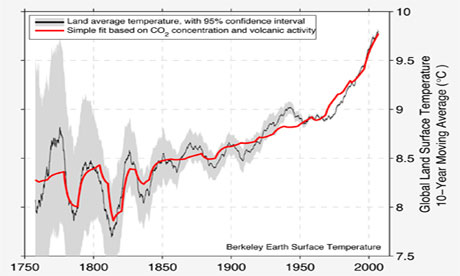
The annual and decadal land surface temperature from the BerkeleyEarth average, compared to a linear combination of volcanic sulfate emissions and the natural logarithm of CO2. Photograph: BerkeleyEarth
So, that’s it then. The climate wars are over. Climate sceptics have accepted the main tenets of climate science – that the world is warming and that humans are largely to blame – and we can all now get on to debating the real issue at hand: what, if anything, do we do about it?
If only. Yesterday’s announcement by Prof Richard Muller that, as a result of his Berkeley Earth Surface Temperature (Best) project’s research, he had undergone a “total turnaround” in his views on climate science and now accepted that the Earth’s land has warmed by 1.5C over the past 250 years and that “humans are almost entirely the cause”, might be seen by many as a watershed moment in this long, often bitter debate. But not, it would appear, for climate sceptics – the very people he designed his project to please.
Rather than join Muller on his road to Damascus, many climate sceptics have predictably been tempted by the neon signs directing them to turn back instead. Muller, as a result of his “conversion“, is now being painted as a figure of distrust and scorn, in much the same way that they have viewed many climate scientists over the years. His research methodologies and results are being mocked and slammed for being simplistic and “agenda driven”.
Climate sceptics know better, of course, and are heralding (at first, via a bizarrely histrionic preview) a conveniently timed piece of research of their own, which they say, “devastatingly” undermines all other known work in this field. The tills at Hubris ‘R Us have certainly been ringing loudly over the past few days.
In one sense, you could say all of this is symptomatic of healthy scientific enquiry. Claim and counter claim are being tested, reviewed and published online to allow full transparency and scrutiny. There are no hiding places. Our scientific understanding of the planet’s climate – and the forces that drive it – are advancing incrementally, yet assuredly. The truth will out.
I would like to hug this idealistic vision tightly to my chest, but I know – as the saying goes – it’s a bit more complicated than that. There are far more factors at play (on both “sides” of the debate) than mere “science” and that murky soup includes – to name just a few ingredients – ideology, vested interest, confirmation bias and a suite of formal and informal fallacies. I can’t comment on either of the latest results being presented by both Muller and Watts et al (who claim that US temperature trends over the past few decades have been “spuriously doubled”). Neither has been peer-reviewed or published in an academic journal so any conclusions seem premature.
What is clear, though, is that Muller’s results are largely symbolic, as opposed to representing a genuine leap forward in scientific understanding. His team’s results are broadly in synch with what mainstream climate science has been claiming for well over a decade.
The power of his findings lay in the journey he has undertaken to arrive at his conclusions. He has sought to address key concerns of climate sceptics about temperature reconstructions (many of which he had himself), as well as investigate why the world has warmed in the way it has over the past couple of centuries. In effect, he has laid down a challenge to climate sceptics (who, I admit, come in many flavours) to come up with a better-evidenced theory than mankind’s emissions being the key reason why temperatures have risen. As he himself says: “To be considered seriously, an alternative explanation must match the data at least as well as carbon dioxide does.”
The key question for me is whether climate sceptics actually want to tackle that all-important question. What evidence will it take to convince them? Are they forever destined to keep saying “it’s not enough for us”? When does the balance of risk tip over in favour of them accepting that pumping ever more greenhouse gases into the atmosphere is not a wise thing to keep on doing?
On a time scale of tens to hundreds of millions of years, the geomagnetic field may be influenced by currents in the mantle. The frequent polarity reversals of Earth’s magnetic field can also be connected with processes in the mantle. New results show how the rapid processes in the outer core, which flows at rates of up to about one millimeter per second, are coupled with the processes in the mantle, which occur more in the velocity range of centimeters per year.


 Advertisement

 Get Science News From The New York Times »
 Email
Email