Category: General news

Managing director of Ebono Institute and major sponsor of The Generator, Geoff Ebbs, is running against Kevin Rudd in the seat of Griffith at the next Federal election. By the expression on their faces in this candid shot it looks like a pretty dull campaign. Read on

  • The Summer of 2012–Too Hot to Handle? NASA

    The Summer of 2012–Too Hot to Handle?

    Inbox
    x
    NASA Science News noreply@nasascience.org
    7:53 AM (2 hours ago)

    to NASA
    NASA Science News for August 3, 2012

    Are the heat waves of summer 2012 a sign of climate change, ordinary weather, or some mixture of the two? Earth scientists discuss the possibilities in today’s story from Science@NASA.

    FULL STORY: http://science.nasa.gov/science-news/science-at-nasa/2012/03aug_summer2012/

    You are currently subscribed to snglist as: nevilleg729@gmail.com.

    This is a free service

  • Stop this culture of paying politicians for denying climate change (MONBIOT)

    Stop this culture of paying politicians for denying climate change

    Protecting the environment requires a sweeping reform of political funding, only then corporations will stop throwing big money at senators

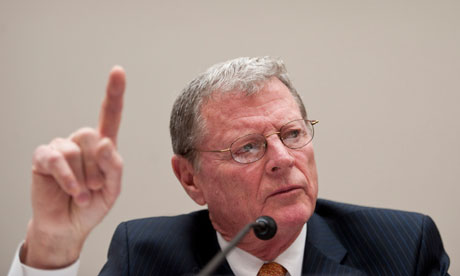
    James Inhofe and senate climate change hearings

    Republican senator James Inhofe told the environment and public works committee ‘climate change is a hoax perpetrated on the American people’. Photograph: Bill Clark/Getty Images

    “The best lack all conviction, while the worst/Are full of passionate intensity.” These words, from WB Yeats’s poem The Second Coming, came to mind as I read the testimony from Wednesday’s Senate hearings on climate change.


    They’re not a precise description of what took place, as the two most eminent climate scientists who testified before the environment and public works committee, Christopher Field and James McCarthy, were not lacking in conviction. But they were, as scientists should be, careful and meticulous, laying out their evidence calmly and sequentially, saying nothing that was not supported by the data.


    By contrast, the Senate committee’s ranking member (its most senior Republican), James Inhofe, spoke with the demagogic passion of a revivalist preacher. “The global warming movement has completely collapsed … the science of the United Nations Intergovernmental Panel on Climate Change (IPCC) was finally exposed … The time has come to put these tired, failed policies to rest and embrace the US energy boom so that we can put Americans back to work, turn this economy around, become totally energy independent from the Middle East, and ensure energy security for years to come.”


    In other words, Inhofe argued, we should take no action on climate change, which he has described as “the greatest hoax ever perpetrated on the American people”.


    Never mind the overwhelming evidence that has accumulated since the last Senate hearings in 2009; never mind the crazy temperatures the US has been experiencing recently, which have alerted many Americans to what climate change is likely to deliver in the decades to come; never mind the prominent sceptic Richard Muller’s assessment of the evidence, which led to his change of heart. (It told us nothing we didn’t know already, but it should at least have caused the deniers to stop and think).


    None of this makes the slightest difference to Inhofe. But how could it? Even if he were persuaded by the great weight of evidence for man-made climate change, changing his mind would be a very expensive decision. It could cost him his seat: not because it would necessarily be an unpopular shift – even in Oklahoma – but because it would jeopardise the massive flow of funds required to remain in high office in the US.


    Take a look at Inhofe’s campaign funding. The major source, contributing half a million dollars over the past five years, has been the oil and gas industry.


    Of his individual contributors, the biggest is Koch Industries – an oil, gas, minerals, timber and chemicals corporation, that is described by its owners, Charles and David Koch, as “the biggest company you’ve never heard of”. They fund a number of anti-environmental and anti-tax lobby groups. They set up the organisation which founded the Tea Party movement.


    The second biggest contributor is Murray Energy, that boasts it is “the largest privately owned coal company in America”. The third is the oil and gas company Devon Energy. The fourth is the Contran Corporation, whose billionaire owner Harold Clark Simmons has a political profile similar to that of the Koch brothers.


    If Inhofe were to change his position on man-made global warming, is it credible that he would retain all this funding? No. He receives money from fossil fuel companies because he articulates the views to which these funders subscribe, and because he advances their interests in the Senate. Given that keeping your seat means spending a fortune on television advertising and other forms of campaigning, changing your views on a matter of great interest to your sponsors is likely to be political suicide.


    For people like the Kochs, Murray Energy and Harold Clark Simmons, the money they give to politicians is small change. For environmental campaigns, contributions of this size would break the bank. The money available to big business means that there will always be a massive asymmetry of this kind in the potential for political funding. As a result, a political system which imposes no effective cap on campaign finance leads inexorably to plutocracy: governance on behalf of the richest people and corporations.


    The first prerequisite for protecting the environment is a functioning democracy. In any other system, those with the most money to spend or, in other circumstances, the most thugs to deploy, win the political battles. The further from democracy a nation strays, the greater the opportunities to destroy the world’s living systems, however unpopular that destruction may be.


    The foremost threat to democratic values in countries like the US and the UK is the freedom with which billionaires and corporations can pay people and parties to represent their views. Protecting the environment, like protecting the welfare of a nation’s poorest and weakest people, requires a sweeping reform of political funding, on both sides of the Atlantic.


    Monbiot.com

  • ALP internal polling shows dire result

    KIM BEAZLEY WAS MOST LIKELY CORRECT IN HIS STATEMENTS IN THE US, WHICH SWAN AND CO DENIED.

    ALP internal polling shows dire result

    Updated: 08:02, Friday August 3, 2012

    ALP internal polling shows dire result

    The Labor Party continues to bleed support, with an internal poll, leaked to the Seven Network, showing Labor would have no federal MPs from Queensland, the Northern Territory, Tasmania and Western Australia, if there had been an election last month.

    It found Treasurer Wayne Swan, Special Minister of State Gary gray, Trade Minister Craig Emerson and Veterans Affairs Minister Warren Snowdon would also be at risk of losing their seats, and even former PM Kevin Rudd is in trouble.

    The polling is likely to encourage more speculation about Labor’s leadership, which has been rampant in recent weeks despite the ALP’s efforts to hose it down.

  • Ratepayer billions down council drain

    Ratepayer billions down council drain

    MILLIONS of dollars a year are being lost by New South Wales councils on high-risk investments made before the global financial crisis.

    Rather than divest investments, known as collateralised debt obligations (CDOs), many councils have held on in the hope the market will recover.

    But the economic uncertainty in the US and the eurozone crisis means councils have been unable to recoup losses, let alone turn a loss into a profit.

    Last month, a major CDO in which many NSW councils had invested defaulted following the bankruptcy of American mortgage insurer PMI Group.

    Documents show more losses will follow as the euro crisis deepens and the US economy continues to stall.

    Councils, churches and charities across Australia have lost about $1 billion since the GFC hit in 2008 due to CDOs – junk bonds that were wrapped in AAA-rated bonds to create a new product.

    Gosford Council’s $24 million in CDOs is now worth $1.4 million while Wingecarribee Council’s $14.7 million is today valued at $1.2 million.

    Port Macquarie Hastings Council lost $6.4 million and its remaining $6 million of CDOs have a book loss of $4.7 million.

    Hurstville Council has losses of $9 million post GFC.

    Coffs Harbour Council has realised losses of $8.8 million since 2007. Latest documents show Coffs Harbour has $4.7 million in CDOs, which have mostly defaulted, now worth $892,308 with a “high risk” the capital won’t be returned.

    But while those were among the most exposed, the true figure of how much they have lost cannot be calculated.

    “Nobody can put a figure on it,” University of Wollongong academic Greg Jones said.

    “If you have $10 million invested for three years and get no return, that is a loss as far as I am concerned. What the net losses are no one is game to say until they mature.”

    Councils defended their decision to keep the CDOs because they were “nearly impossible” to offload. “

    “It was like a game of pass the parcel. Unfortunately most councils ended up being the last person with the parcel and no one wanted to take it off them,” Mr Jones said.

    John Walker, executive director of law firm IMF, which took a class action against Lehman Brothers Australia to the High Court, said councils, churches and charities invested $4 billion in CDOs before the market froze.

    “About 25 per cent of the investment has been lost and losses are increasing,” he said.

    “About half of those losses were in respect to CDOs distributed by Lehman Brothers Australia. There are churches, councils and charities with potential claims against Lehman Brothers of $600 million. But Lehman only has assets of $200 million.”

  • Coalition wants tougher foreign investment rules

    Coalition wants tougher foreign investment rules

    ABCUpdated August 3, 2012, 10:15 am


    Overseas investors would have to face the Foreign Investment Review Board if they want to buy agricultural businesses worth $53 million or more, under proposals being considered by the Federal Opposition.

    The proposal is included in a discussion paper released by Opposition leader Tony Abbott, Nationals leader Warren Truss, and shadow treasurer Joe Hockey this morning,

    It says the threshold for scrutiny on foreigners buying agricultural land should be $15 million.

    The proposed $53m figure for agri-business investments is much lower than the current figure of $244 million.

    Mr Abbott says he supports foreign investment, but it needs to be in Australia’s national interest.

    “I want to make it absolutely crystal clear that the Coalition unambiguously supports foreign investment in Australia,” he said.

    “”We need it, we want it, it is essential for our continued national prosperity … [but] what’s very important though is that the public have confidence that the foreign investment we need and want is in Australia’s national interest.”

    Trade Minister Craig Emerson said the board already reviews state-owned assets, and accused the Coalition of fear-mongering.

    “What the Coalition is seeking to do is misinform,” he said.

    “It is irresponsible behaviour on the part of Mr Abbott and Mr Barnaby Joyce. It is just economic nationalism, or worse, it is economic Hansonism.”

    Former Liberal minister Peter Reith says the Coalition proposals pander to populism and is contrary to public interest.

  • Earth’s oceans and other ecosystems still absorbing about half the greenhouse gases emitted by people

    ScienceDaily: Earth Science News


    Northwest earthquake risk in U.S. looms large: 40% chance of major earthquake within 50 years

    Posted: 01 Aug 2012 10:27 AM PDT

    A comprehensive analysis of the Cascadia Subduction Zone off the Pacific Northwest coast confirms that the region has had numerous earthquakes over the past 10,000 years, and suggests that the southern Oregon coast may be most vulnerable based on recurrence frequency.

    Earth’s oceans and other ecosystems still absorbing about half the greenhouse gases emitted by people

    Posted: 01 Aug 2012 10:24 AM PDT

    Earth’s oceans, forests and other ecosystems continue to soak up about half the carbon dioxide emitted into the atmosphere by human activities, even as those emissions have increased, according to a new study. The scientists analyzed 50 years of global carbon dioxide measurements and found that the processes by which the planet’s oceans and ecosystems absorb the greenhouse gas are not yet at capacity.

    Tropical climate in the Antarctic: Palm trees once thrived on today’s icy coasts 52 million years ago

    Posted: 01 Aug 2012 10:23 AM PDT

    Given the predicted rise in global temperatures in the coming decades, climate scientists are particularly interested in warm periods that occurred in the geological past. Knowledge of past episodes of global warmth can be used to better understand the relationship between climate change, variations in atmospheric carbon dioxide and the reaction of Earth’s biosphere. Scientists have discovered an intense warming phase around 52 million years ago in drill cores obtained from the seafloor near Antarctica — a region that is especially important in climate research.

    Lower hybrid drift waves in Earth’s magnetosphere investigated

    Posted: 01 Aug 2012 08:44 AM PDT

    Scientists have detected and characterized lower hybrid drift waves, a special kind of plasma waves that develop in thin boundaries both in space and in the laboratory. The measurement of fundamental properties of these waves was possible when two of the spacecraft were flying very close to one another in the tail of Earth’s magnetosphere. With wavelengths of about 60 km, these waves appear to play an important role in the dynamics of electrons and in the transfer of energy between different layers of plasma in the magnetosphere.

    Auroras and thin current sheets in space

    Posted: 01 Aug 2012 06:37 AM PDT

    Around Earth, the processes accelerating electrons which hit the atmosphere and cause beautiful auroras are often initiated in thin current sheets. Similar processes, auroras and thin current sheets are found around other planets such as Jupiter and Saturn. Plasma regions close to the hot solar surface are separated by thin current sheets, and similar boundaries should also be common around distant stars.
    You are subscribed to email updates fromScienceDaily: Earth Science News
    To stop receiving these emails, you may unsubscribe now.
    Email delivery powered by Google
    Google Inc., 20 West Kinzie, Chicago IL USA 60610