Category: General news

Managing director of Ebono Institute and major sponsor of The Generator, Geoff Ebbs, is running against Kevin Rudd in the seat of Griffith at the next Federal election. By the expression on their faces in this candid shot it looks like a pretty dull campaign. Read on

  • 1 Million to Ban the Lion Trade (avaaz)

    1 Million to Ban the Lion Trade

    Inbox
    x

    Jamie Choi – Avaaz.org avaaz@avaaz.org
    8:51 AM (1 hour ago)

    to me
    Dear friends,

    South African lions are being slaughtered for their bones, just to make bogus sex potions for men. But if we show President Zuma that this hurts South Africa’s image as a tourist destination, he could stop this cruelty by banning the trade in lion bones and organs. Sign the petition below — we’ll take out ads in major tourism magazines and websites:

    Hundreds of South African lions are being slaughtered to make bogus sex potions for men. But we can stop this cruel trade by hitting the government where it hurts — the tourism industry.

    A global ban on tiger bone sales has traders hunting a new prize — the majestic lions. Lions are farmed under appalling conditions in South Africa for “canned hunting”, where rich tourists pay thousands to shoot them through fences. Now experts say lion bones from these killing farms are being exported to phony ‘medicine’ makers in Asia for record profits. Trade is exploding and experts fear that as prices rise, even wild lions — with only 20,000 left in Africa — will come under poaching attack.

    If we can show President Zuma that this brutal trade is hurting South Africa’s image as a tourist destination, he could ban and punish the trade in lion bones. Avaaz is taking out strong ads in airports, tourism websites and magazines, but we urgently need 1 million petition signers to give the ads their force. Sign below to build our numbers fast:

    http://www.avaaz.org/en/1_million_to_ban_the_lion_trade_fbb/?bhPqncb&v=15583

    ‘Tiger bone wine’ and other tiger-part medicines were banned after massive international outrage — now traders have shifted their attention to lions’ bones to make all kinds of bogus remedies. Experts say unless governments act now, lions could be the next in line — after tigers and rhinos — to face extinction.

    There is a solution: banning and punishing the trade of lion bones and organs. South Africa is currently the largest exporter of lion trophies, bones and organs — it is also the only African country actively breeding lions in large numbers to supply trophy hunting. But if we can show that allowing this senseless trade can hurt South Africa’s booming tourism industry and make visitors flee, President Zuma could be forced to act.

    Let’s build a thunderous global roar for the lions. Avaaz will show the cruelty of the lion bone trade with stinging ads — sign now:

    http://www.avaaz.org/en/1_million_to_ban_the_lion_trade_fbb/?bhPqncb&v=15583

    Avaaz members across the world have come together to demand strong protection for elephants and rhinos, save the world’s bees from poisonous pesticides and achieve huge marine reserves in Chagos and Australia to safeguard vulnerable marine species. Lets come together once again and stand up for Africa’s lions.

    With hope, and determination,

    Jamie, Alex, Antonia, Mia, Alice, Ricken, Luca, Emily and the entire Avaaz team

    More information:

    Lion Bone Trade Fuels Breeding Business in Africa (Al Jazeera)
    http://allafrica.com/view/resource/main/main/id/00040108.html

    South Africa continues to support the lion bone trade (LionAid)
    http://www.lionaid.org/blog/2012/06/south-africa-continues-to-support-the-lion-bone-trade.htm

    Quenching a thirst for lion bones (Mail & Guardian)
    http://mg.co.za/article/2012-04-20-quenching-a-thirst-for-lion-bones/

    Born to be killed (Carte Blanche)
    http://beta.mnet.co.za/carteblanche/Article.aspx?ID=4226

    The Lion Bone’s Connected to the … Rhino Horn? (Rhinoconservation.org)
    http://www.rhinoconservation.org/2012/05/12/the-lion-bones-connected-to-the-rhino-horn/

    Wildlife trafficking trail leads to SA safari man (News 24)
    http://www.news24.com/SouthAfrica/News/Bloody-rhino-poaching-trail-leads-to-SA-safari-operator-20110721

    Support the Avaaz Community!
    We’re entirely funded by donations and receive no money from governments or corporations. Our dedicated team ensures even the smallest contributions go a long way.


    Avaaz.org is a 14-million-person global campaign network
    that works to ensure that the views and values of the world’s people shape global decision-making. (“Avaaz” means “voice” or “song” in many languages.) Avaaz members live in every nation of the world; our team is spread across 19 countries on 6 continents and operates in 14 languages. Learn about some of Avaaz’s biggest campaigns here, or follow us on Facebook or Twitter.

    You are getting this message because you signed “Save our dying planet!” on 2011-12-08 using the email address nevilleg729@gmail.com.
    To ensure that Avaaz messages reach your inbox, please add avaaz@avaaz.org to your address book. To change your email address, language settings, or other personal information, https://secure.avaaz.org/act/index.php?r=profile&user=6be3e9aa63582c9b1397464fcc49baa9&lang=en, or simply go here to unsubscribe.

    To contact Avaaz, please do not reply to this email. Instead, write to us at www.avaaz.org/en/contact or call us at +1-888-922-8229 (US).

  • Stellar Flare Blasts Exoplanet

    Stellar Flare Blasts Exoplanet

    Inbox
    x

    NASA Science News noreply@nasascience.org
    2:07 AM (7 hours ago)

    to NASA

    NASA Science News for June 28, 2012

    Working in tandem, NASA’s Hubble Space Telescope and Swift satellite have caught a distant star blasting one of its own planets with a powerful stellar flare. The eruption stripped thousands of tons of material from the planet’s atmosphere.

    FULL STORY: http://science.nasa.gov/science-news/science-at-nasa/2012/28jun_alienflare/

    You are currently subscribed to snglist as: nevilleg729@gmail.com.

    This is a free service

  • What makes sea-level rise?

    What makes sea-level rise?

    Filed under:

    — stefan @ 1 June 2012

    Last week the science community was shocked by the claim that 42% of the sea-level rise of the past decades is due to groundwater pumping for irrigation purposes. What could this mean for the future – and is it true?

    The causes of global sea level rise can be roughly split into three categories: (1) thermal expansion of sea water as it warms up, (2) melting of land ice and (3) changes in the amount of water stored on land. There are independent estimates for these contributions, and obviously an important question is whether their sum is consistent with the total sea level rise actually observed.


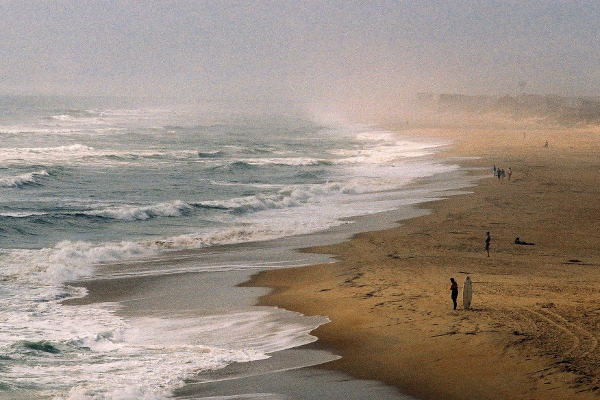
    foto (c) Stefan Rahmstorf 2012

    In the last IPCC report (2007), the time period 1961-2003 was analysed in some detail, and a problem was found: the individual contributions summed up to less than the observed rise – albeit with rather large uncertainties in the estimates. In the years since then, much research effort has been devoted to better quantify all contributions. For the last decade there is also improved observation systems, e.g. the GRACE satellite mission and thousands of autonomous ARGO floats monitoring globally the warming ocean.

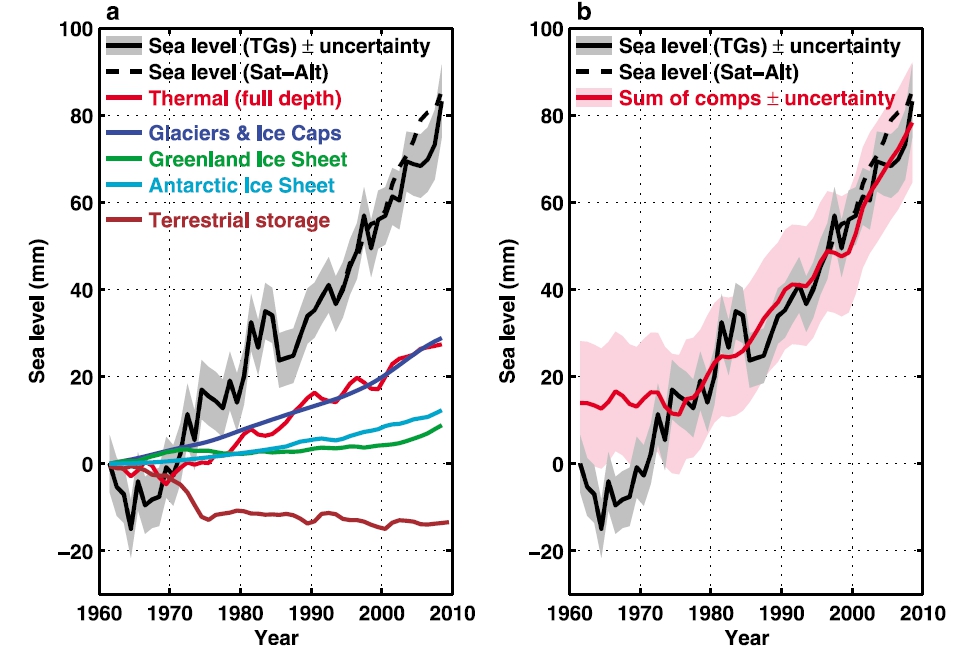
    Last year Church et al. (2011) provided a new sea-level budget analysis (see Fig. 1). For the period 1972-2008 the budget is closed, with a total rise of about 7 cm. A bit over half of that is due to melting land ice, and a bit less than half due to thermal expansion. Land water storage makes a small negative contribution, because the water stored in artificial reservoirs (which lowers sea level) is estimated to be larger than the amount of fossil groundwater pumped up for irrigation (which mostly ends up in the sea). Also for the shorter recent period 1993-2008 (for which we have satellite measurements of global sea level rise, found to be about 3 mm per year) John Church and colleagues successfully closed the sea level budget. Granted, the uncertainties in the estimates are still significant so the issue cannot be considered completely resolved. Nevertheless, the Church et al. paper defines the current state of the art against which all further studies need to measure up.


    Fig. 1. Sea level rise for 1961-2008. On the left the individual contributions are shown, on the right the sum of these contributions (red) is compared to the measured rise (black). Graph from Church et al. (2011)

    The groundwater shock

    On May 20, Nature Geoscience published a Japanese model simulation of global land water storage (Pokhrel et al. 2012), which surprised the expert community with the conclusion that 42% of sea level rise (about 3 out of 8 cm) over the period 1961-2003 is due to reduced land water storage. In contrast to earlier studies, reservoir storage was assumed to be smaller, but mainly groundwater pumping was calculated to be several times larger.

    Are the new numbers realistic? I and many colleagues I spoke to have serious doubts. It is a model result which is in stark contradiction to data-based estimates. The simulation is based on a simple assumption: first the total water demand was estimated, second the availability of near-surface water, and then the shortfall was assumed to be completely supplied by unlimited use of fossil water. The realism of this assumption is debatable – to me it seems to run a risk of greatly overestimating the withdrawal of fossil water.

    The uncertainties also need to be discussed: the fossil water withdrawal is estimated by subtracting two large, uncertain numbers. Yet there is no proper uncertainty analysis. Instead, a single number with three significant digits is presented (359 km3 per year for 1950-2000). That is almost five times the rate of 82 ± 22 km3 per year computed by Konikow (2011) for 1961-2008, based on data for groundwater usage and actual observations of water-level declines in aquifers being depleted. Leonard Konikow, a hydrologist with the US Geological Survey, says about the huge amount of groundwater depletion simulated by Pokhrel: “Groundwater hydrologists would have noticed if such a large volume of water were ‘missing’”.

    A bit dubious is also the fact that for the largely overlapping period 1950-2000 Pokhrel et al. find that less than 20% of sea level rise is due to land water storage, not 42% as for 1961-2003. Yadu Pokhrel responded to my query that this is due to a large short-term increase in the landwater contribution to sea level between 2000 and 2003, combined with the fact that their rates are computed simply from the difference between the end points (2003 minus 1961). 2003 happened to be a drought year with little water stored on land. Church et al. compute their budgets based on linear trends, which is more robust by using all data points and not just the end points.

    Pokhrel et al. don’t even mention the Church et al. paper (although that was published before their paper was submitted). They relate their discussion to the old IPCC finding of “missing sea level rise”, claiming to now have found the source of this missing water. The media largely followed this story line.

    Impact on future projections

    If the Pokhrel numbers were right, what would this mean for the future? There are two methods to estimate future sea level rise: complex process-based models, which try to compute all individual contributions (e.g. glacier melt) under changing climate conditions, and semi-empirical models, which exploit the observed relationship between global temperature and sea level and are calibrated with past data (see my article Modeling sea level rise at Nature Education). Both have their problems and limitations, and currently I don’t think anyone can seriously claim to know which will turn out to be closer to the truth.


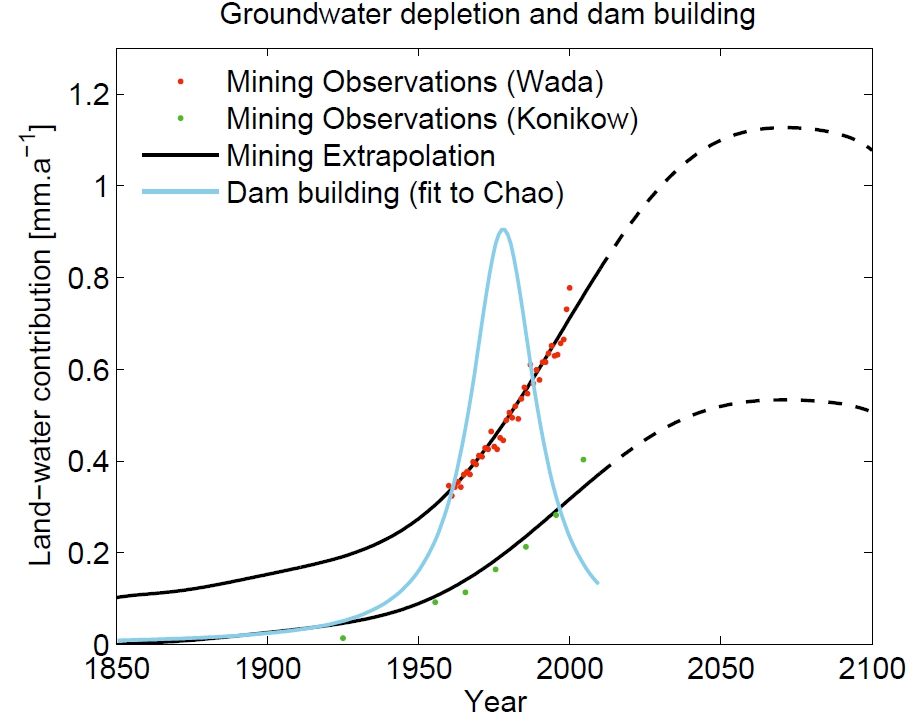
    Fig. 2. Change in sea level in mm per year due to the contribution of groundwater pumping (black curves – estimated based on data by Konikow 2011 and Wada et al. 2010) and water storage in artificial reservoirs (blue – this contribution is negative, i.e. lowers sea level). From Rahmstorf et al. (2011).

    For the process-based models, the high fossil water pumping rates according to Pokhrel would simply have to be added to the projections (artificial reservoirs are generally thought to not offset much of this in future, because reservoir construction is well past its peak and there is not much scope for a large expansion). Last year we published simple projections of the groundwater pumping contribution (Rahmstorf et al. 2011, see Fig. 2), based on the data by Konikow (2011) and an earlier study by Wada et al. (2010) together with the medium UN global population projection. In the upper of the two curves, groundwater pumping raises sea level by 10 cm by 2100. If, based on Pokhrel, we assume groundwater pumping rates that are roughly twice as high, this could add 20 cm to sea level. Very recently, a new study by Wada et al. (2012) gave a more detailed projection up to 2050 which lies in between our two curves. By 2050 they find 2-4 cm sea level rise due to groundwater pumping. If the rate did not increase any further after 2050, this would add up to 5-8 cm by 2100. Whether 5, 10 or 20 cm – it is clear that groundwater pumping is a factor that must be accounted for in future sea level projections.

    The impact of groundwater pumping on semi-empirical projections is smaller, because here we have two partly compensating effects. On one hand there is the added water as just discussed, on the other hand the climate-related part of the projection gets smaller, since the climatic effect on past sea level rise is also smaller, which affects the calibration of the model. In our paper we found that accounting for groundwater depletion according to Wada (i.e. upper curve of Fig. 2) lowers the projections for a moderate global warming scenario (RCP4.5) by 6 cm. If we assume again that Pokhrel’s numbers are roughly twice as high as this, also for the future, then our best estimate for this scenario would come down to 91 cm sea level rise, as compared to 98 cm in our ‘default case’ (for which we used the lower curve of Fig. 2, based on the Konikow data).

    Overall, accounting for the Pokhrel landwater estimates would thus tend to increase the process-based sea level projections and lower the semi-empirical projections, thereby reducing the discrepancy between the two – in my view a very welcome feature. But do I believe it?

    Weblink

    PIK sea level pages (publications, data, graphs, animations and more)

    References

    Church, J.A. et al (2011) Revisiting the Earth’s sea-level and energy budgets from 1961 to 2008, Geophys Res Lett 38, L18601, doi:10.1029/2011GL048794

    Konikow LF (2011) Contribution of global groundwater depletion since 1900 to sea-level rise. Geophys Res Lett 38:5. doi:10.1029/2011gl048604

    Pokhrel, Y.A. et al (2012) Model estimates of sea-level change due to anthropogenic impacts on terrestrial water storage. Nature Geoscience, doi:10.1038/NGEO1476

    Rahmstorf, S, Perrette, M & Vermeer, M (2011) Testing the robustness of semi-empirical sea level projections. Clim. Dynam. 97, 1-15, http://dx.doi.org/10.1007/s00382-011-1226-7

    Wada Y, van Beek LPH, van Kempen CM, Reckman J, Vasak S, Bierkens MFP (2010) Global depletion of groundwater resources. Geophys Res Lett 37:L20402. doi:10.1029/2010gl044571

    Wada, Y et al (2012) Past and future contribution of global groundwater depletion to sea-level rise. Geophys Res Lett 39, L09402, doi:10.1029/2012GL051230

  • Tropical cyclones to cause greater damage, researchers predict

    Tropical cyclones to cause greater damage, researchers predict

    Posted: 01 Feb 2012 07:52 AM PST

    Tropical cyclones will cause $109 billion in damages by 2100, according to researchers in a new paper. That figure represents an increased vulnerability from population and especially economic growth, as well as the effects of climate change. Greater vulnerability to cyclones is expected to increase global tropical damage to $56 billion by 2100 — double the current damage — from the current rate of $26 billion per year if the present climate remains stable.

  • Green News Round-up (The Guardian)

    Green Light: Arctic sea ice, Lonesome George and Rio+20

    Inbox
    x

    The Guardian info@mail.guardian.co.uk
    7:53 PM (5 minutes ago)

    to me
    Images are not displayed. Display images below – Always display images from info@mail.guardian.co.uk

    Having trouble viewing this email?
    The Guardian home
    • Green Light email banner

    Green news roundup: Arctic sea ice, Lonesome George and Rio+20

    The week’s top environment news stories and green events

    If you’re not already receiving this roundup, sign up here to get the briefing delivered to your inbox

    Actic sea ice

    Climate scientists believe the Arctic sea ice is on course to plummet to its lowest levels ever this year. Photgraph: Steven J Kazlowski/Alamy

    Environment news

    Arctic sea-ice levels at record low for June
    Gabon burns ivory stockpiles
    US court upholds EPA’s greenhouse gas rules
    Plans for carbon-capture power station abandoned
    • Sir David King: quantitative easing should be aimed at green economy
    Badger cull ‘not legal or scientific’, high court will hear

    On the blogs

    Gina Rinehart, chairwoman of Hancock Prospecting

    Is Gina Rinehart planning to use Fairfax to push her climate scepticism?
    Fuel duty U-turn highlights need for full service of motoring policy
    Farewell to Lonesome George, who never came out of his shell
    Why there’s only one honest objection to wind farms

    Multimedia

    Lonesome George

    Last giant tortoise Lonesome George dies aged 100 – video
    Sumatran rhino born in captivity – video
    Lonesome George, the last giant tortoise of his kind, dies – in pictures
    The week in wildlife – in pictures

    Rio+20

    Copacabana beach as the United Nations Conference on Sustainable Development, or Rio+20

    Rio +20 makes no fresh, green breast of the new world
    Rio+20 Earth Summit: campaigners decry final document
    Rio+20 summit: the final day as it happened

    Best of the web

    James Murray: Environmentalism is not a religion
    Vestas scraps Kent offshore wind factory plan
    Government denies rift over wind power subsidies
    For more of the best environment comment and news from around the web, visit the Guardian Environment Network.

    … And finally

    Leaving appliances on standby ‘can cost UK households up to £86 a year’
    Fully turning off everyday appliances could be a quick and cheap way for people to save on their energy bills, study finds

    • SKY_Int_Dev_Achievement_Awards_221112
    • Button_Charity_Awards_2012
    • Email Services


    You are receiving this email because you are a Green Light subscriber.

    Click here if you do not wish to receive Green Light emails from the Guardian News and Media.
    Click here to find out about other Email Services from the Guardian.

    Guardian News & Media Limited – a member of Guardian Media Group PLC. Registered Office: Kings Place, 90 York Way, London, N1 9GU. Registered in England No. 908396

  • Geophysicists employ novel method to identify sources of global sea level rise

    Warm ocean currents cause majority of ice loss from Antarctica

    Posted: 25 Apr 2012 11:03 AM PDT

    Warm ocean currents are the dominant cause of recent ice loss from Antarctica, new research shows. New techniques have been used to differentiate, for the first time, between the two known causes of melting ice shelves – warm ocean currents attacking the underside, and warm air melting from above. This finding brings scientists a step closer to providing reliable projections of future sea-level rise.

    Study finds surprising Arctic methane emission source

    Posted: 24 Apr 2012 11:51 AM PDT

    The fragile and rapidly changing Arctic region is home to large reservoirs of methane, a potent greenhouse gas. As Earth’s climate warms, the methane, frozen in reservoirs stored in Arctic tundra soils or marine sediments, is vulnerable to being released into the atmosphere, where it can add to global warming. Now a multi-institutional study has uncovered a surprising and potentially important new source of Arctic methane: the ocean itself.

    Geophysicists employ novel method to identify sources of global sea level rise

    Posted: 24 Apr 2012 11:22 AM PDT

    As the Earth’s climate warms, a melting ice sheet produces a distinct pattern of sea level change known as its sea level fingerprint. Now, geophysicists have found a way to identify the sea level fingerprint left by a particular ice sheet, and possibly enable a more precise estimate of its impact on global sea levels.