David Spratt
The failure of international climate negotiations means that if all countries acted on ALL their commitments, the world would still warm by more than 3 degrees, according to Climate Tracker.
So what would a world 3 degrees warmer llok and feel like? Scientists draw on a number of disciplines and methods to answer the question, including paleo-climatology (study of past climate history), complex mathematical models of the world’s climate system tested and refined against past climate data, observation of current events and specific research testing hypotheses. Mark Lynas surveyed much of this research for his book “Six degrees: our place on a hotter planet” (Harper Collins, 2007). Drawing from his work and other sources, the following is an overview of some of the scientific projections as the world warms. These are not all certain events, but they are what scientific research thinks is likely. A full set of references on pp. 301-327 of “Six Degrees”.
Three degrees of warming
Three degrees may be the “tipping point” where global warming could run out of control, leaving us powerless to intervene as planetary temperatures soar. America’s most eminent climate scientist, James Hansen says warming has brought us to the “precipice of a great “tipping point”. If we go over the edge, it will be a transition to “a different planet”, an environment far outside the range that has been experienced by humanity. There will be no return within the lifetime of any generation that can be imagined, and the trip will exterminate a large fraction of species on the planet” [“Wild” magazine, April 2007].
In the Pliocene, three million years, temperatures were 3 degrees higher than our pre-industrial levels, so it gives us an insight into the three-degree world. The northern hemisphere was free of glaciers and icesheets, beech trees grew in the Transantarctic mountains, sea levels were 25 metres higher [Climate Dynamics, 26, 249-365], and atmospherc carbon dioxide levels were 360-400 ppm, very similar to today. There are also strong indications that during the Pliocene, permanent El Nino conditions prevailed. Hansen says that rapid warming today is already heating up the western Pacific Ocean, a basis for a coming period of ‘super El Ninos’ [Proc. Nat. Acad. Sci., 103, 39, 14288-93].
Between two and three degrees the Amazon rainforest, whose plants produce 10 per cent of the world’s photosynthesis and have no evolved resistance to fire, may turn to savannah, as drought and mega-fires first destroy the rainforest, turning trees back into carbon dioxide as they burn or rot and decompose [Theor. App. Climatology, 78, 137-56]. The carbon released by the forests destruction will be joined by still more from the world’s soils (see below), together boosting global temperatures by a further 1.5ºC [Nature, 408, 184-7]. It is suggested than in human terms the effect on the planet will be like cutting off oxygen during an asthma attack. A March 2007 conference at Oxford talked about ‘corridors of probability’ with models predicting the risk of the Amazon passing a “tipping point” at between 10 to 40 per cent over the next few decades. The UK’s Hadley Centre climate change model, best known for warning of catastrophic losses of Amazon forest, predicts that, under current levels of greenhouse gas emissions, the chances of such a drought would rise from 5% now (one every 20 years) to 50% by 2030, and to 90% by 2100.
The collapse of the Amazon is part of the reversal of the carbon cycle projected to happen around 3 degrees, a view confirmed by a range of researchers using carbon coupled climate models. Vast amounts of dead vegetation stored in the soil – more than double the entire carbon content of the atmosphere – will be broken down by bacteria as soil warms. The generally accepted estimate is that the soil carbon reservoir contains some 1600 gigatonnes, more than double the entire carbon content of the atmosphere. The conversion will begin of the terestrial carbon sink to a carbon source due to temperature-enhanced soil and plant respiration overcoming CO2-enhanced photosynthesis, resulting in widespread desertification and enhanced feedback [Physics Today, www.aip.org/pt/vol-55/iss-8/p30.html].
And it’s already happening. A recent study found that the calculated increase in carbon lost by UK soil each year since 1978 is more than the entire reduction in emissions the UK has achieved between 1990 and 2002 as part of its commitment to Kyoto. As well, some recent studies suggest that the earth’s carbon sinks are smaller than expected and climate by century’s end could be on average up to 1.5 degrees hotter than current “business as usual” projections suggest [http://www.csmonitor.com/2007/0503/p01s02-wogi.html]. New research published in “Science” in May 2007 suggests that the earth’s ability to soak up the gases causing global warming is beginning to fail because of rising temperatures, in a long-feared sign of “positive feedback” (Michael McCarthy, The Independent, 18 May 2007).
Three degrees would likely see increasing areas of the planet being rendered essentially uninhabitable by drought and heat. Rainfall in Mexico and central America is projected to fall 50 per central. Southern Africa would be exposed to perennial drought, a huge expanse centred on Botswana could see a remobilisation of old sand dunes [Nature, 435, 1218-21], much as is projected to happen earlier in the US west. The Rockies would be snowless and the Colorado river will fail half the time. Drought intensity in Australia could triple, according to the CSIRO, which also predicts days in NSW above 35 degrees will increase 2 to 7 times.
With extreme weather continuing to bite – hurricanes may increase in power by half a category above today’s top-level Category Five – world food supplies will be critically endangered. This could mean hundreds of millions – or even billions – of refugees moving out from areas of famine and drought in the sub-tropics towards the mid-latitudes. As the Himalayan ice sheet relentlessly melts with rising temperatures, the long-term water flows into Asia’s great rivers and breadbasket valleys — the Indus, Ganges and Brahmaputra, the Mekong, Yangtse and Yellow rivers — will fall dramatically. If global temperatures rise by three degrees, and that’s becoming the un-official target for western governments, water flow in the Indus is predicted to drop by 90 per cent by 2100. The lives of two billion people are at stake.
As the Arctic continue to warm, melting permafrost in the boreal forests and further north in the Arctic tundra is now starting to melt, triggering the release of methane, a greenhouse gas twenty times more powerful than CO2, from thick layers of thawing peat. The West Siberian bog is estimated to contain 70 billion tonnes of CO2. Prof. Sergei Kirpotin, a botanist at Russia’s Tomsk State University, says: “There’s a critical barrier… Once global warming pushes the melting process past that line, it begins to perpetuate itself.” The West Antarctic ice sheet would likely to irreversibly melting
Two degrees of warming
With two degrees of warming, the summer monsoons in northern China will likely fail, and agricultural production will fall in India’s north as forest die back and national production falls. Flooding in Bangladesh will worsen as its monsoons strengthen [Climate Dynamics, 22, 183-204] and sea levels rise. But in the Andes, glacial loss will reach 40-60% by 2050 [Journal of Hydrology, 282, 1, 130-44], reducing summer run-off and subsequent water shortages will be devastating for nations such as Peru. At two degrees, snowpack decline in California will be one-third to three-quarters [Proc. Nat. Academy Sciences, 101, 34, 12422-7] and in the Northern Rockies from 20-70% [Climatic Change, 62, 75-113] , devastating agriculture as the water run-off declines. Changing climate will have a severe impact on world food supplies. While the Great Plains turn to dust, winter wheat will be able to to grow in central-north USA, but soybean and sorghum production in the south-east USA will halve. In central and south America maize losses are projected for all nations but two [Global Env. Change, 13, 51-9]. In 29 African countries, including Mali, Botswana and Congo, crop failure and hunger are likely to increase.
With two degrees of warming, seas will be on their way to rising 5 to 7 metres; the irreversible melting of the Greenland ice sheet will be underway [Climatic Change, 64, 61-75]. Greenland’s critical melt threshold is regional temperature rise of 2.7 degrees [Nature, 428, 616], but with its temperatures at least 2.2 times the global average [Geophysical Research Letters, 32, L14705], that point will have been triggered at just over a one degree global rise. Rising Arctic temperatures flowing from floating ice loss are already at the threshold beyond which glaciologists think the Greenland ice sheet may be doomed; this accelerated melting is caused by meltwater penetrating crevasses and lubricating the glaciers’ flow. The ice is in effect sliding into the ocean on rivers of water, an effect not included in models of the effect of global warming on the Arctic (New Scientist 25 February 2006]. Greenland’s ice loss rate increased 250% between 2002-04 and 2004-06 [Nature, 443, 330-1], suggesting it may already be too late with a global warming of 0.8 degrees to 2006. The polar bear would be all but extinct; walruses not far behind. The tundra would be almost gone, replaced by forests as the permaforst boundary retreats hundreds of kilometres north. With a five-metre sea level rise, Miami would disappear, as would most of Manhattan. Central London would be flooded, and Bangkok, Bombay and Shanghai would lose most of their area.
With two degrees of warming, Europe likely will be hit every second year by heatwaves like the one in 2003 which killed 22-35,000 people, caused $12b of crop losses, reduced glacier mass by 10%, and resulted in a 30% drop in plant growth dropped, adding half a billion tonnes of carbon to the atmosphere [Geophysical Research Letters, 32, L22709]. April 2007 was UK’s warmest April since records began in 1659 [The Guardian, 2 May 2007]. Concurrently Italy’s government was facing power cuts following the mildest winter since records began, with rivers and lakes in the worst-affected north of the country have never been drier. It is being taken as the latest sign that Italy could find itself on the frontline of the global warming war [BBC News, 26 April 2007]. The Mediteranean will be subject to drought as rainfall drops 20%, and wildfires.
As more carbon dioxide dissolves in seawater to form carbonic acid, the acidity of the ocean increases. With two degrees of warming, increasing uptake of CO2 by large areas of the southern oceans and parts of the Pacific will have increased their acidity by 2050 such that the seas become toxic to organisms with calcium carbonate shells, for the simple reason that the acidic seawater will dissolve them. Many species of plankton – the basis of the marine food chain and essential for the sustenance of higher creatures, from mackerel to baleen whales – will be wiped out. Pteropods, as important as krill in some areas of the oceans, will lose their soft shells and die en masse, as will urchins and coral [Nature, 437, 681-6]. CO2 emissions, if unabated, could cause a mass extinction of marine life (NASA 20 February 2006) similar to one that occurred 65 million years ago when the dinosaurs disappeared: CO2 levels are going up extremely rapidly, overwhelming our marine systems (Washington Post, July 5, 2006)
One degree of warming
With one degree of warming, the Amazon will likely be affected by regular drought: in 2005 such an event meant some tributaries ran dry [Reuters, 11 Oct 2005] and in 1989 forest fires in a drying Amazon poured 0.4 billion tonnes of carbon into the air, more than five per cent of global greenhouse gas emissions for the year. The Amazon is near critical threshold [Phil Trans Royal Soc London B, 359, 539-47].
With one degree of warming, California and the Great Plains states of Nebraska, Montana, Wyoming, Arizona, northern Texas and Oklamhoma will be subject to mega-droughts and desertification, a new and permanent “dust bowl”. During the 1000-1300 AD “Medieval Warm Period” devastating epic droughts [Nature, 384, 552-4] hit the Great Plains, whole native American populations collapsed; in the Holocene maximum 6000 years ago, when temperatures were similar to today, heatwaves seared the western half on continent with 40 per cent less rain than today, sustained over decades [Climatic Change, 63, 49-90].
With one degree of warming, the north Queensland rainforest, very sensitive to temperature rises, will be an “environmental catastrophe” waiting to happen [Proc Royal Soc London B, 270, 1887-92]. Just one degree is likely to reduce Queensland highland rainforest by half [Austral Ecology, 26, 590-603]. The Barrier Reef is already subject to regular bleaching; in 2002, 60-95 per cent of reefs surveyed were bleached, and the reef is now doomed [Age, 30 January 2007]. Bleaching will become more severe and coral reefs will be close to extinction at 2 degrees [Jones & Preston, Climate change impacts, risk and the benefits of mitigation, CSIRO 2006].
With one degree of warming, world cyclones will likely be more severe; small islands states will be abandoned as seas rise (it’s already happening). Ice sheets around the world be suffering severe losses: landslides in the European Alps are already serious as permafrost melts and retreats upwards; the Kilamanjoro ice sheet which has been intact for at least 11,000 years is on the way to disappearing. 80 per cent has been lost in the last 100 years [Science, 298. 589-93] and the rest will be gone by 2015-2020, bringing forest loss to the surrounding area.
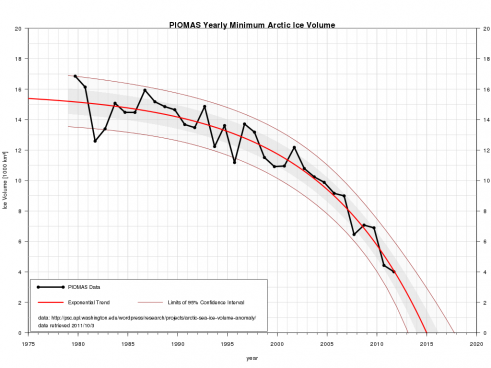
With less than one degree of warming, Arctic ground frozen by permafrost for 3000 years is melting [Geophysical Research Letters, 33, L02503], and the floating ice that covers the north pole is disappearing fast, likely to be gone within three decades; it has passed a crucial tipping point of irreversible climate change [Science, 310, 627-8]. Winter sea ice in the Arctic has failed to reform fully for the third year in a row, and the Arctic’s ice cover is retreating more rapidly than estimated by any of the 18 computer models used by the 2007 IPCC assessments; the shrinking of summertime ice is about 30 years ahead of the climate model projections [Geophysical Research Letters online edition 1 May 2007]. The Arctic may be free of all summer ice as early as 2030, a positive feedback loop with dramatic implications for the entire Arctic region [BBC News, 12 Dec 2006]. With no ice, the Arctic region will rapidly begin heating, by as much as 12 degrees, putting further pressure on the Greenland icecap [Age, 28 October 2006]. Greenland’s irreversible melting will result in a sea rise of five to seven metres, in as little as a hundred years [Environ. Res. Lett., 2, 024002,]. 125,000 years ago during the Eemian period, seas were 5-6 metres higher than today, at temperatures 1-2 higher than pre-industrial levels [Science, 311, 1747-50].
British researchers calculated that an increase of just one degree of warming would eliminate fresh water from a third of the world’s land surface by 2100. The 2006 Conference of the International Association of Hydrogeologists concluded that rising sea levels will also lead to the inundation by salt water of the aquifers used by cities such as Shanghai, Manila, Jakarta, Bangkok, Kolkata, Mumbai, Karachi, Lagos, Buenos Aires and Lima. Within the next few decades rising sea levels will pollute underground water reserves with salt. Long before the rising tides flood coastal cities, salt water will invade the porous rocks that hold fresh water. The problem will be compounded by sinking water tables due to low rainfall and rising water usage by the world’s growing and increasingly urbanised population [New Scientist 16 April 2006].
Four + degrees of warming
Four degrees
• Hundreds of billions of tonnes of carbon locked up in Arctic permafrost – particularly in Siberia – enter the melt zone, releasing globally warming methane and carbon dioxide in immense quantities.
• The West Antarctic ice sheet may lift loose from its bedrock and collapse as warming ocean waters nibble away at its base, much of which is anchored below current sea levels.
• In Europe, new deserts will be spreading in Italy, Spain, Greece and Turkey: the Sahara will have effectively leapt the Straits of Gibraltar. In Switzerland, summer temperatures may hit 48C, more reminiscent of Baghdad than Basel. The Alps will be so denuded of snow and ice that they resemble the rocky moonscapes of today’s High Atlas – glaciers will only persist on the highest peaks such as Mont Blanc. The sort of climate experienced today in Marrakech will be experienced in southern England, with summer temperatures in the home counties reaching a searing 45C. Europe’s population may be forced into a “great trek” north.
Five degrees
• Five degrees of warming occured during the Eocene, 55 million years ago: breadfruit trees grew on the coast of Greenland, while the Arctic Ocean saw water temperatures of 20C within 200km of the North Pole itself. There was no ice at either pole; forests were probably growing in central Antarctica.
• The Eocene greenhouse event was likely caused by methane hydrates (an ice-like combination of methane and water) bursting into the atmosphere from the seabed in an immense “ocean burp”, sparking a surge in global temperatures. Today vast amounts of these same methane hydrates still sit on subsea continental shelves.
• The early Eocene greenhouse took at least 10,000 years to come about. Today we could accomplish the same feat in less than a century.
Six degrees
• At the end of the Permian period, 251 million years ago, up to 95% of species were extinct as a result of a super-greenhouse event, resulting in a temperatures rise by six degrees, perhaps because of an even bigger methane belch than happened 200 million years later in the Eocene.
• One scientific paper investigating “kill mechanisms” during the end-Permian suggests that methane hydrate explosions “could destroy terrestrial life almost entirely”. Acting much like today’s fuel-air explosives (or “vacuum bombs”), major oceanic methane eruptions could release energy equivalent to 10,000 times the world’s stockpile of nuclear weapons._