Category: General news

Managing director of Ebono Institute and major sponsor of The Generator, Geoff Ebbs, is running against Kevin Rudd in the seat of Griffith at the next Federal election. By the expression on their faces in this candid shot it looks like a pretty dull campaign. Read on

  • Underwater volcanoes cause quakes

    News 6 new results for volcanoes
    Underwater volcanoes cause quakes
    SunLive
    The Kermadec Arc region is a 2500km-long chain of underwater volcanoes that stretches from White Island to Tonga. John says many of these volcanoes are active. “So it’s not surprising to see shallow earthquake activity there.
    See all stories on this topic »
    Sir Richard Branson Plans to Journey to the Center of the Earth
    Flavorwire
    In a charming faux press release, Sir Richard Branson has announced his plans for Virgin Volcanic, a massive ride-along drill that he intends to use to explore the world’s volcanoes — bringing Tom Hanks, Seth Green, Barbara Kopple and will.i.am along
    See all stories on this topic »
    Tom Hanks & Seth Green Going on Richard Branson’s ‘Virgin Volcanic’ Expedition?
    GossipCop
    Tom Hanks, Seth Green and will.i.am going to the inner depths of volcanoes? In a press release, Richard Branson announced that the three celebs would join him on a journey into the Earth’s core via his new Virgin Volcanic explorer.
    See all stories on this topic »
    Bald Peak eruption imminent, scientists say
    Newberg Graphic
    City and state officials ordered evacuation of the Newberg area Sunday morning after scientists predicted that Bald Peak, a mountain only recently discovered to be a volcano, will erupt within days, covering the Chehalem Valley in lava and ash.
    See all stories on this topic »
    Disasters and Dinosaurs
    BBC News
    Make model volcanoes and experiment with the patterns left by asteroids hitting the earth. A Shropshire council-run visitor centre, The Shropshire Hills Discovery Centre was opened in 2001 with the aim of Show more… acting as a ‘hub of wheel’,
    See all stories on this topic »

    BBC News
    Are you kidding? April Fools’ Day on the Internet
    msnbc.com
    Branson will “go on the first expedition along with Tom Hanks, Academy Award-winning actor and star of ‘Joe Versus the Volcano.’ ” The billionaire’s fascination with volcanoes started when he was a lad, having read Jules Verne’s “Journey to the Center
    See all stories on this topic »


    This once a day Google Alert is brought to you by Google.

    Delete this alert.
    Create another alert.
    Manage your alerts.

  • Japanese experts warn of earthquakes that could produce 34-metre tsunamis

    Japanese experts warn of earthquakes that could produce 34-metre tsunamis

    Report following disaster last March finds waves pose bigger threat than previously thought and could inundate Pacific coast

    • guardian.co.uk, Sunday 1 April 2012 21.03 BST
    • Article history
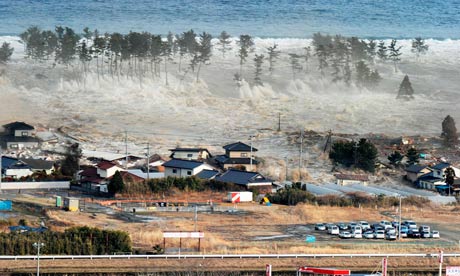
    • tsunami wave hits Japan

      A tsunami hits residences in Natori, Miyagi prefecture, last March after the largest earthquake in Japan’s recorded history hit the country’s east coast. Photograph: AP

      Much of Japan‘s Pacific coast would be inundated by a tsunami more than 34 metres (112 feet) high if an offshore earthquake as powerful as last year’s occurred, according to a government panel of experts. They report that a wave of such height could result from any tsunami unleashed by a magnitude-9.0 earthquake in the Nankai trough, which runs east of Japan’s main island of Honshu to the southern island of Kyushu.

      An earlier forecast in 2003 put the potential maximum height of such a tsunami at less than 20 metres (66 feet).

      The revised tsunami projections, contained in a report posted on a government website, are based on research following last March’s magnitude-9.0 earthquake and tsunami, which spawned a 14-metre (45-foot) wave that devastated most of Japan’s northeastern coast, triggered meltdowns at a nuclear power plant and killed around 19,000 people.

      The catastrophe and the ensuing crisis at the Fukushima Daiichi nuclear power plant, prompted sweeping reviews of Japan’s disaster preparedness and criticism over apparent failures to take into account potential risks.

      The tsunami knocked out power at the 40-year-old coastal nuclear plant, leading to the worst nuclear disaster since Chernobyl in 1986. Tens of thousands of residents have had to leave the area, and it is unclear whether some will ever be able to move back.

      The Fukushima plant was designed to withstand a 6-metre (20-foot) tsunami, less than half the height of the surge that hit it on 11 March, 2011.

      The latest forecast shows a tsunami of up to 21 metres (69 feet) could strike near the Hamaoka nuclear plant on the south-eastern coast. Its operator, Chubu Electric Power Co, is building an 18-metre (59-foot) high sea wall to counter tsunamis. The wall is due to be completed next year.

      The plant was shut down in 2011 due to estimates it has a 90% chance of being hit by a magnitude 8.0 or higher quake within 30 years.

  • Dr. Andrew Glikson’s response to “Csiro Alarmism more dangerous than CO2”

    A RESPONSE TO OLLIER’S ARTICLE CSIRO ALARMISM MORE DANGEROUS THAN CO2” (THE AUSTRALIAN 27.3.2012)

    I refer to the article by Ollier (27.3.2-12) titled “CSIRO alarmism more dangerous than CO2” (http://www.theaustralian.com.au/national-affairs/opinion/csiro-alarmism-more-dangerous-than-co2/comments-e6frgd0x-1226312898312), where the writer states: “The CSIRO projection is extreme, but before explaining why, I would note that the world’s main source of alarmism is the Intergovernmental Panel on Climate Change. This is not really a scientific body but one that adjusts data and subjects it to mathematical modeling before passing its “projections” on to politicians.”

    The IPCC reports represent summaries of thousands of peer review papers in scientific journals, as well as reports by reputable science bodies, including the CSIRO. Here I examine the basis for some of Ollier’s claims:

    1. Ollier is critical of CSIRO’s 2012 report “State of the Climate 2012” which states ”Since 1993, the rates of sea level rise to the north and northwest of Australia have been 7 to 11 mm per year, two to three times the global average, and rates of sea-level rise on the central east and southern coasts of the continent are mostly similar to the global average (www.csiro.au/…/~/…/8E59FBA4F8A94FE4B84F01E271226316.pdf). However, due to the west Pacific current and high water temperatures sea level in the Western Pacific and around northern Australia can exceed global average sea levels.

    1. Ollier states “the CSIRO says that since 1993 sea levels have risen up to 10mm a year in the north and west. That means that somewhere has had a 19cm-rise in sea level since 1993. Where is this place. The European satellite says that sea levels have been constant for the past eight years.”

    However, sea levels over the past eight years have not been constant:

    1. The 1970-2010 mean tide gauge-measured sea level rise rate of ~2.2 mm/year has risen during 1994-2010 to 3.4 mm/year, as measured by Topex-Poseidon + Jason-1 + OSTM Jason-2 satellites. (http://www.cmar.csiro.au/sealevel/sl_proj_21st.html). Similar acceleration of sea level rise rates is reported from other parts of the globe. For example, “The average rate of coastal climate-related sea level rise in the Mediterranean Sea was consequently revisited to be of 1.7 mm yr−1 over the past century, whereas the Atlantic northern Iberian coast revealed a significant high rate of sea level rise in excess of 3.4 mm yr−1 for the past 70 years” (JGR, 117, C01007, 14 PP., 2012) (http://www.agu.org/pubs/crossref/2012/2011JC007469.shtml).

    1. Inherent in Ollier’s future sea level projection is a constant or near-constant linear rate, where he states: “This (1.7 mm/year) is a reasonable level accepted by most sea-level watchers outside the IPCC and CSIRO and gives a sea-level rise of about 15cm by 2100“.  However, the assumption of constant sea level rise is negated by tide gauge and satellite data evidence for an acceleration of Greenland and Antarctic ice melt rates reported by Grace satellite gravity measurements  (http://www.agu.org/pubs/crossref/2011/2011GL046583.shtml). According to the landmark paper by Church et al. 2011 (Revisiting the Earth’s sea-level and energy budgets from 1961 to 2008) “The largest contributions come from ocean thermal expansion (0.8 mm yr−1) and the melting of glaciers and ice caps (0.7 mm yr−1), with Greenland and Antarctica contributing about 0.4 mm yr−1.

    Referring to the title of Ollier’s piece, since the connection between atmospheric CO2, global temperatures and sea levels is an established observation in paleo-climate science, the warnings arising from climate science of global sea level rise consequent on continuing carbon emissions can no longer be refuted.

    (Dr) Andrew Glikson

    1.4.2012

  • Sir Richard Branson unveils “Virgin Volcanic”

    April Fools item perhaps!!!!

    Richard Branson’s Virgin Volcanic: To The Center Of The Earth!
    Huffington Post
    The final frontier: On April 1, Richard Branson plans to officially unveil his latest exploration venture, Virgin Volcanic, which will charter trips inside volcanoes. Sir Richard Branson is at it again. The globetrotting billionaire has announced his
    See all stories on this topic »

    CNE Calls For Caution Visiting Volcanoes
    Inside Costa Rica
    The Comisión Nacional de Prevención de Riesgos y Atención de Emergencias (CNE) has a preventive green alert and restricted access for the perimeter of the Turrialba National Park due to gas emissions from the Turrialba volcano of the last couple of
    See all stories on this topic »

    Inside Costa Rica
    Virgin announces Virgin Volcanic journey to center of Earth
    SlashGear
    Introducing Virgin Volcanic, a corkscrew-shaped vessel that will make its trips via five of the most active volcanoes in the world. It is perhaps Branson’s most ambitious idea to date. April Fool’s! Yep, this is Virgin’s big hoax for tomorrow’s big
    See all stories on this topic »

    SlashGear
    Sir Richard Branson Unveils ‘Virgin Volcanic’
    Mashable
    Branson said, “I have a long held a fascination with volcanoes having read Jules Verne’s Journey to the Centre of the Earth as a young boy. I decided that one day I would go there too. Alongside our adventures with Virgin Galactic and Virgin Oceanic,
    See all stories on this topic »
    Nevado del Ruiz in Colombia May Erupt in “Days to Weeks”
    Wired News
    This means that the signs of activity at the volcano suggest that an eruption is likely in the days to weeks timescale. Marta Calvache from INGEOMINAS mentioed that over the past few days the volcano has experienced tremor related to “fluid motion”
    See all stories on this topic »
    Billionaire Branson plans trip to centre of earth?
    The Asian Age
    I.Am of the Black Eyed Peas in a special capsule down into a volcano and from there to the molten centre of the planet. “I have long held a fascination with volcanoes having read Jules Verne’s Journey to the Centre of the Earth as a young boy,” Branson
    See all stories on this topic »
    Major quake impact on Tokyo could be worse than thought: study
    Reuters
    Japan, situated on the “Ring of Fire” arc of volcanoes and oceanic trenches that partly encircles the Pacific Basin, accounts for about 20 percent of the world’s earthquakes of magnitude 6 or greater. A magnitude 7.3 quake hit central Japan in 1995,
    See all stories on this topic »


    Tip: Use site restrict in your query to search within a site (site:nytimes.com or site:.edu). Learn more.

    Delete this alert.
    Create another alert.
    Manage your alerts.

  • (Dr James Hansen) Case for young people and nature

    Dear President,
    Slovenian National Assembly

    At the suggestion of Slovenian colleagues, I wrote a letter to Dr. Gregor Virant, President, National Assembly of the Republic of Slovenia.  The letter and its attachment (“Case for Young People and Nature”) are available on my website.

    ~Jim

  • CSIRO alarmism more dangerous than Co2

    CSIRO alarmism more dangerous than Co2


    Lobbecke

    Illustration by Eric Lobbecke. Source: The Australian

    THE Weekend Australian reported on March 24 that Port Macquarie Hastings Council was recommending the enforcement of a “planned retreat” because of an alleged danger from sea-level rise in the (distant) future.

    The controversy has two main aspects: is the alarming rise in sea level projected by CSIRO reliable? And is moving people from near-shore sites the correct response?

    The CSIRO projection is extreme, but before explaining why, I would note that the world’s main source of alarmism is the Intergovernmental Panel on Climate Change. This is not really a scientific body but one that adjusts data and subjects it to mathematical modelling before passing its “projections” on to politicians.

    The CSIRO and Bureau of Meteorology, then further adjust data and produce models with even more extreme scenarios.

    In The Weekend Australian on November 7, 2009, the director of the National Tidal Centre of the BOM, Bill Mitchell, reported an Australian average sea-level rise of 1.7mm a year. This is a reasonable level accepted by most sea-level watchers outside the IPCC and CSIRO and gives a sea-level rise of about 15cm by 2100. He said the “upper end was 3mm a year”, which gives a 27cm rise by 2100.


    At 8.30am on November 18, 2009, ABC Radio National had a program on sea-level changes. National Sea Change Taskforce executive director Alan Stokes said: “The IPCC estimate of rise to 2100 was up to 80cm.” No new data was provided to explain the leap and, in fact, the worst estimate by IPCC in its last report was 59cm.

    Note that the IPCC estimates have been falling with each report. In its second assessment report the high-end projection of sea-level rise to 2100 was 92cm, in the third assessment report 88cm, and the fourth 59cm. It is good for the reader to look at sea-level measurements. You can see the sea-level data for the US and a few other countries at http://tidesandcurrents.noaa.gov/sltrends/sltrends.shtml. Most stations show a rise of sea level of about 2mm a year, but note the considerable variations even within a single state, though these are no cause for alarm.

    The CSIRO uses figures far in excess of even the IPCC, which until now were the greatest alarmists. In its 2012 report, State of the Climate, the CSIRO says that since 1993 sea levels have risen up to 10mm a year in the north and west. That means that somewhere has had a 19cm-rise in sea level since 1993. Where is this place? The European satellite says that sea levels have been constant for the past eight years.

    How does the CSIRO arrive at its figures? Not from new data but by modelling. Models depend on what is put into them. For example a 2009 report, The Effect of Climate Change on Extreme Sea Levels in Port Phillip Bay, by the CSIRO for the Victorian government’s Future Coasts Program, based its model on temperature projections to 2100 of up to 6.4C. That compares with the most extreme, fuel-intensive scenario of the IPCC and implies unbelievable CO2 concentration levels in 2100 of about 1550 parts per million.

    Using all known fossil fuel reserves would achieve only half this and continuing the current rate of increase in concentration levels would result in only 550ppm by 2100. The result is a CSIRO prediction of sea-level rise for Port Phillip Bay by 2100 of 82cm and, with the help of the BOM, a further increase due to wind to 98m. That is well above even the top level projected by the latest IPCC report. This example is from Victoria but sea levels must have roughly the same rises and falls all over the world. So the whole world should be alarmed. Indeed, the IPCC and CSIRO try to alarm the world with stories of the drowning of low islands, such as Tuvalu. But detailed mapping has shown that Tuvalu, and many other coral islands, have actually grown during the past 20 years.

    The Netherlands is particularly vulnerable to any large rise of sea levels. It is also a leader in coastal science and engineering, and the Dutch are not alarmed. In the December 11, 2008, issue of NRC/Handelsblad (Rotterdam’s counterpart to The Australian) Wilco Hazeleger, a senior scientist in the global climate research group at the Royal Netherlands Meteorological Institute, wrote: “In the past century the sea level has risen 20cm. There is no evidence for accelerated sea-level rise. It is my opinion that there is no need for drastic measures. Fortunately, the time rate of climate change is slow compared to the lifespan of the defence structures along our coast. There is enough time for adaptation.”

    This brings us to the second part of the debate. We should adapt to changes in the shoreline, as do the Dutch. We should reject draconian rules to save folk from a remote and dubious peril. If Tim Flannery is allowed to take his chance living on his Hawkesbury property near sea level, Port Macquarie’s retirees should be permitted to do so too. They should not be evicted to “save” them from a dire fate they will never see.

    Cliff Ollier is a geologist, geomorphologist, emeritus professor at the University of Western Australia.