Managing director of Ebono Institute and major sponsor of The Generator, Geoff Ebbs, is running against Kevin Rudd in the seat of Griffith at the next Federal election. By the expression on their faces in this candid shot it looks like a pretty dull campaign. Read on
There has always been controversy over the duties of sign-on staff at depots respecting the sobriety or fitness of staff. Sign- on clerks are not medically trained and this has often led to stoppages and other union actions.
Guards, train drivers fight urine tests
Josephine Tovey
March 30, 2012
Gladys Berejiklian … no apologies for being tough on drug testing. Photo: Dallas Kilponen
TRAIN drivers, prison guards and firefighters are calling on the state government not to force them to submit to urine tests for drugs in the light of the Fair Work Australia decision this week that the practice was unjust.
The Herald reported yesterday on a Fair Work Australia ruling that urine tests should not be conducted on employees of state-owned Endeavour Energy, as the tests could register a positive result for drug use from days earlier and were therefore ”unjust and unreasonable”.
The arbitrator said oral swab tests, which pick up drug use in the preceding hours, were a more appropriate test of impairment.
Advertisement: Story continues below
Last night Unions NSW passed a motion stating it would help ensure ”the precedent set by the Endeavour decision flows through to workers throughout the state of NSW.”
RailCorp workers – from frontline staff to senior management – are subject to random urine drug tests.
Bob Hayden, from the Rail, Tram and Bus Union, said: ”We don’t condone drug use … but the debate needs to be about impairment.”
The Prime Minister Julia Gillard and Senator Stephen Conroy , Minister for Broadband, Comunications and the Digital Economy during the NBN press conference in Sydney on March 29, 2012. Photo: Tamara Voninski
Gillard says decision on NBN contractors is for Australia alone to make.
Australia has not harmed its relationship with Beijing by banning Chinese technology giant Huawei from helping to build the high-speed national broadband network (NBN) due to concerns about cyber attacks traced to China, Prime Minister Julia Gillard said Thursday.
The government late last year told Huawei Technologies it was barred from bidding for work on the $36 billion network, The Australian Financial Review newspaper reported this week.
The newspaper said that decision was prompted by Australian intelligence officials who cited hacking attacks traced to China. The company is one of the world’s biggest producers of switching equipment that forms the heart of phone and data networks.
Advertisement: Story continues below
In her first press conference in Australia since she returned from a nuclear summit in South Korea, Gillard said she would not comment in detail on “what ultimately are national security matters.”
She said her government’s decision was correct and had not broken any international trade rules or agreements with China, Australia’s largest trading partner with whom a free trade agreement is under negotiation.
“It is a decision open to the Australian government,” Gillard told reporters. “We’ve taken it for the right reasons through the right process based on the right advice about a piece of critical infrastructure for our nation’s future.”
She acknowledged that Beijing disagreed with that decision.
“But it would be a great error indeed to move from a moment where we are seeing one thing differently and then extrapolate that to the full dimensions of the relationship – a very grave error indeed,” she said.
Chinese demand for iron ore and other minerals has driven an Australian economic boom but Canberra is uneasy about Beijing’s rising military spending and growing assertiveness in Asia. The United States and Australia announced plans in September to include cyber security in their 61-year-old defense alliance, the first time Washington has done that with a partner outside NATO.
Gillard said Australia had a “strong, robust” relationship with China that would continue to “strengthen and grow.”
“In China, people also make decisions about their nation’s future and who should be involved in the rollout of their own telecommunications,” Gillard said. “They want to make those decisions for themselves, completely understandably. So do we.”
Huawei, which unlike many big Chinese companies is not state owned, has rejected suggestions it might be a security risk and said it has won the trust of global telecommunications companies.
The ban highlights concern about Beijing’s cyber warfare efforts, a spate of hacking attempts aimed at Western companies and the role of Chinese equipment providers, which are expanding abroad.
Beijing’s relations with Western governments have been strained by complaints about hacking traced to China and aimed at oil, technology and other companies. A US congressional panel has said it will investigate whether allowing Huawei and other Chinese makers of telecoms gear to expand in the United States might aid Chinese spying.
Huawei expressed disappointment with Australia’s decision. It has operated in Australia since 2004 and said it already works with the country’s major telecoms companies.
Plans approved by Australian lawmakers in 2010 call for building a fiber-optic network to provide high-speed internet access to 90 per cent of the country.
Huawei said it is building similar networks in Britain, New Zealand, Singapore, Malaysia and other countries.
Gillard announced Thursday the rollout of the fibre-optic cable section of the network will see 3.5 million homes and businesses in 1500 towns and suburbs across Australia connected by mid-2015.
Huawei was founded in 1987 by a former Chinese military engineer but says it has no connection to the military. The company says it is employee-owned but has released few details about who controls it, which has fueled questions abroad.
Huawei, based in the southern Chinese city of Shenzhen, near Hong Kong, says its equipment is used in 140 countries.
The former owners of a northwest Queensland mine have received a record fine for contaminating local waterways.
The Mount Isa Magistrates Court on Thursday ordered the former owners of the Lady Annie Mine, 120km northwest of Mt Isa, pay $500,000 after an uncontrolled release of contaminated water during the 2009 wet season.
CopperCo Ltd was charged with causing serious environmental harm under the Environmental Protection Act.
The company pleaded guilty to the offence, which related to an uncontrolled release of contaminated water from stormwater ponds to surrounding creeks, the Department of Environment and Resource Management (DERM) said.
It was the most serious water contamination in Queensland’s history, according to the department.
“The contamination extended for 52 kilometres and was highly toxic, killing freshwater crabs and fish,” DERM Assistant Director-General Dean Ellwood said in a statement.
“DERM also received calls from downstream landholders expressing concern that poor water quality within Saga and Inca Creeks could harm livestock.”
The former owners were also ordered to pay $83,109.55 in investigation costs.
They have already been made to spend an estimated $11 million to clean up and rehabilitate the site, DERM said.
Deputy Premier Jeff Seeney said the record fine should send a strong message to the mining industry.
The Liberal National Party supported mining companies that maintained high standards, he said.
“We support those who do the right thing and will hold to account those who do not,” Mr Seeney said in a statement.
Two others mines in the region have been fined for serious breaches of the Environmental Protection Act during the 2008-2009 wet season.
MMG Century Limited was fined $130,000, and Ernst Henry Mine was fined $100,000.
Climate change is triggering extreme weather disasters, an IPCC report warns. Photograph: Jim Lo Scalzo/EPA
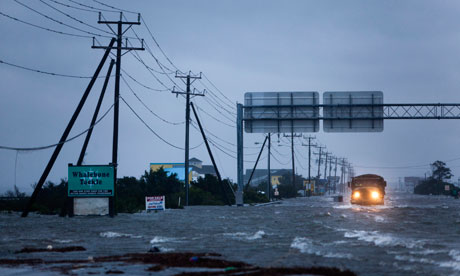
Global warming is leading to such severe storms, droughts and heatwaves that nations should prepare for an unprecedented onslaught of deadly and costly weather disasters, an international panel of scientists has said.
The greatest danger is in highly populated, poorer regions, but no corner of the globe is immune. The document, by the Intergovernmental Panel on Climate Change, forecasts stronger tropical cyclones and more frequent heatwaves, deluges and droughts, and blames man-made climate change, population shifts and poverty.
“We mostly experience weather and climate through the extreme,” said Stanford University climate scientist Chris Field, who is one of the report’s top editors. “That’s where we have the losses. That’s where we have the insurance payments. That’s where things have the potential to fall apart.
“There are lots of places that are already marginal,” said Field. But it’s not just poor areas: “There is disaster risk almost everywhere.”
The scientists say that some places, particularly parts of Mumbai in India, could become uninhabitable from floods, storms and rising seas. In 2005, over 24 hours nearly 3 feet of rain fell on the city, killing more than 1,000 people and causing widespread damage. Roughly 2.7 million people live in areas at risk of flooding.
Other cities at risk include Miami, Shanghai, Bangkok, Guangzhou, Ho Chi Minh City, Yangon and Kolkata.
The people of small island nations may also need to abandon their homes because of rising seas and fierce storms. “The decision about whether or not to move is achingly difficult and I think it’s one that the world will have to face with increasing frequency in the future,” Field said.
Evidence from fossilized raindrop impressions from 2.7 billion years ago indicates that an abundance of greenhouse gases most likely caused the warm temperatures on ancient Earth.
For the first time, instrumentation aboard two NASA missions operating from complementary vantage points watched as a powerful solar storm spewed a two million-mile-per-hour stream of charged particles and interacted with the invisible magnetic field surrounding Earth.
Register before 16 April to receive a free exclusive Greenpeace book!
Dear Neville,
Why has Borneo captured the imagination of nature lovers for centuries? You can see for yourself this October by exploring one of the oldest and most spectacular rainforests in the world.
Join Greenpeace’s Borneo Jungle Challenge in October to unite your passion for the planet with adventure. Immerse yourself in an ecological paradise and raise vital funds to protect its very existence.
• 13 days of adventure including trekking through a UNESCO World Heritage jungle • Watch the sun rise from the lofty heights of Mount Kinabalu • Discover stallactites as you swim through the underwater caves • Meet the big-nosed proboscis monkey, only found in Borneo • Play a vital role in the protection of our planet
Despite the importance of Borneo’s rich landscape – it is under serious threat. Greenpeace is documenting illegal and unsustainable rainforest destruction, exposing and pressuring forest criminals, mobilising worldwide support for forest conservation and pressuring decision makers to bring about positive change.
To find out more please contact Belinda from Inspired Adventures on 1300 905 188 or via email.
Sincerely, Anna Parente Greenpeace Australia Pacific
I’ve gone through wilderness that I couldn’t even imagine, best experience of my life, without a doubt! – Josh Wilkinson, Sumatran Jungle Adventurer 2011
Seeing the contrast between the jungle and the palm oil plantations strikes a chord in your heart. – Susie Lovato, Sumatran Jungle Adventurer 2011
*Limited quantities of books are available on a first come first served basis.