Category: General news

Managing director of Ebono Institute and major sponsor of The Generator, Geoff Ebbs, is running against Kevin Rudd in the seat of Griffith at the next Federal election. By the expression on their faces in this candid shot it looks like a pretty dull campaign. Read on

  • Mining not to blame for latest SA quake

    Mining not to blame for latest SA quake

    Updated March 27, 2012 13:33:32

    Geoscience Australia said a magnitude 3.9 earthquake near Olympic Dam in outback South Australia was not caused by any explosion at the mine.

    The quake’s epicentre was about 10 kilometres from the Roxby Downs mine in the far north of SA on Monday morning.

    A magnitude 6.1 earthquake shook the remote region near Ernabella last week.

    Seismologist Hugh Glanville said the two jolts were not related.

    “We’ve had a few aftershocks and foreshocks for that big one north near Ernabella, but for these two earthquakes they’re too far apart to be linked in that kind of way,” he said.

    The quake near Ernabella left no major damage but locals said cracks opened up in the ground and there were some rockfalls.

    The jolt was felt hundreds of kilometres from the epicentre.

    Topics:earthquake, disasters-and-accidents, olympic-dam-5725, roxby-downs-5725, port-pirie-5540, port-lincoln-5606, port-augusta-5700, ernabella-872, sa, australia

    First posted March 27, 2012 13:29:56

  • Mariana Trench: James Cameron completes record-breaking mission

    Mariana Trench: James Cameron completes record-breaking mission

    Titanic director becomes first person to perform solo voyage to floor of seven-mile-deep canyon – the oceans’ deepest point

    • guardian.co.uk, Monday 26 March 2012 12.16 BST
    • Article history
    • James Cameron, director of such Hollywood smashes as Titanic and Avatar, descends to the Mariana Trench in the Pacific Link to this video

      The film director James Cameron was today described as a real-life Avatar after he returned safely from a one-man mission to the Mariana Trench, the deepest point of Earth’s oceans.

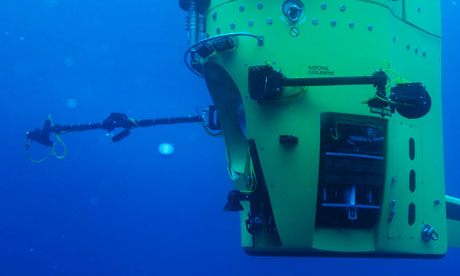
      Cameron emerged from his 12-tonne, lime green submarine, Deepsea Challenger, early this morning after travelling nearly seven miles down to the desert-like bottom of the trench. His ship was equipped with 3D cameras to shoot footage for a planned documentary, using lighting from a spectacular eight-foot tower of LEDs. The director of Titanic and Avatar, who has maintained a long-term interest in the secrets of the oceans’ depths, was able to direct and film the action from within the sub.

      “There is scientific value in getting stereo images because … you can determine the scale and distance of objects from stereo pairs that you can’t from 2D images,” Cameron told National Geographic News ahead of the dive. As he reached the bottom of the trench, which is about 200 miles south-west of the Pacific island of Guam, Cameron sent out a tweet reading: “Just arrived at the ocean’s deepest pt. Hitting bottom never felt so good. Can’t wait to share what I’m seeing w/ you”.

      James Cameron Deepsea challenger test James Cameron’s Deepsea Challenger submersible. Photograph: Reuters

      The Mariana is 120 times larger than the Grand Canyon and more than a mile deeper than Mount Everest is tall. The dive was the first into the depths of the trench since Swiss engineer Jacques Piccard and US navy captain Don Walsh spent 20 minutes there in 1960. Unlike Cameron, they were unable to see – let alone film – very much as their submarine kicked up too much mud from the ocean floor.

      Expedition doctor Joe MacInnis said Cameron’s journey had been “the ultimate test of a man and his machine”, describing his friend as a real-life “avatar”. He said: “He’s down there on behalf of everybody else on this planet. There are seven billion people who can’t go, and he can. And he’s aware of that.”

      The expedition was organised and funded by Cameron himself, an oceanography enthusiast since childhood, along with the National Geographic Society, Rolex and Microsoft co-founder Paul Allen. The director, 57, has undertaken 72 deep-sea submersible dives, 33 of which were to the wreckage of the Titanic, the subject of his 1997 hit film. He expects the trip to the Mariana Trench to be the first of many.

      Expedition member Patricia Fryer told National Geographic News the Deepsea Challenger’s journey to the depths was far more useful scientifically than cheaper unmanned missions. “The critical thing is to be able to take the human mind down into that environment,” said the marine geologist. “To be able to turn your head and look around to see what the relationships are between organisms in a community and to see how they’re behaving – to turn off all the lights and just sit there and watch and not frighten the animals, so that they behave normally. That is almost impossible to do with an ROV [remotely operated vehicle].”

  • Joyce hints at lower House move

    Federal Labor MPs are in denial mode, they cannot, or will not, read the writing on the wall

    Joyce hints at Lower House move

    Updated March 27, 2012 08:06:47

    National Party Senate leader Barnaby Joyce says the time is right for him to try to move to the Lower House.

    Senator Joyce told Lateline last night that the move would be a natural progression at this point in his career.

    His comments came as a poll released this morning confirmed that Labor’s electoral problems are not confined to Senator Joyce’s home state of Queensland.

    The latest Newspoll, published in today’s Australian newspaper, says the Coalition’s lead after preferences has widened to 14 percentage points, while Labor’s primary vote has slipped below 30 per cent again.

    But if Senator Joyce wants to move to the House of Representatives he may face a fight with his own party before he gets to take on the LNP.

    Senator Joyce lives in St George, in the Queensland seat of Maranoa, which has been held by the LNP’s Bruce Scott for 22 years.

    Senator Joyce had considered making a run for New England in northern New South Wales, where he grew up, which is held by the independent Tony Windsor.

    But now he says he wants to stay in Queensland and run for Maranoa.

    “Your aspiration has to be to try and get to the Lower House to match up to the people who you oppose,” he told Lateline last night.

    Pre-selection for the seat has not opened but Senator Joyce said: “I’ll leave that to the wonderful people who have their right at an electorate council to make their vote – and they will make their vote.”

    Some in the Coalition warn a pre-selection battle would be tough if it gets that far, as Mr Scott has a strong network of branch members.

    In the wake of Labor’s wipe-out in the weekend’s Queensland state election, today’s Newspoll shows the Coalition extending its lead over the ALP federally.

    The Coalition is on 57 per cent with the ALP on 43 per cent in the two-party preferred standings.

    Federal Labor’s primary vote has fallen three points to 28 per cent, its lowest point since last September.

    The Coalition’s primary vote is up four points to 47 per cent.

    The Greens’ primary vote stands at 11 per cent.

    However, satisfaction with Prime Minister Julia Gillard’s performance is up three points.

    Topics:government-and-politics, states-and-territories, federal-government, st-george-4487, australia, qld, nsw

    First posted March 27, 2012 06:30:13

  • Anzac story must unite not divide us

    Anzac story must unite not divide us

    0

    WAR has shaped Australia irrevocably. It is difficult to fully comprehend the impact today but in the years from 1914 to 1918, 60,000 young Australian men were killed on the battlefields of Gallipoli and in northern France.

    Gone. Just like that. Sixty thousand young blokes who had mums and dads, sisters and brothers, uncles and aunties, girlfriends, wives, kids, mates. Sixty thousand men out of an Australian population that counted less than five million.

    In three years time on April 25, Australia and New Zealand will commemorate 100 years since the first Anzacs jumped ashore on some remote sliver of beach in a flung-flung region of Turkey – the first Anzac Day.

    Yesterday it emerged the government had commissioned research that claimed the commemoration would be a “double-edged sword” and a “potential area of divisiveness” because of multiculturalism. The report states commemorations should be “culturally sensitive and inclusive”.

    This isn’t political correctness gone mad, as someone in the office lift sputtered to me in high dudgeon. It’s common sense.

    Anzac Day is not a day for jingoism, or sabre-rattling, nor is it a day that should offend anyone.

    It is a day for reflection and, even for a brief moment, it’s a time to try and comprehend the terrible tragedy that goes hand in hand with war. As the report suggested, it is a day that should be inclusive of all Australians.

    I know about this report – I have read it many times. I was on the National Commission on the Commemoration of the Anzac Centenary charged with presenting a report to the Prime Minister on how Australians could commemorate both the centenary of the landings at Gallipoli, and for a four-year program commencing in 2014 which would commemorate the service of all Australians over the past century. The six of us faced a vast blank canvas. Yet one thing was clear: The commemoration of the centenary of Anzac Day will probably be the most significant commemorative day we will see in our lifetimes.

    To assist our progress, a report was commissioned, part of which utilised focus groups. Normally when I hear the term focus group my eyes tend to glaze over, however I attended several gatherings where I sat behind a one-way mirror watching people from various demographics discuss their experience or knowledge of Anzac Day. Or not.

    While many – particularly young people – gave remarkably positive and constructive feedback, some of the responses beggared belief in their total lack of knowledge of Anzac Day.

    At times this was harrowing to watch, as everyday mums and dads were clearly embarrassed and uncomfortable admitting they felt some sort of guilt at not being able to explain Anzac Day to their children or grandchildren. An indigenous Australian described Anzac Day as “a party to which ‘we (Aborigines) weren’t invited”.


    Responses like these were some of the most useful feedback of all. Was the report valuable? Absolutely. One of the key recommendations put forward by the commission was for a national education program that could walk every Australian through our remarkable and unique military history, which has shaped the nation into what it is today.

    The new Anzac Centenary Advisory Board, headed by former chief of defence Angus Houston, has begun to put into place the foundations for all this. It will be a big task and will prove both moving and exciting for all Australians. However, the over-riding concern will be to acknowledge those Australians who never came home.

    We only have one chance to get it right for the centenary of Anzac Day. We owe it to them.


    Warren Brown is The Daily Telegraph’s cartoonist and a member of the Anzac Centernary Ceremonial and Commemmorative Taskforce

  • Climate Change News NY TIMES

    Alert Name: CLIMATE CHANGE NEWS
    March 26, 2012 Compiled: 1:24 PM

    By JANE L. LEVERE (NYT)

    The Sierra Club, aided by a $50 million grant, is introducing its first major national video campaign to promote its Beyond Coal initiative.

    About This E-mail


    You received this e-mail because you signed up for NYTimes.com’s My Alerts tool. As a member of the TRUSTe privacy program, we are committed to protecting your privacy.

  • Impact of climate change may be underestimated

    Note Dr. Andrew Glikson’s remarks on this item , together with supporting scientific reports.


    Neville,

    It has been my view for a long time, in particular following James Hansen, Hans Schellnhuber and other, that the scale and rate of climate change have been underestimated.

    I enclose relevant papers.

    My best wishes

    Andrew

    26-3-2012

    From: Neville Gillmore [mailto:nevilleg729@gmail.com]
    Sent: Monday, March 26, 2012 11:52 PM
    To: Andrew Glikson
    Cc: JOHN JAMES; W. Shawn Gray
    Subject: Impact of climate chamge may be underestimated.


    Hi Andrew. Yours views on this please.

    Neville Gillmore


    Impact of climate change may be underestimated

    11 attachments — Download all attachments
    THE DEEP TIME BLUEPRINTS OF ANTHROOGENIC GLOBAL CHANGE-26-3-2012.pdf THE DEEP TIME BLUEPRINTS OF ANTHROOGENIC GLOBAL CHANGE-26-3-2012.pdf
    439K   View Download
    ON ARCTIC SEA ICE AND COAL  MINE CANARIES.pdf ON ARCTIC SEA ICE AND COAL MINE CANARIES.pdf
    140K   View Download
    TRENDS AND TIPPING POINTS 20-2-2012.pdf TRENDS AND TIPPING POINTS 20-2-2012.pdf
    1388K   View Download
    NASA CHIEF SCIENTIST STATEMENT PART B.pdf NASA CHIEF SCIENTIST STATEMENT PART B.pdf
    174K   View Download
    NASA CHIEF SCIENTIST STATEMENT PART A.pdf NASA CHIEF SCIENTIST STATEMENT PART A.pdf
    100K   View Download
    METHANE AND THE ANTARCTIC ICE SHEET.docx.pdf METHANE AND THE ANTARCTIC ICE SHEET.docx.pdf
    367K   View Download
    AN ICE FREE EARTH_THE CONVERSATION_18 January 2012.docx.pdf AN ICE FREE EARTH_THE CONVERSATION_18 January 2012.docx.pdf
    194K   View Download
    LAST CHANCE AT DURBAN 7-12-11.pdf LAST CHANCE AT DURBAN 7-12-11.pdf
    131K   View Download
    TAG 2009 ABRUPT CLIMATE CHANGE.pdf TAG 2009 ABRUPT CLIMATE CHANGE.pdf
    733K   View Download
    THE SHIFT IN STATE OF THE ATMOSPHERE-A.pdf THE SHIFT IN STATE OF THE ATMOSPHERE-A.pdf
    320K   View Download
    BEYOND 2 DEGREES CELSIUS.pdf BEYOND 2 DEGREES CELSIUS.pdf
    510K   View Download

    Impact of climate change may be underestimated

    By David Mark

    Updated March 26, 2012 18:58:38

    A new study suggests climate scientists may have underestimated the effect of greenhouse gases, with global temperatures now predicted to rise by between 1.4 and 3 degrees Celsius by 2050.

    The study was published in the journal Nature Geoscience by a team of international scientists who ran 10,000 computer simulations of climate models in an attempt to explore the range of global warming predictions made by climate scientists.

    The researchers found that while their results matched the predictions made by the Intergovernmental Panel on Climate Change (IPCC) at the lower end, they were higher than earlier predictions at the higher end.

    One of the certainties about predicting climate change is uncertainty, which is why climate change professor David Frame and 26 of his colleagues from around the world have tried to narrow things down.

    “We set out to look at how a large range of climate models could try to span a range of uncertainties to try to get a better handle on the sort of range of plausible climates we might see in the next half century and beyond,” said Professor Frame, who works at the Victoria University of Wellington.

    “Generally people build a model and they spend a lot of resources on doing so and they try to make it as good as they can. But when everybody tries for their best-shot model, it doesn’t necessarily mean that you systematically explore all the possible uncertainties.”

    When it comes to climate change, there many variables including cloud cover, ocean temperatures and land temperatures. So Professor Frame and his colleagues took one of the world’s best-known climate models and tweaked some of the parameters.


    They then asked 10,000 people around the world to run these new models through their home computers, assuming nothing is done to reduce greenhouse gas emissions.

    “If people keep emitting fossil fuels in the way we expect, with no price on carbon or no future policy initiatives, we expect a range of 1.4 to 3 degrees by 2050,” he said.

    Those numbers are based on average temperatures between 1960 and 1990.

    At the bottom end it is similar to the last prediction made by the IPCC, but it exceeds that group’s prediction at the higher end.

    “What we’ve kind of got is just a broader sweep of that uncertainty range,” Professor Frame said.

    “So it’s not just about the headline result numbers, it’s actually about the physical understanding we can get to with this sort of approach.”

    He says the world is most probably somewhere in the middle range rather than at the extremes.

    “But it makes me think that people who are thinking about real-world problems, farmers, wine growers in Australia, people managing river catchments for instance, might want to have a look at some of these models to think about what … might plausibly happen, what sorts of changes they might plausibly have to manage for,” he said.

    “So one of the real purposes of this is to give planners a chance to … think about scenarios for the future that are physically plausible, are internally consistent, which is an important property and potentially quite practical.”

    The paper comes just three days after the World Meteorological Organisation published its latest Status of the Global Climate Report, which found that 2011 was a year of climate extremes and the 11th warmest year on record.

    The journal has also published a paper which states that extreme weather events over the past decade have increased and were “very likely” caused by man-made global warming.

    Tags: climate-change, environment, greenhouse-gas, emissions-trading, australia

    First posted March 26, 2012 18:58:38